Brewing
Gongfu brewing
- Water temperature
- 75 °C
- Tea amount
- 5 g
- Water volume
- 100 ml
- First steep
- 10 s
- Time added per infusion
- 5 s
- Infusions
- 3

Éméi zhúyèqīng
Choose a brewing method. Start with the recommended quantities and time, then adjust to taste.
Brewing
Brewing
Taste
Tea encyclopedia
Category: Famous tea of Sichuan Province. The "Zhuyeqing" (竹叶青) brand belongs to Éméishān Zhúyèqīng Tea Company Limited (峨眉山竹叶青茶业有限公司) — the sole trademark holder. The tea has received international recognition, including the "World Tea Masterpiece Award" (世界佳茗大奖) at the International Famous Tea Competition, as well as organic production certification.
Category: Famous tea of Sichuan Province. The "Zhuyeqing" (竹叶青) brand belongs to Éméishān Zhúyèqīng Tea Company Limited (峨眉山竹叶青茶业有限公司) — the sole trademark holder. The tea has received international recognition, including the "World Tea Masterpiece Award" (世界佳茗大奖) at the International Famous Tea Competition, as well as organic production certification.
Coordinates: Approximately 29°35′ North latitude, 103°20′ East longitude.
Origin: China, Sìchuān Province (四川, Sìchuān), Lèshān City (乐山, Lèshān), Mount Éméishān (峨眉山, Éméi Shān). The core production area is the high-altitude zone at elevations of 600–1500 m, in the vicinity of Qīngyīngé Temple (清音阁), Báilóngdòng (白龙洞), Wànniánsì Temple (万年寺), and Heishuisi Temple (黑水寺). Secondary zones include high-altitude areas of Leshan and Meishan in the southwest of the Sichuan Basin.
Type: Green tea (non-oxidized). Belongs to pan-fired green teas (炒青绿茶, chǎoqīng lǜchá) with flat leaf shape (扁形绿茶, biǎnxíng lǜchá).
Cultural Significance: Zhuyeqing is inextricably linked with the Buddhist culture of Mount Emeishan — a place where, according to legend, the bodhisattva Púxiān (普贤, Pǔxián, Samantabhadra) resides. The brand philosophy is built around the concept of "cha chan yi wei" (茶禅一味) — "tea and zen are one taste." The highest grade "Lundao" (论道, "Discourse on the Way") refers to the Daoist and Buddhist tradition of contemplative tea drinking. Zhuyeqing is one of the few Chinese teas where brand-building has reached a level comparable to European luxury brands.
History: Tea cultivation on Mount Emeishan has thousand-year roots, closely connected with the Buddhist monasteries of the mountain. However, the "Zhuyeqing" brand in its modern form is a relatively young phenomenon, formed in the second half of the 20th century. According to a widespread version, the name "Zhuyeqing" was proposed by Marshal Chén Yì (陈毅, Chén Yì) in 1964, when he, resting at Wanniansi Temple, tasted the local green tea and, delighted by its flat leaf resembling a bamboo leaf, gave it this name.
From a special zone of core terroir; selection: from several thousand buds, only one gram is selected — literally "a thousand buds per gram" (千颗芽选一克). This makes "Lundao" one of the most labor-intensive green teas in China.
Cultivar: Local indigenous varieties of Camellia sinensis var. sinensis, growing on Mount Emeishan. A specific monovarietal cultivar is not declared — a combination of local populations adapted to the high-altitude microclimate is used.
Picking: Early spring picking — before and around Qingming. Standard — single buds (单芽, dān yá) or one bud with one barely opened leaf (一芽一叶初展). Requirements are extremely strict: buds must be plump, rounded, and uniform in size. Purple buds (紫红芽) are rejected — they darken during processing.
Raw Material: Tender, uniform, plump buds without damage. Processing — on the day of picking.
Altitude: 600–1500 meters above sea level. The core terroir — zone of 800–1200 m around Buddhist temples.
Climate: Mount Emeishan is located on the southwestern edge of the Sichuan Basin, at the junction of subtropical and temperate zones. Average annual sunshine hours — less than 950 (one of the lowest among China's tea-growing regions). Clouds and mist envelop the slopes practically year-round. Diurnal temperature variations are significant. Low temperatures slow the growth of tea bushes, forcing shoots to accumulate record amounts of amino acids and aromatic substances. Abundant diffused light (漫射光) suppresses polyphenol synthesis, reducing bitterness and astringency and forming a mild, sweetish flavor profile.
Soil: Purple soils (紫色土, zǐsè tǔ), formed on Cretaceous period deposits, rich in minerals. A thick layer of leaf humus (fallen leaves from bamboo groves and broad-leaved forests) — up to several feet thick — provides exceptional natural fertility without the need for artificial fertilizers.
Mount Emeishan is a biosphere reserve with unique biodiversity. Tea gardens are surrounded by bamboo groves, coniferous and broad-leaved forests. High humidity, abundance of springs, and complete absence of industrial pollution create ideal conditions for "clean" tea cultivation.
Hand-picking of the most tender buds in early morning hours.
Picked buds are spread in a thin layer for ~30 minutes for brief drying and initiation of aromatic processes.
Final stage — rapid heating at high temperature (up to 380°C on the wok wall). The master performs lightning-fast "turning and gathering" movements (翻搂, fānlǒu) to form the final aroma. Critical temperature control: overheating will give a burnt taste, underheating — weak aroma.
About 5 minutes — to equalize temperature and moisture.
At reduced wok temperature, the master manually shapes each tea leaf, giving it a flat, straight form — the characteristic "bamboo leaf" or "Buddha's eye" (佛眼, fóyǎn). At this stage, a small amount of wax lubricant (虫蜡, chónglà) is used to achieve surface smoothness and shine.
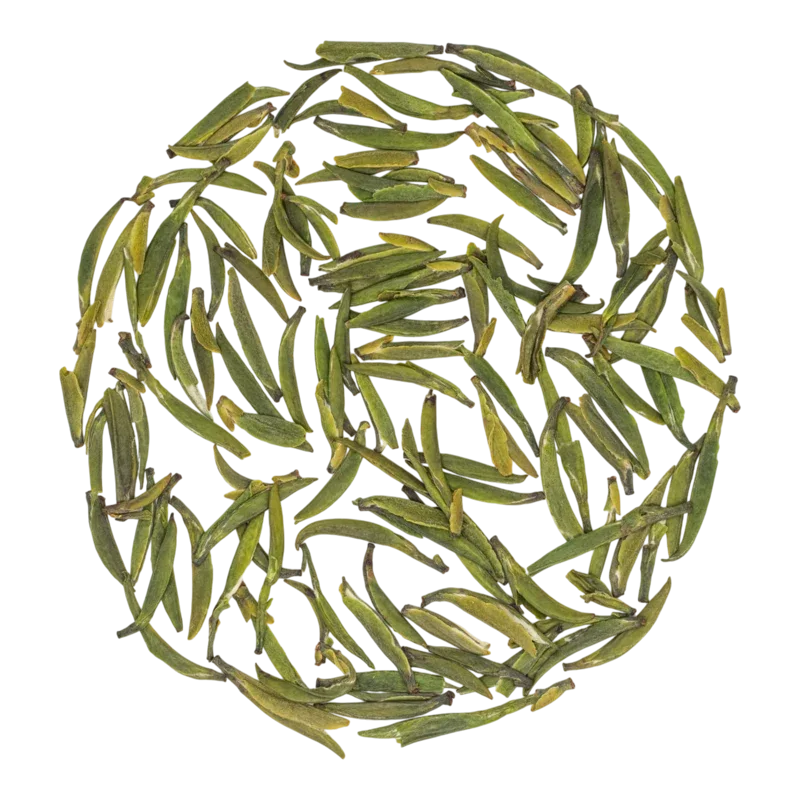
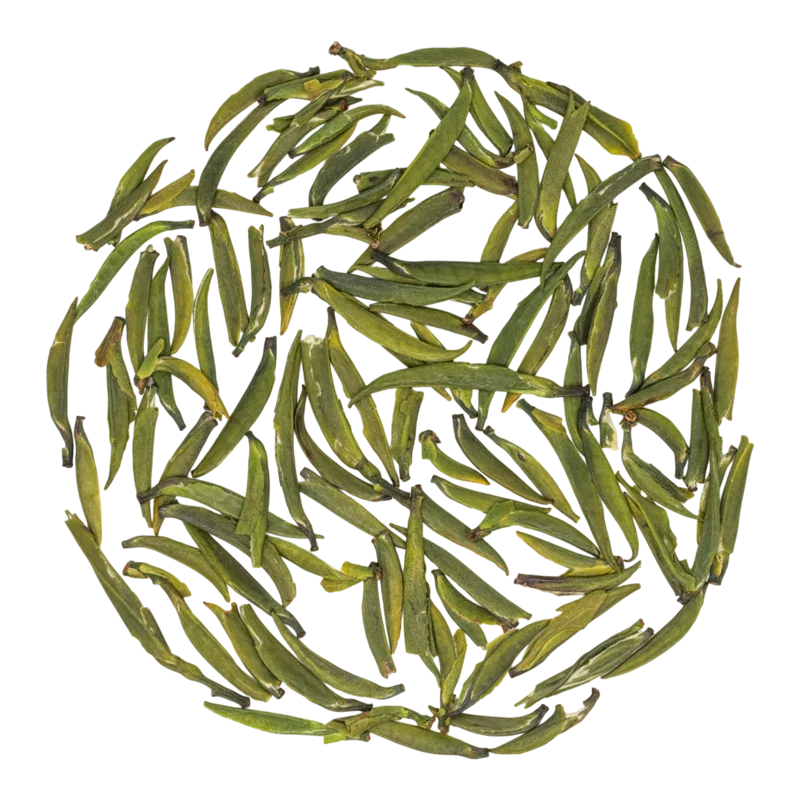
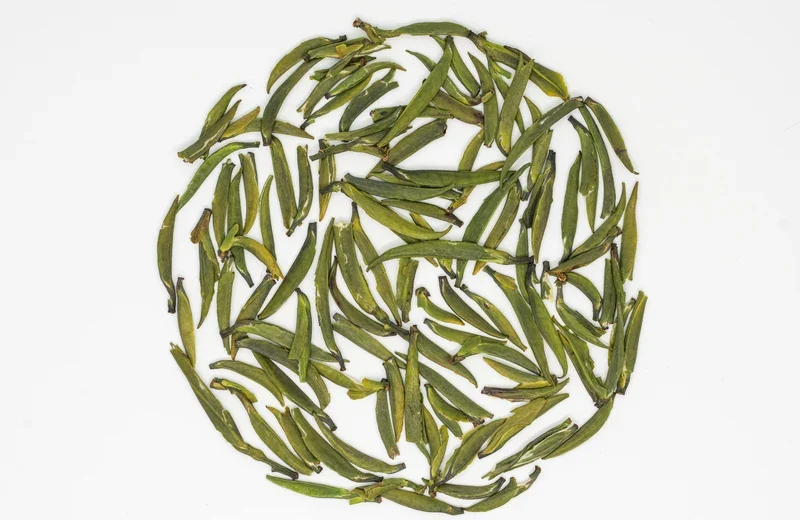
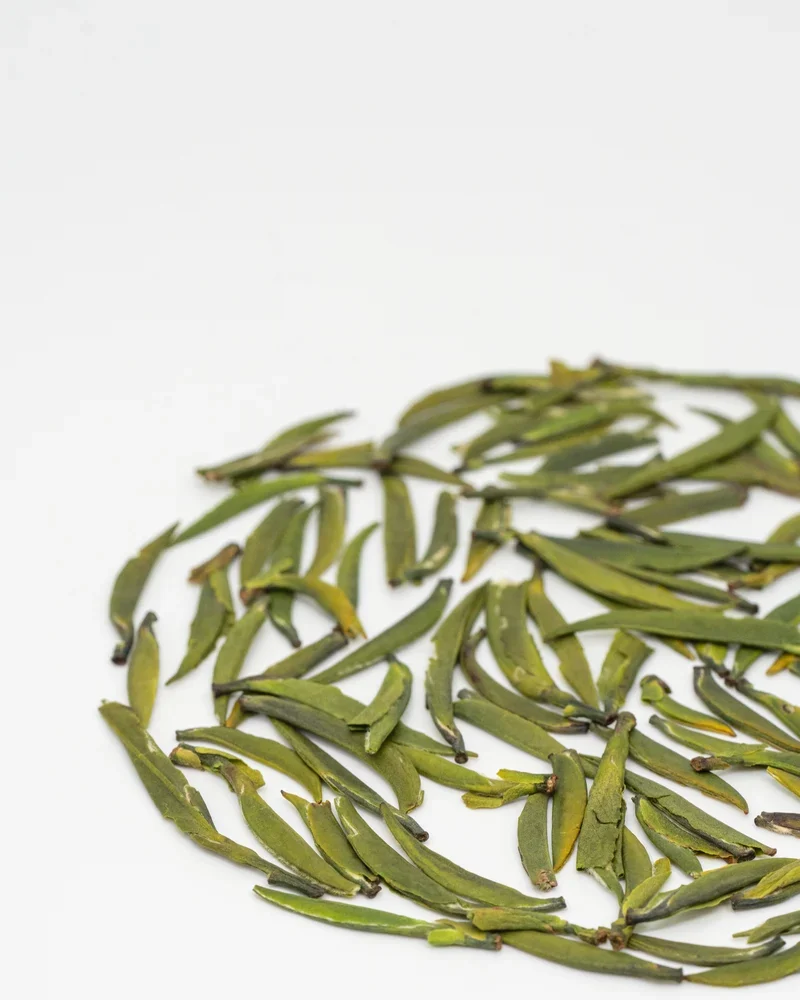
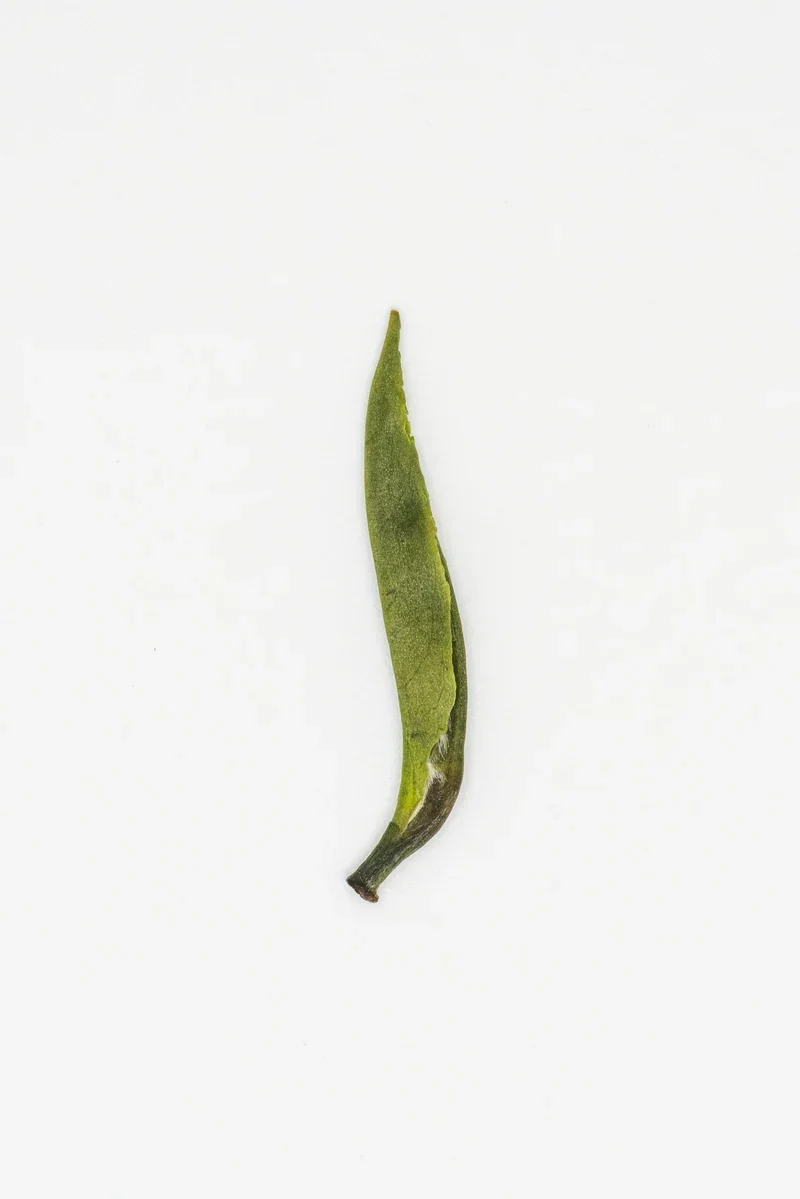
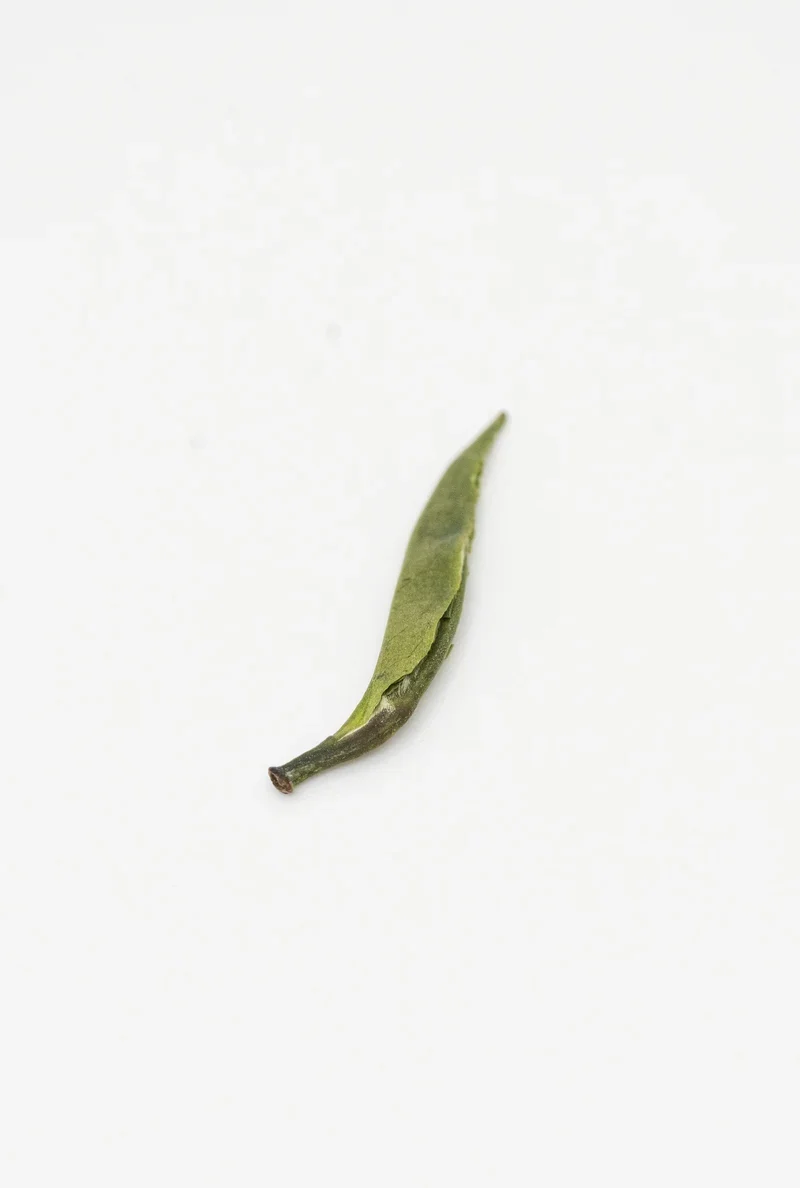
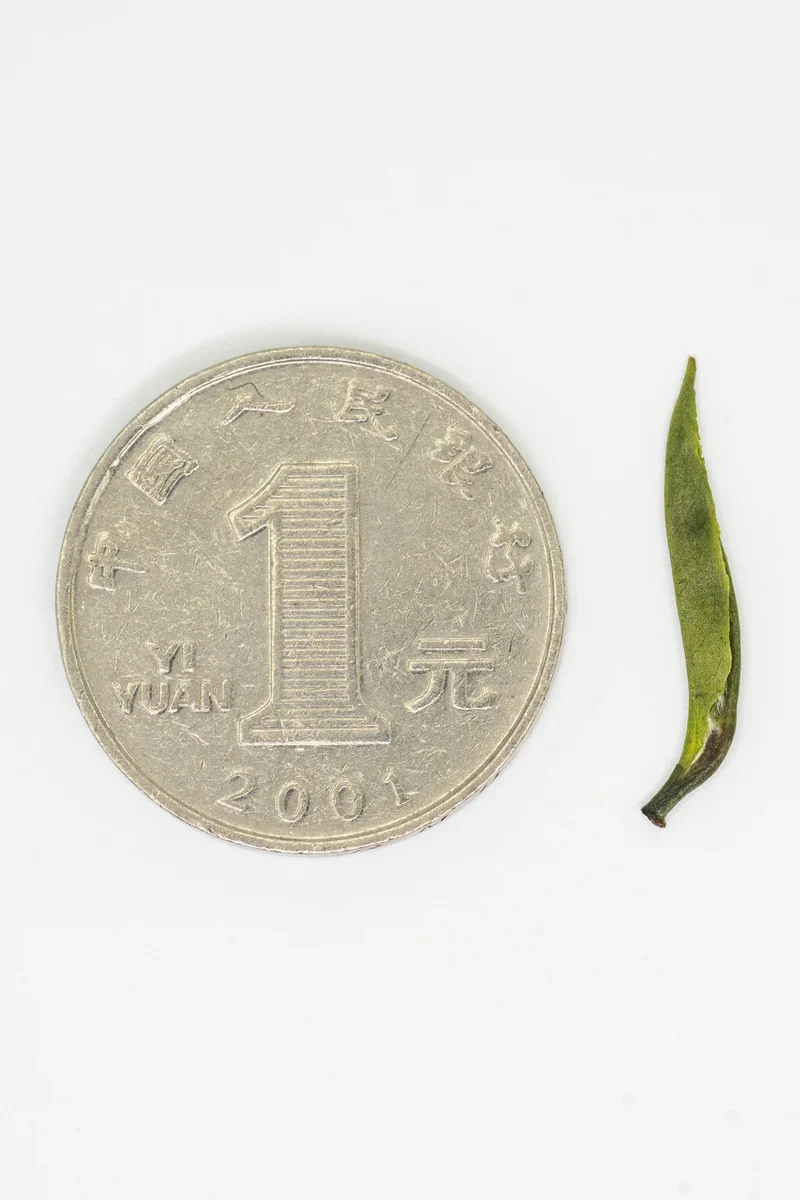
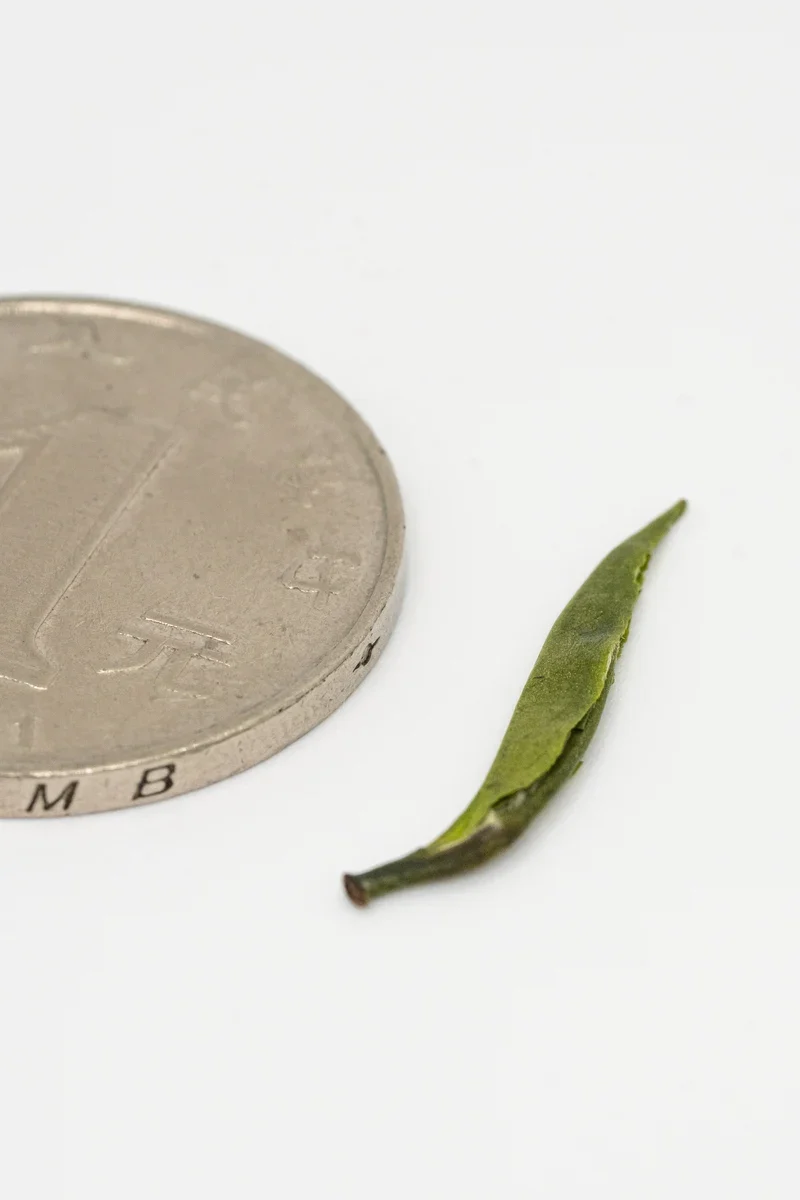
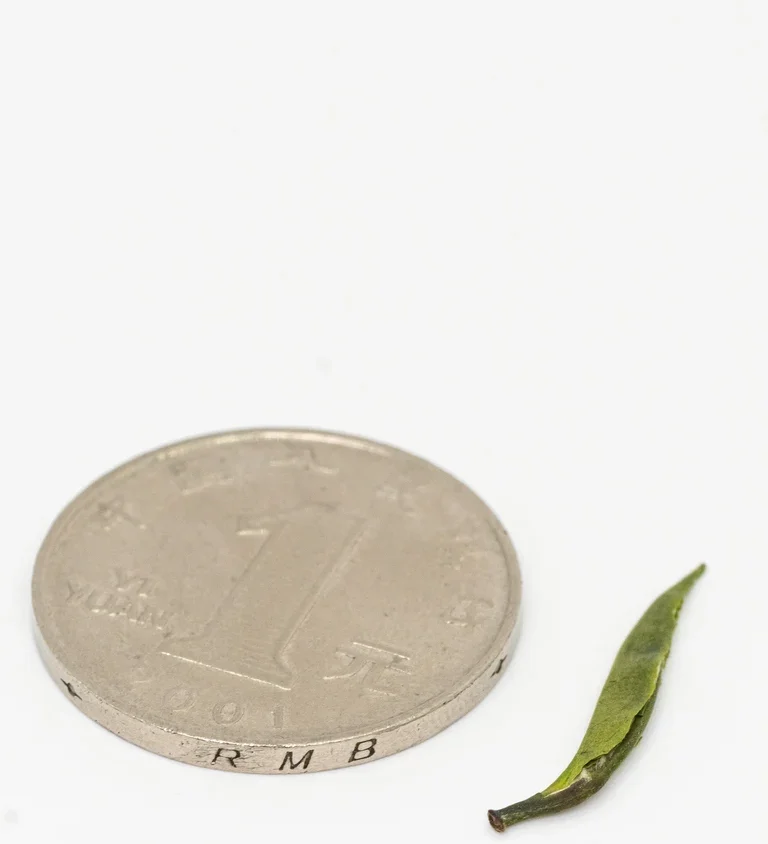
Dry Leaf Appearance: Flat, straight, even tea leaves (扁平挺直), resembling young bamboo leaves or elongated "Buddha's eyes." Color — bright emerald-green (翠绿). Surface smooth, with light oily shine. At the highest "Lundao" grade — flawless uniformity: each tea leaf of the same size and shape.
Dry Leaf Aroma: Delicate chestnut aroma (嫩栗香, nèn lì xiāng) — characteristic of flat pan-fired green teas. Clean green freshness (清香, qīngxiāng). Without grassiness or "raw" tones.
Liquor Aroma: Clean, high, fresh. Chestnut note smoothly transitions to green sweetness. Aroma delicate, without obtrusiveness.
Liquor Color: Light green, clean and clear, with gentle yellow-green tint.
Spent Leaves: Tender, uniform buds, unfolded from flat tea leaves. Color — light green, lively. Buds whole, elastic, without damage.
Taste: Fresh and brisk (鲜爽, xiānshuǎng), clean and mellow (清醇, qīngchún), with silky texture (甘滑, gānhuá). Astringency and bitterness are minimal — result of high-altitude origin and abundant diffused light. Aftertaste — mild, sweetish, with returning freshness.
Alkaloids: Caffeine — moderate content. Theobromine, theophylline.
Amino Acids: Elevated content — result of slowed growth in conditions of low insolation and coolness. Amino acids provide the pronounced freshness and mildness characteristic of "cloudy" mountain teas.
Characteristic chestnut-fresh bouquet is formed during the high-temperature "aroma development" (提香) stage, where pyrazines and other compounds responsible for roasted chestnut notes are created.
Minerals: Potassium, magnesium, zinc, manganese — profile determined by purple mineralized soils of Mount Emeishan.
Polyphenols: Content — significant. EGCG — main component, providing antioxidant potential. According to the manufacturer, the content of polyphenols and antioxidant compounds in Zhuyeqing is higher than in average green tea, which is related to the special terroir of Mount Emeishan.
Vitamins: Vitamin C, B-group vitamins, carotenoids.
Catechins (EGCG) and other polyphenols neutralize free radicals.
Caffeine combined with L-theanine provides mild, focused alertness.
Traditionally recommended in hot weather.
Polyphenols stimulate fat breakdown.
Catechins and caffeine promote acceleration of metabolic processes.
Polyphenols suppress pathogenic microflora in the oral cavity, strengthen gums and tooth enamel.
the listed properties are based on publicly available data and are not medical recommendations.
do not over-steep — prolonged brewing intensifies astringency. Best taste — with quick infusions, when freshness and chestnut sweetness unfold.
Tea Amount: 3–5 g per 150–200 ml water (ratio 1:50).
Teaware: Glass tumbler (玻璃杯) — for observing the "standing" of flat tea leaves in water (they stand vertically, like bamboo leaves in the wind). White porcelain gàiwǎn (盖碗) — for aroma evaluation. Recommended to use soft spring water; mineral water with high hardness may distort the taste.
Water Temperature: 85–90°C for standard grades; 80–85°C for "Lundao" (more delicate raw material).
Both are flat pan-fired green teas, but from completely different terroirs. Longjing is more "structured," with pronounced bean-chestnut aroma and umami note. Zhuyeqing is lighter, milder and "simpler" in taste, with greater purity and less complexity.
Fellow Sichuan tea, but twisted (not flat), with abundant down and floral-orchid aroma. Ganlu is more complex and multifaceted; Zhuyeqing is more visually perfect and "brand-oriented."
From Anhui. Large flat leaves with orchid aroma. Houkui is radically larger and more "monumental"; Zhuyeqing is miniature and laconic.
It's important to understand that "Zhuyeqing" as a brand and "zhuyeqing" as a descriptive name for flat green tea with bamboo leaf shape are not the same thing. Only products of Emeishan Zhuyeqing Tea Company have the right to the trademark.
Basic level — high quality with relative accessibility. Suitable for daily tea drinking.
Middle level — careful hand sorting after main production. Lasting aroma, denser taste. Positioned as "tea treasure."
Highest level — from special zone, "a thousand buds per gram," extremely small volume. Most expensive and prestigious.
original products have branded design, hologram and QR code for authenticity verification.
genuine Zhuyeqing — perfectly even, flat, emerald tea leaves of uniform size. Heterogeneity in shape and color — sign of counterfeit.
clean chestnut-fresh tone without harshness and "perfumery."
"Lundao" cannot be cheap; suspiciously low prices — sure sign of counterfeit.
No reviews yet. Tell us what you think of this tea.
Rate this tea and share your impressions. We review each submission before publishing it.