Brewing
Gongfu brewing
- Water temperature
- 93 °C
- Tea amount
- 5 g
- Water volume
- 100 ml
- First steep
- 10 s
- Time added per infusion
- 5 s
- Infusions
- 4

Nínghóng Gōngfū
Choose a brewing method. Start with the recommended quantities and time, then adjust to taste.
Brewing
Brewing
Taste
Tea encyclopedia
Category: Chinese gōngfu red teas (工夫红茶, gōngfu hóngchá); historically famous teas of China.
Category: Chinese gōngfu red teas (工夫红茶, gōngfu hóngchá); historically famous teas of China.
Coordinates: ≈ 29.0° N, 114.4° E (center of Xiushui County). Protected zone: 28°47′–29°22′ N, 113°57′–114°56′ E.
Origin: China, Jiāngxī Province (江西省, Jiāngxī Shěng); Jiǔjiāng Prefecture (九江市, Jiǔjiāng Shì); Xiūshuǐ County (修水县, Xiūshuǐ Xiàn) — primary producer (≈80% of total Ninghong volume). Also produced in adjacent counties Tonggu (铜鼓县) and Wuning (武宁县). The geographical indication protection zone covers 36 townships and towns of Xiushui County.
Type: Red tea (black tea) (红茶, hóngchá) — fully oxidized.
Cultural Significance: Ninghong occupies a special place in the history of Chinese tea exports: alongside Qímén Hóng Chá (祁红) and Zhèng Shān Xiǎo Zhǒng (正山小种), it formed the trinity of great red teas that paved the way for Chinese tea in the European market. American tea scholar William Ukers in his monograph "All About Tea" (1935) noted that "Ninghong is distinguished by excellent appearance, tight twist, black color and red-amber liquor, highly valued in blends." Moreover, through Ninghong masters, tea culture spread to Hubei (Yihong production), Hunan and Georgia, making Xiushui the "homeland of gongfu red tea" (工夫红茶故乡) in a broad historical sense.
History: Xiushui County, anciently known as Yìníng (义宁, Yìníng) or Fēnníng (分宁, Fēnníng), has more than a thousand years of tea history. As early as the Northern Sōng dynasty (北宋, Běi Sòng, 960–1127), the local green tea Shuāngjǐng (双井茶, Shuāngjǐng Chá) was celebrated, which the poet Huáng Tingjian (黄庭坚, Huáng Tíngjiān, 1045–1105) gifted to capital literati, including Sù Dōngpō (苏东坡). However, red tea emerged here much later. During the Dàoguāng era (道光, Dàoguāng, 1821–1850), Xiushui began producing red tea in the "gongfu" style, and by the mid-19th century Ninghong had become one of China's leading export teas. By the 1890s, annual Ninghong exports reached 300,000 chests (25 jin / ~12.5 kg each), comprising over one-tenth of the country's entire tea exports. The county operated more than one hundred tea firms (茶行, cháháng) and trading houses — "Zhenzhi Gongsi" (振植公司), "Jichang Hang" (吉昌行), "Yihe Fu" (怡和福), "Hengfeng Shun" (恒丰顺) and many others.
Name Breakdown: 宁 (Níng) — from the ancient regional name "Ningzhou" (宁州, Níngzhōu), under which Ninghong was known in international markets; 红 (hóng) — "red," designation for fully oxidized tea; 工夫 (gōngfū) — "skill, diligence," indicating orthodox technology with meticulous hand sorting and precise control of each stage. Thus, "Ninghong Gongfu" literally means "red tea from Ningzhou, made with skill."
Cultivar: Traditionally uses local small-leaf and medium-leaf populations of Camellia sinensis var. sinensis (群体种, qúntǐzhǒng), historically growing in the mountainous regions of Xiushui. In recent decades, alongside indigenous populations, zoned breeding cultivars have been planted.
Picking: Spring–summer. Best batches — from spring first picking (清明前后, Qīngmíng qiánhòu — around Qingming festival, early April). Summer and autumn pickings provide raw material for mass grades.
Pluck Standard: "One bud and one leaf" (一芽一叶) for highest grades; "one bud and two leaves" (一芽二叶) for standard; pure buds (单芽) for premium batches like "Taizi Cha."
Raw Material: Whole, undamaged leaf with minimal stem content; freshness is critical — from picking to withering no more than 4–6 hours.
Altitude: From 200 to 1,200 m; best plantations — on slopes of the Mùfù mountain range (幕阜山脉, Mùfù Shānmài) to the north and Jiǔlǐng range (九岭山脉, Jiǔlǐng Shānmài) to the south, at altitudes 400–800 m. Maximum elevation of the county — 1,715 m.
Climate: Subtropical humid monsoon. Average annual temperature — 16.5°C; annual precipitation — 1,577 mm; frost-free period — 247 days. The mountainous terrain of Xiushui creates vertical climatic zonation: constant movement of clouds and mists, diffused light, moderate insolation. Precisely such conditions — abundant moisture, cloudiness, difference between day and night temperatures — promote accumulation of aromatic precursors, amino acids and polyphenols in tea leaves. The Xiū River (修河, Xiū Hé) crosses the county from west to east, forming a fertile floodplain.
Soil: 90% of the area is occupied by red and yellow soils (红壤/黄壤) with pH 4.5–6.5; deep fertile horizon with high organic content, potassium, manganese and iron; good water permeability. Forest coverage of the county — 67.6%, ensuring natural moisture balance and protection from wind erosion.
Manual picking predominates; plantations are located on mountain slopes with gradients up to 25°, terraced to prevent erosion. Fertilization — predominantly organic; mulching is applied. Optimal soil acidity for Ninghong — pH 4.5–5.5.
Hand selection of tender shoots in morning hours.
On bamboo racks or in ventilated rooms; duration — 12–18 hours. Leaf moisture decreases to 60–64%; leaf becomes soft and aromatic, losing "grassy" smell. For large productions, trough withering (萎凋槽, wěidiāo cáo) with forced ventilation is used.
Mechanical rolling lasting 60–90 minutes with alternating pressure. Leaf is formed into tight "thread-like" twist (条形紧结, tiáoxíng jǐnjié) — Ninghong's calling card.
At temperature 24–28°C and relative humidity 85–95%. Duration — 3–5 hours, until copper-red color of leaf appears and pronounced fruity-honey aroma. At this stage catechins oxidize to theaflavins and thearubigins.
Two-stage: primary at 110–120°C, final at 80–90°C. Residual moisture — 5–6%.
Finished tea is sifted, cleaned of stems, divided into fractions and if necessary blended to achieve stable flavor profile. Precisely the thoroughness of sorting — the multiple "gongfu" process — gave name to the entire style.
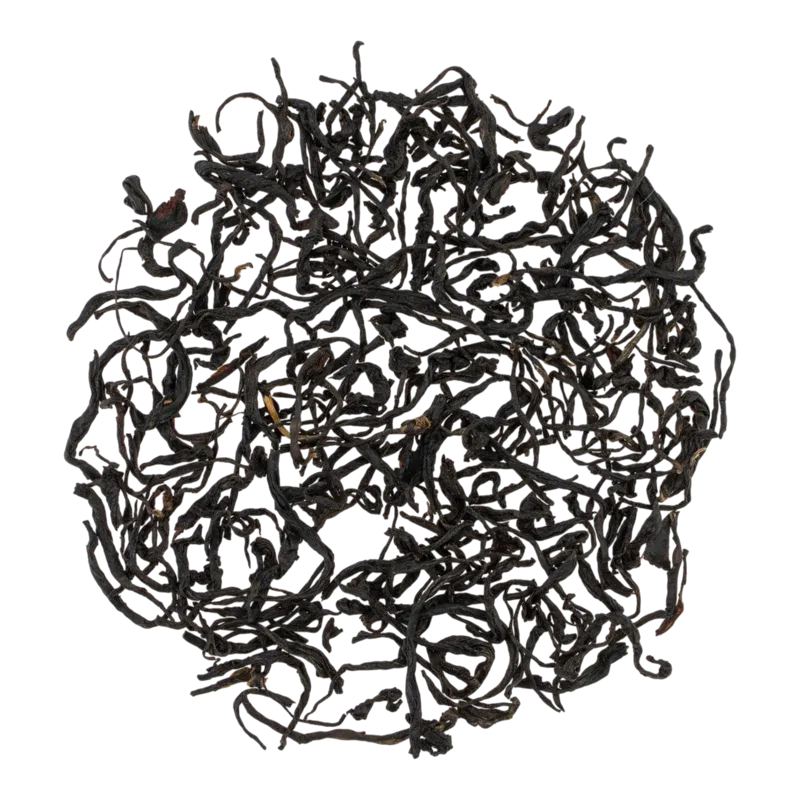
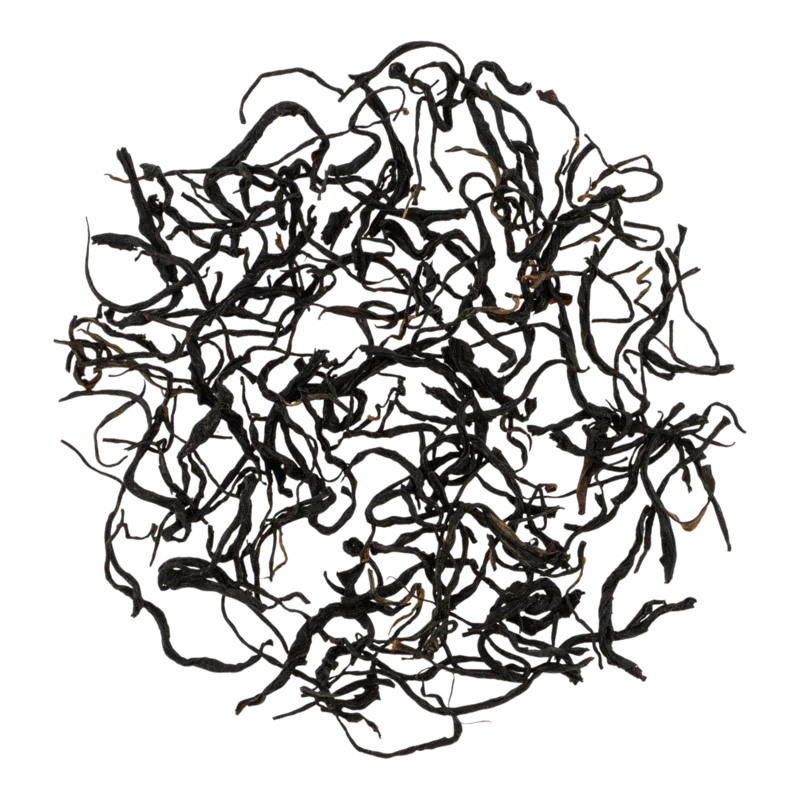
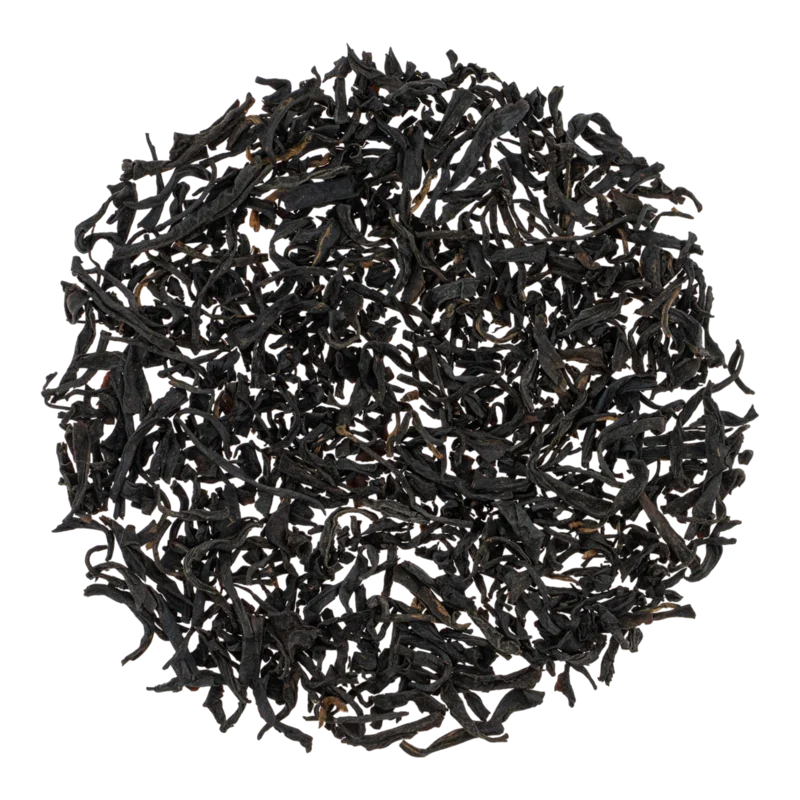
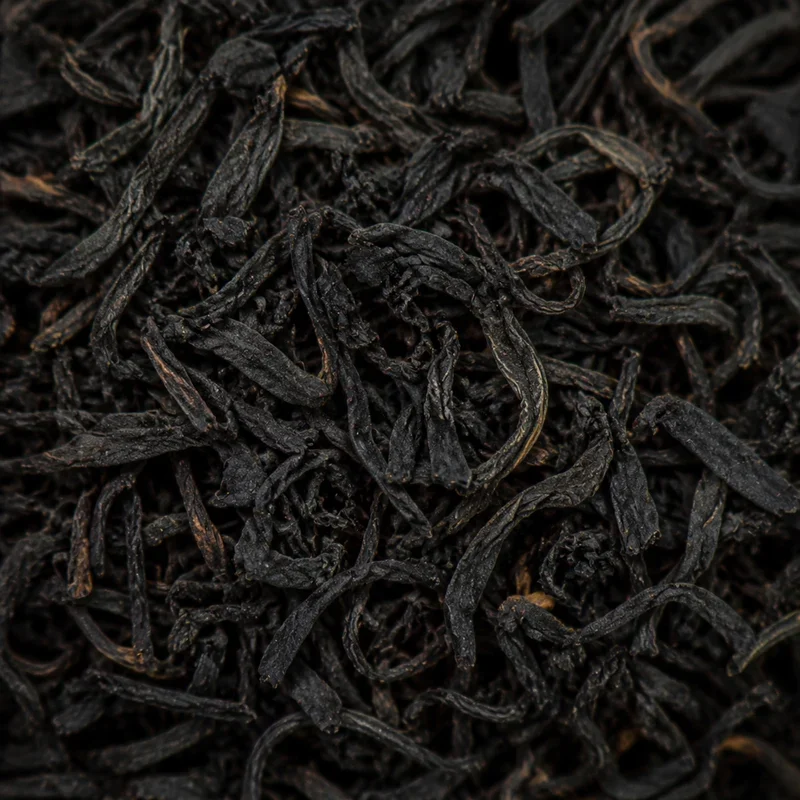
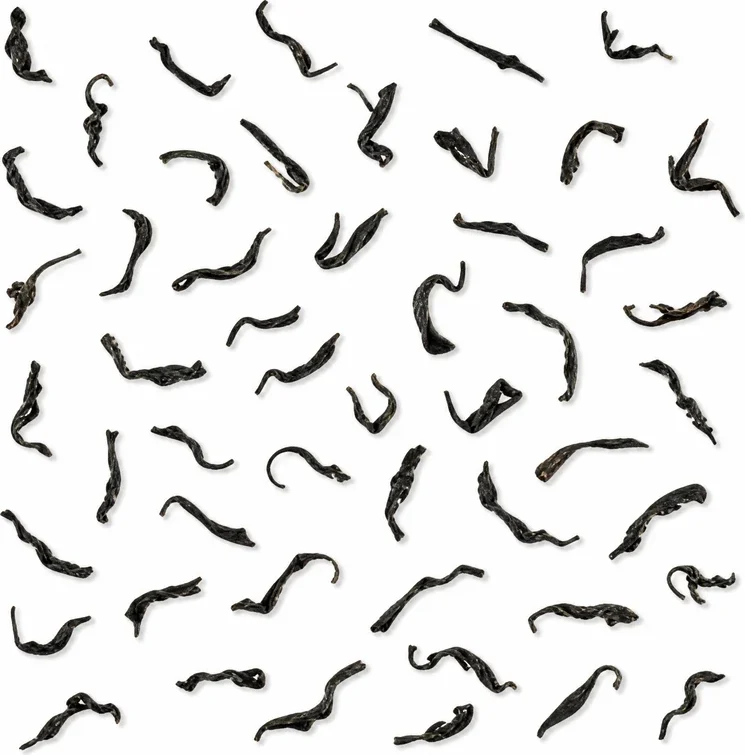
Dry Leaf Appearance: Tight, dense "thread-like" twist (紧结, jǐnjié); slender, elongated "needles" (苗锋修长, miáofēng xiūcháng); color — dark brown to black with oily luster (乌润, wūrùn). Golden tips present in highest grades.
Dry Leaf Aroma: Sweet and high (甜香高长, tiánxiāng gāocháng); notes of honey, dried fruits, light tones of fresh baking and roasted nuts.
Liquor Aroma: Multi-layered: in the foreground — ripe honey and caramel; in development — tones of dried apricot, prunes, bread crust; in the aftertaste — delicate florality and woody warmth.
Liquor Color: Red-amber, bright and clear (红亮, hóngliàng); in best batches — with golden "ring" at cup edges.
Spent Leaves: Tender red, evenly colored (浅红, qiǎnhóng); leaves soft, elastic, unfold completely.
Taste: Sweet and mellow (甜醇, tiánchún); dense but not heavy "body"; velvety astringency quickly transitions to prolonged sweet aftertaste (回甘). The characteristic "clean sweetness" of Ninghong — one of the main quality markers.
Amino Acids: 5–7% — high indicator, explaining pronounced natural sweetness.
36–40%.
3–4.5%.
1–1.5% — impart brightness and "liveliness" to liquor.
0.7–2% — form color depth and taste "body."
2.5–3.5% — contribute to roundness and "oiliness" of liquor.
Minerals: Potassium, magnesium, manganese, iron, zinc, fluorine — conditioned by red and yellow soils of Xiushui.
Polyphenols: 16.5–25% — relatively moderate indicator, ensuring mild, non-aggressive astringency.
Vitamins: B-group vitamins (B₁, B₂), traces of vitamin C, vitamin E.
Caffeine (3–4.5%) combined with L-theanine provides smooth and prolonged energy boost without nervousness.
Theaflavins and thearubigins neutralize free radicals; moderate polyphenol level makes Ninghong gentle on stomach with regular consumption.
Warm red tea stimulates secretion of digestive enzymes and helps absorption of protein and fatty foods.
Polyphenols promote vascular elasticity; tea polysaccharides are associated with blood sugar level normalization.
Like other red teas, Ninghong belongs to "warm" beverages in traditional Chinese dietology; especially good in cool weather.
L-theanine aids concentration and stress reduction.
Fluorine contained in tea leaves strengthens tooth enamel; tannins have moderate bacteriostatic action.
3–4 g tea, 200 ml water at 90°C, steeping 3–4 minutes. Ninghong — one of few Chinese red teas traditionally used in blends for Western market; it works excellently for independent "Western" brewing.
Tea Amount: 4–5 g per 100–120 ml (gongfu method); 3–4 g per 200 ml (European method in porcelain teapot).
Teaware: White porcelain gàiwǎn (盖碗) — allows evaluation of liquor brightness and aroma; porcelain teapot; Yíxīng teapot (宜兴紫砂壶) for more "enveloping" profile.
Water Temperature: 90–95°C.
The most internationally known Jiangxi-Anhui red tea. Qimen is more aromatically refined, with signature "orchid" fragrance (祁门香) and elegant, slightly dry profile. Ninghong — sweeter, fuller, with more pronounced honey note and "enveloping" body. Historically Ninghong is older than Qimen by approximately 90 years.
Fujian gongfu red tea from Fu'an. Tanyang — more juicy, with fruity-floral character (especially in modern "huaguoxiang" (花果香) versions). Ninghong — more classic, drier, with accent on honey-bread note.
Fujian "small varietal" red tea, more ancient by type but not by industrial biography. Traditional Xiǎo Zhǒng possesses bright smoky aroma (松烟香) and longan taste; modern — fruity-floral. Ninghong has no smoky notes but shares with modern Xiao Zhong rounded sweetness.
Yunnan red tea from large-leaf Assam cultivars. Dianhong — significantly "more powerful," with notes of cocoa, spices and tropical fruits, higher levels of polyphenols and caffeine. Ninghong — more delicate, lighter, with cleaner "silky" sweetness.
Price Category: Wide range — from affordable mass grades (100–300 yuan / 500 g) to premium "Taizi Cha" and hand-sorted batches (1,000–3,000+ yuan / 500 g). Cost factors: picking standard, tip content, season (spring first picking more expensive), degree of hand processing, reputation of specific producer.
No reviews yet. Tell us what you think of this tea.
Rate this tea and share your impressions. We review each submission before publishing it.