Brewing
Gongfu brewing
- Water temperature
- 75 °C
- Tea amount
- 5 g
- Water volume
- 100 ml
- First steep
- 10 s
- Time added per infusion
- 5 s
- Infusions
- 3

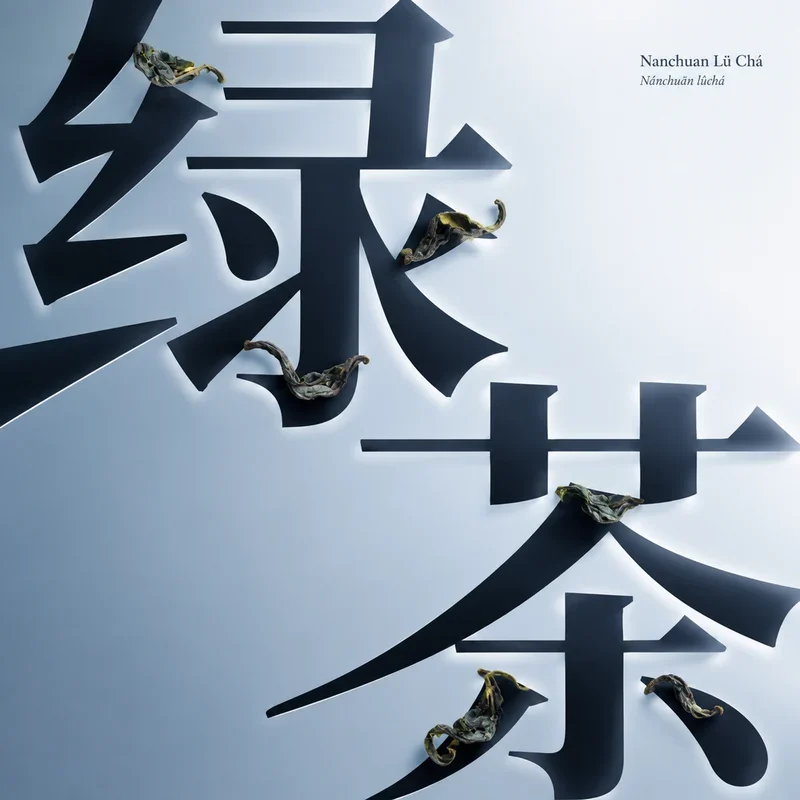
Nánchuān lǜchá
Choose a brewing method. Start with the recommended quantities and time, then adjust to taste.
Brewing
Brewing
Taste
Tea encyclopedia
Category: National Geographical Indication Product of China (全国农产品地理标志产品, 2012). Four-time winner of "Top Ten Famous Teas of Chongqing" (重庆市十大名茶, since 2008). Gold medal at Geneva International Food Exhibition (日内瓦国际食品博览会金奖, 1987 — Nanchuan red tea). First place among all Chinese export red teas (全国外销第一名, 1980). Status of "National Tea Base County" (全国茶叶基地县, 1970) for the district.
Category: National Geographical Indication Product of China (全国农产品地理标志产品, 2012). Four-time winner of "Top Ten Famous Teas of Chongqing" (重庆市十大名茶, since 2008). Gold medal at Geneva International Food Exhibition (日内瓦国际食品博览会金奖, 1987 — Nanchuan red tea). First place among all Chinese export red teas (全国外销第一名, 1980). Status of "National Tea Base County" (全国茶叶基地县, 1970) for the district.
Approximately 29°10′ N, 107°10′ E.
Origin: China, Chóngqìng Municipality (重庆市), Nánchuān District (南川区). 29 townships. Geographic coordinates: 106°54′–107°27′ E, 28°46′–29°30′ N. Core: northern townships — Dàguān (大观镇, Dàguān Zhèn), Xīnglóng (兴隆镇, Xīnglóng Zhèn), Mùliáng (木凉镇, Mùliáng Zhèn), Hétú (河图镇, Hétú Zhèn), Qiánfēng (乾丰镇, Qiánfēng Zhèn) — at elevations of 750–1200 m, in the cloud belt, on selenium-containing (Se) soils.
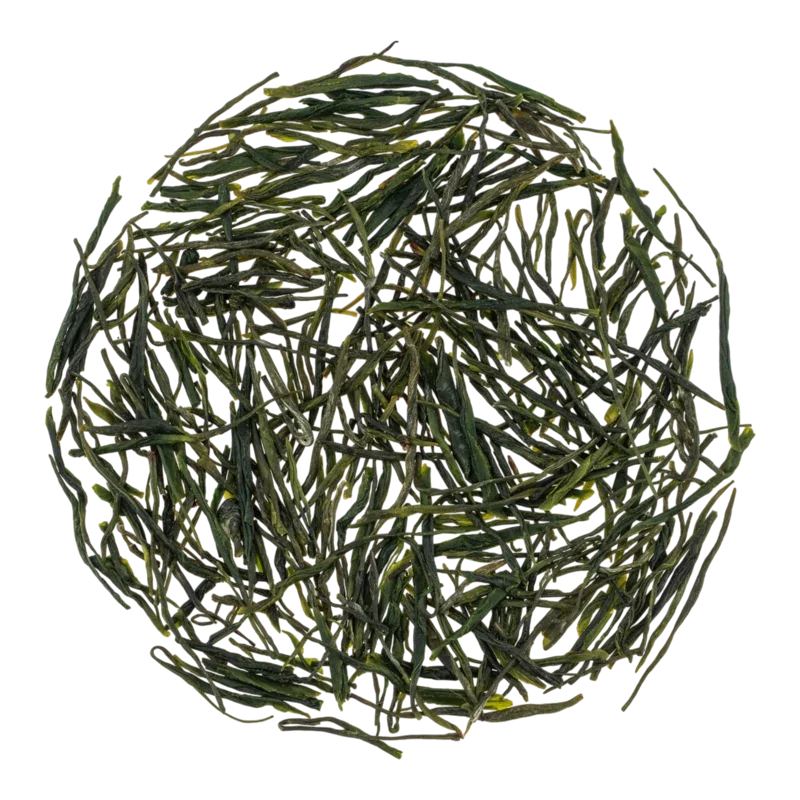
Type: Green tea (绿茶, lǜchá), unoxidized. Technology — pan-firing followed by charcoal drying. Produced in three forms: straight (紧直形, jǐn zhí xíng) — for highest grade "Jinfo Yucui", eyebrow-shaped (眉形, méi xíng) — for first grade, bulk pan-fired (大宗炒青, dàzōng chǎoqīng) — for second grade and basic-level products.
Cultural Significance: Mount Jinfo — "Golden Buddha Mountain" — received its name from evening glow: on summer and autumn evenings, when sunlight falls on the multi-layered rocky cliffs, the mountain shines with golden light, "like a golden Buddha radiating countless rays". UNESCO World Heritage Site (since 2014), Mount Jinfo is part of the "South China Karst" series and recognized as one of the planet's most important biodiversity centers. Tea from this mountain is the "sacred drink of Golden Buddha", embodying Buddhist symbolism of "chan-cha yi wei" (茶禅一味, "tea and chan — one taste"). Mount Jinfo also hosts the "Five Unique [species]" (金佛山五绝): wild tea trees, square bamboo (方竹), silver fir (银杉, Cathaya argyrophylla), ginkgo and tree rhododendron.
One bud + one leaf in initial stage (一芽一叶初展). Hand processing using "ten hand techniques" method (十大手法, shí dà shǒufǎ). "Bamboo leaf" shape (竹叶形). Chestnut aroma with "tender" note. Se ≥0.3 mg/kg. Price: 5000–10,000 yuan/kg.
One bud + two leaves. Eyebrow-shaped form. Dense, persistent taste. Basis of summer-autumn tea.
One bud + two-three leaves. Bulk pan-fired form.
Cultivar: Two main clones: Fúdǐng Dàbái Chá (福鼎大白茶, Fúdǐng Dàbái Chá) — standard high-yield cultivar, and Bāyú Tèzǎo (巴渝特早, Bāyú Tèzǎo, "Super-early Bayu") — stripeless ultra-early clone developed for Chongqing conditions. Additionally — local population varieties (群体种, qúntǐ zhǒng), descendants of ancient tea trees. Biochemical profile: amino acids — 4.3%, polyphenols — 30.35%. The territory of Mount Jinfo also preserves about 2000 wild trees of Camellia nanchuanica — an endemic large-leaf species that is a first-category nationally protected plant.
Climate: Subtropical humid monsoon (亚热带湿润季风气候). Average annual temperature — 15.1°C (on Mount Jinfo peak in summer — only ~17°C vs ~28°C in Chongqing). Average annual precipitation — 1185 mm. Key indicator — 260 days of fog per year (雾日260天). Relative humidity — 90%. Diffused light predominates. Daily temperature variation — over 10°C. These conditions create an environment of exceptionally slow shoot growth and intensive amino acid accumulation.
Soil: Weakly acidic purple soils (紫色土, zǐsè tǔ) and yellow clays (黄泥土, huángnítǔ), pH 4.5–6.5. Parent rock — Permian limestones. Organic matter abundant. Key feature: locally selenium (Se) content exceeds 1 ppm — Nanchuan District is recognized as the largest selenium soil zone in Chongqing (more than half the territory). Selenium — essential microelement, deficient in most tea regions.
600–1200 m. Production core — 750–1200 m, in the "cloud belt" (云雾带, yúnwù dài). Mount Jinfo — eastern terminus of Dàlóu Mountains (大娄山), main peak Fengchuiling (风吹岭) — 2238 m (or 2251 m according to some sources).
Forest cover — 51%. Zero industrial pollution in core zone. Mount Jinfo's biodiversity (over 5000 plant species, including 181 endemics existing only here; more than 500 vertebrate species) provides natural biological protection from pests, reducing pesticide need to zero for highest grade.
Water: Rivers originate on Mount Jinfo and flow into Yangtze and Wu rivers. High water quality, some sources contain strontium (Sr) at mineral water standard levels.
Up to 8 hours — notably longer than most green teas. Extended spreading at high humidity (90%) promotes preliminary enzymatic protein breakdown and free amino acid accumulation.
130°C. "Tossing and shaking" method (抛抖, pāo dǒu) — high frequency turning prevents scorching and ensures uniform fixation.
Light pressure, 4–8 minutes. Breaks cell membranes for better extraction, forms initial shape.
Hot air. Moisture reduction to ~15–20%.
Intermediate stage for moisture equalization.
To moisture content ≤7%. Charcoal provides gentle infrared heating, enhancing chestnut aroma without "burnt" notes characteristic of direct flame.
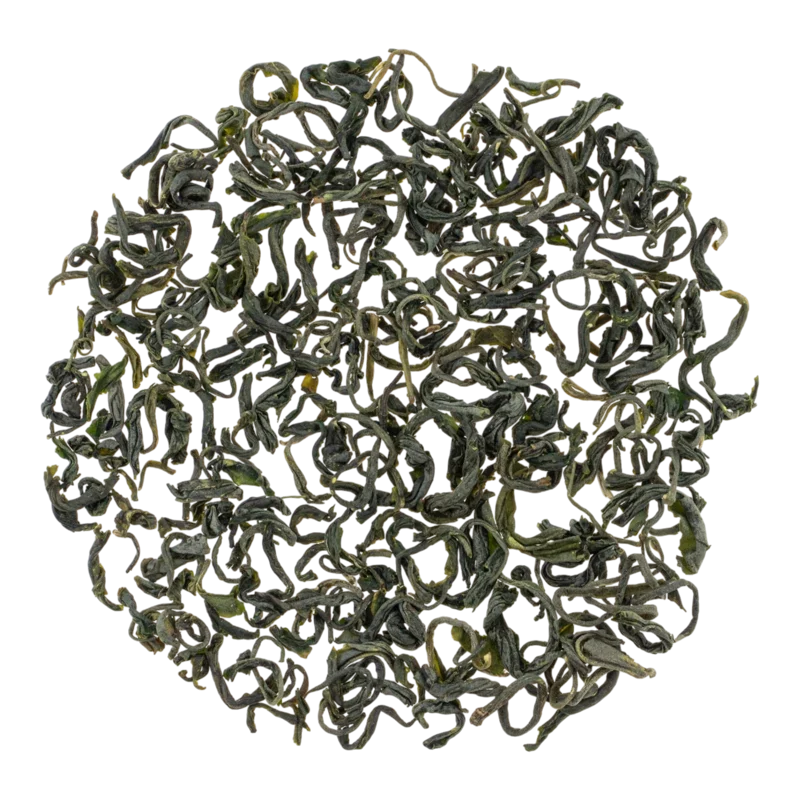
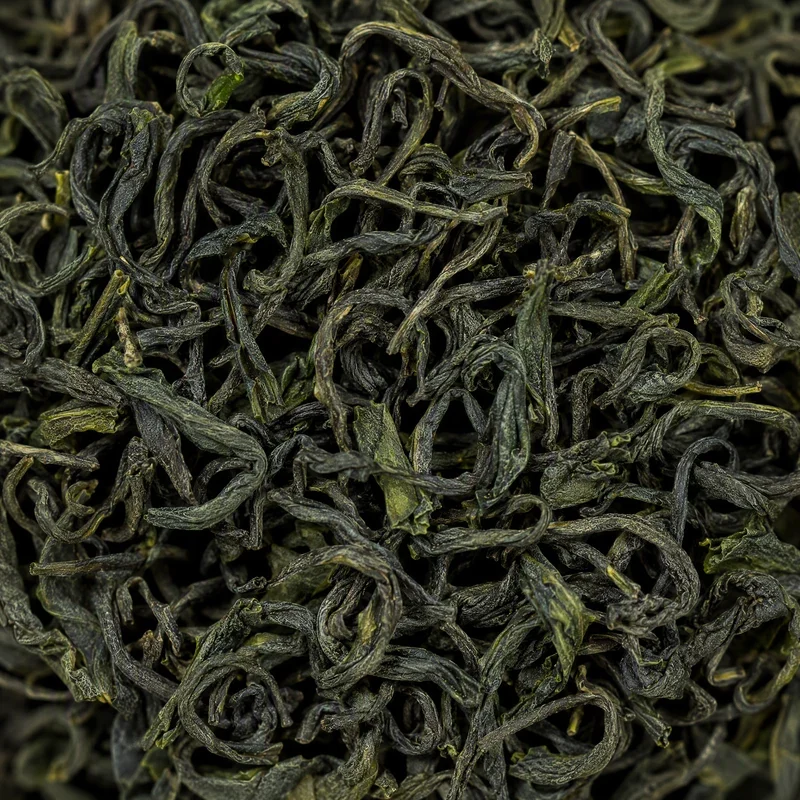
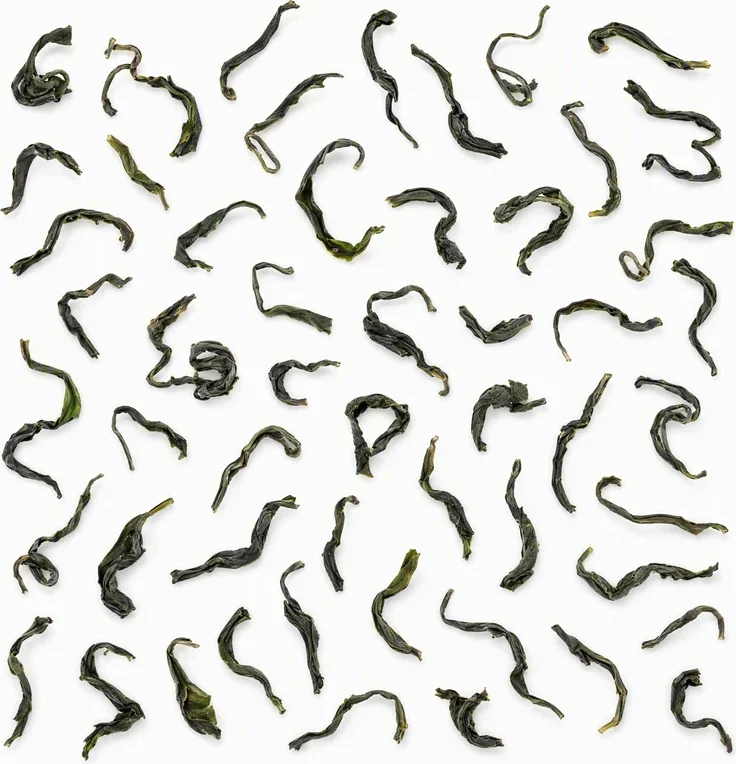
Dry Leaf Appearance: Highest grade: straight, tight tea particles, green with abundant down, "like bamboo leaves" (紧直绿润, jǐn zhí lǜ rùn). First grade: eyebrow-shaped (眉形), compact. Bulk: pan-fired green mass.
Dry Leaf Aroma: Chestnut (栗香, lìxiāng) — primary, warm, persistent. In highest grade — additional "tender" note (嫩香, nèn xiāng), fresh and slightly milky. In bulk grades — clean (清香, qīng xiāng).
Liquor Aroma: Chestnut-warm, unfolds in two stages: first — bright "nutty strike", second — soft grassy wave with light sweetness. Aroma persistence — 5–6 steeps for highest grade.
Liquor Color: Tender green, bright (嫩绿明亮, nèn lǜ míng liàng). Clear, with slightest yellow tone in light.
Spent Leaves: Yellow-green, uniform, leaves open in "bouquets" (芽叶成朵, yá yè chéng duǒ) — sign of careful picking and processing.
Taste: Fresh and brisk (鲜爽, xiān shuǎng) — 4.3% amino acids (double the average!) give pronounced "umami" profile. Mellow and rich (醇厚, chún hòu) — high water-extractable content (≥35%). Returning sweetness — persistent, with long "milky-sweet" finish. Bitterness and astringency — minimal due to low polyphenol/amino acid ratio.
Amino Acids: 4.3% — double the average value for green tea (~2–3%). Main component — L-theanine (L-茶氨酸). High content due to three factors: 260 days of fog (diffused light suppresses photosynthetic conversion of theanine to catechins), daily variation >10°C (low night temperatures slow amino acid catabolism) and selenium-containing soils (Se participates in amino acid metabolism).
≥35% — high liquor "richness", multiple brewing capability.
≥0.3 mg/kg in highest grade. From selenium-containing soils of Mount Jinfo (locally Se >1 ppm). Selenium — essential microelement with antioxidant, immunomodulating and thyroprotective action.
Approximately 3.0–4.0% — moderate, typical for green tea.
Minerals: K, Mg, Mn, Zn, F, Se. Strontium (Sr) — trace level from mountain water sources.
Polyphenols: 30.35% — moderately high indicator. Balanced catechin profile: sufficient "body" without excessive astringency.
Vitamins: C, B₁, B₂, E, K. Vitamin C preserved due to gentle processing.
Polyphenols (30.35%) + selenium — dual antioxidant system. Selenium is cofactor of glutathione peroxidase — one of key antioxidant defense enzymes.
Caffeine + L-theanine — gentle, prolonged tone without anxiety.
Amino acids (4.3%) + selenium. Theanine stimulates γ-δ T-lymphocyte proliferation. Selenium supports thymus function and antibody production.
Selenium — component of deiodinases, enzymes converting thyroxine (T₄) to triiodothyronine (T₃). Regular Se-tea consumption may be beneficial in selenium-deficient regions.
Catechins (primarily EGCG) promote fat oxidation and cholesterol profile normalization.
L-theanine improves attention and working memory, stimulates brain α-waves.
Fluoride from tea leaf has caries-preventive action.
Optimal for "Jinfo Yucui" — observing "bamboo leaf" unfolding.
For first and bulk grades — controlled short steeps.
Tea Amount: 3 g per 150 ml (1:50 ratio).
Water Temperature: 80–85°C for first and second grades. For highest grade "Jinfo Yucui" — 75°C (tender material requires gentle regime).
Enemies: Moisture, light, heat, foreign odors. Se-containing tea especially sensitive to oxidation — store strictly airtight.
Shelf Life: In sealed packaging at 0–5°C — up to 18 months.
Airtight packaging, refrigerator 0–5°C. Preferably — vacuum or nitrogen packaging.
"Rest" 1–2 weeks after production for aroma stabilization.
Classic Sichuan green tea, also from mountain region (Mengding, 1456 m). Shape — twisted, aroma — chestnut. Nanchuan Lü Cha differs: higher Se content, straighter shape in highest grade, 260-day fog (vs ~300 sunny days at Mengding).
Another famous Chongqing green tea. "Elegant bud" from Yongchuan — needle shape, fresh profile. Nanchuan Lü Cha is fuller-bodied, with more pronounced chestnut aroma and Se bonus.
China's only major steamed green tea (from neighboring Hubei). Also Se-tea (Enshi — one of world's largest Se regions). Difference — in technology: Ēnshī Yǔ Lù is steamed (蒸青), while Nanchuan is pan-fired (炒青) and charcoal-dried, giving warmer, "chestnut" profile instead of "grassy-fresh".
Guizhou Se-Zn tea, direct competitor in "selenium" niche. Both — mountain green teas with Se, but Nanchuan Lü Cha has richer history (Lu Yu, "Tea Chronicle") and UNESCO terroir.
5000–10,000 yuan/kg — premium level, comparable to elite Longjings.
800–2000 yuan/kg.
Affordable, everyday.
No reviews yet. Tell us what you think of this tea.
Rate this tea and share your impressions. We review each submission before publishing it.