Brewing
Gongfu brewing
- Water temperature
- 93 °C
- Tea amount
- 5 g
- Water volume
- 100 ml
- First steep
- 10 s
- Time added per infusion
- 5 s
- Infusions
- 4


Nánchuān hóngchá
Choose a brewing method. Start with the recommended quantities and time, then adjust to taste.
Brewing
Brewing
Taste
Tea encyclopedia
Category: Chinese red teas (gongfu black tea, 工夫红茶). Belongs to high-mountain red teas of southwestern China. Flagship product — "Qiannian Jinshan Hong" (千年金山红, Qiānnián Jīnshān Hóng, "Thousand-Year Golden Mountain Red") — positioned as an elite-class tea from ancient tree material.
Category: Chinese red teas (gongfu black tea, 工夫红茶). Belongs to high-mountain red teas of southwestern China. Flagship product — "Qiannian Jinshan Hong" (千年金山红, Qiānnián Jīnshān Hóng, "Thousand-Year Golden Mountain Red") — positioned as an elite-class tea from ancient tree material.
Coordinates: ≈ 29.0° N, 107.1° E.
Origin: China, Chóngqìng Municipality (重庆市, Chóngqìng Shì), Nánchuān District (南川区, Nánchuān Qū). Main production zone — Jinfushan (金佛山, Jīnfóshān, "Golden Buddha Mountain"), part of the Daloushan mountain system (大娄山, Dàlóu Shān). Key sites located in Délóng Township (德隆镇, Délóng Zhèn), Cháshù Village (茶树村, Cháshù Cūn).
Type: Red tea (black tea) (红茶, hóngchá) — fully oxidized.
Cultural Significance: Nanchuan red tea is the "calling card" of Nanchuan and the entire southwestern tea region, a symbol of the thousand-year tea tradition of western China. Golden Buddha Mountain is a UNESCO World Heritage site (natural), and the ancient tea trees growing here are perceived as living testimony to one of the centers of origin of the tea plant. The local tradition of "oil tea" (油茶汤, yóuchá tāng) — brewing ground tea with oil, pork, peanuts and eggs — is preserved in Delong villages to this day.
History: Nanchuan District is one of the most ancient tea-growing territories in southwestern China. According to the "Nanchuan County Gazetteer" (《南川县志》, "Nánchuān Xiànzhì"), local people have long collected and processed tea: "In our Nan there are bush tea and white tea of two types; in spring tender leaves appear...". The tea treatise "Tea Classic" (《茶经》) by Lù Yǔ (陆羽, Lù Yǔ) mentions tall tea trees in "Bashan Xiachuan" (巴山峡川) — this very region is considered by researchers to include the territory of modern Nanchuan.
Name Breakdown: 南 (nán) — "south"; 川 (chuān) — "river, stream" (historical reference to the Sichuan/Chongqing region); 红茶 (hóngchá) — "red tea (black tea)". Thus, Nanchuan Hong Cha — "red tea from Nanchuan". The brand "千年金山红" (Qiānnián Jīnshān Hóng) literally translates as "thousand-year red [tea] from Golden Mountain", emphasizing the connection with ancient tea trees of Jinfushan.
Cultivar: Nanchuan large tea tree — Camellia nanchuanica (南川大树茶, Nánchuān Dàshù Chá) — endemic arboreal (乔木型, qiáomù xíng) wild species belonging to the five-chambered tea series (五室茶系). This plant is recognized as a national protected species of the first category. The largest specimen, located in Chashu Village at an elevation of ≈ 1350 m, is approximately 2700 years old and is honorably called the "progenitor of tea trees" (茶树鼻祖). Currently, about 2000 mature specimens are preserved on Jinfushan; the total base area is more than 8200 mu (≈ 547 ha). Besides wild species, local populations (群体种, qúntǐzhǒng) and breeding cultivars Fúdǐng Dà Bái Chá (福鼎大白茶) and Bāyú Tè Zǎo (巴渝特早) are also used for mass production.
Picking: Spring — main season: March–April. Due to high-mountain location, harvest begins later than in flatland areas of Sichuan. Summer harvest is also practiced but valued lower.
Pluck Standard: For elite batches (千年金山红) — early spring large buds (壮芽, zhuàngyá); for standard gongfu — one bud and one–two leaves (一芽一叶 / 一芽二叶). The leaf is distinguished by increased size, broad blade and thick flesh — a characteristic feature of large-leaf arboreal material.
Raw Material: Whole, fresh leaf without mechanical damage. Ancient tree material does not require pesticide treatment: the Jinfushan ecosystem provides natural resistance to pests.
Altitude: 800–1600 m above sea level; core zone — 1300–1400 m (Delong area).
Climate: Subtropical monsoon with pronounced vertical zonation. Average annual temperature at tea garden elevation ≈ 17°C (versus 26°C on Nanchuan plain). Average annual precipitation — about 1400 mm, concentrated in summer period. Foggy days — up to 260 per year; relative humidity — ≈ 90%. Significant diurnal temperature variation promotes accumulation of aromatic substances in the leaf.
Soil: Weakly acidic (pH 4.5–6.5), parent rock — Permian sandstones (扁沙土). Rare combination of quartzose sandstones and limestones provides high organic matter content and mineral saturation, forming characteristic "rock rhyme" (岩韵, yányùn) in taste.
Ancient trees grow in wild forest conditions among endemic species (Davidia tree, silver fir), without fertilizers and pesticides. For cultivated plantations, only organic fertilizers (manure) are used; application of urban, industrial or medical waste is prohibited by standard NY/T5018-2001.
Topography: Typical karst landscape (喀斯特地貌). Jinfushan — northern extremity of the Daloushan ridge; maximum elevation — 2251 m.
Hand selection of tender material; for elite batches — only early spring large buds from ancient trees.
Slow reduction of leaf moisture, initiation of enzymatic processes and "tuning" of aromatic profile. Natural air withering is used; for large-leaf ancient tree material this stage takes longer than for small-leaf cultivars.
Mechanical destruction of cellular structure to release juices; formation of characteristic dense twist. Thick leaf of arboreal material requires longer and gentler rolling.
Key stage: development of theaflavins and thearubigins, formation of sweet, honey-fruit notes. Controlled temperature and humidity; for ancient tree material oxidation is conducted somewhat longer than usual, ensuring deep, multi-layered taste.
Fixation of taste-aromatic profile. Charcoal heating (炭火, tànhuǒ) is applied using traditional technique followed by stabilization.
Separation by fractions — batches with high proportion of golden tips are separately distinguished. Finished tea undergoes quality control and is packaged under conditions excluding contact with foreign odors.
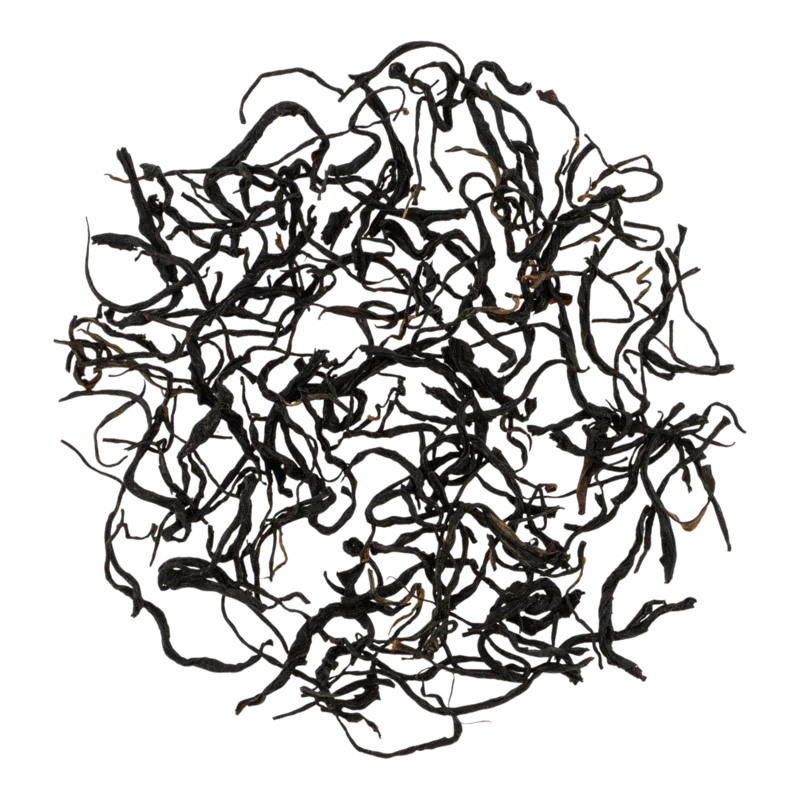
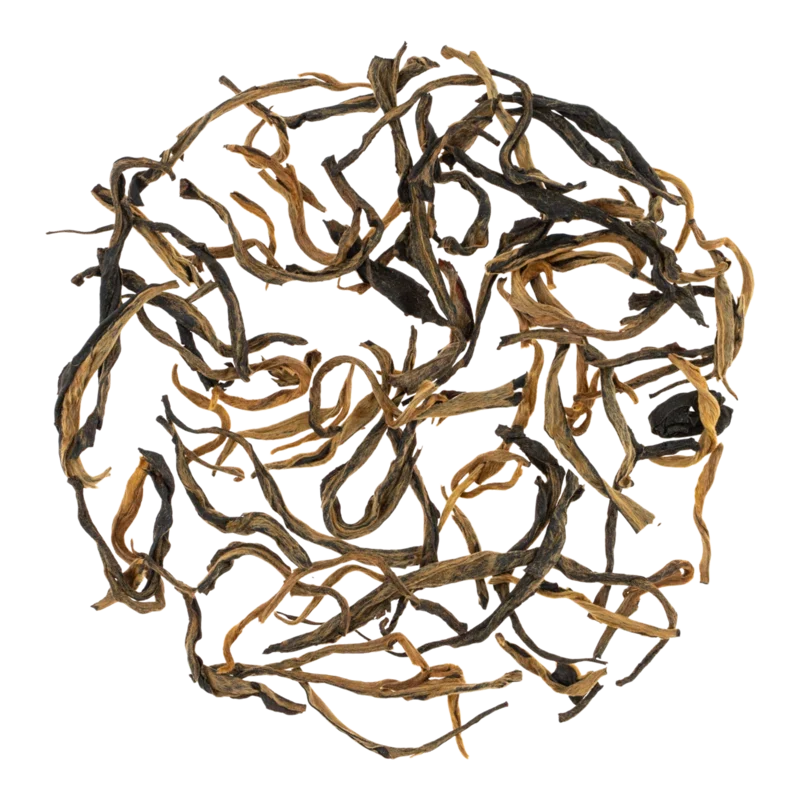
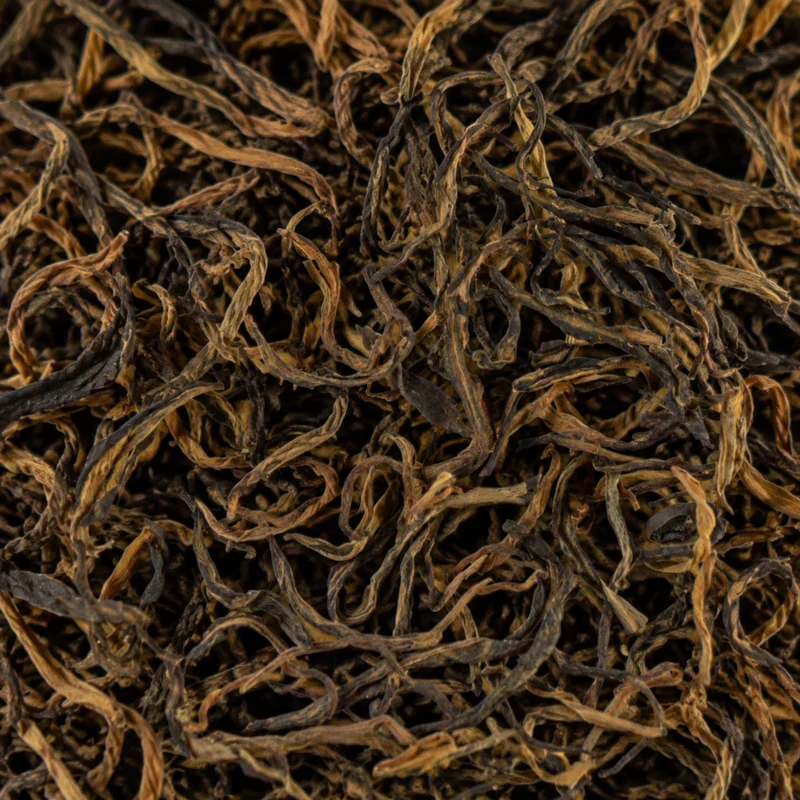
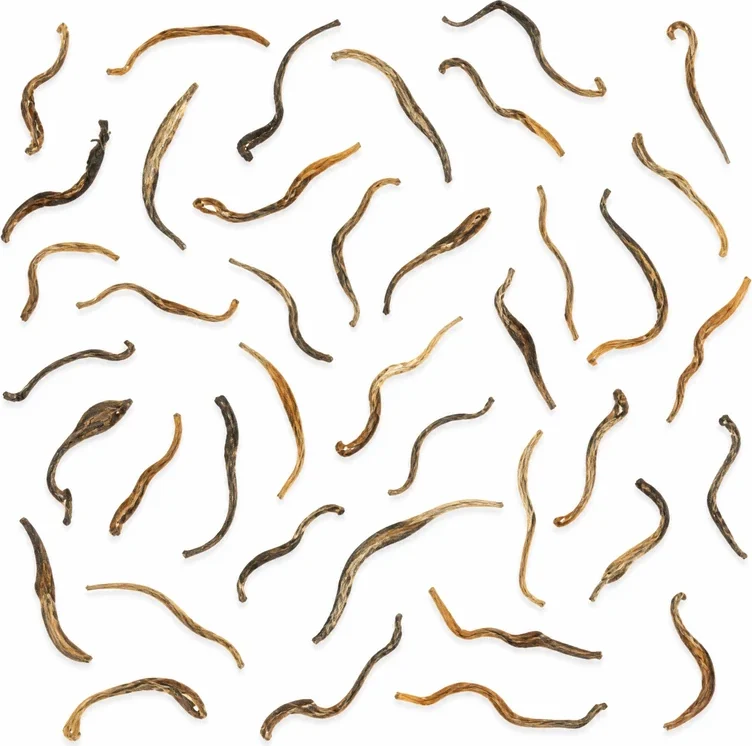
Dry Leaf Appearance: Dense, tight twist; large-leaf conditions — wider and thicker than typical Fujian gongfu. Color — deep black with oily luster (乌润光亮). Golden tips (金毫, jīnháo) are well visible in elite batches.
Dry Leaf Aroma: Warm, with distinct floral notes, light overtone of ripe fruits and barely perceptible mineral "stone" nuancing.
Liquor Aroma: Multi-layered: initial wave — floral (orchid, magnolia), middle — honey with transition to dried fruits (apricot, date), final — bread-caramel. Characteristic feature — aroma persistence even after 7–8 steeps.
Liquor Color: Orange-red (橙红), bright and clear, with noticeable golden rim (金圈, jīnquān) on surface — sign of high theaflavin content.
Spent Leaves: Leaf opens elastically and evenly; large, well-preserved blade shapes of copper-brown to reddish-chestnut shade. Ancient tree material opens especially prominently, demonstrating thick flesh and distinct vein network.
Taste: Full-bodied, rich, with pronounced natural sweetness (回甘, huígān). Astringency is soft and rounded, without aggressiveness. Aftertaste is warming, long, with notes of floral honey and light fruity acidity. Elite batches from ancient tree material are distinguished by increased "body" density (茶体, chátǐ), close to Yunnan dianhongs.
Alkaloids: Caffeine — moderate level (typically 2.5–3.5% for large-leaf material); theobromine and theophylline — in trace amounts.
Amino Acids: Especially high content — up to 4.3% (according to agrochemical studies of C. nanchuanica), significantly exceeding indicators of most red teas. L-theanine provides soft sweetness and "creamy" aftertaste.
≥ 35% — high indicator explaining liquor richness and excellent resistance to multiple brewing.
B-group vitamins, vitamin C (partially destroyed during oxidation); potassium, magnesium, manganese, zinc. Karst soils enrich the leaf with selenium and other microelements.
Complex of floral terpenes (linalool, geraniol) and Maillard reaction products formed during drying; these give the characteristic floral-honey bouquet.
Polyphenols: Dominated by catechin oxidation products — theaflavins (responsible for "liveliness" and golden rim of liquor) and thearubigins (form color depth and taste body). Total tea polyphenol content — ≈ 24–28% (according to data for similar large-leaf material from southwestern China).
Combination of caffeine and high L-theanine level gives vigor without nervousness — effect is more even and prolonged than coffee.
Theaflavins and thearubigins possess pronounced antioxidant potential, contributing to cell protection from oxidative stress.
Warm red tea with moderate astringency is comfortable for the stomach; traditionally consumed after meals to improve digestion.
In moderate consumption, red tea polyphenols support vascular elasticity and normalize cholesterol levels.
Especially valued in cold weather; full-bodied liquor subjectively reduces feelings of fatigue and chills.
L-theanine promotes attention concentration and state of "calm focus".
Increased content of zinc, manganese and selenium (due to karst terroir) is beneficial for immune system and skin condition.
High L-theanine level (up to 4.3% amino acids in source material) promotes alpha-wave production in the brain, providing relaxation without drowsiness — ideal accompaniment to evening tea drinking.
Tea Amount: 4–6 g per 100–120 ml.
Teaware: Gàiwǎn (盖碗, gàiwǎn) of white porcelain — optimal for revealing floral bouquet. Yíxīng teapot (宜兴紫砂壶) — adds additional roundness to liquor. For European style — porcelain teapot of 200–300 ml volume.
Water Temperature: 90–95°C. For elite batches from ancient tree material, 95–98°C is acceptable — thick leaf opens well at higher temperature.
Yunnan red tea from large-leaf var. assamica material. More powerful, "smoky", with pronounced chocolate-caramel tones. Nanchuan Hong Cha — more elegant, with higher floral note and "rock" minerality, with comparable brewing durability.
Fujian red tea from small-leaf material. Characterized by pine-smoky or fruit-coniferous notes. Nanchuan Hong Cha lacks smokiness but shares with xiaozhong depth and complexity of aftertaste.
Anhui gongfu with characteristic "Qi-perfumery" (祁门香) note — elegant, orchid-like. Nanchuan Hong Cha is broader in palette: to florality are added honey and karst minerality, and body is denser thanks to large-leaf material.
Famous Chongqing green tea — closest "neighbor" by terroir. Nanchuan Hong Cha complements it on Chongqing's tea map: if Yongchuan Xiuya — cool freshness and delicate green tenderness, then Nanchuan — warm, warming depth with full-bodied character, worthy of separate place in any connoisseur's collection.
Wide. Standard gongfu from cultivated material — affordable price category. Elite "Thousand-Year Jinshan Hong" from ancient tree material — ultra-premium segment (up to 120,000 yuan per 1 kg according to producer data), explained by rarity of source material.
Tree age; growing elevation; harvest standard (one bud vs. bud with leaves); proportion of golden tips; spring vs. summer harvest batch.
No reviews yet. Tell us what you think of this tea.
Rate this tea and share your impressions. We review each submission before publishing it.