Brewing
Gongfu brewing
- Water temperature
- 75 °C
- Tea amount
- 5 g
- Water volume
- 100 ml
- First steep
- 10 s
- Time added per infusion
- 5 s
- Infusions
- 4

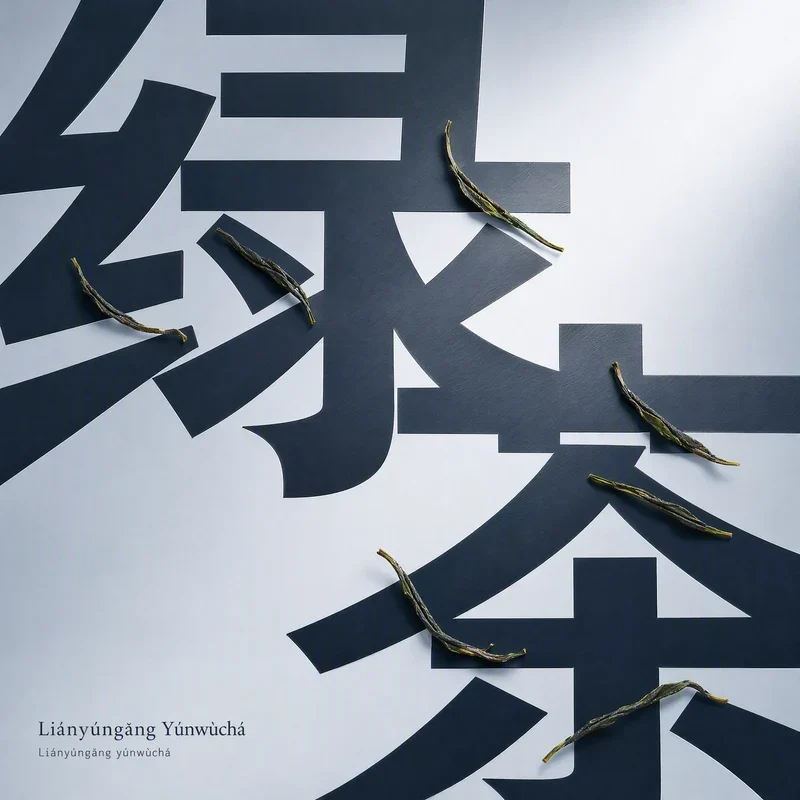
Liányúngǎng yúnwùchá
Choose a brewing method. Start with the recommended quantities and time, then adjust to taste.
Brewing
Brewing
Taste
Tea encyclopedia
Category: One of the "Three Famous Teas of Jiangsu" (江苏三大名茶). Geographical indication product of the PRC (国家地理标志证明商标, 2010). Intangible cultural heritage of Jiāngsū Province (省级非遗, 2009 — manual technology "八法"). One of the "Four Famous Teas of Jiangsu" (江苏四大名茶, 1980). Green product category A (绿色食品A级, 2019). As of 2024 — tea garden area comprises 5800+ mu (~387 hectares), annual production volume — ~65 tons, total product value — 28 million yuan.
Category: One of the "Three Famous Teas of Jiangsu" (江苏三大名茶). Geographical indication product of the PRC (国家地理标志证明商标, 2010). Intangible cultural heritage of Jiāngsū Province (省级非遗, 2009 — manual technology "八法"). One of the "Four Famous Teas of Jiangsu" (江苏四大名茶, 1980). Green product category A (绿色食品A级, 2019). As of 2024 — tea garden area comprises 5800+ mu (~387 hectares), annual production volume — ~65 tons, total product value — 28 million yuan.
Coordinates: Approximately 34°38′ N, 119°07′ E.
Origin: China, Jiāngsū Province (江苏省, Jiāngsū Shěng), prefecture-level city Liányúngǎng (连云港市, Liányúngǎng Shì). Yúntáishān mountain range (云台山), Yellow Sea coast (黄海). Production core: Dàzhúyuán Village (大竹园村, Dàzhúyuán Cūn) in Sucheng district (宿城, 550 m) — birthplace of "八法" technology; Huāguǒshān (花果山) — tea gardens at ~400 m elevation, awarded the title "China's Most Beautiful Tea Garden" (中国最美茶园), providing up to 40% of the highest grade; Nanyuntai Forest Farm (南云台林场) — tree nursery and intangible heritage workshop, producing golden tea "Qingmiao" (清妙, Qīngmiào).
Type: Green tea (绿茶, lǜchá), unfermented. Manual pan-firing followed by drying. Leaf shape — "eyebrow-like" (眉状, méizhuàng): tightly rolled, curved strips with pronounced down. Primary technology — proprietary "八法" (bā fǎ, "Eight Methods"), including "三炒三揉" ("three pan-firings, three rollings").
Single bud, picked before Qingming. Annual volume — only ~150 kg (~300 jin) — one of the most limited-production "famous teas" of China. Chestnut aroma with pronounced "tender" notes. Price — from 2000 yuan per 500 g.
One bud + one leaf. Price — 800–1500 yuan per 500 g.
One bud + one-two leaves. Price — 500–800 yuan per 500 g.
Mass season, for daily consumption and packaging.
Cultivar: Foundation — local population variety (本地群体种, běndì qúntǐzhǒng), supplemented by Fuding Dabai Cha (福鼎大白茶, Fúdǐng Dàbái Chá) — medium-leaf frost-resistant cultivars of Camellia sinensis var. sinensis with fleshy buds. In Wuzheng'an monastery (悟正庵), ancient tea trees up to 800 years old are preserved — among the oldest in Jiangsu Province. Biochemical profile: polyphenols ≥25%, amino acids ≥3.5% (spring tea — up to 5.2%).
Picking: Main season — spring, from late March to late April. Standard: highest grade — single bud, picked before Qīngmíng (清明); first grade — one bud + one leaf, before Gǔyǔ (谷雨). To produce 1 kg of dry tea of the highest grade requires 60,000–70,000 buds.
Climate: 34° N — transitional zone between temperate and subtropical climate, at the junction of continental and maritime influence. Average annual temperature — 14–15.2°C. Annual precipitation — 920–1500 mm. Relative humidity — ~70%. Cloudiness — more than 180 days per year (clouds and sea fog from the Yellow Sea). Proportion of diffused light — over 70%. Daily temperature variation — more than 8°C. These conditions slow the decomposition of L-theanine and limit polyphenol synthesis, resulting in spring tea accumulating up to 5.2% amino acids — 20% higher than usual.
Soil: Slightly acidic yellow soils (黄壤, huángrǎng), pH 5.0–6.5. Organic matter content ≥2%. Parent rock — quartz gravel, providing excellent water permeability and aeration. Forest cover — 76%.
Tea gardens are located at 300–480 m elevation on the slopes of Yuntaishan (maximum mountain height — 624.4 m, Yunüfeng peak, 玉女峰). Production core — Sucheng district (宿城), ~550 m.
Ecological model "tea — forest — grass" (茶—林—草, chá–lín–cǎo): tea bushes grow in natural forest understory, providing biological shading and pest protection. Chemical pesticides are prohibited. Products undergo control for 481 parameters of EU standards. Huaguoshan tea gardens are awarded the title "China's Most Beautiful Tea Garden" (中国最美茶园).
Bamboo sieves, 4–6 hours at room temperature. Leaf moisture reduces to 70%.
Wok temperature — 150–180°C. Manual pan-firing by tossing (手工抛炒, shǒugōng pāochǎo): the master tosses the leaves in the wok, alternating "shaking" (抖, dǒu) and "smothering" (闷, mèn). Time — 6–7 minutes, until tea aroma appears and leaves darken.
Unique method "Taiji Baoqiu" (太极抱球, Tàijí Bàoqiú, "Taiji: Embracing the Ball") — a movement borrowed from taijiquan practice, allowing preservation of down (毫) on the leaf surface undamaged.
Intermediate drying to fix the shape.
Formation of "eyebrow-like" leaf shape.
Final processing at 60°C — "aroma lifting".
Moisture reduces to ≤6%.
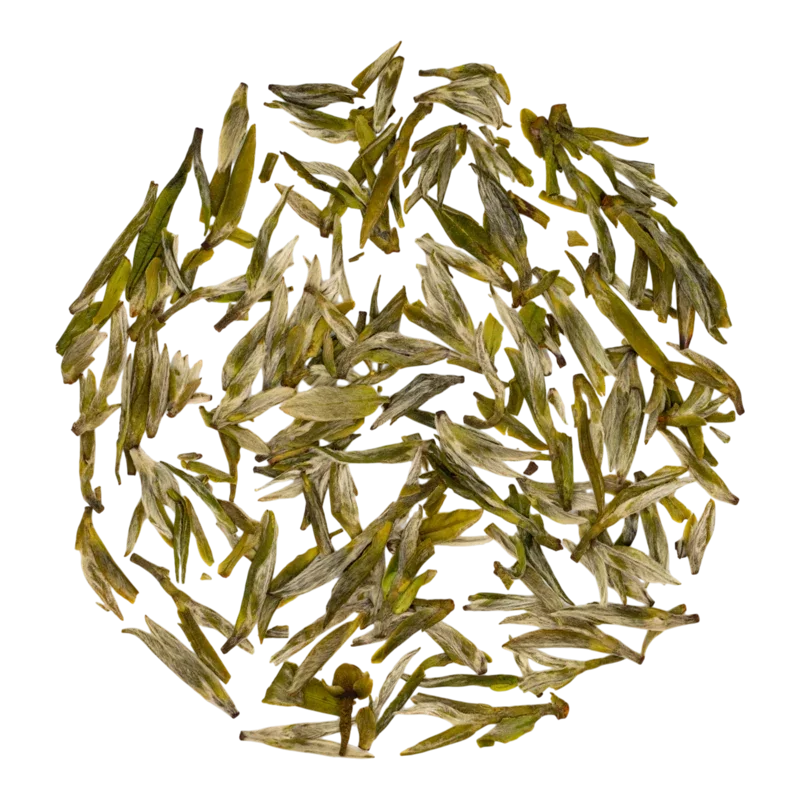
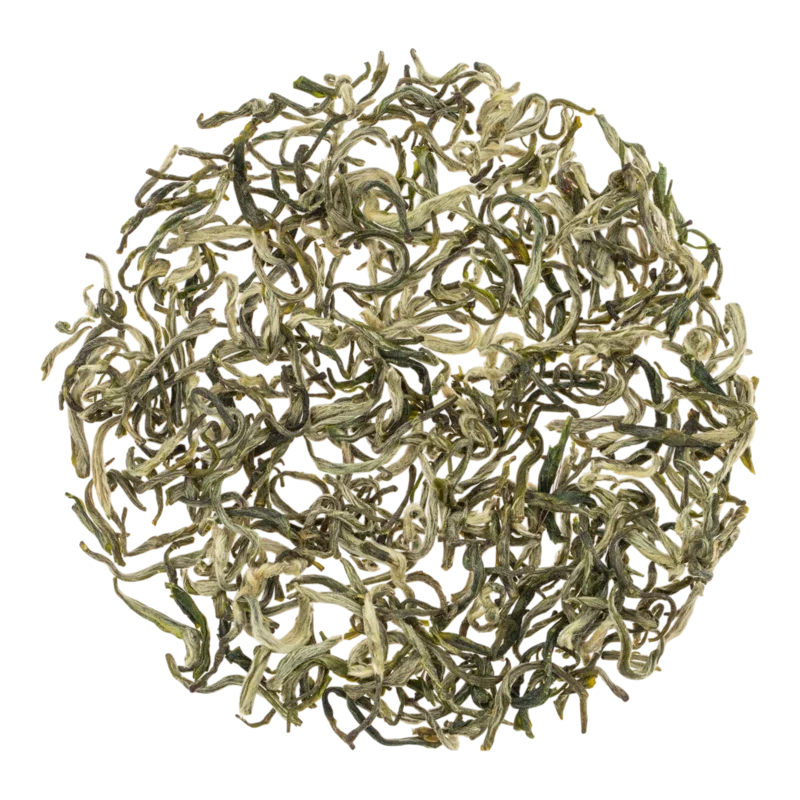
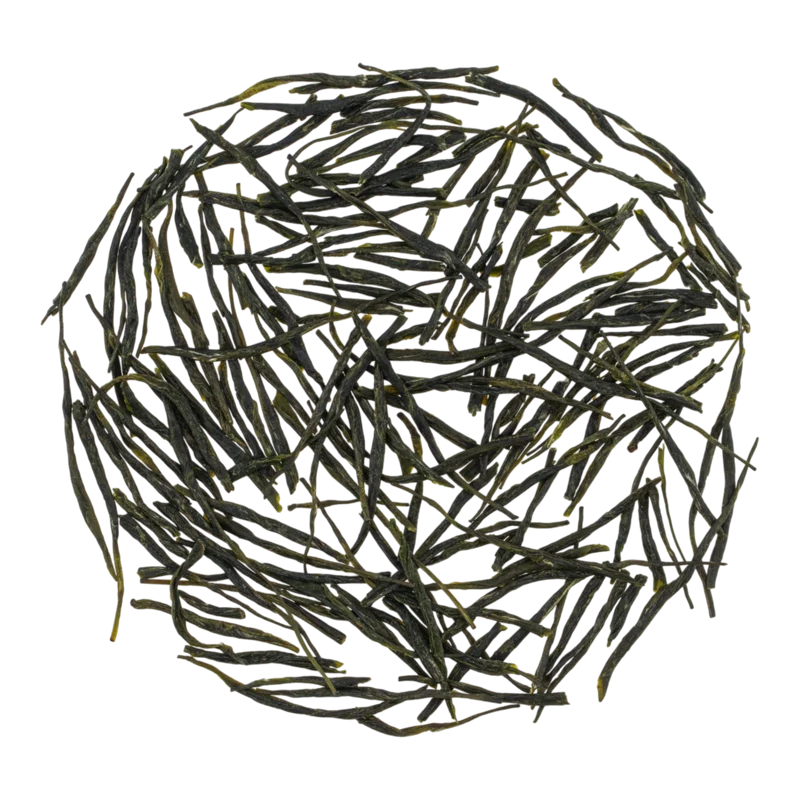
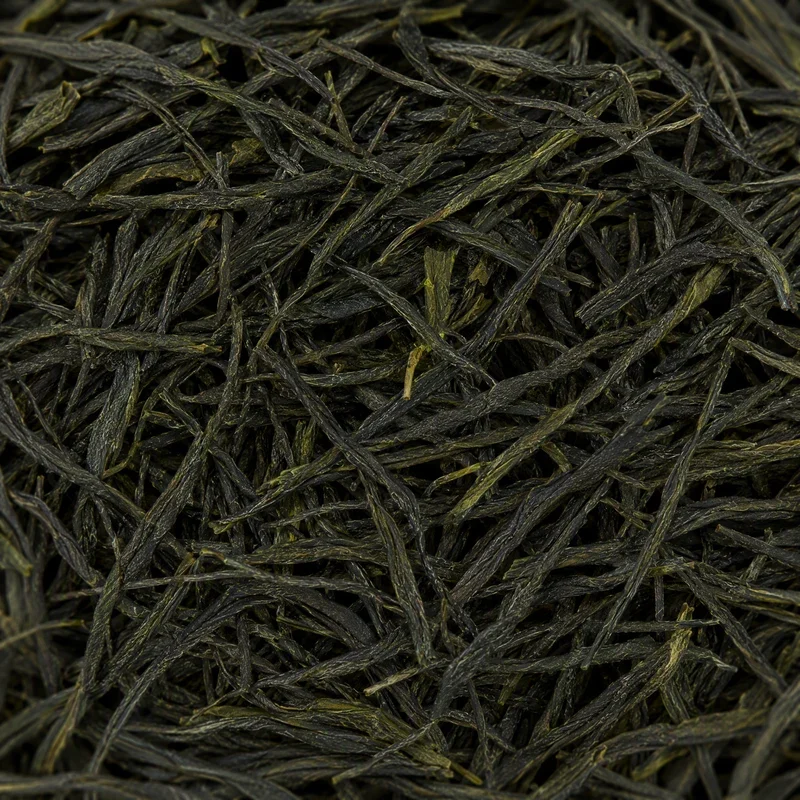
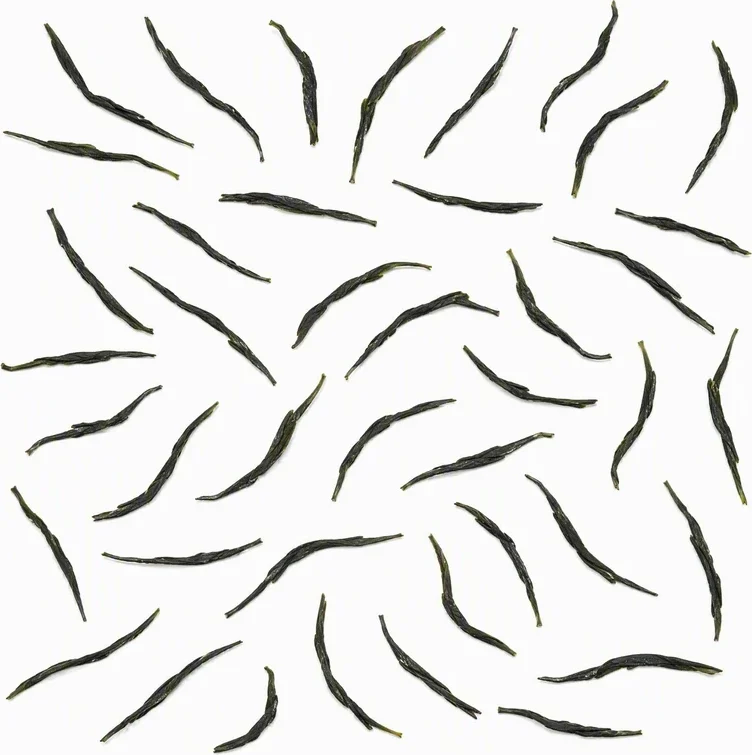
Dry Leaf Appearance: Tightly rolled "eyebrows" (紧圆卷曲, jǐnyuán juǎnqū), shape "眉状" — curved, like ink-painted eyebrows. Color — emerald green with abundant silvery down (翠绿显毫). Leaves uniform, without fragments.
Dry Leaf Aroma: Chestnut (栗香, lìxiāng) — primary, persistent. In highest grade — additional "tender" aroma (嫩香, nènxiāng) with fresh green notes.
Liquor Aroma: Pure, high, chestnut (清香高长). In spring tea — lighter, "floral" register. Cold cup aroma persists for more than 10 minutes.
Liquor Color: Yellow-green, clear and bright (黄绿清亮, huánglǜ qīngliàng). High transparency.
Spent Leaves: Tender, "alive", leaves unfold in "bouquets" (嫩匀鲜活,芽叶成朵). Characteristic "olive" green.
Taste: Traditional formula: "味醇、色秀、香馨、液清" (wèi chún, sè xiù, xiāng xīn, yè qīng) — "taste mellow, color elegant, aroma fragrant, liquor clear". Body — fresh and rich (鲜浓, xiānnóng), simultaneously full (醇厚, chúnhòu). Returning sweetness — quick and distinct. Characteristic note — "astringency transforming to sweetness" (涩中泛甜): initial astringent note transforms into mineral sweetness.
Amino Acids: 3.5–5.2% — peak value of 5.2% achieved in spring mingqiancha, which is ~20% higher than ordinary green teas. L-theanine provides "freshness" and depth of taste.
≥4.35% — significantly higher than average for green tea (typical level — 2–4%). Provides enhanced tonic effect.
147.33 mg/g — high indicator, confirmed by laboratory analysis.
Amino acid/polyphenol ratio lower than southern green teas, while caffeine is higher. This combination forms the characteristic Yunwucha profile of "鲜浓" — "fresh and rich".
Minerals: K, Mg, Zn, Mn, Fe.
Polyphenols: ≥25% — high indicator for northern tea. Main component — catechins (EGCG, ECG, EC), determining antioxidant activity.
Vitamins: Vitamin C (high content), B vitamins. Tannins (茶丹宁) — elevated content.
Caffeine 4.35% — one of the highest indicators among green teas, providing powerful CNS stimulation combined with the mild effect of L-theanine.
High content of catechins (147.33 mg/g) and vitamin C — double antioxidant shield.
Polyphenols contribute to lowering LDL cholesterol and triglyceride levels.
In Lianyungang folk medicine, tea was traditionally used as a remedy for dysentery (民俗验方, "folk prescription"). Modern research confirms the bacteriostatic activity of catechins.
Tannins stimulate digestive enzyme secretion.
L-theanine crosses the blood-brain barrier, promoting alpha wave generation and improving concentration.
Polyphenols and caffeine jointly contribute to maintaining vascular elasticity.
Catechins (especially EGCG) inhibit pro-inflammatory cytokines.
Tea Amount: 3 g per 150 ml water (1:50 ratio).
Teaware: Glass tumbler — for observing the unfolding of "eyebrow-like" leaves; gaiwan (盖碗) 120–150 ml; porcelain teapot.
Water Temperature: 80–85°C for standard grade; 75°C — for highest mingqiancha (delicate material).
Container: Hermetic vacuum packaging from aluminum foil. Storage in tin can with tight lid is acceptable.
Enemies: Moisture, light, foreign odors, heat. Do not store near products with strong aromas.
Shelf Life: 12 months under proper conditions. After opening — up to 1 month.
Temperature: Refrigerator, 0–5°C. For long-term storage — freezer (−18°C).
Needle-shaped tea from Nanjing. Shape — thin "needles" vs "eyebrows" of Yunwucha. Yuhua Cha — more "piney", with pronounced coniferous aroma; Yunwucha — chestnut and richer. Yuhua Cha is produced on plains (~30 m), Yunwucha — in mountains (300–550 m).
"Snail-shell" rolled tea from Suzhou. Biluochun — "fruity", with garden fruit notes (grows among fruit trees); Yunwucha — "maritime", with mineral note (grows by Yellow Sea coast). Biluochun — more delicate; Yunwucha — fuller, with pronounced caffeine.
"Cloud tea of Mount Lushan" from Jiangxi. Both — "cloud" teas, but Lushan is located at 29° N (5° further south), giving higher polyphenol levels and more "green" flavor profile. Yunwucha — more northern, drier, with more pronounced caffeine and chestnut base.
Tea from Anhui. Mao Feng — "orchid-like", with floral-herbal aroma; Yunwucha — chestnut, with mineral note. Both — mountain teas, but Mao Feng grows in milder subtropical climate.
Míngqiánchá (明前茶) — from 2000 yuan per 500 g (with annual volume of only ~150 kg — practically collectible tea). Yuqiancha — 800–1500 yuan. First grade — 500–800 yuan. Mass grade — 200–400 yuan.
Harvest season (mingqiancha — times more expensive), growing elevation (Dazhuyuan village, 550 m — most valuable), manual vs mechanical processing.
No reviews yet. Tell us what you think of this tea.
Rate this tea and share your impressions. We review each submission before publishing it.