Brewing
Gongfu brewing
- Water temperature
- 75 °C
- Tea amount
- 5 g
- Water volume
- 100 ml
- First steep
- 10 s
- Time added per infusion
- 5 s
- Infusions
- 3

jiǔcéng shān lǜchá
Choose a brewing method. Start with the recommended quantities and time, then adjust to taste.
Brewing
Brewing
Taste
Tea encyclopedia
Category: High-mountain green teas of Guizhou; Chinese regional green teas with geographical indication. Part of the provincial brand system "Guizhou Lu Cha" (贵州绿茶, Guìzhōu Lǜchá).
Category: High-mountain green teas of Guizhou; Chinese regional green teas with geographical indication. Part of the provincial brand system "Guizhou Lu Cha" (贵州绿茶, Guìzhōu Lǜchá).
Coordinates: Approximately 26°12′ North latitude, 105°28′ East longitude (the region is located in the "golden belt of tea production" on the 26th parallel north).
Origin: China, Guìzhōu Province (贵州省, Guìzhōu Shěng), Liùpánshuǐ City (六盘水市, Liùpánshuǐ Shì), Liùzhī Special District (六枝特区, Liùzhī Tèqū). The geographical indication zone covers the entire territory of Liuzhi Special District.
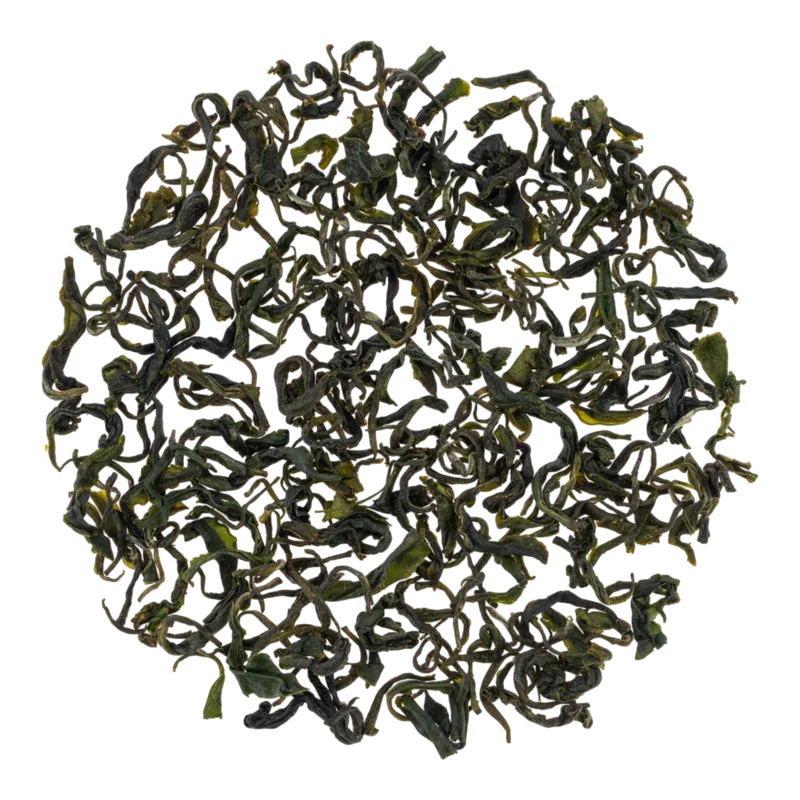
Type: Green tea (绿茶, lǜchá), unoxidized. Produced in two forms: flat (扁形, biǎnxíng) and curled (卷曲形, juǎnqū xíng).
Cultural Significance: Jiuceng Shan Lu Cha has become a symbol of economic revival and "green development" (绿色发展) of Liuzhi Special District — a former coal-mining area that has reoriented toward ecological agriculture and tea tourism. Liuzhi Special District is an administrative formation with the unique status of a "special district" (特区, tèqū), created in the 1960s to manage coal resources, and now has become a showcase of sustainable development. Tea products are actively promoted as part of the strategy to reduce poverty and create jobs in the mountainous regions of Guizhou. Seven townships with tea plantations of over ten thousand mu each operate within Liuzhi Special District, with the total area of tea gardens exceeding 107,000 mu (more than 7,100 hectares).
History: Tea cultivation in the Jiucengshan mountain range dates back to the 1960s, when a farm for urban "educated youth" (知青农场, zhīqīng nóngchǎng) was established here, laying the foundation for tea plantations. In the locality of Banpocun (半坡村, Bànpō Cūn), thousand-year-old wild tea trees (千年古茶树) are preserved, testifying to the centuries-long presence of tea trees in this region. In 2008, the company "Liuzhi Special District Jiucengshan Local Products Development Co., Ltd." (六枝特区九层山土特产开发有限公司) was created, which registered the "Jiucengshan" brand and began large-scale development of the region's tea resources. In 2017, the tea received the status of a product with national geographical indication (国家地理标志保护产品). In 2024, the "S9" series was awarded a silver prize at an international tea exhibition, and the value of the "Jiucengshan Cha" brand was estimated at 25.67 billion yuan.
Name Breakdown: Jiǔcéngshān (九层山) — literally "Mountain of Nine Tiers" (九 jiǔ — nine; 层 céng — tier, layer; 山 shān — mountain). According to local legend, the massif contains about one hundred mountain peaks that line up tier after tier, like a multi-story tower — hence the figurative name "nine tiers." Lú chá (绿茶, lǜchá) — green tea.
Cultivar: The foundation of plantings (about 60%) consists of the cultivar Fúdǐng Dàbáichá (福鼎大白茶, Fúdǐng Dàbáichá) — an especially early variety (Camellia sinensis var. sinensis) with early bud awakening, high polyphenol content, well-suited for producing aromatic flat green teas. Additionally, local population varieties (本地群体种, běndì qúntǐ zhǒng) are cultivated, including large-leaf and medium-leaf forms with thick, fleshy leaves rich in pectic substances — ideal raw material for curled teas of the mao jian (毛尖) type. The region contains over 300,000 ancient tea trees over one hundred years old.
Picking: Main harvest — spring, with early spring peak (明前, míngqián) for highest grade tea. Standard: fully bud — for T9 series; bud with one leaf — for high-quality tea; bud with two leaves — for mass production.
Raw Material: Young uniform raw material, without coarse, damaged, or diseased leaves. Purity is confirmed by annual testing for 481 types of pesticide residues according to EU standards.
Altitude: 1,000–1,500 m above sea level.
Soil: Micro-acidic yellow soils (微酸性黄壤, wēi suānxìng huáng rǎng), pH 5.0–6.5, with organic matter content ≥ 2%. Soils are rich in selenium, zinc, and other microelements. Forest cover comprises 78.8%, industrial pollution is absent. Water supply is provided by the Zangke River, whose water meets the first class of national quality standards.
Tea gardens are located at the junction of Lángdài Township (郎岱镇, Lángdài Zhèn) and Zāngkē Township (牂牁镇, Zāngkē Zhèn) in a typical river valley zone influenced by water masses of the Zāngkē River (牂牁江). Average annual temperature — 14°C, annual precipitation — over 1,200 mm. Foggy days exceed 180 per year, diffused light comprises over 70% of total illumination, daily temperature variation exceeds 10°C. Average annual sunshine duration — only 1,107 hours, significantly lower than in eastern tea-producing provinces — precisely this factor of "limited sunshine" (寡日照, guǎ rìzhào) promotes amino acid accumulation and formation of mild, sweet taste.
High-altitude location slows tea tree growth, which promotes nutrient accumulation in young shoots. According to available data, amino acid content in spring raw material comprises 3.5–5.0% (20% higher than lowland analogues), and polyphenols — over 40%, forming the characteristic "cold high-mountain character" (高山冷韵, gāoshān lěngyùn). Tea gardens are managed according to ecological standards: only physical methods (light traps) are used for pest control, chemical pesticides are completely prohibited.
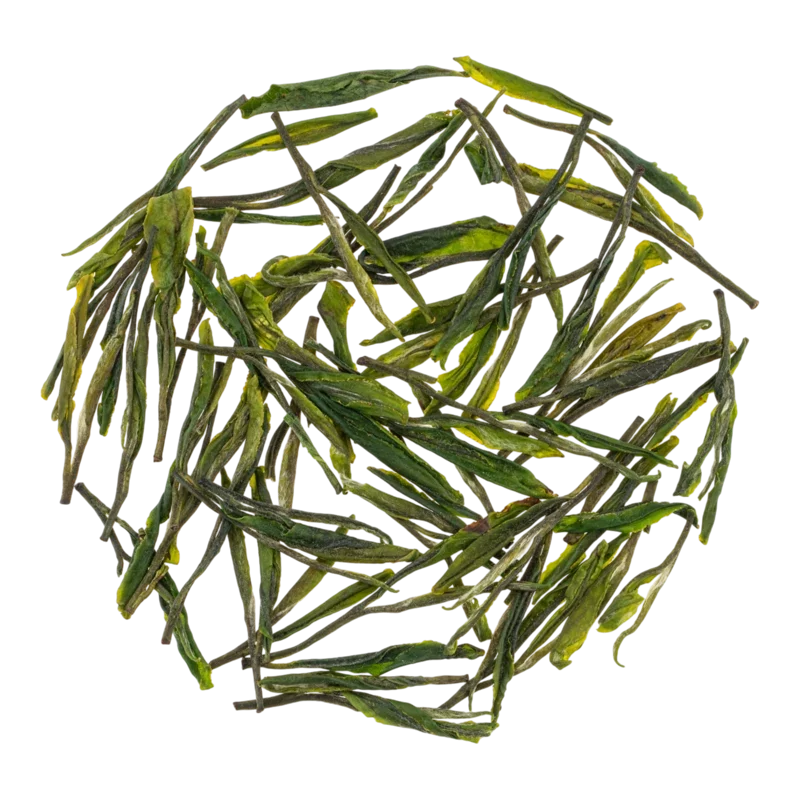
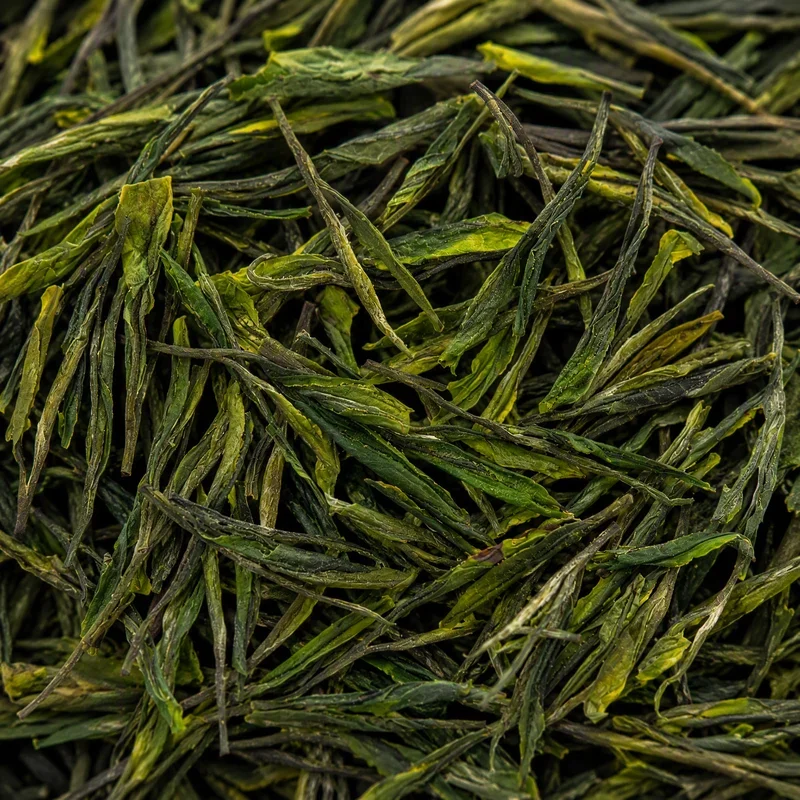
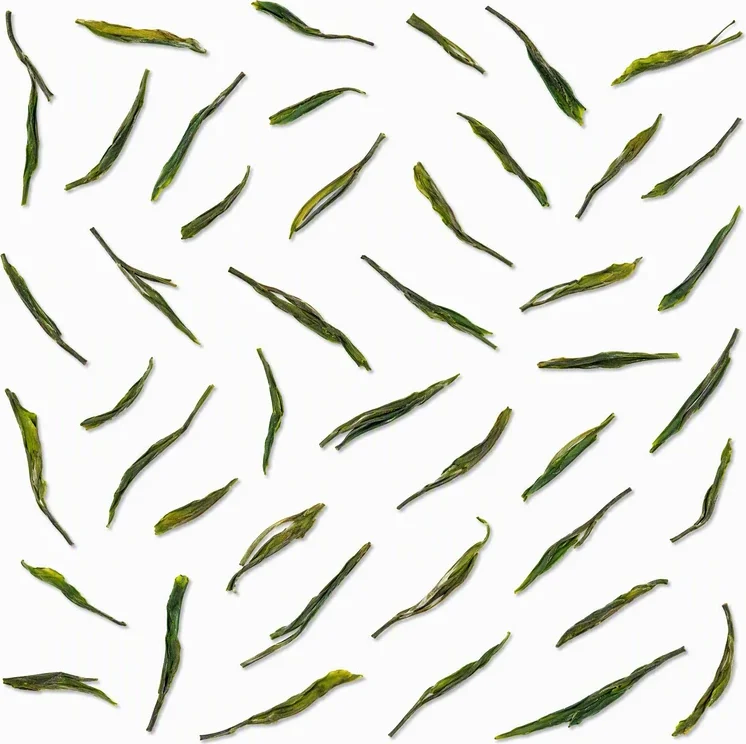
Dry Leaf Appearance: Depends on form: flat tea (especially "Ming Qian Cui Ya" series, 明前翠芽) — flat, straight, even tea leaves of emerald-green color; curled tea — dense, tight strips with pronounced weight. Both types are distinguished by uniformity and purity.
Dry Leaf Aroma: Delicate aroma of young shoots (嫩香, nèn xiāng) — for flat type; chestnut aroma (栗香, lì xiāng) — for curled type. Light floral notes are present in spring samples.
Liquor Aroma: Persistent and clean: delicate freshness in highest grades, deep chestnut tone in curled leaf tea. Aroma in cooled cup (冷杯留香, lěng bēi liú xiāng) persists for more than 10 minutes.
Liquor Color: Tender green, bright and clear (嫩绿明亮, nèn lǜ míngliàng) for highest grades; yellow-green and transparent for mass tea.
Spent Leaves: Tender yellow-green leaves, even and elastic, with thick, fleshy buds. Overwintered buds (越冬芽, yuèdōng yá) may show light reddish edges — a characteristic natural sign.
Taste: Fresh and brisk (鲜爽, xiānshuǎng), mellow and rich (醇厚, chúnhòu). Amino acid harmony provides pronounced sweetness, polyphenols give light astringency quickly transitioning to sweet aftertaste (回甘, huígān). Tea polysaccharides create a sensation of full taste and soft coating.
Alkaloids: Caffeine, theobromine, theophylline — in standard concentrations for green tea.
Amino Acids: 3.5–5.0%, including L-theanine. High content is a consequence of high-altitude location and limited sunshine.
≥ 42%, indicating an extremely rich flavor profile and high extractability.
Organic selenium in significant quantities — a distinguishing geochemical feature of regional soils.
Essential Oils: Form the chestnut-floral aromatic profile, especially pronounced due to slow high-altitude growth.
Minerals: Zinc, potassium, manganese, and other microelements.
Polyphenols: ≥ 14.5% (according to some sources — up to 40% at seasonal peak). The foundation consists of catechins providing antioxidant activity. Notably, polyphenol content exceeds indicators of average green teas from flatland production by 15%.
Vitamins: C (in fresh raw material), B group, K.
The polyphenol complex, enhanced by organic selenium, provides increased effectiveness in neutralizing free radicals — according to available data, 20% higher than the average level for green teas.
Catechins (especially EGCG) suppress fat absorption, and high water extract content (≥ 42%) enhances metabolic effect with regular consumption.
The combination of organic selenium and polyphenols promotes cardiovascular system protection and maintenance of vascular elasticity.
Caffeine combined with L-theanine provides smooth toning without sharp spikes — a state of clear concentration.
Polyphenols and pectic substances beneficially affect gastrointestinal tract function.
The complex of vitamins, minerals, and biologically active polyphenols supports the body's protective functions.
Tea Amount: 3 g per 150 ml water (1:50 ratio).
Teaware: Glass cup (玻璃杯, bōli bēi) — for observing tea form and leaf opening; white porcelain gaiwan (白瓷盖碗, báicí gàiwǎn) — for concentrating aroma.
Water Temperature: 80–85°C (for highest grade tea of T9 series — 75°C). It is recommended to boil water and let it cool for approximately 2 minutes.
The most famous green tea of Guizhou, included in the ten classical Chinese teas. Produced in Qiannan Buyi and Miao Autonomous Prefecture from local small-leaf varieties. Compared to Jiuceng Shan Lu Cha, Duyun Mao Jian possesses more delicate aroma, fine needle-like form, and delicate umami profile. Jiuceng Shan is more dense, rich, and "heavy" in body.
Another leading Guizhou green tea of flat form, produced in Meitan County. In appearance and style most similar to the flat form of Jiuceng Shan Lu Cha, however grows at lower altitudes (600–900 m), giving a softer but less "cold" flavor profile.
Classical flat green tea from Zhejiang. The flat form of Jiuceng Shan Lu Cha visually resembles Longjing but differs in more pronounced chestnut aroma, greater body density, and characteristic "high-mountain coolness," uncharacteristic of flatland Longjing.
Green tea from neighboring Shuicheng district within the same Liupanshui City. Similar terroir and altitude profile, but Jiucengshan differs in more large-scale ecological control and presence of ancient tea trees in the foundation of population genetic fund.
Green tea from Fenggang County (Guizhou Province), also rich in zinc and selenium and having geographical indication status. Compared to Jiuceng Shan, Fenggang tea grows at somewhat lower altitudes, possesses a more delicate and refined flavor profile, while Jiuceng Shan wins in body density and depth of chestnut aroma.
Price Category: T9 series tea (特级, tèjí), fully bud — over 1,000 yuan per jin (500 g), retail 400–600 yuan per 100 g. High-quality green tea "bud with one leaf" — 50–100 yuan per jin (this is one of the most accessible high-mountain teas of Guizhou, related to large-scale production). Mass tea — significantly cheaper.
Price Factors: Harvest season (early spring significantly more expensive), raw material grade, form (flat more expensive than curled), European certification passage.
No reviews yet. Tell us what you think of this tea.
Rate this tea and share your impressions. We review each submission before publishing it.