Brewing
Gongfu brewing
- Water temperature
- 93 °C
- Tea amount
- 5 g
- Water volume
- 100 ml
- First steep
- 10 s
- Time added per infusion
- 5 s
- Infusions
- 4

Jìng'ān hóngchá
Choose a brewing method. Start with the recommended quantities and time, then adjust to taste.
Brewing
Brewing
Taste
Tea encyclopedia
Category: Regional gōngfū red tea (工夫红茶, gōngfū hóngchá) from Jiangxi Province. Belongs to the new wave of regional red teas created using elite raw material previously used exclusively for green or white teas.
Category: Regional gōngfū red tea (工夫红茶, gōngfū hóngchá) from Jiangxi Province. Belongs to the new wave of regional red teas created using elite raw material previously used exclusively for green or white teas.
Coordinates: Approximately 28°55′ N, 115°10′ E (central part of Jing'an County). The county is located within 114°54′–115°30′ E and 28°47′–29°06′ N.
Origin: China, Jiāngxī Province (江西省, Jiāngxī Shěng), Yíchūn City (宜春市, Yíchūn Shì), Jing'an County (靖安县, Jìng'ān Xiàn). Main tea-producing townships: Zhōngyuán (中源乡, Zhōngyuán Xiāng), Luówān (罗湾乡, Luówān Xiāng), Zǎodū (璪都镇, Zǎodū Zhèn), Sanzhualen (三爪仑乡, Sānzhuǎlún Xiāng), Bǎofēng (宝峰镇, Bǎofēng Zhèn). Core tea plantation area — Shuāngxī Village (双溪村, Shuāngxī Cūn) at the foot of Jiǔlǐng Mountains (九岭山, Jiǔlǐng Shān).
Type: Chinese red tea (black tea) (红茶, hóngchá), fully oxidized.
Cultural Significance: Jing'an County, with 84.1% forest coverage, is one of the most ecologically pristine areas in Jiangxi Province. It houses the province's only National Demonstration Forest Park, and the average concentration of negative ions in the air reaches 6,400 units/cm³, exceeding the highest national standard. The area bears the unofficial nickname "natural oxygen bar" (天然氧吧, tiānrán yǎngbā). In this context, Jing'an Hong Cha is perceived as "tea of purest ecology" — a product whose value is inseparable from the pristine nature of Jiulingshan.
History: Tea traditions in Jing'an County span over 400 years. According to the "Jing'an Agricultural Chronicle" (靖安农业志, Jìng'ān nóngyè zhì), wild "white tea" was discovered in Jiulingshan Mountains near Shuangxi Village several centuries ago. The "Jiangxi Yearbook" (江西年鉴, Jiāngxī niánjiàn) for 1935 recorded local varieties "Jing'an Bai Cha" and "Jing'an Mao Jian."
Name Breakdown: "Jing'an" (靖安) is the county name; "jing" (靖) means "peaceful, tranquil," "an" (安) means "safe, secure." "Hong Cha" (红茶, hóngchá) means "red tea." Thus, the name literally reads as "red tea [from] Peaceful Tranquility."
Cultivar: Primary raw material — local white-leaf cultivar Jing'an Bái Chá (靖安白茶品种), belonging to Camellia sinensis var. sinensis. Characteristic feature — pronounced temperature-dependent albinism: during early spring shoot formation (at temperatures below 23°C), young leaves acquire white or pale yellow color with translucent texture, while veins remain green. As temperature rises, leaves turn green. Precisely during the "white" phase, leaves accumulate maximum free amino acids (up to 6–9%) with abnormally low polyphenol levels (about 10.7%), radically distinguishing it from typical tea cultivars. Local population varieties (群体种) are also used for expanded batches.
Picking: Spring harvest, strictly during the "white phase" — about 20 days around Qīngmíng Festival (清明, Qīngmíng), usually late March to mid-April. This extremely narrow season ensures exceptional tenderness and biochemical uniqueness of the raw material.
Pluck Standard: One bud + one to two leaves (一芽一二叶, yī yá yī èr yè). For premium batches — one bud + one half-opened leaf.
Raw Material: Whole, uniform leaf without mechanical damage; absence of coarse stems; minimal delay between harvest and withering initiation. Morning harvest after dew evaporation is preferred.
Altitude: 300–600 m a.s.l.; best tea gardens are located above 400 m, in the mountain mist zone.
Climate: Subtropical monsoon with moderate temperatures. Average annual temperature — about 16.9°C. Abundant precipitation, high humidity. Frequent mists, especially in spring and autumn, provide soft diffused lighting — ideal conditions for amino acid accumulation.
Soil: Red (红壤), yellow (黄壤), and purple (紫色土) soils, as well as alluvial deposits. Texture — loam or sandy loam. Soil depth — from 1 m. Acidic reaction, pH 4.5–5.6. Organic matter content — not less than 2%. High natural fertility due to centuries of forest litter accumulation.
County forest coverage — 84.1%; tea gardens are surrounded by pristine subtropical forest. Negative ion concentration — up to 6,400 units/cm³. Pesticide use is strictly regulated; geographically protected batches must comply with national ecological standards.
Hand-picking one bud with one to two leaves during the "white phase." Leaves are placed in bamboo baskets without compression.
Leaves are spread in thin layers on bamboo trays in ventilated rooms. Duration — 10–16 hours (natural withering) or 4–6 hours (with warm air flow). Goal — reducing leaf moisture to 58–62%, achieving soft elasticity and light floral aroma appearance. Given the tenderness of white-leaf raw material, withering is conducted especially gently, without over-drying.
Moderate rolling following "light → medium → light pressure" principle, duration 40–60 minutes. Goal — damaging cell membranes to release enzymes and cell juice to leaf surface. Cell destruction degree — 75–85%. After rolling — breaking clumps and brief spreading for cooling.
Rolled leaf is laid in oxidation room at 25–30°C temperature and humidity above 90%. Duration — 2–4 hours (shorter than most gongfu red teas), due to low polyphenol content in original raw material. Control — by mass color (transition from greenish-yellow to copper-red) and aroma (appearance of sweet floral-honey tone without acidic notes).
Two-stage: initial heating at 100–110°C to stop oxidation (毛火, máohuǒ), then finish drying at 75–85°C (足火, zúhuǒ) to 5–6% moisture. Gentle temperature regime preserves delicate floral aroma notes.
Batch standardization by fraction size, removal of dust, fragments, and coarse parts. Grade separation by tip content.
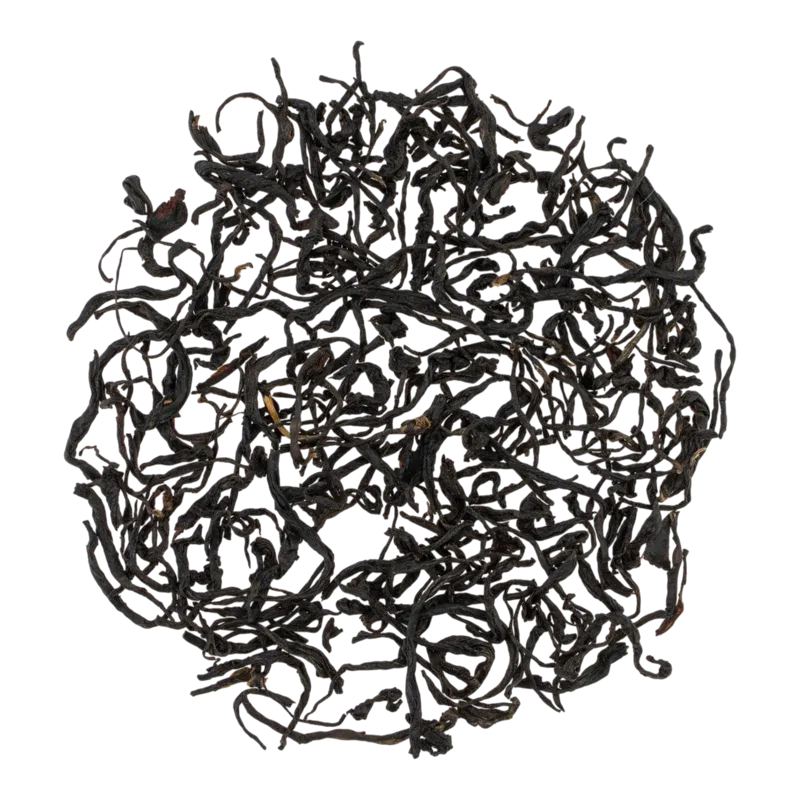
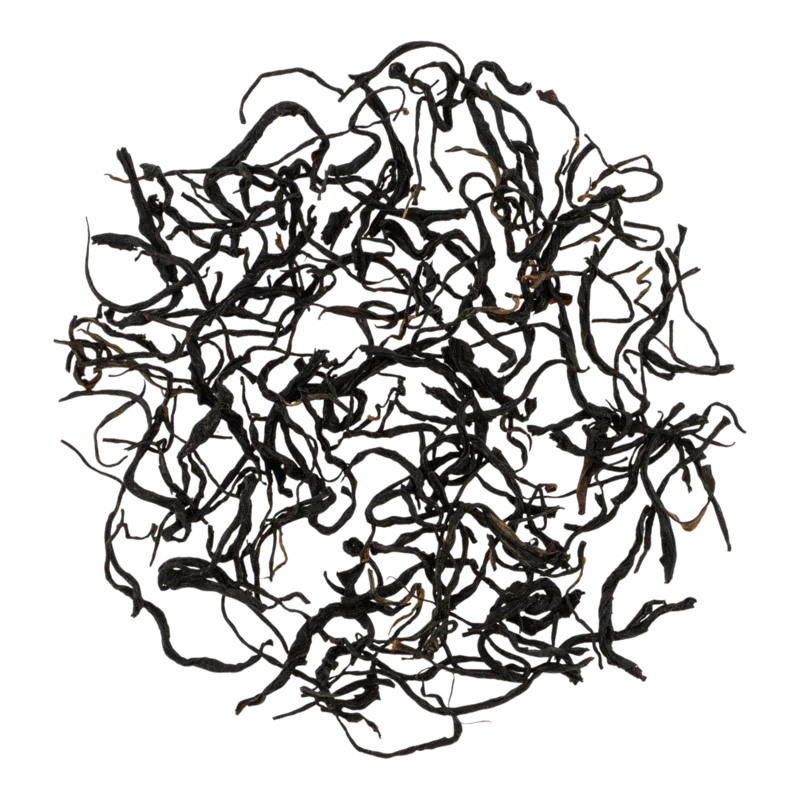
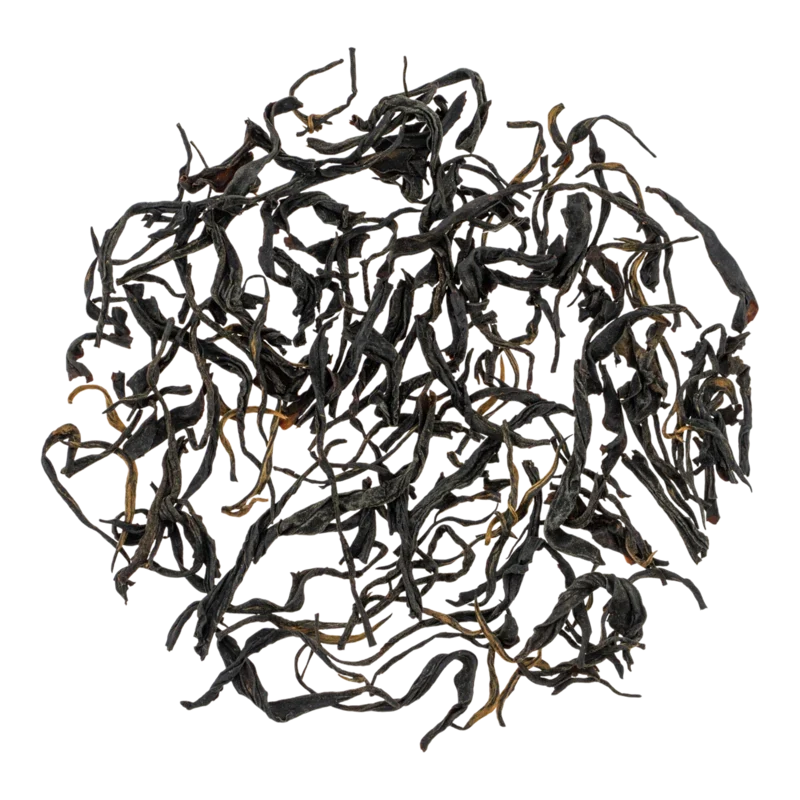
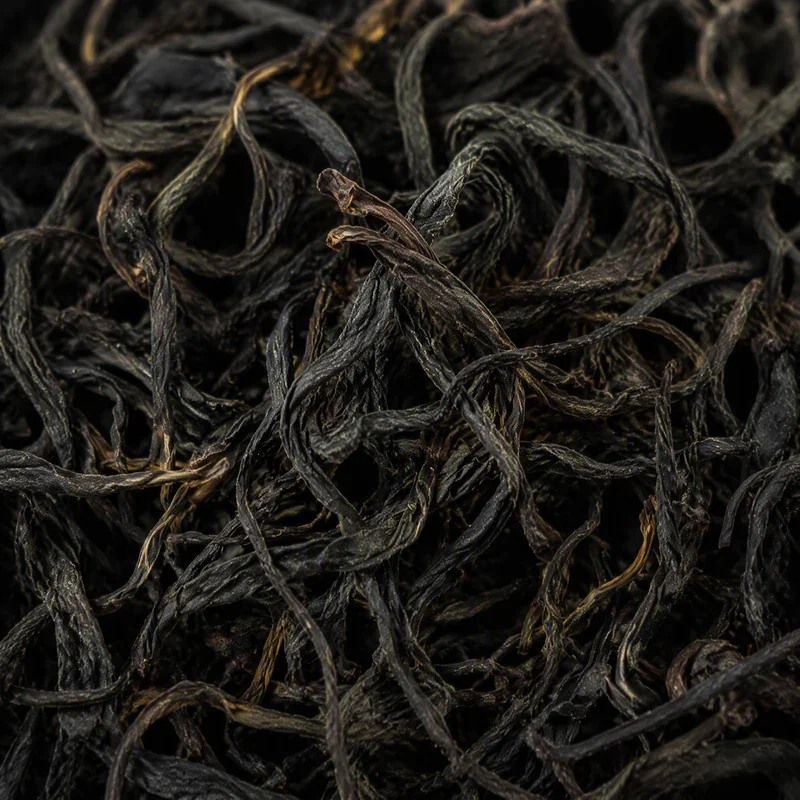
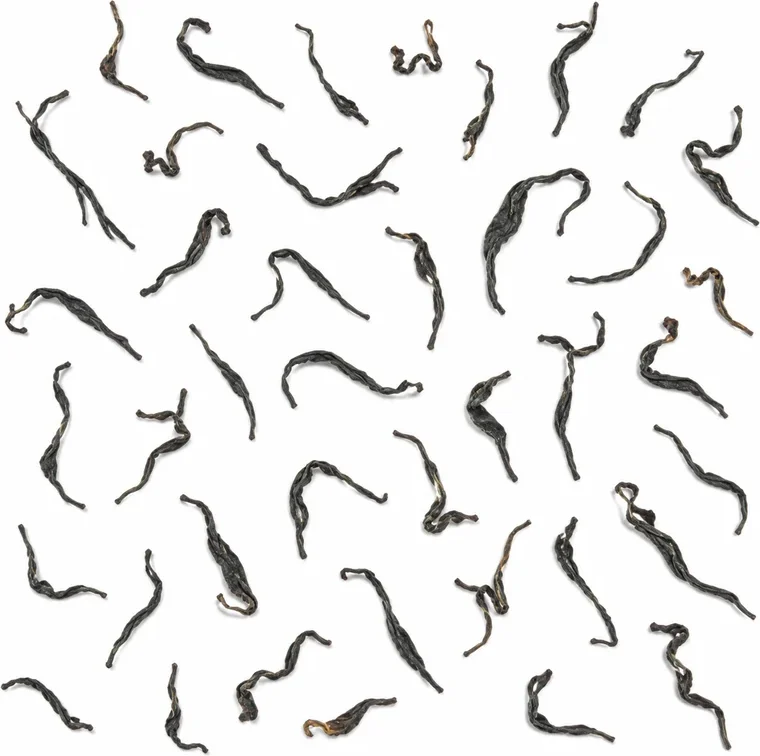
Dry Leaf Appearance: Fine to medium twist; tea particles are slender and sufficiently dense. Color — dark brown to black with "oily" luster (色泽乌润油亮). In highest grades, golden tips (金毫, jīnháo) are distinctly visible, contrasting with the dark base.
Dry Leaf Aroma: Warm, honey-caramel with notes of dried flowers and roasted chestnut. Aroma is delicate, not sharp, with gentle sweetness.
Liquor Aroma: Floral-honey with pronounced sweetness and light fruity note (apricot, dried plum). Due to high amino acid content in raw material, aroma possesses characteristic "freshness" atypical for standard gongfu red teas. In cooling cup, soft vanilla and caramel notes emerge.
Liquor Color: From red-amber to ruby with golden highlights (红亮透金黄, hónglìang tòu jīnhuáng). Clear and bright with characteristic golden ring around cup edge.
Spent Leaves: Even reddish-copper color, leaves elastic and soft. In highest grades — whole, unrolled "bud + leaf" pairs with preserved form.
Taste: Dense and round with emphasized natural sweetness and "juiciness" (鲜甜, xiāntián). Astringency is minimal — consequence of initially low polyphenol levels in white-leaf cultivar. Pronounced returning sweetness (回甘, huígān) that persists for a long time. Aftertaste — soft-honey with light mineral coolness. Liquor texture — silky, "oily."
Alkaloids: Caffeine — 2–3% (somewhat below average for red teas). Theobromine and theophylline — in trace amounts.
Amino Acids: Key feature. Free amino acid content in raw material reaches 6–9% (standard green teas — 2–3%). L-theanine (L-茶氨酸) — dominant amino acid responsible for "umami"-like sweetness, relaxing effect, and characteristic taste "freshness." Part of amino acids remains after full oxidation, making Jing'an Hong Cha taste exceptionally soft.
Increased content of cis-jasmone, linalool, and geraniol explains pronounced floral aroma character.
Minerals: Potassium, manganese, zinc, fluorine, selenium. Red and yellow soils of Jing'an provide balanced mineral profile.
Polyphenols: Total polyphenol content significantly below average for red teas — about 10–15% (original raw material contains only ~10.7% polyphenols). During oxidation, catechins transform into theaflavins (茶黄素) and thearubigins (茶红素), forming liquor color and velvety texture. Low polyphenol level — reason for minimal astringency.
Vitamins: B-group vitamins (B₁, B₂), trace amounts of vitamin C and vitamin P (rutin).
Moderate caffeine content combined with high L-theanine levels provides gentle, prolonged alertness without nervousness — classic "tea focus."
Theaflavins and residual catechins support body's antioxidant potential. Studies show theaflavins possess pronounced ability to neutralize free radicals.
Red tea is traditionally classified as "warm" (温性, wēnxìng) beverage promoting comfortable digestion, especially after heavy or fatty meals.
Theaflavins help maintain normal cholesterol levels and vascular elasticity. Potassium, abundantly extracted into liquor, helps regulate heart rhythm.
Manganese and fluorine in liquor support bone mineral density and tooth enamel health.
L-theanine and caffeine synergy improves concentration, memory, and reaction speed while reducing subjective stress levels.
High L-theanine content (inherited from white-leaf cultivar) promotes alpha brain wave production, creating calm focus sensation.
Tea Amount: 4–5 g per 100 ml (gongfu method) or 2–3 g per 200–250 ml (cup steeping).
Teaware: Porcelain gàiwǎn (盖碗) 100–120 ml — best choice for revealing delicate floral notes. Porcelain teapot suitable for softer infusion. Clay teaware not recommended for top grades — may absorb delicate aromas.
Water Temperature: 90–95°C for standard batches; 85–90°C for delicate single-bud grades.
Container: Airtight, opaque — tin with tight lid, triple-layer foil bag, or porcelain container.
Protection from direct light, moisture, and foreign odors. Optimal temperature — 10–25°C. Do not store near spices, coffee, or fragrances.
Best organoleptic qualities — within 12–18 months after production. Some dense batches with high tip content pleasantly "mature" for 2–3 years with careful storage, acquiring deeper honey tones. However, long-term aging potential for Jing'an Hong Cha is lower than large-leaf red teas (Dianhong, Lapsang).
Historical red tea from Xiūshuǐ County (修水县), also Jiangxi Province. Ninghong is one of "China's eight great gongfu red teas" with century-and-half history. Profile is more saturated and "muscular" with pronounced astringency and candied fruit notes. Jing'an Hong Cha is softer, sweeter, and more delicate — result of white-leaf raw material's unique biochemical composition.
Group of Fujian gongfu red teas (Zhenghe Gongfu, Tanyang Gongfu, Bailin Gongfu). All are produced from large-leaf cultivars with higher polyphenol content, giving liquor greater "strength" and astringency. Jing'an Hong Cha differs with silky texture and natural sweetness requiring no adaptation.
Conceptually similar product — red tea from famous Anji white-leaf cultivar (Zhejiang Province). Both teas use albino raw material with high amino acid content; both are distinguished by tenderness and softness. Differences lie in terroir (Zhejiang vs. Jiangxi) and processing nuances.
"Qihong" — world-famous Anhui red tea with characteristic "Qimen aroma" (violet, orchid, honey). Qimen possesses more pronounced and "classic" aromatic profile with extended firing. Jing'an Hong Cha is simpler in aroma structure but surpasses Qimen in taste softness and freshness.
Premium Fujian red tea from single-bud raw material. Both teas are sweet and aromatic, but Jin Jun Mei is significantly more expensive, with profile closer to roasted sweet potato and longan. Jing'an Hong Cha is more "fresh" and "spring-like."
No reviews yet. Tell us what you think of this tea.
Rate this tea and share your impressions. We review each submission before publishing it.