Brewing
Gongfu brewing
- Water temperature
- 93 °C
- Tea amount
- 5 g
- Water volume
- 100 ml
- First steep
- 10 s
- Time added per infusion
- 5 s
- Infusions
- 4

Jīndǐng hóngchá
Choose a brewing method. Start with the recommended quantities and time, then adjust to taste.
Brewing
Brewing
Taste
Tea encyclopedia
Category: Hainan red tea (black tea). Jindding is one of the leading brands under the umbrella brand "Wuzhishan hongcha" (五指山红茶), which received geographical indication status in 2015. Produced both as orthodox leaf tea (功夫红茶, gōngfū hóngchá) and in CTC granule format for export.
Category: Hainan red tea (black tea). Jindding is one of the leading brands under the umbrella brand "Wuzhishan hongcha" (五指山红茶), which received geographical indication status in 2015. Produced both as orthodox leaf tea (功夫红茶, gōngfū hóngchá) and in CTC granule format for export.
Coordinates: approximately 18°47′ N, 109°30′ E (Jinjiang Farm area, southern slope of Wuzhishan).
Origin: China, Hǎinán Province (海南省, Hǎinán Shěng), Wǔzhǐshān City (五指山市, Wǔzhǐshān Shì), southern slope of Mount Wuzhishan, territory of Jīnjiǎng Farm (金江农场). Wuzhishan is the highest peak on Hainan Island (1867 m) and the center of one of China's largest tropical rainforest massifs, included in the Hǎinán Tropical Rainforest National Park (海南热带雨林国家公园).
Type: Chinese red tea (black tea) (红茶, hóngchá), fully oxidized.
Cultural Significance: Wǔzhǐshān is a sacred mountain of the Lì people (黎族) inhabiting central Hainan and a symbol of the entire island. Local Lì and Miáo (苗族) have traditionally collected wild tea in mountain forests for medicinal purposes: leaf infusions prevented colds, reduced fever, and fought intestinal disorders. Red tea (black tea) from this region is unique in China, combining tropical low latitude, high altitude, and coastal monsoon climate, giving it a unique organoleptic profile. In 2017, an annual festival "China's First Early Spring Tea" (中国·五指山第一早春茶) was established, promoting Wuzhishan hongcha as an elite tourism product. The fact that Academician Chen Zongmao's station operates at the Hainan Tea Science Academy lends scientific weight to the brand.
History: Hainan's tea culture has ancient roots: as early as the Song period (960–1279), poet Sù Dōngpō (苏东坡) described local plants in his notes about exile on the island. During the Ming era (1368–1644), wild tea from the Wuzhishan area — "Shuiman cha" (水满茶, Shuǐmǎn chá, "tea of full waters") — was already supplied to the court as "southern overseas tribute." The name "Shuiman" originates from the Li people's language (黎族) and means "ancient" or "highest." During the Qing era, Shuiman cha maintained its status as "southern tribute" (南荒贡品). Industrial red tea (black tea) production on Hainan began in the late 1950s: in 1959, export bases were established using local large-leaf populations and Assam forms imported from Yunnan. By the 1960s, the state-owned Tongshi Tea Farm (国营通什茶场) — the future Jinjiang factory — was created on the southern slope of Wuzhishan, becoming the island's first professional tea enterprise. By 1965, the area of new tea plantations on Hainan reached 10,000 mu (about 667 hectares), with annual output of 350 tons of dry tea. During the peak period (early 1990s), the island had over 50 tea farms (37 of them state-owned), 12,000 mu of plantations, and annual volume of 8,000 tons. Hainan red tea (black tea) was actively exported to Europe and America under the "Yuanhang" brand (远航, "Long Voyage"), whose name was personally approved by Premier Zhou Enlai. The "Jindding" brand (金鼎) appeared as the Jinjiang farm's brand. The modern period has been marked by several ac
Name Breakdown: Jindding (金鼎) literally means "golden tripod," a symbol of greatness and stability in Chinese culture; Hóngchá (红茶) — red tea (black tea). The name is a trademark of Jinjiang Farm.
Cultivar: Primary raw material — Hainan large-leaf population (海南大叶种, Hǎinán dàyè zhǒng), Camellia sinensis var. assamica and related forms, including wild endemic trees of the Wuzhishan region (some requiring three people to encircle the trunk, reaching heights up to 25 m). Also used are forms imported from Yunnan in the 1950s–1960s. Hainan's large-leaf cultivars are characterized by thick, fleshy shoots with high tenderness retention (持嫩性), ideal for red tea (black tea) production: elevated content of epigallocatechin gallate (EGCG) and other esterified catechins ensures active enzymatic conversion to theaflavins and thearubigins.
Picking: Year-round; thanks to tropical climate, tea bushes vegetate almost continuously. Spring harvest (from February) — the earliest in China; the concept of "first early spring tea" is based precisely on this. Summer and autumn harvests are also conducted, though spring batches are valued higher.
Pluck Standard: For leaf tea (功夫红茶): 1 bud + 1 leaf or 1 bud + 2 leaves in initial unfolding stage. For CTC granules: 1 bud + 2–3 leaves. For elite batches, exclusively single buds or bud with one leaf are used.
Raw Material: Shoots must be fresh, plump, and undamaged; large-leaf raw material requires rapid delivery to the factory due to high oxidase enzyme activity in tropical heat conditions.
Altitude: 600–800 m above sea level, in the mountain cloud belt on the southern slope of Wuzhishan.
Climate: Tropical monsoon combined with tropical rainforest microclimate. Average annual temperature 22–24 °C; mild winters without frost and without typhoon impact (the mountain massif dampens their energy). Cloud cover — over 200 days per year, creating diffused light favorable for chlorophyll b accumulation and aromatic precursors.
Soil: Lateritic brick-red soils (砖红壤, zhuānhóng rǎng), light, gravelly, enriched with aluminum and iron. Deep fertile humus horizon forms due to intensive biological cycling in tropical forest — abundant leaf litter provides constant organic input. Acidic reaction (pH 4.5–5.5).
Over 2500 mm annually, with pronounced wet season; high relative humidity year-round.
The territory is part of or directly adjacent to Hainan Tropical Rainforest National Park — China's first tropical rainforest national park — the region's forest cover exceeds 80%. Biodiversity is exceptional: more than 3,800 plant and animal species, including the Hǎinán gibbon (海南长臂猿) — one of the world's rarest primates. Tea plantations are located in the mountain fog belt (云雾带), neighboring relict tropical trees, providing natural "green cushioning," air filtration, and eliminating the need for chemical pesticides. High cloud cover creates ideal diffused light conditions: ultraviolet and blue-violet spectrum penetrate freely, stimulating aromatic precursor and chlorophyll b synthesis, while excessive red and infrared light is absorbed by cloud cover.
Manual — for leaf tea; mechanized — for mass CTC.
Leaf spreading on bamboo trays or in flow-through withering apparatus. Duration 12–24 hours (depending on air humidity); leaf moisture reduces to 60–62%.
For leaf tea — mechanical rolling in 2–3 sessions of 30 minutes with intermediate clump separation. For CTC — passage through rotorvanes (Crush-Tear-Curl), producing small uniform granules.
In specialized rooms with controlled temperature and humidity; duration depends on raw material type and target profile. Large-leaf tropical raw material oxidizes faster than medium-leaf from temperate zones.
Two-stage: primary heating (毛火) to stop oxidation, then cooling (摊凉, tānliáng) and secondary drying (二烘), repeated cooling and final fixation (足火). For elite batches, emphasis on low-temperature slow drying (低温慢烘), preserving delicate aromatic compounds.
Separation by fractions (leaf tea, broken, fannings, dust) — four standard "grades" (花色): leaf (叶茶), broken (碎茶), fannings (片茶), dust (末茶).
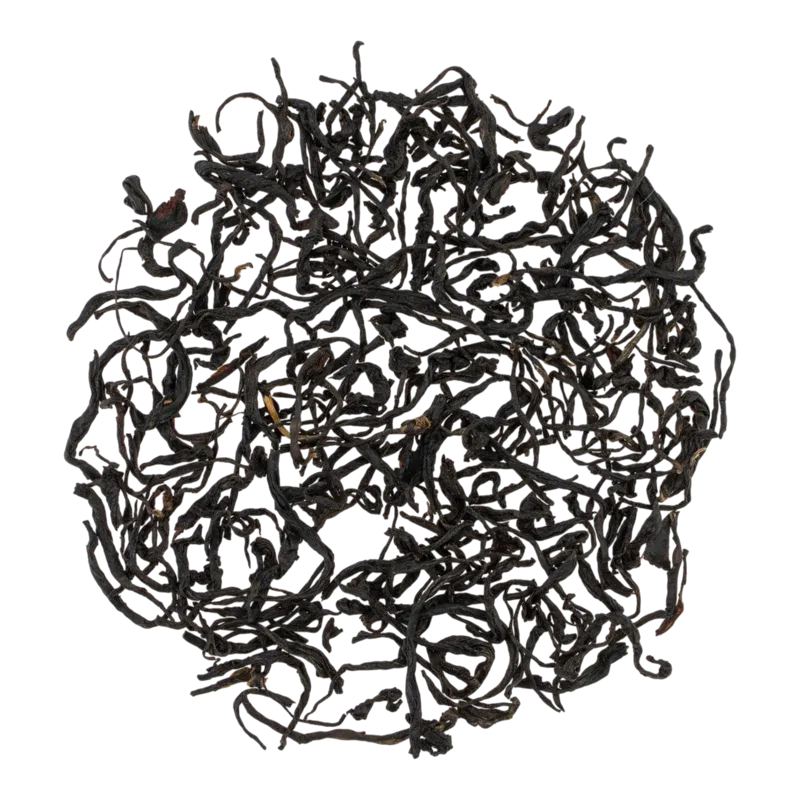
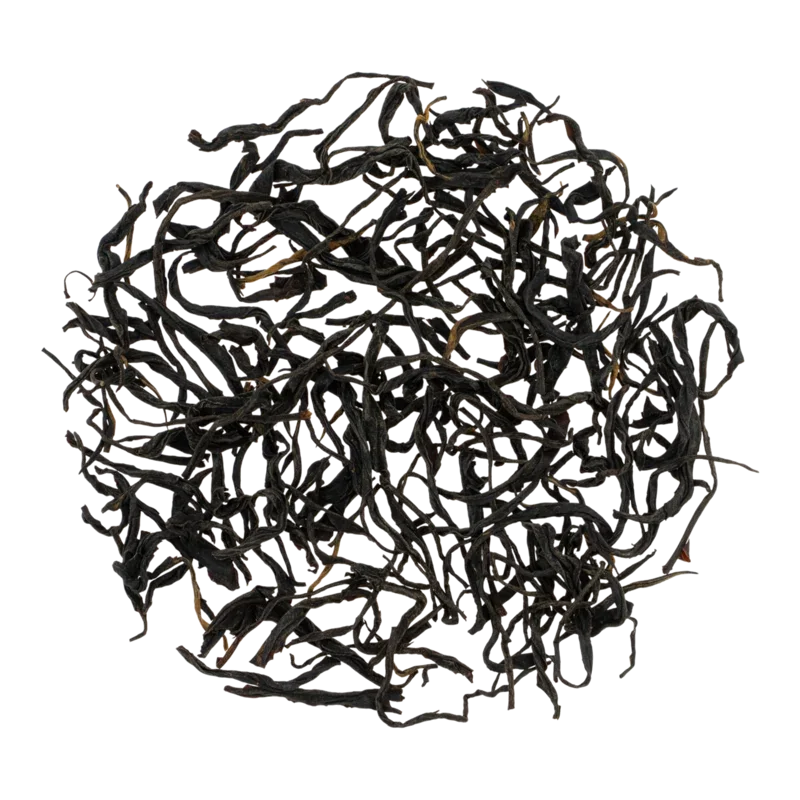
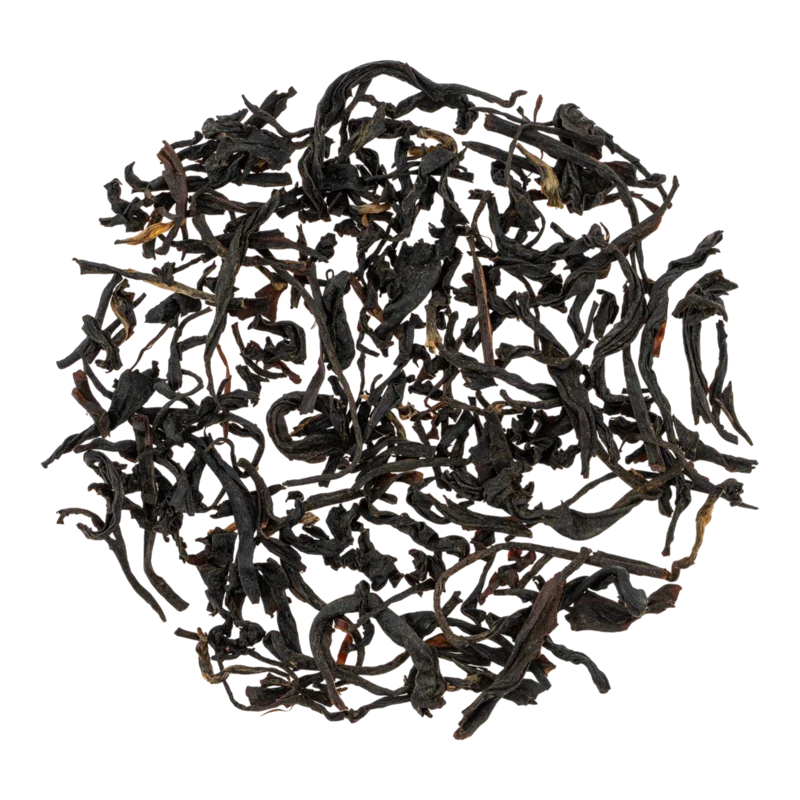
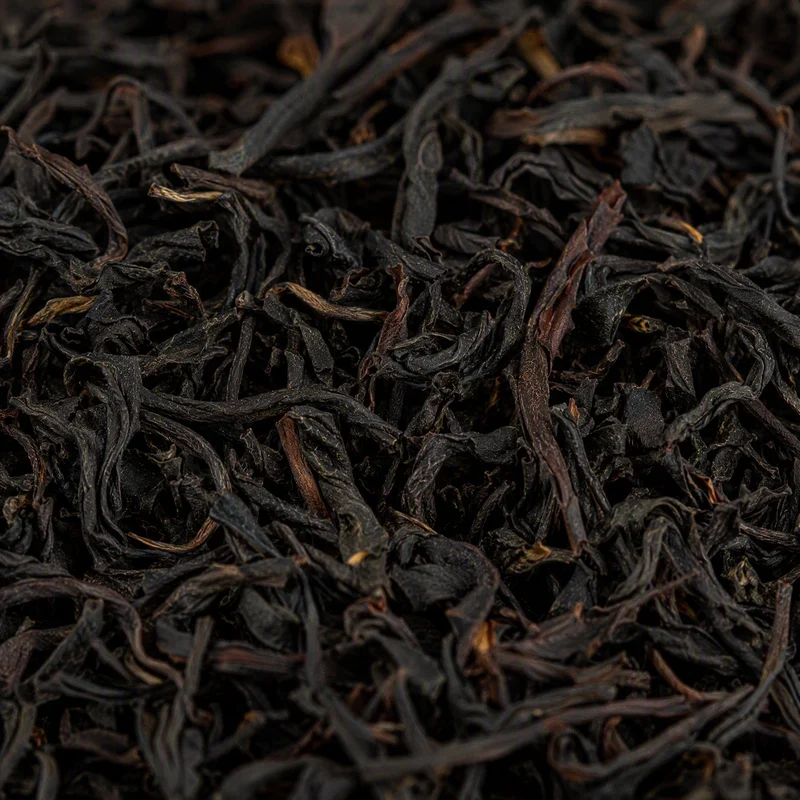
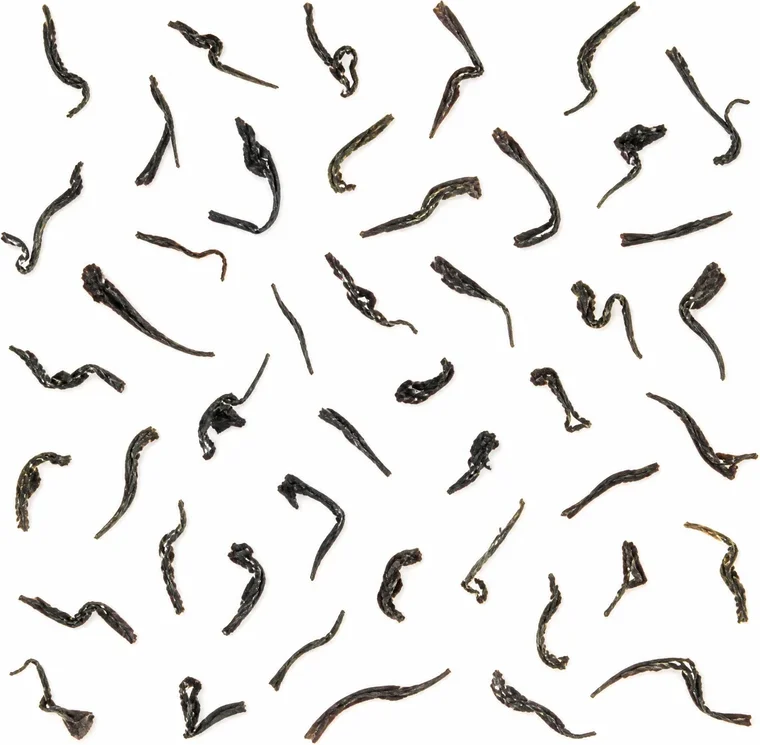
Dry Leaf Appearance: Dense, compact twist; leaf plump and resilient (肥硕), dark brown with oily luster (棕褐油润); higher grades show noticeable golden tips.
Dry Leaf Aroma: Soft, enveloping, with pronounced milky-honey notes (奶蜜香) — the characteristic "signature" of Wuzhishan red tea (black tea). In the background — light cocoa and dried fruit tones.
Liquor Aroma: Multi-layered: leading notes — creamy honey and melted cream; middle register — ripe tropical fruits (lychee, papaya); in the base — warm woody sweetness. Aroma is persistent, unfolding gradually from infusion to infusion.
Liquor Color: Red-amber (红琥珀色), clear, transparent and bright; with high grades — with pronounced golden rim.
Spent Leaves: Plump, soft, bright red (肥软红亮); leaves unfold completely, demonstrating the fleshy structure of large-leaf raw material.
Taste: Sweet, soft and enveloping (甜醇爽滑); full body without pronounced astringency; in the aftertaste — long honey returning sweetness (回甘). Sensation of roundness and "sliding" texture on the tongue — consequence of high thearubigin content.
Alkaloids: Caffeine — ≥ 2%; theobromine and theophylline — in trace amounts.
Amino Acids: Free amino acids — > 1.5%; L-theanine makes the main contribution to taste softness and sweetness.
≥ 34%, indicating high saturation and extractability of the liquor.
The ratio of polyphenols to amino acids (酚/氨比) in large-leaf tropical forms is higher than in small-leaf northern ones — this makes Hainan raw material optimal precisely for red tea (black tea), where intensive oxidation "unlocks" the polyphenol potential.
Minerals: Wuzhishan teas are distinguished by elevated cobalt (Co) and molybdenum (Mo) content, as well as general richness in trace elements due to lateritic soils of tropical forest.
Polyphenols: Content in finished tea — ≥ 10% (by GI standard). Large-leaf tropical form is initially rich in catechins (especially EGCG and ECG); during oxidation they efficiently convert to theaflavins (≥ 0.1% in finished tea) and thearubigins (≥ 2.5%), providing color depth and velvety texture.
Vitamins: B₁, B₂, C (partially preserved), E, P (rutin).
Caffeine combined with L-theanine provides gentle, sustained tonic effect without nervousness; well-suited for morning ritual.
Theaflavins and thearubigins — powerful free radical scavengers supporting cellular protection.
Red tea (black tea) with full oxidation is gentle on gastric mucosa; warm liquor after meals is traditionally recommended for improving digestion.
Red tea (black tea) flavonoids help maintain vascular elasticity; studies indicate association of regular red tea (black tea) consumption with reduced cardiovascular event risk.
Mineral profile (manganese, fluorine, calcium) supports bone tissue with moderate consumption.
Red tea (black tea) is a "warming" beverage in traditional Chinese dietology; especially appropriate in autumn and winter.
Local ethnomedicinal tradition of Li and Miao attributes fever-reducing and general strengthening properties to tea from the Wuzhishan area.
Jindding works excellently in "Western" format — with milk or condensed milk added according to Hainan "laoba cha" tradition (老爸茶), as well as tea with lemon.
Tea Amount: 4–5 g per 100–120 ml (gongfu); 2–3 g per 200–250 ml (steeping).
Teaware: Porcelain gàiwǎn (盖碗) 100–120 ml or porcelain teapot — ideal choice, allowing the milky-honey aroma to unfold; glass vessel for visual pleasure from amber liquor.
Water Temperature: 90–95 °C for standard leaf batches; 85–90 °C for delicate single-bud grades.
Yunnan. Also large-leaf raw material (var. assamica), but continental and high-mountain terroir (1200–2000 m). Dianhong is denser and more powerful, with honey-malt profile; Jindding is softer, with pronounced milky sweetness and tropical fruitiness.
Guangdong, also large-leaf raw material. Profile closest to Jindding by raw material type and climate, but Yinghong is more "robust" and "astringent," with less milky softness.
Sichuan, medium-leaf raw material. Characterized by orange-caramel aroma (橘糖香), absent in Jindding; body lighter, structure more elegant.
Fujian, small-leaf raw material, pine smoke. Fundamentally different aromatic profile (smoke, pine, longan); Jindding by contrast is "clean," without smoky tones, emphasizing tropical sweetness.
No reviews yet. Tell us what you think of this tea.
Rate this tea and share your impressions. We review each submission before publishing it.