Brewing
Gongfu brewing
- Water temperature
- 93 °C
- Tea amount
- 5 g
- Water volume
- 100 ml
- First steep
- 10 s
- Time added per infusion
- 5 s
- Infusions
- 4

jīn máo hóu hóngchá
Choose a brewing method. Start with the recommended quantities and time, then adjust to taste.
Brewing
Brewing
Taste
Tea encyclopedia
Category: Modern artisanal red tea (black tea). Positioned as a continuation of the "Xianghong" (湘红) tradition — historical Hunan red tea (black tea), one of the "three great red teas of China" alongside Qíhóng (祁红) and Jianhong (建红). Released under the trademark "Zhenxi" (臻溪, Zhēnxī).
Category: Modern artisanal red tea (black tea). Positioned as a continuation of the "Xianghong" (湘红) tradition — historical Hunan red tea (black tea), one of the "three great red teas of China" alongside Qíhóng (祁红) and Jianhong (建红). Released under the trademark "Zhenxi" (臻溪, Zhēnxī).
Coordinates: Tianzishan — approximately 29°22′ North latitude, 110°28′ East longitude. Highest point — Tiānzǐfēng Peak (天子峰, Tiānzǐfēng), 1262.5 meters above sea level.
Origin: China, Húnán Province (湖南省, Húnán Shěng), Zhāngjiājiè City (张家界市, Zhāngjiājiè Shì), Wǔlíngyuán District (武陵源区, Wǔlíngyuán Qū), Tiānzǐshān Town (天子山镇, Tiānzǐshān Zhèn). The core of production — "Yucha Yuan" (御茶园, Yùchá Yuán, "Imperial Tea Garden") on Mount Tianzishan, located in Zhāngjiājiè National Forest Park (张家界国家森林公园). Additional raw material comes from tea zones of Wulingshan (武陵山区), Xuefengshan (雪峰山区) and Luóxiāo Range (罗霄山脉).
Type: Chinese red tea (black tea) (红茶, hóngchá), fully oxidized. Distinguished from classic gōngfū hóng chá by the integration of elements from oolong production (摇青, yáoqīng — "shaking the leaves") and hei cha (dark tea), which gives it a unique aromatic and functional profile.
Cultural Significance: Jin Mao Hou became a symbol of the revival of Hunan red tea (black tea) and the modern "face" of the "Xianghong" brand. Its development is inscribed in Hunan Province's strategy to create a "trillion yuan tea industry" (千亿茶产业). Since 2018, the provincial government declared "Hunan Hong Cha" (湖南红茶) a priority public brand, and Jin Mao Hou took the place of its technological flagship.
History: Red tea (black tea) appeared in Hunan in 1854, when Guangdong merchants brought red tea (black tea) production technology to Ānhuà County (安化县, Ānhuà Xiàn). Within decades, Hunan red tea (black tea) — "Xianghong" — became one of the leading export products; at its peak, its export volume reached 70% of all Chinese red tea (black tea) exports. In 1915, Anhua red tea (black tea) won a gold medal at the Panama-Pacific International Exposition (巴拿马万国博览会, Bānámǎ Wànguó Bólǎnhuì), establishing the reputation of "Xianghong" at the international level. However, in the second half of the 20th century, external competition from Sri Lanka, Kenya and India, as well as the abolition of state export subsidies, led to the decline of Hunan red tea (black tea).
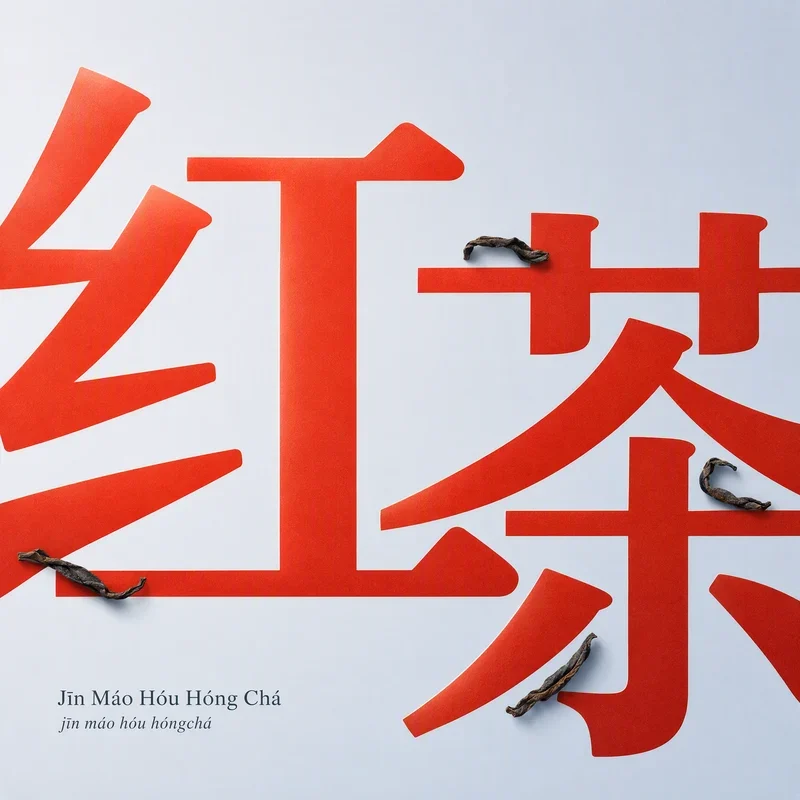
Name Breakdown: "Jin" (金, jīn) — gold, "Mao" (毛, máo) — down, fuzz, "Hou" (猴, hóu) — monkey. The name refers to the dense golden down on the finished tea, reminiscent of the fur of the golden snub-nosed monkey (金丝猴, jīnsī hóu) — an endemic primate of Central China. "Hong Cha" (红茶) — red tea (black tea).
Cultivar: For original Jin Mao Hou, predominantly Zhènghé Dàbái Chá (政和大白茶, Zhènghé Dàbái Chá) — national standard cultivar GSI3005-1985, Fuan Dàbái Chá (福安大白茶, Fú'ān Dàbái Chá) — GSI3003-1985, as well as local population varieties (群体种, qúntǐzhǒng) Camellia sinensis var. sinensis, growing in the highlands of Tianzishan and surrounding mountain ranges of Wulingshan are used. Leaf blades are large, with high content of tea polyphenols and abundant pubescence.
Picking: Predominantly spring (late March — April) for premium batches. Early summer harvest is permitted for mass production.
Pluck Standard: Single buds (单芽, dānyá) or one bud with one half-opened leaf (一芽一叶初展, yī yá yī yè chūzhǎn). For highest grades, exclusively single-bud batches are used.
Raw Material: Uniform, clean leaf without mechanical damage and coarse petioles; freshness of raw material is critical — the interval from harvest to the beginning of withering is minimal.
Altitude: 1000–1265 meters above sea level. The core "Yucha Yuan" is located at approximately 1265 m elevation.
Climate: Subtropical mountain monsoon. Average annual temperature at Tianzishan peak — about 12°C (in the tea plantation zone, below the peak — up to 14–15°C). Annual precipitation — about 1800 mm. Frost-free period — about 240 days. Prolonged cloudiness and fogs provide natural diffusion of sunlight, which promotes accumulation of amino acids and aromatic compounds in the leaf.
Soil: Acidic red-yellow (yellow earths), pH 4.5–5.5, formed on quartzite sandstone substrate. Soils are well-drained, rich in organic matter thanks to a thick forest litter layer. High content of iron and silicon affects the mineral profile of the tea.
Tea gardens are located in the zone of pristine subtropical forest of the National Park; the core area is 500 mu (≈33 ha) on the territory of Xiangjiatai Village (向家台村). Certified as organic (有机茶园), without the use of pesticides and synthetic fertilizers.
Leaves are spread in a thin layer and subjected to controlled natural or artificial illumination of a specific spectrum, which accelerates moisture loss and stimulates initial biochemical transformations. The goal is to reduce leaf moisture to a state of soft elasticity, without allowing over-drying.
Borrowed from oolong tea technology. Withered leaf is placed in bamboo baskets or mechanical drums and periodically shaken. This causes partial cell damage along the edge of the leaf blade, provoking local oxidation and release of floral aromatic components. This stage forms the characteristic floral-fruity note, uncharacteristic of ordinary red teas (black teas).
Duration 60–70 minutes according to the scheme "no pressure → light pressure → increasing pressure → strong pressure → weakening." Target degree of cell destruction — more than 80%. After rolling — manual breaking of lumps and sifting for cooling the mass.
Key innovation. Oxidation is conducted in a specially equipped room with temperature control (about 30°C), humidity (above 95%) and oxygen concentration. Enhanced aeration allows bringing theaflavin content (茶黄素, cháhuángsù) to maximum value, which determines the brightness of the liquor, "golden ring" on the edge of the cup and velvety taste. Duration — 3–6 hours; control is conducted by color, aroma and laboratory indicators.
Drying at reduced temperature prevents volatilization of fine aromatic fractions fixed at previous stages. As a result, a persistent, multi-layered aroma "huamixiang" (花蜜香, huāmìxiāng — "floral-honey") is formed.
Final standardization of the batch by fraction size, tip content and uniformity.
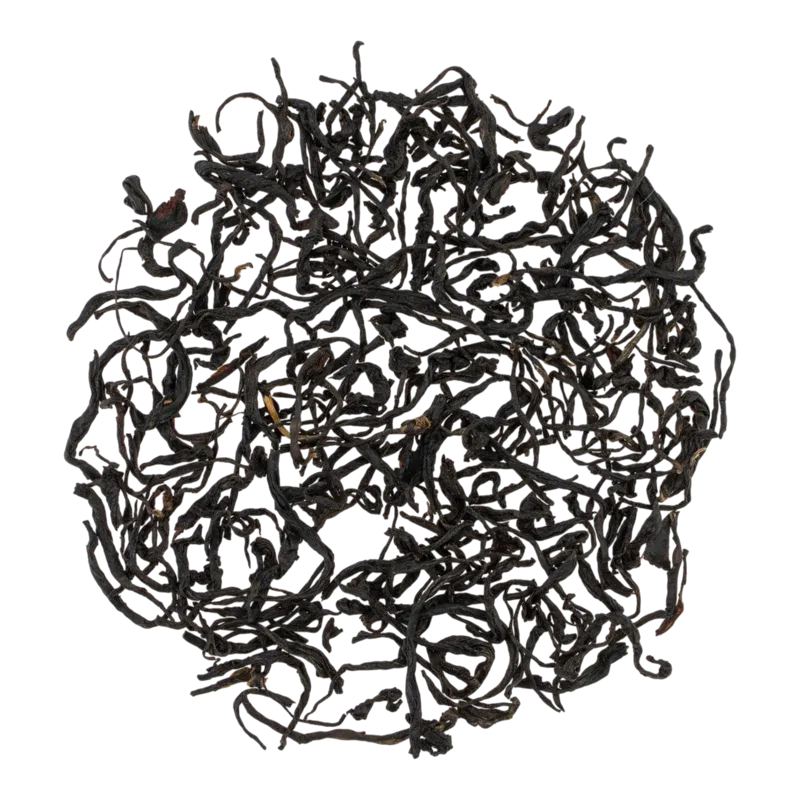
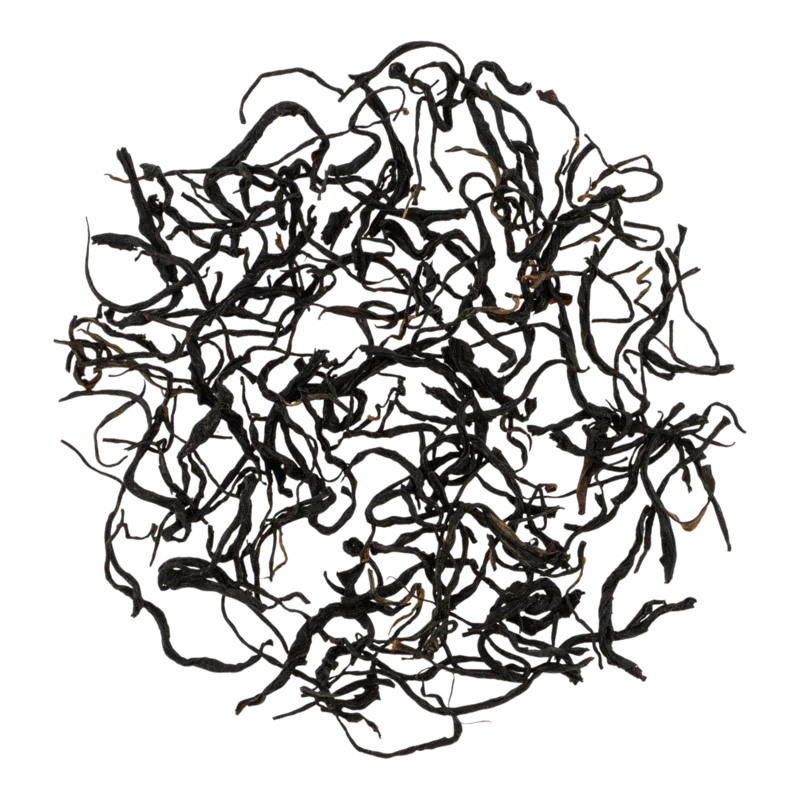
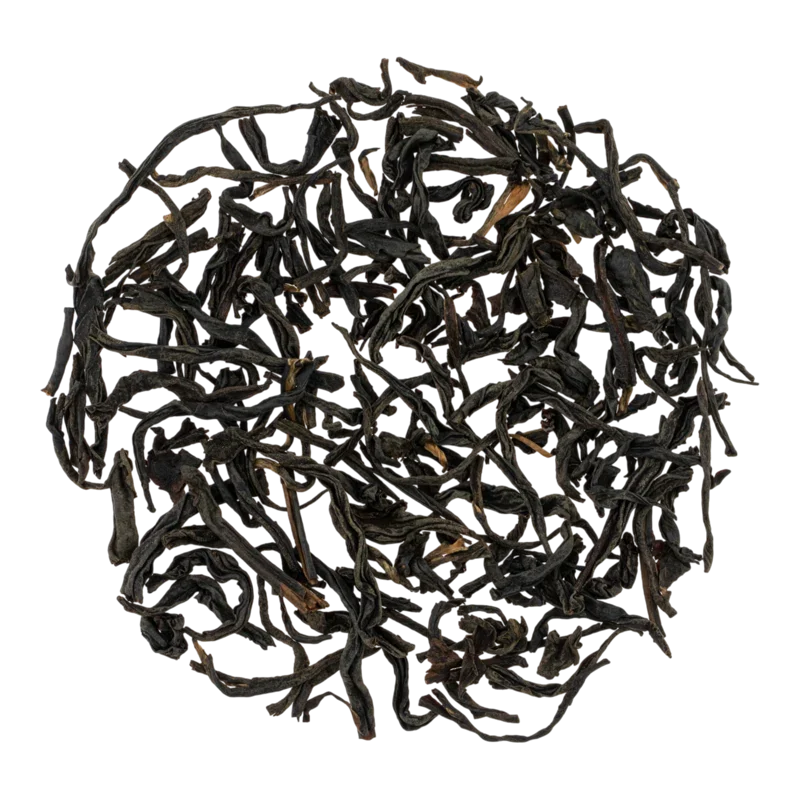
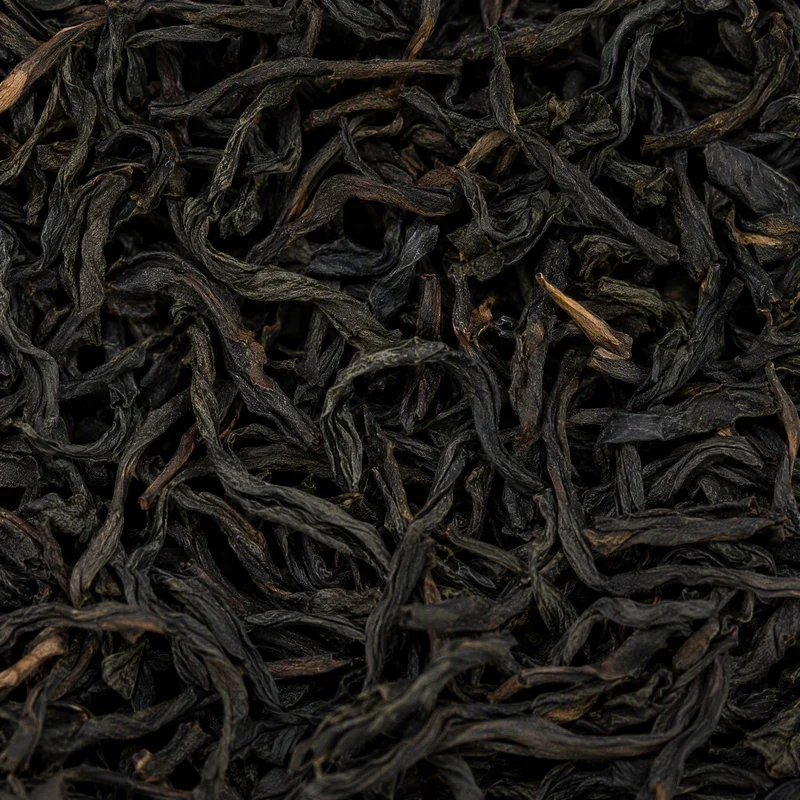
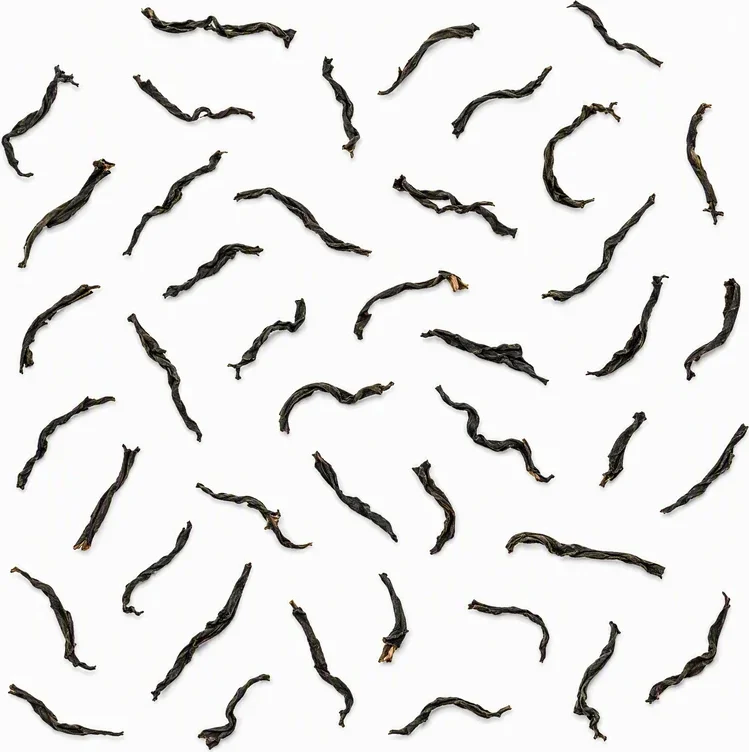
Dry Leaf Appearance: Thin, tightly twisted rod-like tea particles with a slight curve (略带弯勾), abundantly covered with golden-yellow down. Under good lighting, the surface shimmers with gold. Visually resembles the fur of a golden snub-nosed monkey — hence the name. Base color — dark brown with oily luster.
Dry Leaf Aroma: Pronounced floral-honey with overtones of ripe peach, apricot and wildflowers. First note — bright fruity sweetness; when warming the vessel, a deep honey tone with light caramel notes unfolds.
Liquor Aroma: Multi-layered "huamixiang": in the foreground — floral notes (wild rose, osmanthus), in the middle — ripe honey and candied fruits, in the finale — a delicate woody-spicy trail. The aroma is persistent, preserved in the empty cup (杯底香, bēidǐxiāng) for a long time.
Liquor Color: Bright red, clear, with a pronounced golden ring around the edge of the cup (金圈, jīnquān) — an indicator of high theaflavin content. At proper brewing temperature, the liquor sparkles in the light.
Spent Leaves: Uniform red-copper color, leaves are soft and elastic. In highest grades — whole untwisted buds with preserved down. Coloration is uniform, without dark spots or green inclusions.
Taste: Rich and at the same time surprisingly soft. First sip — fresh and sweet (甘鲜, gānxiān), with pronounced "juiciness" (鲜爽度). Body is dense, silky texture, without bitterness and coarse astringency. Aftertaste is long, with persistent sweet return (回甘, huígān) and mineral coolness. Distinctive feature — combination of floral lightness of oolong and honey density of classic red tea (black tea).
Alkaloids: Caffeine (咖啡碱) — 2.5–4%, provides tonic effect. Theobromine and theophylline are present in trace amounts, complementing the mild stimulating action.
Amino Acids: L-theanine (L-茶氨酸) — main component supporting taste softness and "umami"-like freshness. High-altitude origin of raw material promotes increased accumulation of free amino acids (up to 3–5% in dry matter for spring bud batches).
The producer indicates increased content of biologically active compounds of the MAF group (abbreviation not deciphered in open sources), associated with integration of hei cha technologies.
More than 400 identified aroma components form the unique "huamixiang" profile. Key groups — linalool and its oxides (floral notes), geraniol (rose notes), phenylacetaldehyde (honey notes), nerol (light freshness).
Minerals: Potassium (up to 70% passes into the infusion when brewed), manganese (element important for bone tissue), zinc, fluorine, selenium. Quartzite soils of Tianzishan enrich the leaf with silicon.
Polyphenols: Total content of tea polyphenols — 20–28% (depending on grade and season). Thanks to enriched oxidation technology, a significant part of catechins is converted to theaflavins (茶黄素, cháhuángsù) — their content is purposefully brought to maximum, which distinguishes Jin Mao Hou from most red teas (black teas). Theaflavins are responsible for the golden tint of the liquor, velvety texture and antioxidant activity. Thearubigins (茶红素, cháhóngsù) provide depth of red color.
Vitamins: Water-soluble B-group vitamins (B₁, B₂, B₆), vitamin C (in trace amounts, most is destroyed during oxidation), vitamin P (rutin).
High theaflavin content provides powerful antioxidant action — according to a number of studies, theaflavins are comparable to green tea catechins in their ability to neutralize free radicals.
Theaflavins and potassium contribute to cholesterol profile normalization and maintaining vascular elasticity. Regular consumption of red tea (black tea) is associated with reduced risk of cardiovascular diseases.
The combination of caffeine and L-theanine provides sustained, calm alertness without sharp peaks and drops — the so-called "tea focus."
Red tea (black tea) is traditionally considered a "warm" beverage; its fermented nature promotes comfortable digestion, especially after fatty food. Properties inherited from hei cha technology enhance this effect.
High content of manganese and fluorine contributes to maintaining bone tissue density and dental enamel health.
Polyphenolic compounds of red tea (black tea) support immune system function and possess moderate anti-inflammatory properties.
Antioxidants slow photoaging processes; water-soluble B-group vitamins support healthy skin tone.
The warm, enveloping floral-honey aroma provides a relaxing sensory effect, reduces subjective stress levels.
Tea Amount: 3–5 g per 100 ml (gongfu method, mild infusion) or 5–8 g per 100 ml (rich infusion); for European method — 2–3 g per 200–250 ml.
Teaware: White porcelain gàiwǎn (盖碗) 100–120 ml — optimal choice, emphasizing aroma. Porcelain teapot is suitable for a softer infusion. Yixing clay is acceptable for dense batches, but may muffle upper floral notes.
Water Temperature: 90–95°C for standard batches; 85–90°C for delicate single-bud grades. When using boiling water, quick pouring is recommended to avoid the appearance of a sour tint.
Container: Airtight, opaque — ceramic, porcelain jar with tight lid, three-layer kraft bag with aluminum layer.
Protection from direct light, moisture and foreign odors. Temperature 10–25°C, relative humidity not above 70%.
Fresh tea is good in the first 12–24 months. For aging purposes — from 3 years and beyond, provided proper container and stable microclimate. The denser the grade and the more tips, the better the aging potential.
Fujian premium red tea (black tea) from Tóngmùguān (桐木关). Both teas use single-bud raw material and possess floral-honey profiles, however Jin Jun Mei is produced by classic small-batch Zhengshan Xiaozhong technology, without integration of oolong and hei cha elements. Its aroma is closer to sweet potato and longan, while Jin Mao Hou is distinguished by more pronounced florality thanks to the yaoqing stage. Jin Jun Mei is not intended for long-term storage.
Yunnan red tea (black tea) from large-leaf Assamica-like varieties. Dianhong is more "muscular," with dense body and pronounced notes of cocoa, dried fruits and black pepper. Jin Mao Hou is lighter, more delicate, with emphasis on freshness and florality.
Famous Anhui "Qihong" with characteristic "Qimen aroma" (祁门香) — orchid, violet, honey. Both teas belong to the category of aromatic red teas (black teas), but Qimen is produced from medium-leaf Zhu Ye cultivar by classic gongfu technology with prolonged final baking. Qimen's profile is more restrained and "chamber-like," while Jin Mao Hou is brighter and fresher.
Same name but fundamentally different tea. This is a traditional Fujian red tea (black tea), a refined variety of Zhènghé Gōngfū (政和工夫) — one of the three great Fújiàn Gōngfū (闽红三大工夫). Produced in Zhènghé County (政和县) from Zhenghe Dabaicha and Fuan Dabaicha cultivars by classic Gongfu Hongcha technology (without yaoqing and enriched oxidation). Known in the West as Golden Monkey — one of the most popular Chinese red teas (black teas) in the export market. Taste profile: soft, enveloping, with notes of honey, caramel and chocolate — without the pronounced florality of the Hunan variant. Not intended for long-term storage (optimal in the first year). In 2009, it took 2nd place at the World Tea Championship. Key difference: Fujian — classic, Hunan — innovation.
Historical prototype from which Jin Mao Hou grew. Traditional Xianghong is mass export red tea (black tea) with dense but less refined taste. Jin Mao Hou can be viewed as a premium evolution of Xianghong using modern technologies.
No reviews yet. Tell us what you think of this tea.
Rate this tea and share your impressions. We review each submission before publishing it.