Brewing
Gongfu brewing
- Water temperature
- 75 °C
- Tea amount
- 5 g
- Water volume
- 100 ml
- First steep
- 10 s
- Time added per infusion
- 5 s
- Infusions
- 3

Húběi zǐjīng
Choose a brewing method. Start with the recommended quantities and time, then adjust to taste.
Brewing
Brewing
Taste
Tea encyclopedia
Category: Chinese regional green tea; export product.
Category: Chinese regional green tea; export product.
Coordinates: ~31°36′ N, ~112°18′ E (approximate, for the central part of Hubei's tea region).
Origin: China, Húběi Province (湖北, Húběi), central regions between the Yangtze River (长江, Chángjiāng) and Hàn River (汉水, Hànshuǐ). Hubei Province is located in the center of China's "Golden Tea Belt" and is one of the country's largest tea regions, the historical homeland of Lù Yǔ (陆羽) and an important link in the Great Tea Road.
Type: Green tea (绿茶, lǜchá), unoxidized. The technology includes steaming (蒸青, zhēngqīng) — brief steam treatment to inactivate enzymes, which distinguishes this tea from most Chinese green teas that use wok firing.
Cultural Significance: Hubei Zi Jing does not possess the status of "famous tea" or geographical indication, but represents an interesting cultural phenomenon — a bridge between ancient Chinese steaming technology and modern taste expectations of the European market. For Western consumers, this tea often becomes the first introduction to quality Chinese green tea at an accessible price.
History: Hubei Province possesses one of China's oldest tea cultures. Archaeological evidence indicates the use of wild camellias by local tribes as early as the 6th century BCE. Systematic cultivation and development of processing technologies, including leaf steaming, began during the Tāng dynasty (唐朝, Tángcháo, 7th–10th centuries), largely thanks to Buddhist monks in mountain monasteries. Lù Yǔ (陆羽, 733–804), author of the world's first tea treatise — "The Classic of Tea" (《茶经》, Chájīng) — originated from Hubei. The Jīngzhōu (荆州, Jīngzhōu) area has long been considered one of the important tea centers.
Name Breakdown: Zǐ Jǐng (紫荆) translates as "redbud" or "cercis" (Cercis chinensis) — a beautiful flowering tree widely distributed in central China. The name likely refers to the local flora around tea gardens or carries symbolic meaning: in Chinese culture, redbud is associated with family unity and spring renewal. Húběi (湖北) means "north of the lake" (referring to Dongting Lake).
Cultivar: Camellia sinensis var. sinensis — Chinese variety. Plants belong to ancient breeding lines of central China, adapted to the temperate climate of the Yangtze-Han river region. Bush form, small-leaf type.
Picking: Second summer harvest (late June — early July). This is significantly later than the spring peak, which explains the lower price and somewhat different chemical profile compared to spring teas. Summer raw material contains more polyphenols and fewer amino acids.
Pluck Standard: First-level flush — bud and two young opened leaves (一芽二叶, yī yá èr yè). Young shoots with buds covered in silvery down (trichomes).
Raw Material: Uniform, without coarse leaves and stems, without mechanical damage. Healthy, clean raw material is selected without signs of diseases and pests.
Altitude: 800–1,200 m above sea level.
Climate: Temperate-subtropical, with sufficient precipitation (1,000–1,400 mm annually) and frequent fogs at elevations. Average annual temperature is 15–17°C. Significant temperature differences between day and night slow shoot growth and promote accumulation of aromatic substances. Cloud cover provides a high proportion of diffused light, favorable for amino acid and chlorophyll synthesis. Vegetation period duration is about 250–270 days, allowing several harvests per season.
Soil: Mountain and forest soils, slightly acidic, with good organic matter content. The mineral profile of Hubei soils is enriched with selenium and zinc — a characteristic feature of tea regions in the western and central parts of the province. Soil specificity forms the mineral component in the tea's flavor.
Central Hubei — fertile hilly terrain between the country's largest waterways. The province is part of China's "Golden Tea Belt" along with Sichuan and Zhejiang, due to the optimal combination of latitude, humidity, and elevation.
Harvested leaves are briefly withered to reduce moisture. In some cases, infrared lamps are used (temperature ~45°C, time ~40 minutes, target humidity ~62%). This stage prepares the leaf for steaming.
Brief treatment with hot steam (~100°C, up to 90 seconds) — the key stage. Steam inactivates enzymes responsible for oxidation and fixes chlorophyll, giving the leaf a stable green color. Unlike wok firing, steaming produces a milder, "vegetable" profile with reduced astringency. This very method was borrowed from China to Japan and became the foundation for producing sencha and gyokuro.
Mechanical rolling in special rollers gives the leaf its characteristic needle shape. Pressure releases cell juices and forms the extractiveness of the future infusion.
Multi-stage process. Preliminary drying at ~80°C to stabilize shape, then primary at ~60°C to bring moisture to 5–6% — a level ensuring long-term storage. In some cases, final conditioning in vacuum chambers is used for maximally uniform removal of residual moisture.
Finished tea is sorted by fractions and grades; stems and substandard fragments are removed.
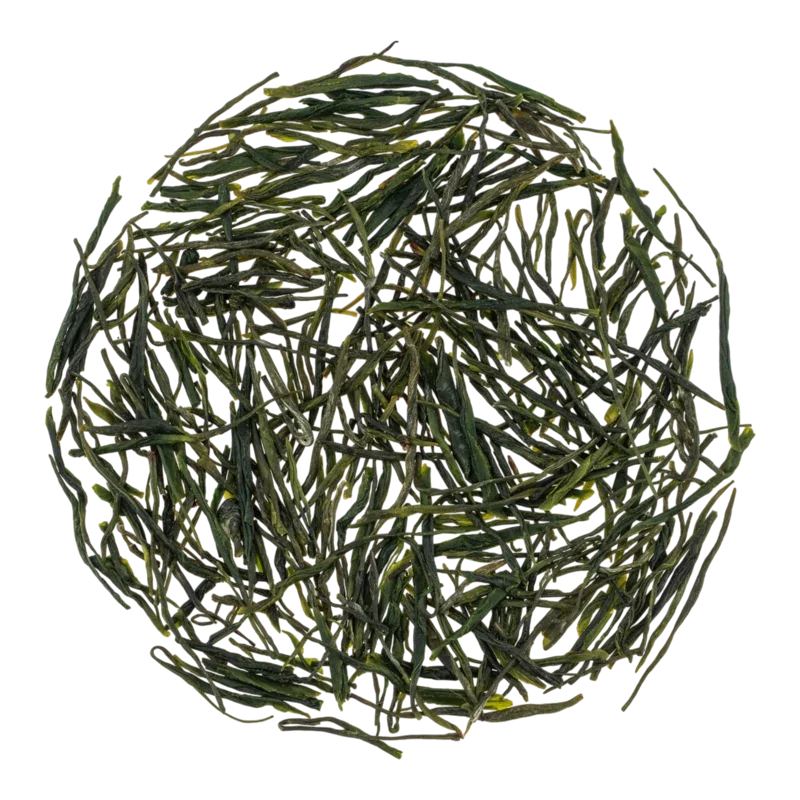
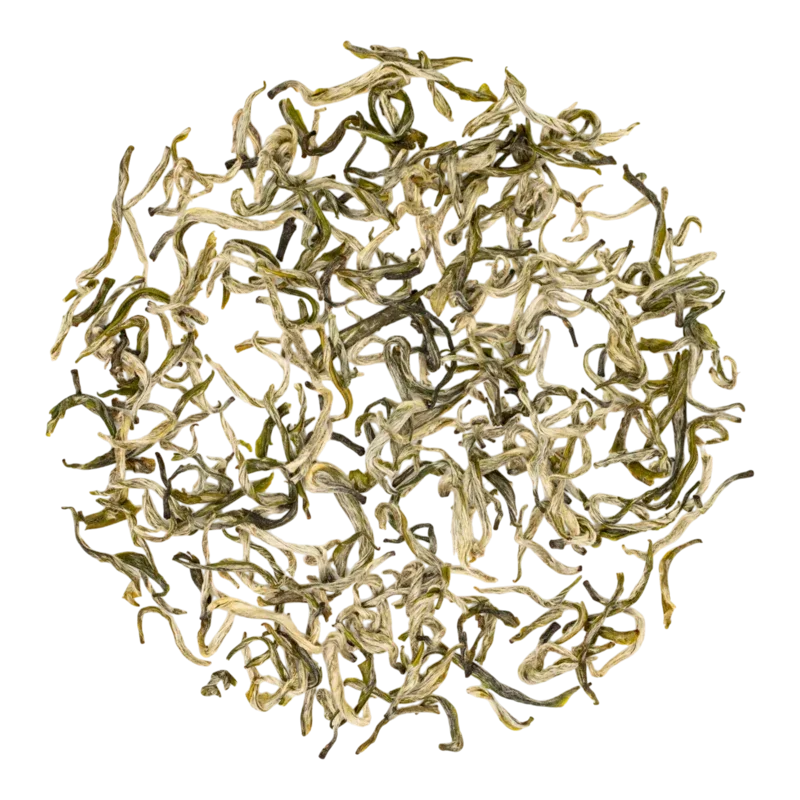
Dry Leaf Appearance: Thin, tightly rolled needles (针形, zhēnxíng) 10–12 mm long, olive-green in color. Bud tips are covered with delicate white down. Leaf is even, uniform, with good integrity.
Dry Leaf Aroma: Fresh, grassy, with light floral and fruity notes. No pronounced "roasted" character — a characteristic feature of steamed teas.
Liquor Aroma: Opens with notes of fresh greenery and young herbs. Linalyl acetate contributes light citrus tones, hexanal — green apple notes, β-ionone — delicate floral nuances. Overall profile — clean, fresh, "spring-like," without heaviness.
Liquor Color: Light yellow with distinct greenish tint, transparent.
Spent Leaves: Leaves fully unfold, demonstrating their integrity and tenderness. Color — bright green, even, lively.
Taste: Mild, refreshing, with predominant grassy and light fruity notes. Astringency is weakly expressed — this is the result of purposeful selection of processing regimes for export batches. Body is light, transparent, with pleasant sweetness. Aftertaste is clean, with light fresh sweetness that gradually fades.
Alkaloids: Caffeine (~2–4%), theobromine, theophylline.
Amino Acids: Content is lower than in spring teas of highest grades, but sufficient for forming pleasant sweetness and mildness.
Steaming fixes chlorophyll significantly more effectively than firing, giving the infusion a pronounced green tint and "lively" character.
Potassium, manganese; possible presence of selenium, characteristic of central Hubei soils.
Linalyl acetate (citrus tones), hexanal (green apple), β-ionone (floral notes) — typical "fresh" profile of steamed green tea.
Polyphenols: Main antioxidant group, including EGCG. Content in summer raw material is somewhat higher than in spring, which partially compensates for reduced amino acid concentration.
Vitamins: Vitamin C (content higher than in fired teas, thanks to gentle fixation regime), vitamin K1 (~180 μg per 100 g dry tea — important information for patients taking anticoagulants).
High polyphenol content and preserved chlorophyll provide effective neutralization of free radicals and protect cells from oxidative stress.
L-theanine combined with caffeine promotes improved concentration and mental clarity — the effect of "calm alertness."
Catechins help maintain healthy cholesterol levels and vascular elasticity with regular consumption.
Vitamin C, polyphenols, and mineral components jointly support the body's protective functions.
Polyphenols stimulate metabolic processes, promote body weight normalization.
Mild, without sharp stimulating action — suitable for daily consumption throughout the day.
Fluoride and catechins have bacteriostatic action, promoting caries prevention and breath freshening.
Antioxidants (polyphenols, vitamin C) participate in protecting skin from oxidative stress and photoaging.
This information is for general educational purposes and is not medical advice.
Soft water (spring or filtered) is critically important for this tea — hard water suppresses the delicate aroma. Do not use re-boiled water.
Tea Amount: 3–4 g per 150 ml water.
Teaware: Glass cup for observing needle unfolding; porcelain gaiwan (盖碗, gàiwǎn) for controlled brewing; porcelain teapot — for European style (longer steepings).
Water Temperature: 70–75°C. Important not to use boiling water: delicate steamed leaves are easily "burned," leading to bitterness and destruction of delicate aromas.
China's most famous steamed green tea, also from Hubei. Common feature — steaming method and "vegetable" profile; difference — Enshi Yulu is produced from spring raw material of highest grades, gives denser, more oily flavor with pronounced umami, and costs significantly more. Hubei Zi Jing is lighter and more accessible.
Related steaming technology, borrowed from China. Sencha typically has more intense "marine" and umami profile (especially fukamushi), while Hubei Zi Jing is milder and more fruity. Sencha price is usually higher.
Famous green tea from neighboring Henan Province. Maojian is wok-fired (not steamed), giving more pronounced "roasted" character and chestnut notes. Zi Jing is cleaner, fresher, lighter.
Classic fired tea from Zhejiang. Flat leaf shape, bean-chestnut aroma, fuller body and pronounced sweetness. Zi Jing is thinner, grassier, without "roasted" character; however, Longjing's price is tens of times higher. Comparison of the two teas clearly demonstrates the difference between firing and steaming: one gives warm nutty tones, the other — fresh green coolness.
Famous twisted green tea from Jiangsu. Both teas have fruity notes, but Biluochun is significantly more aromatic (fruit orchards between rows), sweeter and denser. Leaf shape also differs: spiral for Biluochun and needle-like for Zi Jing.
Hubei Zi Jing is positioned as quality green tea in the accessible segment. Retail price in Europe — about 10–15 euros per 100 g, in China — about 30–50 yuan per 100 g. The difference is due to logistics and customs duties, not quality differences.
Price Factors: raw material grade, harvest season (spring is valued higher than summer), packaging type, batch orientation (domestic market vs. export).
No reviews yet. Tell us what you think of this tea.
Rate this tea and share your impressions. We review each submission before publishing it.