Brewing
Gongfu brewing
- Water temperature
- 93 °C
- Tea amount
- 5 g
- Water volume
- 100 ml
- First steep
- 10 s
- Time added per infusion
- 5 s
- Infusions
- 4

huáng méigui xiǎo zhǒng
Choose a brewing method. Start with the recommended quantities and time, then adjust to taste.
Brewing
Brewing
Taste
Tea encyclopedia
Category: Belongs to the group Zhèng Shān Xiǎo Zhǒng (正山小种, zhèng shān xiǎo zhǒng) — "small variety from the true mountain," indicating origin from the historical center of Lapsang Souchong production. Unsmoked or lightly smoked variety. Modern artisanal tea.
Category: Belongs to the group Zhèng Shān Xiǎo Zhǒng (正山小种, zhèng shān xiǎo zhǒng) — "small variety from the true mountain," indicating origin from the historical center of Lapsang Souchong production. Unsmoked or lightly smoked variety. Modern artisanal tea.
Coordinates: Approximately 27°43′ N, 118°01′ E.
Origin: China, Fújiàn Province (福建省, fújiàn shěng), Wǔyí Mountains region (武夷山, wǔyí shān). Specifically — vicinity of Tóngmùguān village (桐木关, tóngmùguān) and adjacent mountainous territories within the Wǔyí Mountains National Nature Reserve (武夷山国家级自然保护区).
Type: Red tea (black tea) (红茶, hóngchá) — fully oxidized (oxidation degree 80–90%, sometimes up to 100%). According to European classification — black tea.
The Huang Mei Gui cultivar is one of the few varieties that brilliantly realizes itself in two categories simultaneously: as cliff oolong (岩茶, yánchá) with characteristic "rock rhyme" (岩韵, yányùn) and as red tea (black tea) of Xiao Zhong type. This is like an actor equally convincing in comedy and drama.
Huang Mei Gui is the result of crossing two highly aromatic cultivars: Huang Guan Yin (known for its "penetrating" aroma — "通天香", tōng tiān xiāng) and Huang Dan (legendary "Golden Osmanthus" with pronounced floral profile). The combination of these two aromatic lines produced a cultivar with unique "rose" character.
Huang Mei Gui Xiao Zhong is part of the broad "new Lapsang Souchong" movement gaining strength since the early 21st century. Along with Jīn Jùn Méi (金骏眉) and other innovative red teas (black teas) from Wuyi, it offers an alternative to the classic smoky profile — allowing connoisseurs to appreciate terroir and raw material "without intermediary" in the form of pine smoke.
The international name Lapsang Souchong is one of the most mysterious in the tea world. Its origin is not fully clarified: "Lapsang" may be a transliteration of Fujian dialectal pronunciation of "正山" (zhèng shān → la̍p-sáng in Hokkien dialect), and "Souchong" — from "小种" (xiǎo zhǒng → siáu-chéng). Thus Chinese "true mountain, small variety" became English "Lapsang Souchong."
Cultural Significance: This tea embodies the philosophy of "new Wuyi red tea (black tea)" — a direction in which the emphasis shifts from the smoky profile of traditional Lapsang Souchong to revealing the inherent aromatic potential of the raw material and terroir. Huang Mei Gui Xiao Zhong is a bridge between the worlds of Wuyi yan cha (cliff oolongs) and Zheng Shan Xiao Zhong, connecting the breeding achievements of oolong tea cultivation with classic red tea (black tea) technology.
History: The Tongmuguan area in the Wuyi Mountains is considered the cradle of red tea (black tea): it was here in the 16th–17th centuries during the Ming dynasty that Zheng Shan Xiao Zhong was created — the world's first red tea (black tea). According to one legend, its appearance resulted from chance — tea leaves delayed in processing due to passing troops underwent spontaneous oxidation and were dried over pine charcoal, which gave them an unexpected smoky-sweet flavor. By the 17th century, this tea reached Europe through Dutch merchants, where it received the name Lapsang Souchong (from dialectal pronunciation of Fujian terms). The Huang Mei Gui cultivar is a product of modern breeding. It was developed by the Tea Research Institute of the Fújiàn Academy of Agricultural Sciences (福建省农业科学院茶叶研究所) through artificial crossing of Huáng Guǎn Yìn (黄观音, huáng guānyīn) as the maternal plant and Huáng Dān (黄旦, huáng dàn, also known as Huang Jin Gui — "Golden Osmanthus Turtle") as the paternal plant. Breeding work was conducted from 1986–1999, and in 2010 the variety passed national certification and was officially registered as a state breeding variety. Its scientific code is 506. The use of this highly aromatic oolong cultivar for producing red tea (black tea) in the Xiao Zhong style is an innovation of recent decades, aimed at creating tea with a unique floral profile.
Huang Mei Gui is a highly aromatic cultivar with a terpene index of 0.62. The content of volatile aromatic compounds in fresh leaves is significantly above average, making it exceptional raw material for both oolongs and red teas (black teas).
Cultivar: Huáng Méi Guī (黄玫瑰, huáng méigui), code 506. Asexual (vegetatively propagated) variety. Botanical characteristics: small tree (小乔木, xiǎo qiáomù), semi-spreading crown (半开张, bàn kāizhāng), dense branching. Leaves of medium size (中叶种, zhōng yè zhǒng), elongated-elliptical, 9–12 cm long, with pronounced serrations along the edges. Young leaves have a characteristic yellowish-green tint. The leaf is dense, leathery, with a convex surface and slightly wavy edge. The plant belongs to early varieties (早生种, zǎo shēng zhǒng) and is distinguished by high yield.
Picking: Spring (late March — April), the period of maximum accumulation of aromatic substances. Harvest standard: one bud and two-three upper leaves (一芽二三叶, yī yá èr sān yè). Hand-picking in morning hours.
Raw Material: Tender, young leaves and buds, harvested in ecologically clean mountainous areas of Wuyi. Raw material quality is the decisive factor: it determines the expression of the characteristic rose aroma.
Altitude: 600–1200 m above sea level. Tea gardens are located on canyon slopes and in mountain valleys, protected from strong winds.
Climate: Subtropical monsoon. Average annual temperature +17–18°C. Precipitation — 1800–2300 mm per year. Humidity — 80–85%. Foggy days — more than 100 per year. Significant diurnal temperature fluctuations and diffused lighting create ideal conditions for accumulating aromatic substances: slowed photosynthesis → fewer catechins (bitterness), more amino acids and terpenes (aroma and sweetness).
Soil: Red and yellow podzols, often on volcanic rock foundation (Danxia landform — 丹霞地貌), rich in minerals — iron, manganese, zinc. Well-drained, with acidic reaction (pH 4.5–5.5).
Wǔyí Mountains (武夷山, wǔyí shān), Fujian Province. Tongmuguan reserve zone and adjacent territories. The Wuyi Mountains are a UNESCO World Heritage site (since 1999), a unique natural area with rich biodiversity.
Cultivation in natural reserve conditions with rich biodiversity. Tea trees grow among wild subtropical vegetation — pines, camphor trees, bamboo — which contributes to forming a complex, multi-layered aromatic profile.
Hand-picking of buds and upper leaves in morning hours, after dew has dried.
Picked leaves are spread in a thin layer on bamboo trays in open air or in a ventilated room. Duration — 12–16 hours. Moisture content decreases to 58–62%. At this stage, enzymatic processes begin, aroma precursors are formed.
Leaves are rolled to break cell walls and release juice and enzymes that accelerate oxidation. Rolling forms the characteristic longitudinal shape of dry leaf.
Rolled leaves are left in a humid warm environment (25–28°C, humidity 90–95%) for complete oxidation. Oxidation degree — 80–90%, sometimes up to 100%. Duration — 3–5 hours. At this stage, catechins transform into theaflavins and thearubigins, the leaf acquires a red-brown color, and the characteristic taste and aroma of red tea (black tea) are formed.
Final drying to stop oxidation and reduce moisture to 3–5%. Key feature: Unlike classic Lapsang Souchong, which is intensively dried and smoked over blazing pine wood (松木, sōngmù), Huang Mei Gui Xiao Zhong is either not smoked at all (smokeless drying with hot air), or subjected to very light drying over pine charcoal without open fire and smoke — exclusively to impart a subtle woody undertone that does not mask the cultivar's own floral aroma.
Finished tea is sorted by quality and leaf size, removing stems and broken fragments.
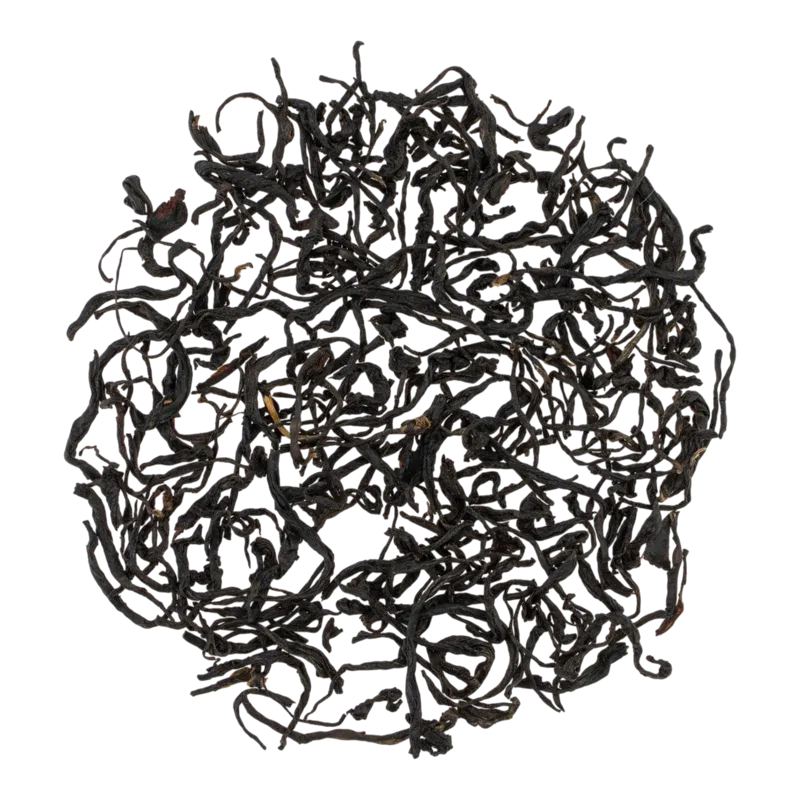
Dry Leaf Appearance: Longitudinally twisted leaves of dark brown, almost black color, with golden or reddish buds. Medium leaf size, tight twist, whole leaf. Surface with light oily sheen.
Dry Leaf Aroma: Bright, complex, with pronounced floral notes of rose and orchid, hints of tropical fruits (lychee, longan), honey and light minerality. The characteristic "rose" note is the calling card of the cultivar. With light charcoal drying — a barely perceptible sweet woody undertone.
Liquor Aroma: Intense, sweet, floral, significantly richer than dry leaf aroma. Rose dominates, complemented by honey and fruity nuances. With each infusion, new facets emerge — from tropical fruits to subtle minerality.
Liquor Color: Bright, clear, from golden-orange to copper-red. Clarity and transparency of liquor is an indicator of high processing quality.
Spent Leaves: Elastic, uniform leaves of copper-brown color, well-preserved in shape. Leaves are resilient, do not tear when stretched — a sign of quality raw material and correct oxidation.
Taste: Soft, smooth, sweetish, without excessive astringency. Floral and fruity tones dominate, complemented by light minerality and honey sweetness. Pleasant, refreshing acidity is present, adding volume. Aftertaste is long, sweet, with "rose" resonance. Texture — silky, enveloping.
Alkaloids: Caffeine (2–3%), theobromine, theophylline.
Amino Acids: L-theanine and other free amino acids. High-altitude origin and shading of Wuyi tea gardens contribute to increased theanine content, ensuring taste softness.
Main feature — exceptionally rich aromatic complex inherited from the Huang Mei Gui cultivar. Terpene index 0.62 — one of the highest among Wuyi cultivars. Main components: linalool and its oxides (floral-woody notes), geraniol (rose, geranium), nerol (fresh floral notes), citronellol (rose and citrus notes), phenylethyl alcohol (rose). With light charcoal drying, trace amounts of longifolene and α-terpineol may be present, but in significantly lower concentration than in traditional smoked Lapsang Souchong.
Minerals: Potassium, manganese, fluorine, iron. Mineral composition reflects the specificity of Wuyi soils of volcanic origin.
Polyphenols: Total content — up to 18%. During complete oxidation, catechins (including EGCG) transform into theaflavins (golden tint of liquor, light astringency, antioxidant activity) and thearubigins (red color, fullness of taste). The ratio of theaflavins to thearubigins determines the balance between brightness and depth.
Vitamins: C, P (rutin), B group.
Theaflavins, thearubigins and residual catechins effectively neutralize free radicals, reducing oxidative stress and slowing cellular aging processes.
Caffeine combined with L-theanine provides a state of "calm alertness" — increased concentration and performance without nervous overstimulation. Theanine stimulates alpha-wave brain activity, promoting focus and creativity.
Oxidized red tea (black tea) gently stimulates production of digestive enzymes and improves peristalsis. In traditional Chinese dietology, recommended after heavy meals.
Vitamin P (rutin) combined with polyphenols helps strengthen blood vessel walls and improve their elasticity.
Red tea (black tea) polyphenols contribute to normalizing metabolism and maintaining healthy weight.
The very process of brewing and tasting aromatic tea is a powerful stress relief tool. L-theanine additionally stimulates serotonin and GABA production.
Red tea (black tea) in traditional Chinese medicine belongs to beverages of "warm" nature, recommended in cold season.
3–4 g per 200–250 ml of 90°C water, steep 3–5 minutes. 1–2 re-steepings are acceptable.
Teaware: Porcelain gàiwǎn (盖碗, gàiwǎn) — optimal choice for revealing floral aroma. Also suitable are Yixing clay teapots (designated for red teas) and glass teapots (for visual enjoyment of liquor color).
Water Temperature: 90–95°C. Boiling water is not recommended — it can "burn" delicate floral aromas.
Container: Airtight, opaque container — ceramic jar, tin with tight lid, dense foil-lined bag. Categorically avoid contact with strongly scented products.
Humidity: No more than 60%.
Shelf Life: Optimally consume within 18–24 months after production. Best taste — in the first 12 months. This is not a tea for long-term aging.
Dry, cool, dark. Avoid direct sunlight, heat sources and moisture.
Temperature: Room temperature (15–25°C). Refrigerator storage is not required (and not recommended due to risk of moisture condensation when removing).
Classic Lapsang Souchong with intense smoky aroma of pine resin, notes of longan and dried fruits. Powerful, rich, "masculine" character. Huang Mei Gui Xiao Zhong is its antipode: without smoke, floral, elegant, "feminine."
Premium red tea (black tea) from Tongmuguan, produced exclusively from buds of local wild bushes. Delicate, honey-floral, with sweet potato notes. Huang Mei Gui Xiao Zhong differs with more pronounced "rose" note and fuller body due to presence of leaves in raw material.
Growing popular category of "cultivar" Xiao Zhong, each bringing its own aromatic character. Huang Mei Gui stands out among them precisely with "rose" profile — one of the most recognizable and valued.
"Younger brothers" of Jin Jun Mei — red teas (black teas) from Tongmuguan with more developed picking standard. More affordable in price, with fruity-honey profile. Huang Mei Gui Xiao Zhong is more complex and "floral."
Price Category: Medium and high. Cost is determined by: specific cultivar (Huang Mei Gui is not the most common variety), manual labor in harvesting and processing, limited production volume in the Wuyi reserve zone, and growing demand among connoisseurs of "unsmoked Lapsang Souchong." Approximate price: from 40 to 150 dollars per 100 g depending on specific plot and harvest year.
Specialized tea companies with direct supplies from Wuyi.
Genuine Huang Mei Gui has a complex, multi-layered aroma with characteristic "rose" note that persists through many infusions. Artificial flavoring (perfuming cheaper tea) is easily recognized: aroma is sharp, one-dimensional and quickly disappears after 1–2 brewings.
Uniform, whole, tightly twisted leaf of medium size. Non-uniform raw material, large stems, broken leaf — signs of counterfeit or low quality.
Clean, clear, bright — from golden-orange to copper-red. Cloudy liquor is a warning sign.
Suspiciously low price (less than 15–20 dollars per 100 g) for tea labeled "Huang Mei Gui" from Tongmuguan should raise suspicion.
No reviews yet. Tell us what you think of this tea.
Rate this tea and share your impressions. We review each submission before publishing it.