Brewing
Gongfu brewing
- Water temperature
- 75 °C
- Tea amount
- 5 g
- Water volume
- 100 ml
- First steep
- 10 s
- Time added per infusion
- 5 s
- Infusions
- 3

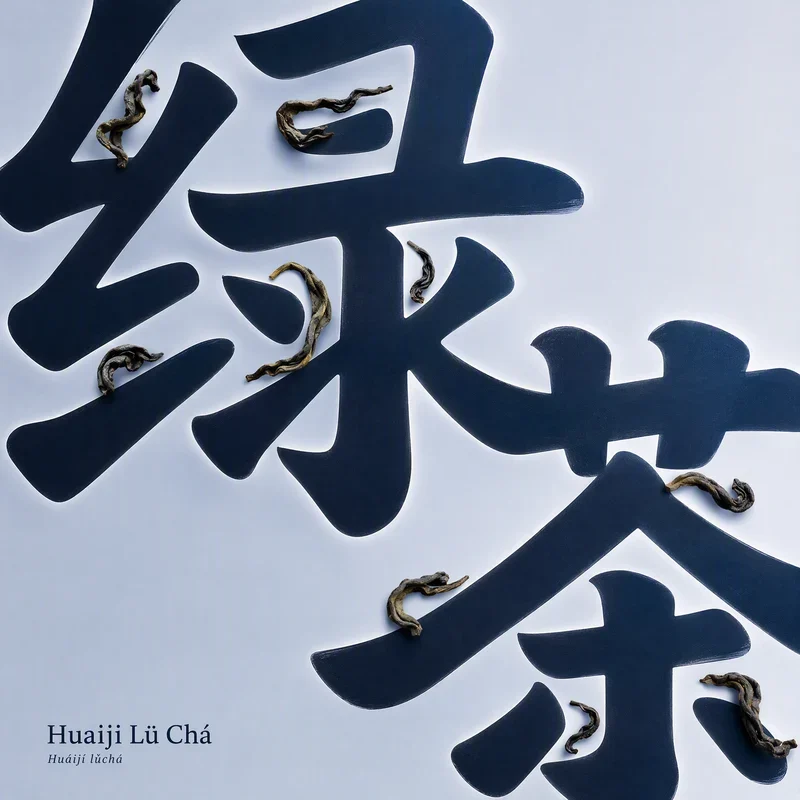
Huáijí lǜchá
Choose a brewing method. Start with the recommended quantities and time, then adjust to taste.
Brewing
Brewing
Taste
Tea encyclopedia
Category: Regional green tea with elements of protected designation of origin. Huaiji County is known as the birthplace of "Xingang tea" (新岗茶, Xīngǎng chá), which received national geographical indication product status (地理标志产品) in 2018; the green line is part of this broader tea brand.
Category: Regional green tea with elements of protected designation of origin. Huaiji County is known as the birthplace of "Xingang tea" (新岗茶, Xīngǎng chá), which received national geographical indication product status (地理标志产品) in 2018; the green line is part of this broader tea brand.
Coordinates: Approximately 24.08° N, 112.18° E (center of Huaiji County). Qiashui Town — ~24.15° N, 112.35° E.
Origin: China, Guǎngdōng Province (广东, Guǎngdōng), Zhàoqìng City (肇庆, Zhàoqìng), Huáijí County (怀集县, Huáijí xiàn). The main production area is Qiàshuǐ Town (洽水镇, Qiàshuǐ zhèn), located in the northeast of the county, in the zone of Xīngǎng State Forest Farm (新岗林场, Xīngǎng línchǎng) and Dachoudding Provincial Nature Reserve (大稠顶, Dàchóudǐng).
Type: Green tea (绿茶) (non-oxidized). Kill-green (杀青, shāqīng) completely stops oxidation; the main method is pan-firing (炒青, chǎoqīng) or baking (烘青, hōngqīng) depending on the producer.
Cultural Significance: Huaiji is a meeting place of Han, Zhuang, and Yáo cultures (壮族, 瑶族): the county has Xiashuai Zhuang-Yáo National Township (下帅壮族瑶族乡). Tea drinking here accompanies the daily life of mountain communities and is part of hospitality: fresh green tea is served to guests alongside local mushrooms (香菇) and honey.
History: Huáijí County (怀集, Huáijí) is one of the most ancient in southern China: it was founded in 436 CE during the Liú Sòng dynasty (刘宋, Liú Sòng) and has never changed its name since then — a rarity for Southern China. Historically, the county was a crossroads of trade routes between Guangdong, Guangxi, and Hunan: the Suíjiāng River (绥江, Suíjiāng) connected Huaiji with Guangzhou and further — with maritime trade routes. Tea culture in the mountainous areas of the county developed over centuries, but the modern tea brand began to take shape in the 1970s, when the first organized tea plantations were established in Qiashui Town with the assistance of Xingang Forest Farm. In the 2010s, the region actively joined the program to create a green agricultural base for the Greater Bay Area (粤港澳大湾区绿色农副产品生产基地), which stimulated the development of the tea industry. In 2018, "Xingang red tea" (新岗红茶) received national protection as a geographical indication product, and the green line "Xingang lü cha" (新岗绿茶) and "Huaiji lü cha" began developing in parallel, with emphasis on ecological purity and high-mountain quality.
Name Breakdown: Huáijí (怀集) — "gathering to embrace": a name given at the county's founding, with the connotation of "attracting, drawing together" — reflected the county's strategic position at the junction of three provinces. Lü Chá (绿茶, lǜchá) — literally "green tea" — a direct indication of the processing type. Thus, the name is simple and functional: "green tea from Huaiji."
Cultivar: Local population varieties (群体种, qúntǐ zhǒng), adapted to the mountain climate of northwestern Guangdong. Regional cultivars selected for both green and red tea needs are also used.
Picking: Spring harvest is primary (March–April); for premium batches — early spring buds before Qīngmíng (清明). Summer and autumn harvests are used for mass-market batches.
Pluck Standard: For highest grades — one bud and one to two upper leaves (一芽一叶 — 一芽二叶). For ordinary batches — one bud and two to three leaves.
Raw Material: Intact, freshly picked, without mechanical damage. Rapid delivery to production is critical due to high average daily temperatures in the subtropics.
Altitude: Main tea plantations are located at altitudes of 300–1,290 m. The highest point of the county is Dachoudding Mountain (大稠顶, Dàchóudǐng), 1,626 m — the "first peak of Zhaoqing" and a provincial nature reserve. Plantations near Dachoudding produce the highest-class raw material.
Climate: Subtropical monsoon, with transitional characteristics from southern to central subtropical. Average annual temperature — about 20.8°C (county data) or ~21.2°C (mountain zone meteorological station data). January — ~11.3°C, July — ~28°C. Annual precipitation — about 1,650–1,785 mm. Frost-free period — ~310 days. Sunshine duration — ~1,828 hours per year. Mountain areas are characterized by frequent fogs and high cloud cover, providing diffused light — a key factor in amino acid accumulation in tea leaves.
Soil: Acidic red-brown soils (赤红壤, chìhóng rǎng) predominate, developed on clay shales. Soils are deep, rich in organic matter and minerals, with pH ~4.5–4.6. Elevated selenium (Se) content is noted in mountain zone soils.
Emphasis on ecological farming: plantations are located surrounded by virgin forests of Dachoudding Nature Reserve; "Xingang tea" (新岗茶) products have "green food product" certification (绿色食品). Several farms in Qiashui Town also produce "beauty tea" (美人茶, měirén chá) — a variety damaged by leafhopper cicadas, giving a honey aroma. Qiashui Town area — 529 sq km, making it one of the largest in the county; the territory contains an extensive state forest (610,000 mu of forest land), providing tea plantations with natural protection from winds and stable microclimate. A significant portion of tea plantations is located on mountain slopes with natural shading from surrounding forest, allowing them to do without artificial shading.
Hand selection of shoots, preferably in morning hours. Raw material is delivered in shaded baskets.
Spreading fresh leaves in a thin layer on bamboo trays in a cool, ventilated room. Duration — 3–5 hours. Moisture equalization and initial aroma "awakening."
Pan-firing in a wok or drum apparatus at 150–200°C. Enzyme inactivation, oxidation cessation, aroma base formation. Duration — 5–8 minutes.
Tea particle formation and cell wall destruction for improved extraction. Moderate intensity — to preserve leaf integrity.
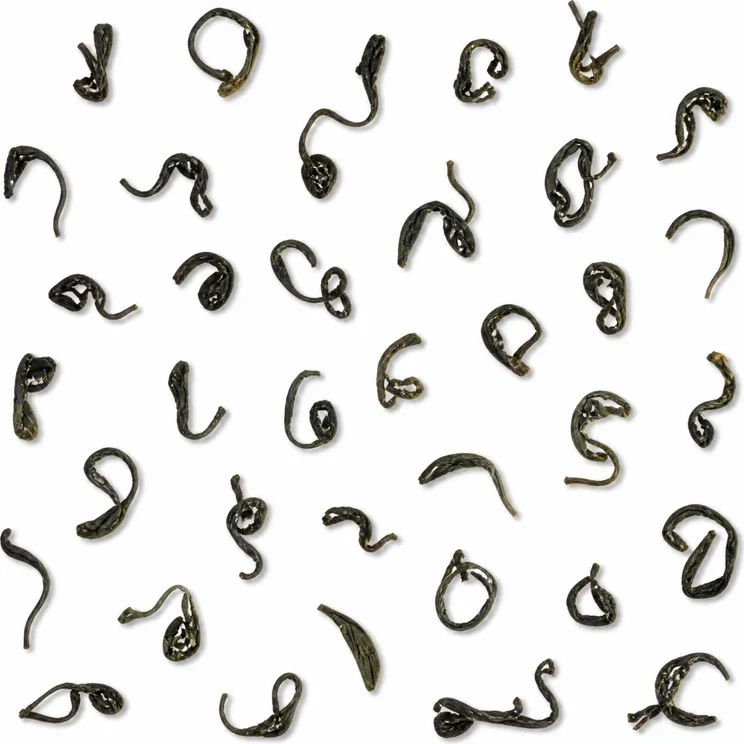
Giving tea particles characteristic shape — flat, needle-like, or slightly curved, depending on the specific brand.
Stepped drying to bring moisture to 5–6%, aroma fixation, and tea stabilization for storage.
Stem and fragment removal; grading by quality; packaging.
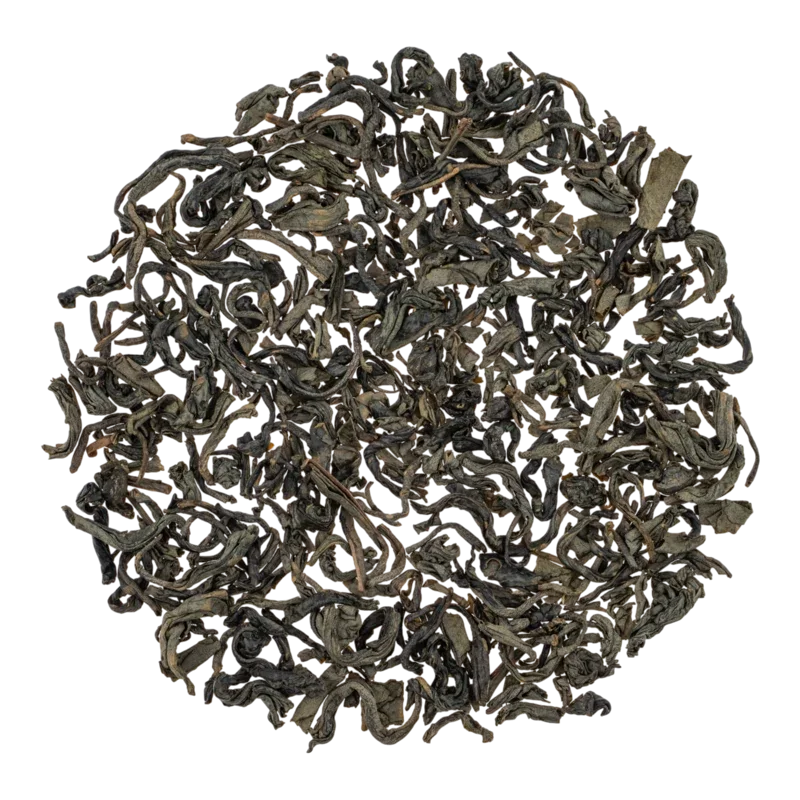
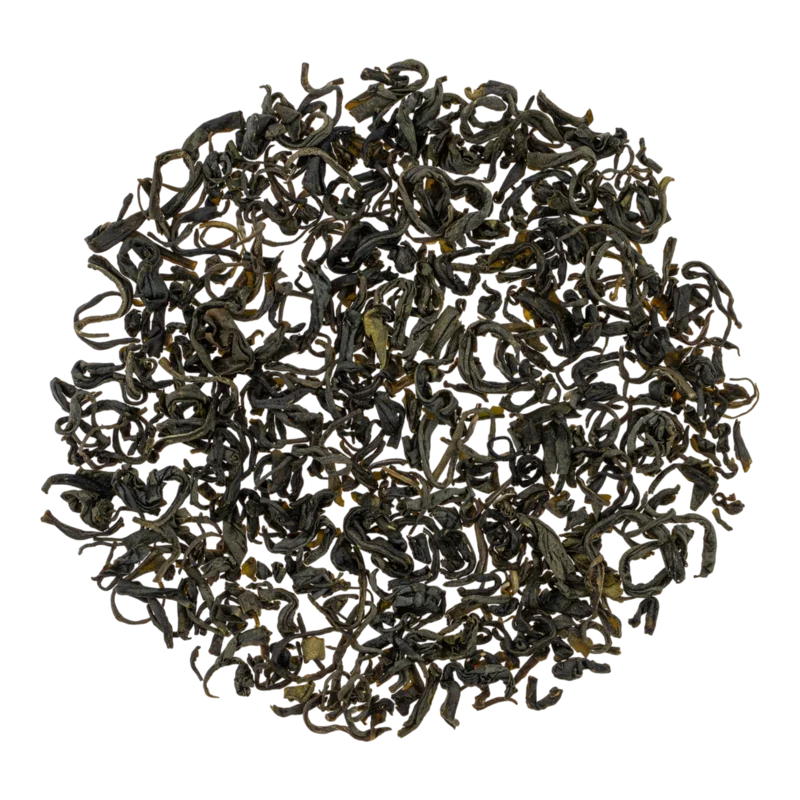
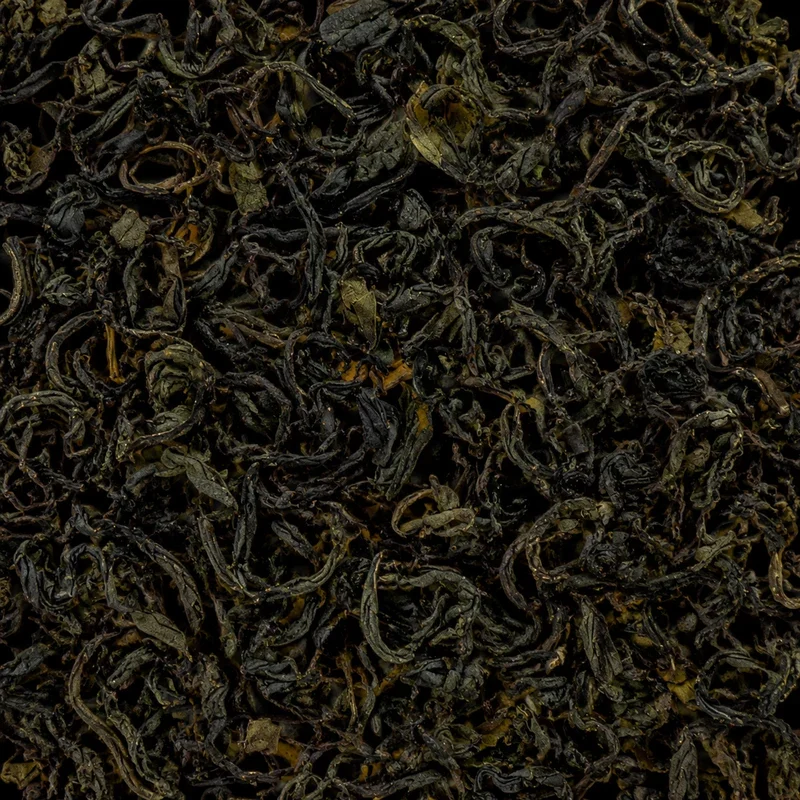
Dry Leaf Appearance: Thin, uniform tea particles with clean shape; color — rich green with light luster. In highest grades — noticeable white down.
Dry Leaf Aroma: Fresh, clean, with distinct chestnut undertones (栗香, lì xiāng). In premium batches — light floral notes.
Liquor Aroma: Clean, bright; chestnut tone unfolds more fully, complemented by gentle sweetness and green freshness.
Liquor Color: Green or yellow-green, bright and clear (明亮清澈, míngliàng qīngchè).
Spent Leaves: Tender green, uniform, elastic. Leaves retain integrity and fresh green color.
Taste: Soft, fresh, brisk (鲜爽, xiānshuǎng), with moderate body density. Without roughness or sharp astringency. Well-suited for multiple infusions (耐泡, nàipào) — up to 5–6 steepings. Pronounced sweet aftertaste (回甘, huígān).
Alkaloids: Caffeine — 2–3.5% dry weight. Theobromine and theophylline — in trace amounts.
Amino Acids: Elevated content relative to average levels for regional green teas — result of high-mountain terroir, frequent fogs, and diffused lighting. L-theanine (L-茶氨酸) — key amino acid determining taste softness and sweetness.
Essential Oils: Linalool, geraniol, cis-3-hexenol (responsible for "green" tone); pyrazines — for chestnut undertones.
Minerals: Elevated selenium (Se) content — reflection of regional soil geochemical profile. Potassium, magnesium, phosphorus, zinc are present.
Polyphenols: Content — typical for high-mountain green teas of the subtropical zone (~28–32% dry weight). Catechins (EGCG, ECG, EC) provide antioxidant activity.
Vitamins: Vitamin C, B-group vitamins (B₁, B₂), carotenoids.
Catechins, especially EGCG, neutralize free radicals, reducing oxidative stress.
Caffeine combined with L-theanine gives an effect of "alertness without nervousness" — calm concentration suitable for daytime tea drinking.
Polyphenols stimulate digestive secretion; tea is well-suited to accompany light to medium-density food.
Natural selenium in tea composition — important microelement for antioxidant enzyme systems (glutathione peroxidase) and immune support.
Catechins and flavonoids help reduce LDL cholesterol levels and maintain vascular elasticity.
L-theanine increases brain alpha-wave activity, improving working memory and concentration ability.
In Guangdong's hot subtropical climate, green tea is traditionally valued as a heat-clearing remedy (清热, qīngrè).
Not recommended on empty stomach in large quantities; for those with increased caffeine sensitivity — with caution in the afternoon. Pregnant women and people with gastrointestinal diseases in acute stage should limit consumption. Do not brew too strong and do not drink cooled tea that has stood for more than several hours: oxidized polyphenols may irritate mucous membranes.
Tea Amount: 2–3 g per 100 ml (gaiwan) or 5–7 g per 200–250 ml (glass/teapot).
Teaware: Porcelain gàiwǎn (盖碗, gàiwǎn) — optimal for revealing delicate aroma. Glass cup (玻璃杯) — for visual pleasure. Porcelain or ceramic teapot — for group tea drinking.
Water Temperature: 75–85°C. For delicate early spring harvest — 75–80°C.
Actually the same production area (Qiashui Town), often identical raw material. The difference is rather marketing: "Xingang" is a narrower brand with GI status; "Huaiji Lü Cha" is a broader umbrella term. Profile practically coincides.
Green tea from Jiaoling County (Meizhou City, eastern Guangdong). Also mountainous, with emphasis on ecological purity. Taste is slightly more astringent and "mineral," with less pronounced chestnut tone.
Green tea from Fengshun County (Meizhou City). Emphasis on "mountain character" (高山韵味), taste is fresh but body is thinner than Huaiji. Different climatic context — southeastern Guangdong.
Rare green tea from Fengkai County, neighboring Huaiji. Similar soil-climatic conditions but even less known in the market. Direct comparison is difficult due to small production volume.
Famous green tea from Shaoguan (northern Guangdong). Noticeably more "classical" in profile: abundant white down, high floral aroma, light body. Huaiji is denser and more "chestnut-like."
No reviews yet. Tell us what you think of this tea.
Rate this tea and share your impressions. We review each submission before publishing it.