Brewing
Gongfu brewing
- Water temperature
- 100 °C
- Tea amount
- 7 g
- Water volume
- 100 ml
- First steep
- 10 s
- Time added per infusion
- 5 s
- Infusions
- 12


hóngshuǐ wūlóng
Choose a brewing method. Start with the recommended quantities and time, then adjust to taste.
Brewing
Brewing
Taste
Tea encyclopedia
Category: Taiwanese oolongs of traditional (roasted) profile. Historically belongs to the lineage of classic Dòngdǐng Oolong (凍頂烏龍, Dòngdǐng Wūlóng), representing its "original," pre-reform style.
Category: Taiwanese oolongs of traditional (roasted) profile. Historically belongs to the lineage of classic Dòngdǐng Oolong (凍頂烏龍, Dòngdǐng Wūlóng), representing its "original," pre-reform style.
Coordinates: Main Lugu area — approximately 23°45′ N, 120°44′ E; high-mountain Lishan areas — approximately 24°15′ N, 121°15′ E.
Origin: Táiwān (臺灣, Táiwān), Nántóu County (南投縣, Nántóu Xiàn). The birthplace of the technology is considered to be Lùgǔ Township (鹿谷鄉, Lùgǔ Xiāng) — the historic Dòngdǐng district (凍頂, Dòngdǐng). Today, Hongshui Oolong is also produced in high-mountain areas of Líshān (梨山, Líshān), Yílán (宜蘭, Yílán), and in some cases — in mainland Fújiàn Province (福建, Fújiàn), where Taiwanese technology has been adapted by local masters.
Type: Oolong (semi-oxidized tea, 烏龍茶, wūlóng chá). Oxidation level — medium and above medium (40–60%), which significantly exceeds the typical 15–25% for modern Taiwanese high-mountain oolongs. According to some classifications, it approaches traditional dark oolongs.
At tea competitions in Lugu in the 1990s, the best samples of Hongshui Oolong with golden-amber liquor were informally called "little gold" (小黃金) — they were valued as the pinnacle of Taiwanese tea master craftsmanship.
One traditional way to evaluate Hongshui Oolong quality is the "cold cup test": after the liquor is drunk, the empty cup is left on the table. In authentic high-class tea, honey-fruity aroma persists on cup walls for more than 30 minutes; in mediocre tea — quickly transitions to burnt caramel tone.
Historically, Hongshui Oolong and Dongding Oolong are the same tea; "red water" is not a separate variety but a description of traditional Dongding production style. Separation into two names occurred only in the 1980s, when "new" Dongding became light and floral, while the old style acquired its own name.
Thanks to deep oxidation and roasting, Hongshui Oolong is one of the few Taiwanese oolongs purposefully aged over decades. Collectible samples 20–30 years old appear at auctions and are valued for extraordinarily silky texture and complex "aged" profile.
Perfectly made Hongshui Oolong when opening spent leaves demonstrates the classic picture of "green center with red rim" — visual evidence of precisely controlled partial oxidation, where edges damaged during shaking oxidized to red while center remained green.
Cultural Significance: Hongshui Oolong occupies a unique position in Taiwanese tea culture — it is simultaneously a keeper of the historical heritage of the Dongding school and a symbol of the movement for returning to the roots of Taiwanese tea mastery. In the context of the modern market dominated by "green" high-mountain oolongs, Hongshui Oolong is perceived as a conscious choice in favor of depth, complexity, and maturity. At annual tea competitions in Lùgǔ (鹿谷鄉農會優良茶比賽), the best samples of Hongshui Oolong invariably attract expert attention; in the past, precisely this style, informally called "little gold" (小黃金, xiǎo huángjīn), was considered the most desirable trophy of competitions.
History: Hongshui Oolong is a direct heir to the traditional method of producing Dongding Oolong. Historically, Taiwanese oolongs were made using cloth-wrapped rolling technology (布球揉捻, bùqiú róuniǎn), borrowed from the Fujian tradition of processing Tieguanyin. With this method, tea leaves underwent deep oxidation and multi-stage charcoal roasting, resulting in the characteristic reddish hue of the liquor — "red water."
Cultivar: The main cultivar for producing Hóngshuǐ Oolong is Qīngxīn Oolong (青心烏龍, Qīngxīn Wūlóng), also known as Ruǎnzhī Oolong (軟枝烏龍, Ruǎnzhī Wūlóng) — a small-leaf variety (Camellia sinensis var. sinensis), historically the "gold standard" of Taiwanese oolongs. Qingxin Oolong leaves are distinguished by dark green coloration, fleshy texture, and high content of pectic substances, making it ideal for producing teas with deep oxidation. Besides the main cultivar, the following are permitted:
Picking: The crop is harvested four times a year: spring (April–May), summer (June–July), autumn (September–October), and winter (November–December). Spring and winter harvests are most valued: spring gives bright aroma and rich body, winter — special softness and deep "cold" tone (冷韻, lěngyùn).
Pluck Standard: Bud and two-three opened leaves (一芽二叶, yī yá èr yè). For Hongshui Oolong, sufficient leaf maturity is important: too tender shoots will not provide the body density necessary for perceiving roasted notes.
Raw Material: Whole upper shoot with uniform degree of maturity; leaves should be elastic, without mechanical damage, foreign odors, and excessive coarseness. High pectin content in raw material is the key to the oily texture of the finished tea.
Altitude: Classic Dongding Hongshui Oolong is grown at altitudes of 600–1200 m above sea level; high-mountain versions (梨山紅水烏龍) — at altitudes of 1400–2500 m, in the zone of pristine mountain forest.
Climate: Average annual temperature 21–23 °C, abundant annual precipitation, relative humidity constantly above 80%. Mountain fog and diffused sunlight promote accumulation of amino acids and pectic substances in tea leaves. In winter, temperatures in high-mountain areas drop sufficiently to slow tea bush growth — this makes winter leaves denser and richer in extractive substances.
Soil: Acidic yellow soils (黃壤, huáng rǎng) with high organic content, good drainage, and a developed system of weathered fine-grained mountain rocks. The mineral composition of Dongding soils provides the characteristic "stony" note in the aftertaste.
The main production area is Lugu Township in Nantou County, located on the western slopes of Taiwan's Central Mountain Range. This is hilly-mountainous terrain with dense subtropical vegetation, forest cover exceeding 70%, and a characteristic system of narrow mountain valleys. High-mountain versions are produced in the Lishan area, part of the Xuěshān (雪山, Xuěshān) mountain system.
Upper shoots of "bud + two leaves" standard are picked by hand or semi-mechanically. Picked raw material is immediately delivered to the workshop to prevent uncontrolled oxidation.
Leaves are spread in a thin layer in open air (sun withering, 日光萎凋, rìguāng wěidiāo) or indoors (室內萎凋, shìnèi wěidiāo). For Hongshui Oolong, withering is conducted with increased intensity (中重度萎凋) so that leaves lose a significant portion of moisture and become pliable for subsequent oxidation.
Key stage determining tea character. Leaves are repeatedly shaken on bamboo sieves, alternating active cycles with "rest" periods (靜置, jìngzhì). Mechanical action on leaf edges triggers local oxidation of polyphenols — forming the famous "red rim on green background" (青蒂綠腹紅鑲邊, qīng dì lǜ fù hóng xiāng biān). Oxidation level is brought to 50% and above — substantially deeper than modern "green" oolongs (15–25%).
High-temperature heating stops enzymatic processes, fixing the achieved oxidation level and direction of aromatic compounds.
Leaves are rolled using cloth-wrapping method (布球揉捻, bùqiú róuniǎn): tea mass is placed in a cotton bag, repeatedly compressed and opened, alternating with heating. The process takes four to eight hours and forms the characteristic semi-spherical shape of tea particles. Complex thermochemical reactions occur inside the cloth, enhancing body and throat note (喉韻, hóuyùn).
Key final stage. Tea undergoes slow roasting over charcoal (炭焙, tàn bèi) or in electric ovens at moderate temperature. Traditional charcoal roasting (文火精製, wénhuǒ jīngzhì) is conducted in several cycles, each adding a layer of depth: nutty-caramel shades, silky texture, and increased storage stability. Roasting degree varies from medium to strong depending on the master's intention.
Final moisture stabilization to below 5%, ensuring safe storage and revelation of aromatic potential during aging.
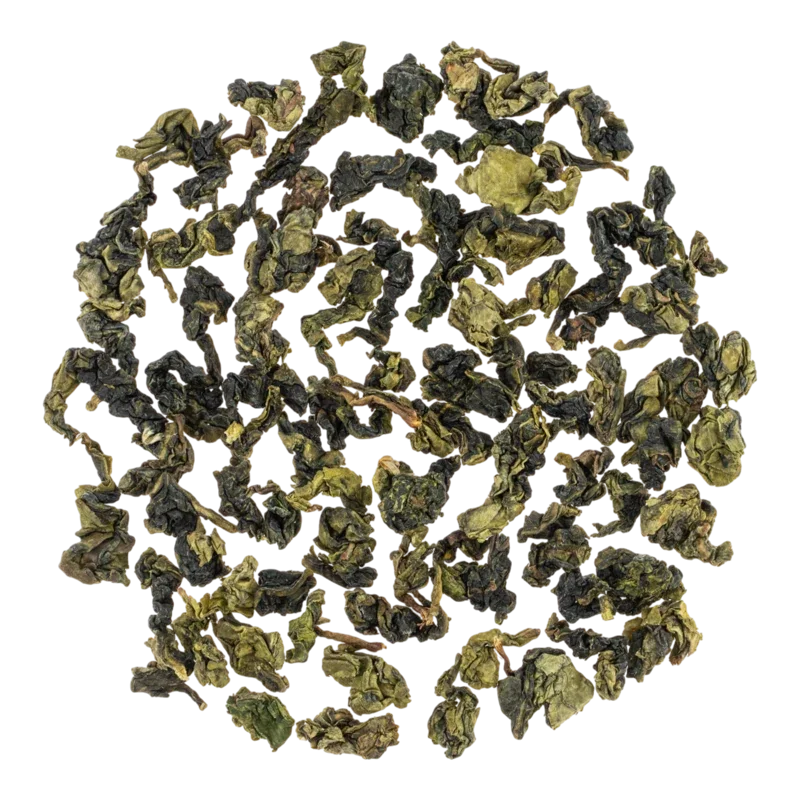
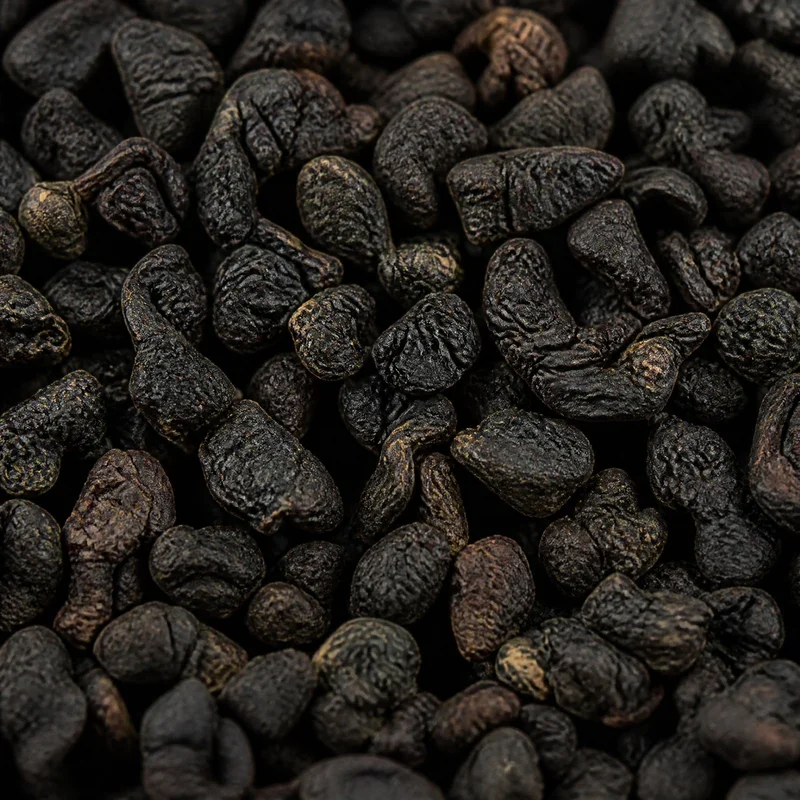
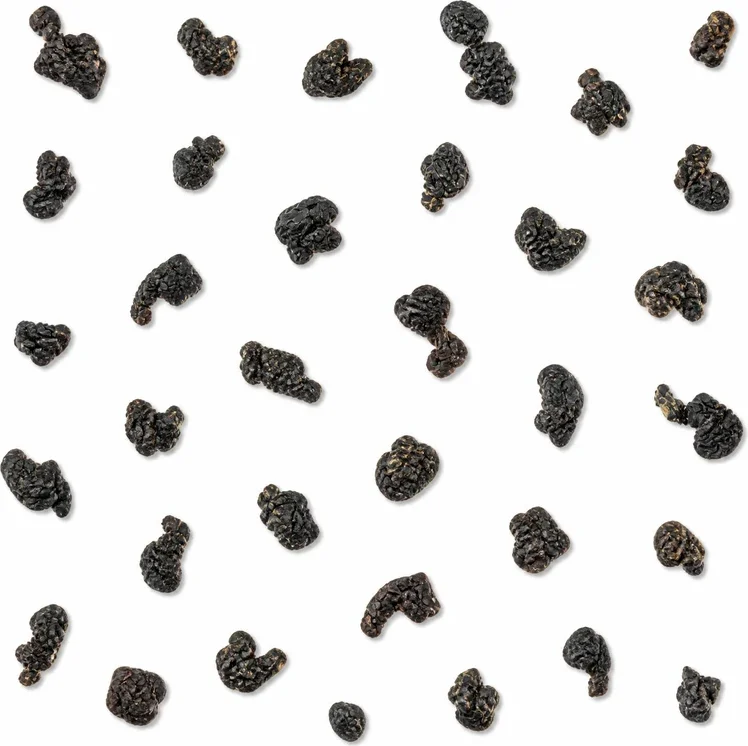
Dry Leaf Appearance: Tightly rolled semi-spherical granules (紧结半球型, jǐnjié bànqiú xíng), uniformly calibrated. Color — from dark green to brownish-brown with reddish highlights, often with light golden down on individual tea particles. In highest grades, golden tips are visible (金毫, jīn háo).
Dry Leaf Aroma: Rich, multi-layered: dominated by tones of roasted nuts (walnut, almond), caramel and baked fruits (dried apricots, prunes); base — light woodiness, spices, barely perceptible chocolate nuance. Honey and floral overtones appear when leaves are warmed in palms for extended time.
Liquor Aroma: Bright and warm, with predominance of ripe fruits (熟果香, shúguǒ xiāng), floral and honey notes. Characteristic feature — exceptionally long "cold cup" aroma (冷杯留香, lěng bēi liú xiāng): when cooling, empty cup continues to emit sweet fermented aroma for over 30 minutes.
Liquor Color: From golden-amber to reddish-brown — depending on degree of oxidation and roasting. Liquor is clear, transparent, with oily sheen.
Spent Leaves: Whole opened leaves, resilient, elastic. Central part of leaf — olive-green, with distinctly visible red oxidation rim at edges (紅鑲邊, hóng xiāng biān). In properly made tea, the "bottom" is uniform, without burnt spots.
Taste: Full-bodied, oily-round, with pronounced natural sweetness and soft astringency. Main notes: roasted nuts, caramel, dried fruits, baked apple. Aftertaste (回甘, huígān) — deep, long-lasting, with slow release of sweetness from throat. Liquor body is dense, with noticeable pectic viscosity (胶质感, jiāozhì gǎn). High-mountain versions add characteristic "high-mountain coolness" (高山清韻, gāoshān qīngyùn) to the basic profile.
Alkaloids: Caffeine (咖啡碱, kāfēi jiǎn) — moderate content, approximately 2–3% of dry mass. Deep roasting partially reduces caffeine extractability during brewing, making Hongshui Oolong gentler on the stomach compared to "green" oolongs. Theobromine and theophylline are also present in trace amounts.
Amino Acids: L-theanine (γ-glutamylethylamide) — the main amino acid of tea leaves — provides natural sweetness and mild relaxation effect. Thanks to high-mountain terroir and use of winter harvest, free amino acid levels in the best samples can reach 2.5–3.5% of dry mass. L-theanine acts synergistically with caffeine, providing gentle, focused alertness without nervousness.
Key components include geraniol (香葉醇, xiāngyè chún), comprising about 60% of oolong aromatic profile, as well as neraniol, linalool and its oxides, methyl salicylate. The roasting process additionally generates pyrazines and furan compounds responsible for nutty and caramel notes.
High pectin content (characteristic of Qingxin Oolong cultivar) gives the liquor oily, enveloping texture — one of Hongshui Oolong's calling cards.
Minerals: Potassium, magnesium, manganese, fluorine, zinc, phosphorus — in trace amounts typical for oolongs.
Polyphenols: Total polyphenol content (tea tannins) in dry Hongshui Oolong leaves is approximately 18–25% of dry mass — lower than green teas (~30%) but higher than fully oxidized red teas. As a result of deep oxidation, a significant portion of catechins (especially EGCG and ECG) transforms into theaflavins and thearubigins, which give the liquor characteristic fullness, reddish hue, and soft velvety astringency. Precisely the balance of residual catechins and their oxidation products determines the smooth, non-astringent taste of Hongshui Oolong.
Vitamins: Vitamin C (partially destroyed during roasting), B group (B₁, B₂, B₃), E, K.
The combination of caffeine and L-theanine provides steady, focused alertness without sharp peaks and drops characteristic of coffee.
Polyphenols, theaflavins and thearubigins neutralize free radicals. Antioxidant capacity of medium-heavily oxidized oolongs is comparable to green tea in several indicators.
Deeply roasted oolongs are traditionally considered most "gentle" for the stomach: roasting reduces content of aggressive catechins and "softens" tannins (柔化丹宁, róuhuà dānníng), reducing irritating effect on mucous membranes.
In traditional Chinese classification system, Hongshui Oolong belongs to teas with "warm" energy. It warms well in cool weather and promotes improvement of peripheral circulation.
Regular consumption of oolongs is associated with favorable influence on blood lipid profile, including reduction of LDL levels.
L-theanine promotes increase in alpha-wave amplitude in the brain, associated with calm concentration state.
Oolong polyphenols participate in fat metabolism regulation — effect is individual and manifests within balanced diet.
Tea fluorides and polyphenols have antibacterial action and promote caries prevention.
Don't over-steep — excessive steeping can give excessive astringency. Recommended to wait for tea temperature around 60 °C before tasting — precisely at this temperature Hongshui Oolong's flavor profile reveals most fully. New, recently produced tea may retain light "green" astringency (青涩, qīngsè) — recommended to let it rest about a month before consumption.
Tea Amount: Gōngfū method (功夫泡法, gōngfū pàofǎ): 6–8 g per 100–150 ml water. European method: 3–5 g per 200–250 ml water. Producers from Lugu often recommend 1:30 ratio — for example, 5 g per 150 ml.
Teaware: Clay teapot from Yíxīng (宜興, Yíxīng) or Taiwanese clay — ideal choice for roasted oolongs: porous walls soften liquor and emphasize flavor depth. Gàiwǎn (蓋碗, gàiwǎn) of white porcelain suits aroma evaluation and universal use.
Water Temperature: 95–100 °C. For deeply roasted samples — full boiling water; for versions with moderate roasting, reduction to 92–95 °C is acceptable.
Container: Airtight opaque container — tin can, ceramic teapot, or double zip-bag of foil material with valve for air removal.
Enemies: Moisture, heat, foreign odors, and direct sunlight.
Dry, cool, dark place with temperature 15–25 °C and relative humidity not exceeding 60%.
Well-roasted Hongshui Oolong can be stored for years, gaining depth and softness. Collectors annually conduct repeated "re-roasting" (覆焙, fùbèi) over slow charcoal to refresh aromatic profile and prevent dampening. With age, liquor becomes more oily, and taste — more rounded and sweet.
In modern form, Dongding is predominantly lightly oxidized oolong with floral-creamy aroma and golden-yellow liquor. Hongshui Oolong is essentially the "elder brother" — version of Dongding made according to original recipe with deeper oxidation and roasting. Hongshui liquor is darker, taste — denser and "warmer," with dominance of nutty-fruity notes instead of floral.
High-mountain oolong with light oxidation (15–20%), fresh floral aroma and delicate creamy taste. Contrast with Hongshui Oolong is maximal: Alishan is "transparency and freshness," Hongshui — "depth and warmth." Alishan is practically not roasted.
One of the highest-mountain Taiwanese oolongs (1400–2600 m). Usually produced in light style with delicate "cold" aroma and exquisite minerality. However, "Lishan versions" of Hongshui Oolong exist, combining high-mountain aromatics with roasting depth — these are rare and valuable samples.
Taiwan's highest-mountain tea district (~2600 m). Oolongs from here possess unique ethereal lightness and mineral sweetness. Hongshui Oolong is generally denser and more "earthy" in character but significantly more accessible in price.
Roasted Taiwanese oolong from Muzha district (Taipei), technologically close to Hongshui Oolong. Both teas feature deep oxidation and charcoal roasting. Muzha Tieguanyin, however, is produced from Tieguanyin cultivar (or Sijichun) and possesses more "mineral," austere character, while Hongshui Oolong based on Qingxin Oolong is more rounded and fruity.
Price Category: Hongshui Oolong belongs to medium and upper price segments of Taiwanese oolongs. Price depends on growing altitude, seasonality (spring and winter harvests are more expensive), cultivar (Qingxin Oolong is valued higher), master's reputation, and roasting degree. Special (特級, tèjí) grades with careful hand processing can cost from 2000 yuan per jin and higher. High-mountain versions from Lishan are significantly more expensive than standard Dongding ones.
No reviews yet. Tell us what you think of this tea.
Rate this tea and share your impressions. We review each submission before publishing it.