Brewing
Gongfu brewing
- Water temperature
- 93 °C
- Tea amount
- 5 g
- Water volume
- 100 ml
- First steep
- 10 s
- Time added per infusion
- 5 s
- Infusions
- 4

Hóngbǎoshí chá
Choose a brewing method. Start with the recommended quantities and time, then adjust to taste.
Brewing
Brewing
Taste
Tea encyclopedia
Category: Regional red tea (black tea) of Guizhou Province. Part of the "Fenggang Xinxi Cha" brand product line. Technologically occupies an intermediate position between classic gongfu red tea (black tea) and granulated teas (颗粒形, kēlìxíng).
Category: Regional red tea (black tea) of Guizhou Province. Part of the "Fenggang Xinxi Cha" brand product line. Technologically occupies an intermediate position between classic gongfu red tea (black tea) and granulated teas (颗粒形, kēlìxíng).
Coordinates: Approximately 27°55′ North latitude, 107°40′ East longitude (central part of Fenggang County). The county is located in the "golden tea belt" — between 27° and 30° North latitude.
Origin: China, Guìzhōu Province (贵州省), Zūnyì City (遵义市), Fènggāng County (凤冈县). Main tea-producing zones: Xiānrénlǐng Mountain (仙人岭, Xiānrénlǐng), Yělùgài Mountain (野鹿盖, Yělùgài), Cháshòushān Mountain (茶寿山, Cháshòushān), as well as Tiánbà Community (田坝社区, Tiánbà Shèqū) — the core of the "Tea Sea" (茶海之心, Cháhǎi Zhī Xīn), a national 4A-category tourist site.
Type: Chinese red tea (black tea) (红茶, hóngchá), fully oxidized.
Cultural Significance: Fenggang County is one of Guizhou's largest tea-producing areas (50,000 hectares of tea gardens, second place in the province by area). Fenggang has been awarded the titles "National Key Tea-Producing County" (全国重点产茶县), "Top-10 Ecological Tea-Producing Counties of China" (中国十大生态产茶县), and "Homeland of Zinc- and Selenium-Rich Organic Tea" (富锌富硒有机茶之乡). Hongbaoshi Cha embodies the diversification strategy of "green" Fenggang into the "red" niche, demonstrating that the famous zinc-selenium raw material reveals itself not only in green teas but also in fermented teas.
History: Tea cultivation in the territory of modern Fenggang County spans more than two millennia. In the "Chajing" (茶经, Chájīng, "The Classic of Tea") by Lù Yǔ (陆羽, Lù Yǔ, 8th century), it is recorded: "Yizhou tea... is often found, and its taste is excellent" (夷州茶,往往得之,其味极佳). According to historical research, "Yizhou" (夷州) refers precisely to the territory of modern Fenggang, where during the Tang dynasty the eponymous prefecture was located. During the Qing dynasty, the geographical work "Guizhou Tongzhi" (贵州通志) noted: "At the city walls of Longquan springs forth a source... the water from the small spring outside the city is sweet and clear, and tea brewed with it is extraordinarily good."
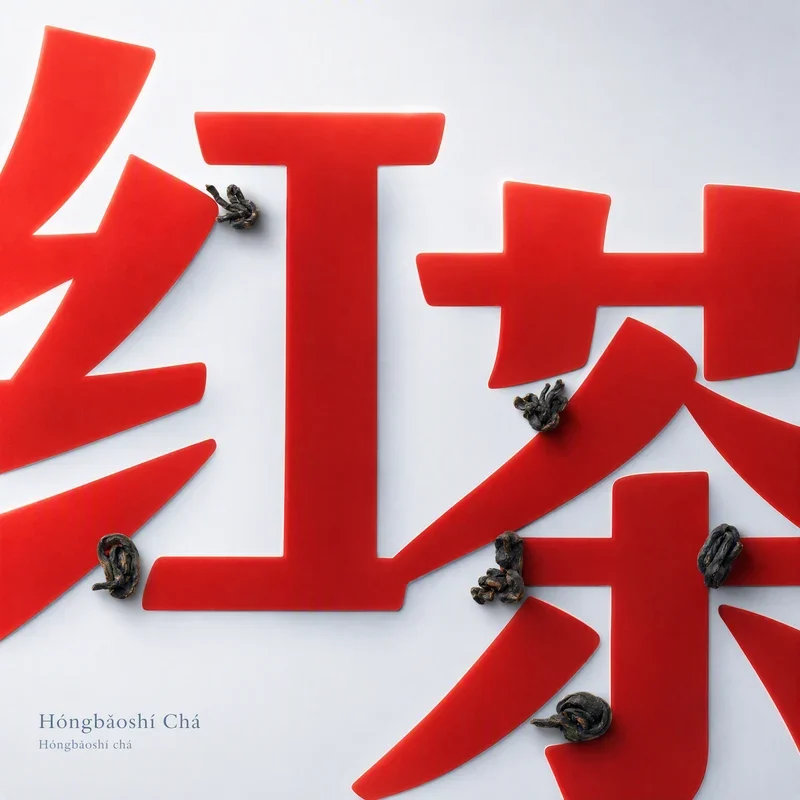
Name Breakdown: "Hong" (红, hóng) — red, "baoshi" (宝石, bǎoshí) — precious stone. "Hongbaoshi" (红宝石) — "ruby." The name is inspired by the ruby color of the liquor and the precious roundness of the tea granules. "Cha" (茶, chá) — tea.
Cultivar: Local population varieties (群体种, qúntǐzhǒng) Camellia sinensis var. sinensis, adapted to the mountainous conditions of northeastern Guizhou. Among the main ones are cultivars of the "Fenggang Lao Chashu" group (凤冈老茶树, "old tea trees of Fenggang"), as well as regionalized varieties recommended by the Guizhou Tea Institute. Medium-sized leaves with good pubescence and relatively high polyphenol content, ensuring fullness of flavor during complete oxidation.
Picking: Spring (March–April) for premium batches; early summer harvest is permitted for standard grades.
Pluck Standard: One bud + one–two leaves (一芽一二叶). For the highest grade (特级, tèjí) — one bud + one half-opened leaf. For mass batches — one bud + two-three leaves.
Raw Material: Uniform, whole leaves without damage and coarse stems; freshness is critical. Special requirement: raw material must originate from certified zinc-selenium tea gardens.
Altitude: 800–1200 meters above sea level. The best gardens are above 900 m, in the zone of constant mists.
Climate: Subtropical monsoon humid. Average annual temperature — about 21°C (in the tea garden zone — 15–18°C). Abundant precipitation, high relative humidity. The Guizhou highlands are characterized by the formula "high altitude, low latitude, abundant clouds, no pollution" (高海拔、低纬度、多云雾、无污染), providing ideal conditions for the accumulation of aromatic compounds and amino acids.
Soil: Acidic yellow and yellow-brown mountain soils, pH 5.0–6.5. Key feature — natural enrichment with zinc (Zn) and selenium (Se). Zinc content in local tea is approximately twice the average for China, and selenium — 1.5 times higher. Zinc is considered the "flower of life and source of intelligence" (生命之花、智力之源), and selenium — the "element of longevity and anti-cancer element" (长寿元素、抗癌元素).
Forest coverage in the core tea zone (Tianba) exceeds 90%. The use of pesticides and chemical fertilizers is categorically prohibited in zones certified for export to the EU. The county has repeatedly confirmed compliance with European pesticide residue control standards.
Hand-picking of one bud + one–two leaves. Leaves are delivered to the workshop in bamboo baskets, avoiding compression.
Leaves are spread in thin layers on bamboo trays or in mechanical withering troughs. Duration — 8–16 hours depending on temperature and humidity. Goal — reducing leaf moisture to 58–62%, achieving soft elasticity.
Two-stage: initial rolling to break cell membranes (40–50 minutes, following the principle "no pressure → light → medium → light"), then special granule formation. It is at this stage that the tea acquires its characteristic "rosette" form (盘花颗粒状): withered and partially rolled leaves are rolled into dense, compact granules resembling pearls. This method is borrowed from the Guìzhōu tradition of producing granulated green teas (颗粒形绿茶) (for example, "Lü Baoshi" — "Green Emerald").
Granules are placed in a fermentation room at 25–30°C and humidity above 90%. Duration — 3–5 hours. The granular form slows oxidation compared to needle-shaped rolling, allowing for more uniform oxidation. Control — by color (copper-red) and aroma (sweet, fruity-honey).
Two-stage: initial drying at 100–110°C (毛火) to stop oxidation, then final drying at 80–90°C (足火) to 5–6% moisture. The dense granular structure requires somewhat longer heating for uniform drying of the granule core.
Grade separation by size and uniformity of granules, tip content. Highest grade (特级) — dense, uniform-sized granules with golden tip inclusions.
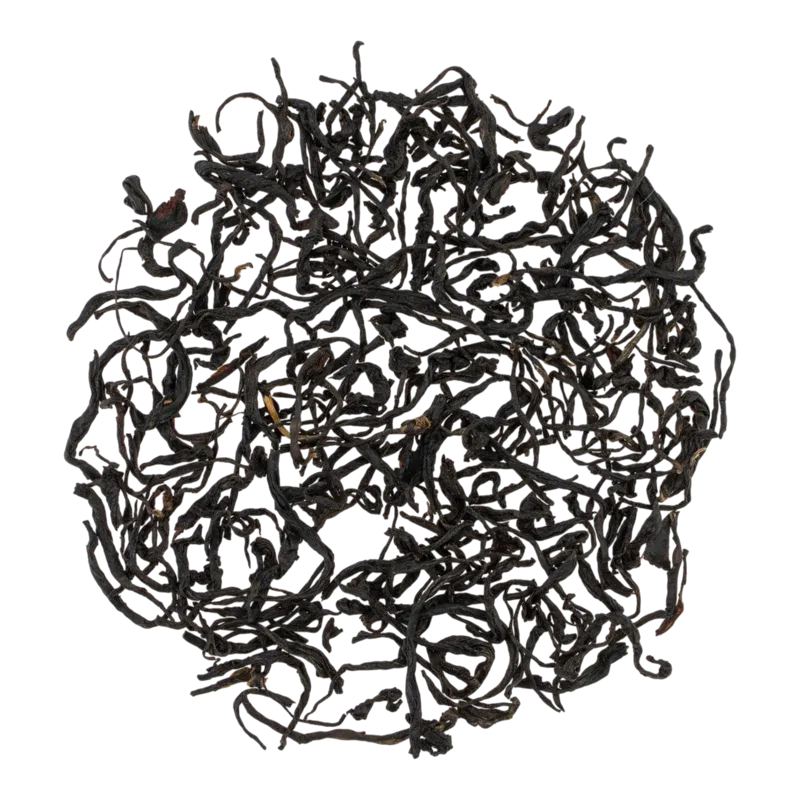
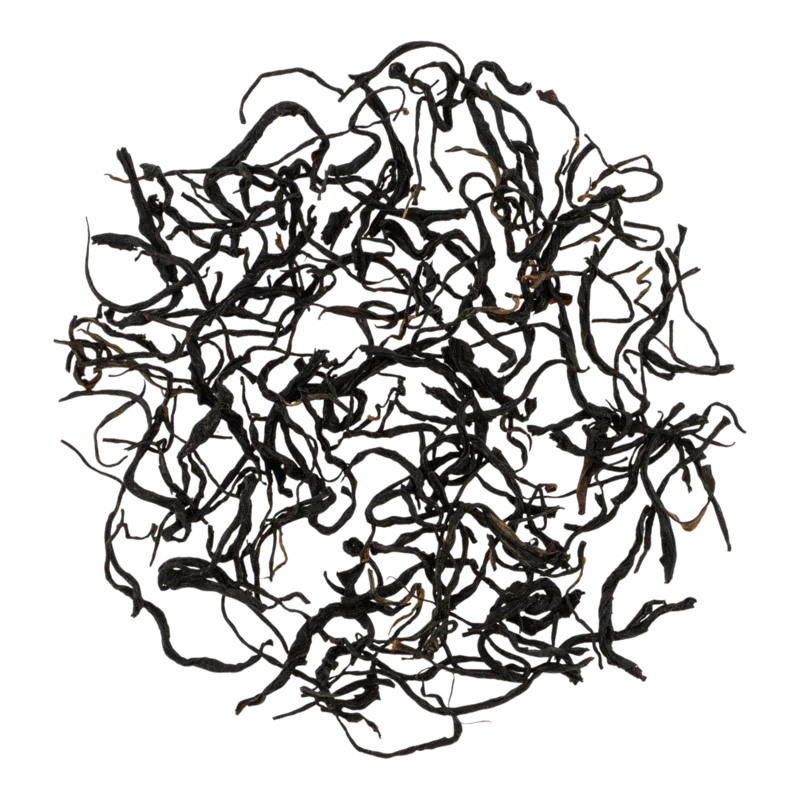
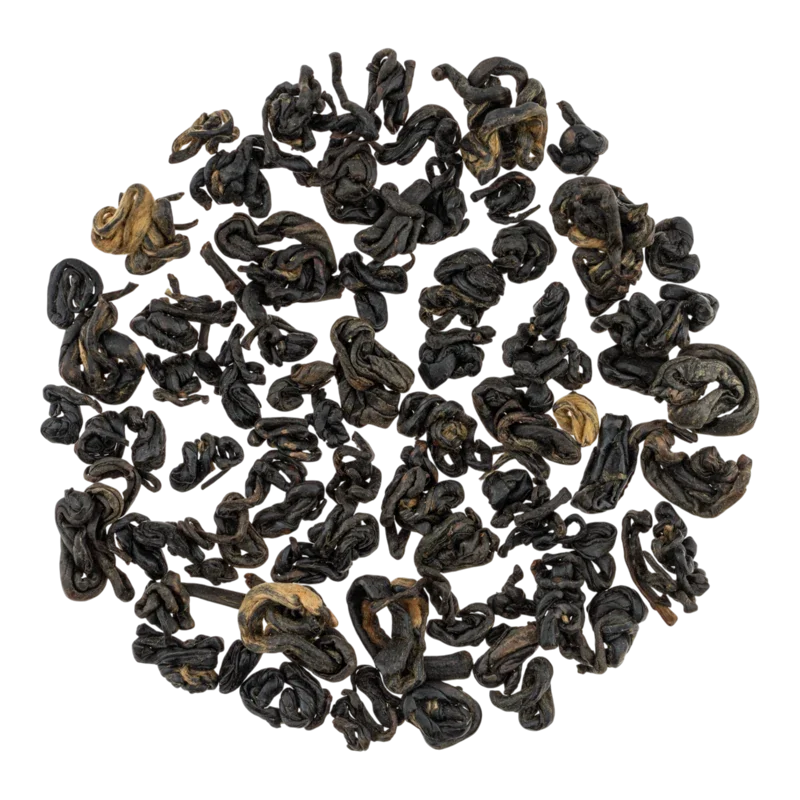
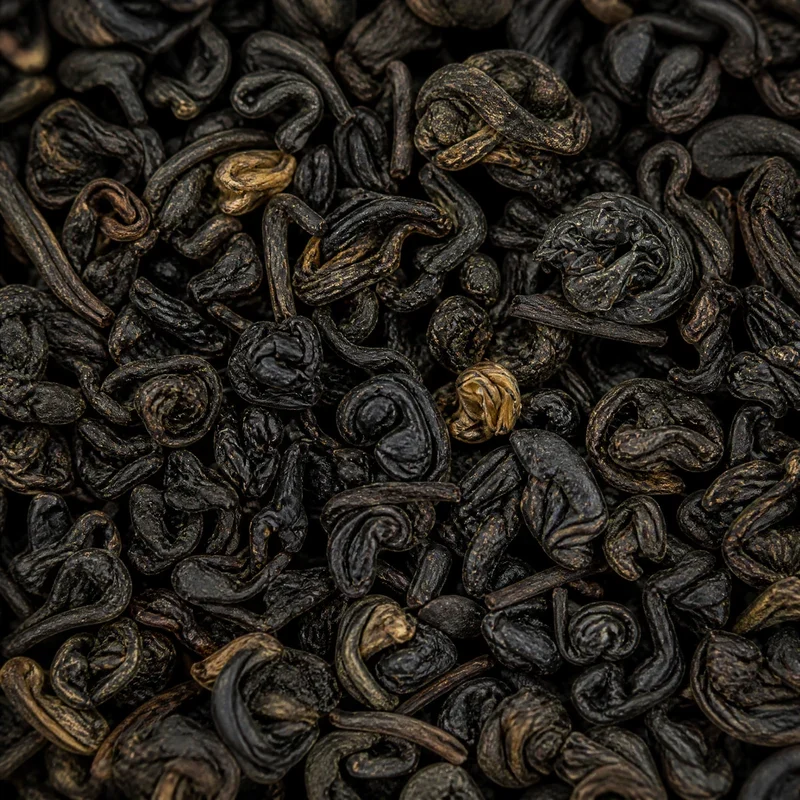
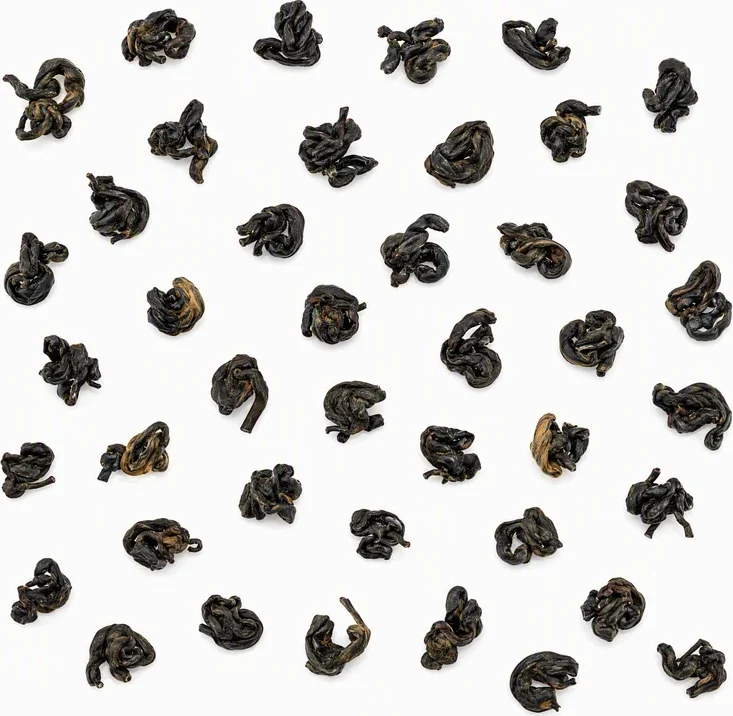
Dry Leaf Appearance: "Rosette-form" granules (盘花颗粒状), dense, heavy, round, resembling small pearls or a scattering of small gems. Color — dark brown to black, with flashes of golden tips. Granule surface — matte or with light luster.
Dry Leaf Aroma: Restrained, sweet-honey with notes of roasted chestnut and dried fruits. When the vessel is heated, a deeper caramel tone is revealed.
Liquor Aroma: Floral-honey and fruity, with notes of apricot, ripe plum, and light caramel. Thanks to the granular rolling, the aroma unfolds gradually — from infusion to infusion the tea "unfolds" like a flower.
Liquor Color: Ruby-red (hence the name), clear, with pronounced brightness. Golden ring around the cup edge — indicator of high theaflavin content.
Spent Leaves: Red-copper colored, elastic. Granules gradually open during brewing, revealing whole "bud + leaf" pairs. In highest grades — uniform leaves without coarse fragments.
Taste: Dense, rich yet rounded. Sweetness is pronounced and natural; mild astringency is present but delicately balanced. Pronounced returning sweetness (回甘, huígān). Long aftertaste with honey overtones and light mineral coolness. Texture — "oily," enveloping.
Alkaloids: Caffeine — 2.5–4%. Theobromine and theophylline — in trace amounts.
Amino Acids: L-theanine — key amino acid supporting mildness and "sweet freshness" of taste. Free amino acid content — 2.5–4%. Guizhou teas generally distinguish themselves with elevated amino acid content thanks to high-mountain terroir.
Zinc content in tea from Fenggang is approximately twice the average for Chinese teas. Zinc is an essential microelement participating in the work of more than 300 enzymes, maintaining immunity, protein and DNA synthesis.
Selenium content is 1.5 times above average. Selenium is a powerful antioxidant, part of glutathione peroxidase; associated with maintaining thyroid function and reducing the risk of several chronic diseases.
Linalool, geraniol, phenylacetaldehyde, nerol — main components of floral-fruity aroma. Water extract content (水浸出物) exceeds national standards, ensuring "full-bodied" liquor.
Minerals: Potassium, manganese, fluorine, strontium (Sr) — additional microelement characteristic of regional soils.
Polyphenols: Total content — 18–25%. During oxidation, catechins transform into theaflavins (茶黄素) and thearubigins (茶红素), providing the ruby color of the liquor, "velvet" texture, and antioxidant activity.
Vitamins: B-group vitamins (B₁, B₂, B₆), trace amounts of vitamin C (partially destroyed during oxidation), vitamin P (rutin).
Synergy of theaflavins and organic selenium provides powerful two-level antioxidant effect: polyphenols neutralize free radicals directly, while selenium supports the work of the body's own antioxidant enzymes (glutathione peroxidase).
Zinc is one of the key elements for immune system function; its elevated content in tea from Fenggang makes regular tea drinking a mild form of micronutrient support.
Theaflavins contribute to lipid profile normalization; potassium helps regulate blood pressure.
Zinc participates in neuroplasticity and hippocampus function; combined with caffeine and L-theanine in red tea (black tea) provides mild stimulation of cognitive functions.
Selenium is necessary for thyroid hormone synthesis and protecting thyroid cells from oxidative stress.
Red tea (black tea) is traditionally considered a "warm" beverage; complete oxidation makes it gentle on the stomach and comfortable after meals.
Manganese, fluorine, and strontium support bone tissue mineral density.
Antioxidant complex (selenium + theaflavins) and zinc contribute to maintaining healthy skin tone and slowing photoaging processes.
Tea Amount: 5–6 g per 100 ml (gongfu method) or 3–4 g per 200–250 ml (European method). Granules are dense and heavy — visually it may seem there is little tea, but by weight the dose is sufficient.
Teaware: Porcelain gàiwǎn (盖碗) 100–130 ml; porcelain or glass teapot. For dense batches with high tip content — Yíxīng clay (紫砂, zǐshā) will emphasize roundness and "oiliness" of taste.
Water Temperature: 90–95°C. Granular form permits slightly higher temperature than for needle-shaped delicate red teas (black teas).
Container: Airtight, opaque — tin can with tight lid, foil-lined bag, porcelain container.
Protection from direct light, moisture, and foreign odors. Optimal temperature — 10–25°C.
Best organoleptic qualities — within 12–24 months. Dense granular structure slows oxidative processes, so Hongbaoshi maintains freshness slightly longer than needle-shaped red teas (black teas). Some dense batches pleasantly "mature" up to 2–3 years, acquiring deeper honey-dried fruit tones.
The "major" red tea (black tea) brand of Guizhou Province, part of the "three greens plus one red" (三绿一红) — Guizhou tea's calling card. Zunyi Hong typically has classic needle-shaped form and a more intense, "robust" profile. Hongbaoshi differs with granular form, milder taste, and emphasis on zinc-selenium mineral composition.
Yunnan red tea (black tea) from large-leaf Assam-like varieties. Dianhong is more "muscular," with dense body and pronounced cocoa and dried fruit notes. Hongbaoshi is lighter in texture, with more pronounced florality, and distinguished by unique mineral profile (Zn, Se).
Guìzhōu granular green tea developed by master Mou Yìngshū (牟应书). Both teas are "precious stones" from Guizhou and both have granular form, but Lü Baoshi is unoxidized green tea with more grassy, fresh profile. Hongbaoshi is its "red brother," warmer and more honey-like.
Famous Anhui "Qihong" with complex "Qimen aroma." Both teas are aromatic gongfu red teas (black teas), but Qimen is produced from small-leaf Zhu Ye cultivar and has a more "chamber," violet-orchid profile. Hongbaoshi is more fruity and "sunny," with mineral undertones.
Fujian classic gongfu red tea (black tea). Profile closer to honey and dried fruits, with pronounced "body." Hongbaoshi yields to it in density but wins in freshness and unique mineral composition.
No reviews yet. Tell us what you think of this tea.
Rate this tea and share your impressions. We review each submission before publishing it.