Brewing
Gongfu brewing
- Water temperature
- 93 °C
- Tea amount
- 5 g
- Water volume
- 100 ml
- First steep
- 10 s
- Time added per infusion
- 5 s
- Infusions
- 4

hóng fèng gāo xiāng
Choose a brewing method. Start with the recommended quantities and time, then adjust to taste.
Brewing
Brewing
Taste
Tea encyclopedia
Category: Premium Yunnan red tea (black tea) in the "gao xiang" / "ti xiang" style (高香 / 提香, gāo xiāng / tí xiāng — "elevated aroma"), involving final high-temperature heating to enhance the aromatic profile.
Category: Premium Yunnan red tea (black tea) in the "gao xiang" / "ti xiang" style (高香 / 提香, gāo xiāng / tí xiāng — "elevated aroma"), involving final high-temperature heating to enhance the aromatic profile.
Coordinates: approximately 22°40'–25°00' N, 99°00'–101°30' E (tea-producing zone of western and southwestern Yunnan, including Lincang, Pu'er, and Baoshan districts).
Origin: China, Yúnnán Province (云南省, Yúnnán Shěng). Main production zones are located in high-altitude areas at 1800–2200 meters above sea level. Yunnan is the birthplace of red teas (black teas) of the Diān Hóng (滇红, Diān Hóng) category — one of the most significant red tea (black tea) traditions in China, originating in 1939.
Type: Red tea (black tea) (红茶, hóngchá). Fully oxidized tea. By Western classification — black tea. Belongs to the category of Gōngfu Hóng (工夫红茶, gōngfu hóngchá) — "red teas of supreme craftsmanship," whose production requires meticulous handwork at every stage.
Specialized tea shops in Kunming, Fengqing, and other Yunnan tea centers. Direct purchases from established tea factories and cooperatives.
Reputable online tea retailers specializing in Chinese teas, established tea importers with direct Yunnan connections.
Look for producers with transparent sourcing information, detailed processing descriptions, and positive reviews from tea community.
Classic premium Yunnan red tea (black tea), consisting predominantly of golden buds. More "pure," tippy profile with predominant honey-malty notes. Hong Feng Gao Xiang, due to "gao xiang" technique, possesses more pronounced chocolate-cocoa tones and deeper, "roasted" character.
One of the three greatest red teas (black teas) in the world. Small-leaf, with subtle, delicate "Qimen aroma" (orchid, honey, dried fruits). Unlike powerful, full-bodied Hong Feng Gao Xiang, Qimen represents elegance and refinement.
Fujian red tea (black tea), ancestor of all red teas (black teas) in the world. Traditional version possesses characteristic smoky aroma (smoking over pine wood). Hong Feng Gao Xiang lacks smokiness, offering instead chocolate-honey depth.
Yunnan red tea (black tea) sun-dried rather than oven-dried. Possesses lighter, fruity-acidic profile and aging capability (like pu-erh). Hong Feng Gao Xiang, having undergone high-temperature heating, is its complete opposite: rich, "warm," and stable in taste from day one.
Cultural Significance: Hong Feng Gao Xiang continues the tradition of Yunnan Gongfu Hongs — red teas (black teas) of "supreme craftsmanship," which since the mid-20th century occupied an important place in Chinese diplomatic and cultural life. In 1986, Queen Elizabeth II of Great Britain, visiting Yunnan, received Yunnan red tea (black tea) as a state gift and, according to legend, preserved it as a relic in a glass display case at Buckingham Palace. High-aroma Yunnan red teas (black teas) are valued for their ability to combine the power and depth of large-leaf raw material with the refinement and complexity of aroma.
History: Hong Feng Gao Xiang is part of the rich tradition of Yunnan red tea (black tea), whose history began in 1939 when Féng Shàoqiú (冯绍裘, Féng Shàoqiú) — an outstanding tea technologist evacuated from Anhui during the Second Sino-Japanese War — arrived in Shùnníng County (顺宁, modern Fengqing, 凤庆) on assignment from the China Tea Company (中茶公司). Using local large-leaf raw material, Feng Shaoqiu first produced red tea (black tea) samples that were sent to the Hong Kong tea market and immediately caused a sensation. Thus was born Dian Hong — Yunnan red tea (black tea), which quickly gained recognition in the USSR, Eastern Europe, and the London tea market. The variety Diān Hóng Tè Jí Gōngfū Chá (滇红特级工夫茶) was subsequently designated as "tea for diplomatic receptions" (外事礼茶, wàishì lǐchá) by the Ministry of Foreign Affairs of the PRC. Hong Feng Gao Xiang represents a modern development of this tradition: the high-temperature final heating technique (高香 / 提香, gāo xiāng / tí xiāng), borrowed partly from Fujian red tea (black tea) production practice, is applied to Yunnan large-leaf raw material, creating a tea with enhanced, "elevated" aroma — cocoa, dried fruits, and honey.
Name Breakdown: The name consists of four characters. "Hong" (红) — "red," indicating the type of tea. "Feng" (凤) — "phoenix," symbol of nobility, rebirth, and supreme quality in Chinese culture (Fengqing district, birthplace of Dian Hong, also contains "feng" — 凤庆, "Phoenix Prosperity"). "Gao" (高) — "high," "elevated." "Xiang" (香) — "aroma," "fragrance." Together — "Red Phoenix High Aroma" — a poetic name emphasizing the noble character and pronounced aromatic profile of the tea.
Cultivar: Production uses the large-leaf Yunnan variety of tea bush (Camellia sinensis var. assamica), also known as Yúnnán Dàyè Zhǒng (云南大叶种, Yúnnán dàyè zhǒng). This is an arboreal or semi-arboreal (乔木型 or 半乔木型) form of tea plant with large, fleshy leaves. Most valued for Hóng Fēng Gǎo Xiāng production is raw material from Fèngqìng Dàyè Zhǒng (凤庆大叶种, Fèngqìng dàyè zhǒng) bushes — a local population recognized as a national variety in 1985. Fengqing large-leaf bushes are distinguished by elevated tea polyphenol content, ensuring high yield of theaflavins and thearubigins during oxidation — two key quality indicators for red tea (black tea).
Picking: Young flushes are used — bud and two upper leaves (一芽二叶, yī yá èr yè). Flush length usually does not exceed 3 cm. Hand-picking in morning hours is preferred. Summer harvest, thanks to intense ultraviolet radiation at Yunnan altitudes (UV index ≥8), is characterized by elevated polyphenol and anthocyanin content.
Raw Material: Fresh, undamaged leaves of optimal maturity are selected. Catechin content in quality raw material reaches 18% or more calculated on dry matter, which is an important indicator of potential for producing high-quality red tea (black tea).
Altitude: 1800–2200 meters above sea level. High-altitude plantation location is one of the key quality factors: day-night temperature differential slows leaf growth and promotes accumulation of aromatic substances and amino acids.
Climate: Subtropical mountain climate with abundant precipitation (1400–1600 mm annually), mild winters, and cool summers. Intense ultraviolet radiation (UV index ≥8) at altitudes above 1800 m stimulates synthesis of anthocyanins and other protective pigments in tea leaves, enriching the biochemical profile of raw material. High humidity and frequent fogs (more than 200 days per year in mountain valleys) moderate the climate and diffuse sunlight.
Soil: Ferrallitic red soils (红壤, hóng rǎng) predominate with acidity pH 4.5–5.5 and humus content of at least 3%. These deep, well-drained soils, rich in iron and aluminum, create ideal conditions for developing the powerful root system of large-leaf bushes.
High-altitude areas of Yunnan Province — primarily Fèngqìng (凤庆, Fèngqìng), Yúnxiàn (云县, Yúnxiàn), and Chāngníng (昌宁, Chāngníng) counties in Líncāng Prefecture (临沧市, Líncāng Shì), as well as areas of Pu'er Prefecture (普洱市, Pǔ'ěr Shì) and Bǎoshān (保山市, Bǎoshān Shì). Fengqing is considered the historical birthplace of Dian Hong and possesses the most developed red tea (black tea) cultivation infrastructure.
Yunnan is the birthplace of the tea tree: in Fengqing County, on the banks of the Láncāng River (澜沧江, Láncāngjiāng — upper reaches of the Mekong), grows the "King of Tea Trees" — a cultivated tree of the Xiāngzhúqīng (香竹箐) variety estimated to be over 3200 years old. Ancient tea groves and wild populations of Camellia sinensis var. assamica provide Yunnan with unique genetic diversity and access to highly mineralized "ancient tree" raw material.
Hand-picking of young flushes "one bud + two leaves."
Freshly picked leaves are spread on bamboo screens or special racks for natural moisture loss. Withering temperature is about 30–35°C, leaf moisture decreases to approximately 60–65%. Goal — make the leaf pliable, initiate initial enzymatic reactions, and develop basic aromatic notes.
Mechanical action on withered leaf to break cell walls and release cell sap. Ensures contact of polyphenols (catechins) with polyphenol oxidase — the enzyme that initiates oxidative processes. Large Yunnan leaf requires intensive rolling, while maintaining flush integrity.
Key stage determining red tea (black tea) character. Rolled leaves are placed in humid environment at temperature around 25–28°C and relative humidity above 90%. During enzymatic oxidation, catechins transform into theaflavins (providing brightness to liquor and refreshing astringency) and thearubigins (ensuring depth of red color and fullness of taste). Oxidation duration is carefully controlled to achieve optimal balance. At this stage, the characteristic honey-caramel profile forms.
Multi-stage thermal treatment to inactivate enzymes, stabilize achieved oxidation degree, and reduce moisture. Distinguishing feature of "gao xiang" style — final heating at elevated temperature (提香, tí xiāng — "lifting aroma"), aimed at enhancing and "elevating" the aromatic profile. This final heating promotes development of cocoa, caramel, and roasted nut notes — characteristic of teas of this style. Final moisture of finished product — 3–5%.
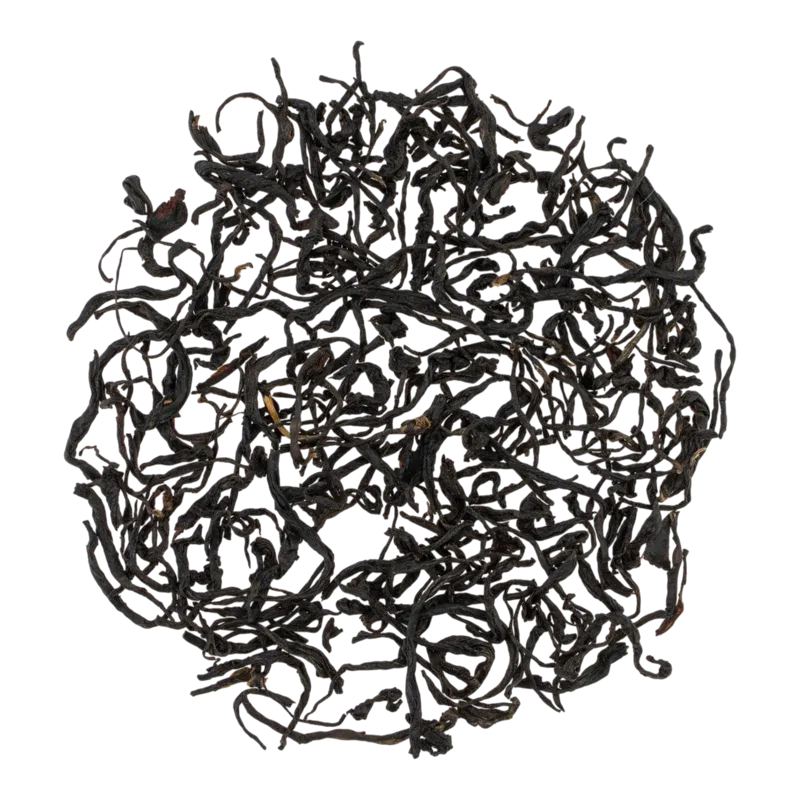
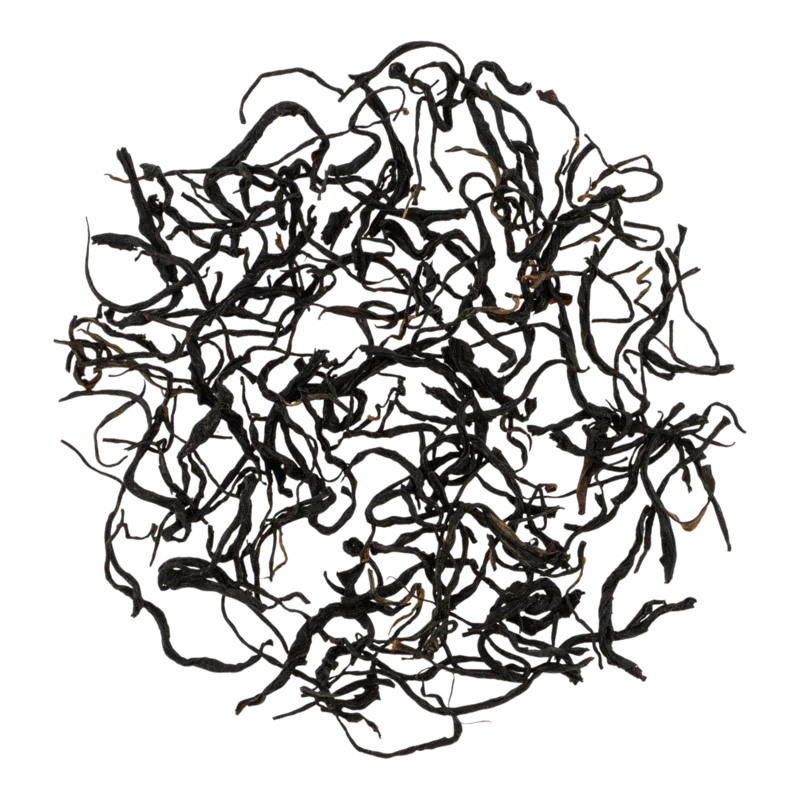
Dry Leaf Appearance: Neatly rolled longitudinal strips of dark brown or black color, dense and oily in appearance. Characteristic presence of golden tips (buds), giving the loose tea contrasting variegation. Leaf is whole, even, without crumbs — sign of quality hand processing.
Dry Leaf Aroma: Rich, warm, enveloping. Cocoa bean and dark chocolate notes dominate, supported by dried fruit tones (prunes, raisins), light caramel sweetness, and subtle woody-spicy note.
Liquor Aroma: Unfolds gradually and evolves from steeping to steeping. In first steepings, cocoa and dark chocolate notes dominate; in middle steepings, honey and caramel tones come to the fore; in late steepings, dried fruit and warm wood tones appear. Aroma is persistent, remains in empty cup (留杯香, liúbēi xiāng).
Liquor Color: Bright, clear, rich red-amber color with golden rim — characteristic sign of high-quality Yunnan red tea (black tea).
Spent Leaves: Large, whole, elastic leaves of copper-brown color, evenly oxidized, with well-preserved structure.
Taste: Rich, dense, with pronounced "body" and smooth, enveloping texture. Honey-caramel profile forms the base, complemented by chocolate depth and soft malty sweetness. Astringency is minimal, bitterness absent with proper brewing. Aftertaste is long, warming, with warm honey notes and light spiciness.
Alkaloids: Caffeine (theine) — main tonic component, content in Yunnan large-leaf red teas (black teas) averages 30–50 mg/g dry matter. Theobromine and theophylline are also present.
Amino Acids: L-theanine (1.2–2.3% of dry matter) — main amino acid of tea, providing mild relaxing effect and "sweet" taste component. Balance of L-theanine and caffeine creates characteristic state of "alert calm."
Intense ultraviolet radiation at Yunnan altitudes stimulates anthocyanin synthesis — pigments with pronounced antioxidant properties, contributing to taste complexity.
High-temperature final heating (提香) promotes Maillard reactions and caramelization, forming cocoa, caramel, and roasted nut notes.
Minerals: Potassium, magnesium, manganese, zinc, fluorine, iron. Mineral profile enriched by deep ferrallitic soils.
Polyphenols: Total content in original raw material reaches 18% or more calculated on dry matter — significantly higher than small-leaf varieties. During complete oxidation, catechins transform into theaflavins (茶黄素, cháhuángsù, 0.3–1.5%) — "soft gold of tea," responsible for brightness and "liveliness" of liquor, and thearubigins (茶红素, cháhóngsù, 5–11%) — pigments determining depth of red color and fullness of taste.
Vitamins: B-group vitamins (B₁, B₂, B₃), vitamin E. Vitamin C content significantly decreases during complete oxidation.
High caffeine content combined with L-theanine provides sustained increase in alertness and concentration without sharp peaks and drops.
Theaflavins, thearubigins, and anthocyanins — complex of powerful antioxidants reducing oxidative stress and helping neutralize free radicals.
Theaflavins are known for their ability to help maintain normal cholesterol levels. They are often called "soft gold" (软黄金, ruǎn huángjīn) of tea precisely for this effect.
Red tea (black tea) is traditionally considered beneficial for digestion, stimulating gastric juice secretion. Especially useful after heavy and fatty meals.
In traditional Chinese medicine, Yunnan red tea (black tea) belongs to "warm" (温性, wēnxìng) beverages, recommended in cold seasons and for people with "cold" constitution.
Tea polyphenols possess moderate antimicrobial properties.
Synergy of caffeine and L-theanine improves working memory, reaction speed, and concentration ability.
Complex of polyphenols, vitamins, and minerals supports general body resistance.
With European method, steep 3–4 minutes. Using soft water with low mineralization promotes fuller extraction and better aromatic profile development.
Teaware: Yíxīng clay teapot (紫砂壶, zǐshā hú) — classic choice for Yunnan red teas (black teas), rounding taste and emphasizing depth. Porcelain gàiwǎn (盖碗, gàiwǎn) allows more precise extraction control and aroma evaluation. Glass teapot provides opportunity to admire beautiful liquor color.
Water Temperature: 90–95°C. Yunnan large-leaf red tea (black tea) tolerates high temperatures well, but boiling water may increase astringency.
Container: Airtight opaque container — ceramic tea caddy, tin can, or vacuum bag. Ceramic is preferable for long-term storage.
Humidity: No more than 60%. Avoid moisture contact.
Light: Protection from direct sunlight and artificial lighting.
Shelf Life: With proper conditions, red tea (black tea) maintains quality up to 2–3 years. Some Yunnan Gongfu Hongs with proper storage can develop additional softness and depth over time.
Store isolated from products with strong odors (spices, coffee, perfumery).
Temperature: Stable, room temperature (15–25°C), without sharp fluctuations.
A classic Yunnan red tea of the highest grade, consisting predominantly of golden buds. A more "pure," tippy profile with predominant honey-malt notes. Hong Feng Gao Xiang, due to the "gao xiang" technique, possesses more pronounced chocolate-cocoa tones and a deeper, more "roasted" character.
One of the three greatest red teas in the world. Small-leafed, with a delicate, refined "Qimen aroma" (orchid, honey, dried fruits). Unlike the powerful, full-bodied Hong Feng Gao Xiang, Qimen represents elegance and refinement.
A Fujian red tea, the progenitor of all red teas in the world. The traditional variant possesses a characteristic smoky aroma (smoking over pine wood). Hong Feng Gao Xiang lacks smokiness, offering instead chocolate-honey depth.
A Yunnan red tea dried in the sun rather than in an oven. Possesses a lighter, fruity-tart profile and aging capability (like pu-erh). Hong Feng Gao Xiang, having undergone high-temperature heating, is its complete opposite: rich, "warm," and stable in flavor from the first day.
Price Category: Hong Feng Gao Xiang is positioned as premium red tea (black tea). Cost depends on specific terroir (high-altitude Fengqing areas valued higher), picking season (spring and summer more expensive than autumn), age of tea bushes (raw material from old trees — gu shu, 古树 — costs significantly more), and producer reputation. On domestic Chinese market, prices for quality Yunnan Gongfu Hongs of "gao xiang" style range from 300 to 1500+ yuan per jin (500 g). On international market — from 15 to 50+ USD per 50 g.
No reviews yet. Tell us what you think of this tea.
Rate this tea and share your impressions. We review each submission before publishing it.