Brewing
Gongfu brewing
- Water temperature
- 93 °C
- Tea amount
- 5 g
- Water volume
- 100 ml
- First steep
- 10 s
- Time added per infusion
- 5 s
- Infusions
- 4

hé hóngchá
Choose a brewing method. Start with the recommended quantities and time, then adjust to taste.
Brewing
Brewing
Taste
Tea encyclopedia
Category: Gōngfū hóng chá (工夫红茶, gōngfū hóngchá) — traditional style of masterful processing. Historically belongs to the family of small varieties (小种, xiǎozhǒng) of Wuyi origin.
Category: Gōngfū hóng chá (工夫红茶, gōngfū hóngchá) — traditional style of masterful processing. Historically belongs to the family of small varieties (小种, xiǎozhǒng) of Wuyi origin.
Coordinates: approximately 27°48′–28°24′ North latitude, 117°44′–117°70′ East longitude. The geographical indication zone covers 1200 hectares.
Origin: China, Jiāngxī Province (江西省, Jiāngxī shěng), Shàngráo City (上饶市, Shàngráo shì), Yánshān County (铅山县, Yánshān xiàn). Main production zones are concentrated in the townships of Tianzhushan (天柱山乡), Huángbì (篁碧乡), Taiyuan (太源乡), Hufang (湖坊镇), Gexianshan (葛仙山乡), Yingjiang (英将乡) and Wǔyí Mountain (武夷山镇). The main historical base is Fozhai Village (佛寨村) on Tianzhushan Mountain, at an altitude of 1200–1500 m.
Type: Chinese red tea (black tea) (红茶, hóngchá), fully oxidized.
Cultural Significance: He Hong Cha occupies a special place in the history of world tea drinking: it was through Hekou that red tea first reached Europe, beginning the tradition of afternoon tea in England. The town of Hekou bears the title "First Town on the Great Tea Road" (万里茶道第一镇). The poet Qīng Chéng Hóngyī (程鸿益) captured the atmosphere of the tea boom in "Hekou Bamboo Branch Poems" (《河口竹枝词》). He Hong Cha is part of the cultural complex of "two treasures of Yanshan" (铅山双绝) alongside the famous Liánsì paper (连四纸).
History: Tea cultivation in Yanshan County dates back to the Song dynasty (960–1279), when local teas — Zhōushān Chá (周山茶), Baishui Tuán Chá (白水团茶) and Xiǎo Lóngfēng Tuán Chá (小龙凤团茶) — were already supplied to the court as tribute tea (贡品, gòngpǐn). During the Ming dynasty, in the Xuande–Zhengde reign periods (1426–1521), the "Yanshan County Gazetteer" (《铅山县志》) first recorded the names "Xiaozhong He Hong" (小种河红) and other local red teas. From the Jiajing period (1522–1566), the town of Hekou became the largest river trade center in southern China and a key hub for tea processing and transportation. According to the Ming "Xinzhou Prefecture Gazetteer" (《信州府志》), "河红茶 is the most famous red tea in the country and the first Chinese tea to enter world trade." During the Wanli period (1573–1620), traders from other provinces flocked to Hekou, Shitan and Chenfang to purchase He Hong Cha. During the Qing dynasty, under Qianlong and Jiaqing, Yanshan's tea trade reached its peak: Hekou alone had 48 tea trading houses, and up to 30,000 people were engaged in red tea processing. Shǎnxī merchants (晋商, jìnshāng) in the 18th century organized large-scale purchases in the Wuyi Mountains, transporting tea through Hekou along the Great Tea Road to Russia and Europe. Russian, English and Indian traders personally came to Hekou for batches of red tea. In 1956, the state tea farm of Hekou was restored, and exports to Japan, Singapore, Europe and Hong Kong resumed. In 1958, tea from Yanshan was awarded by
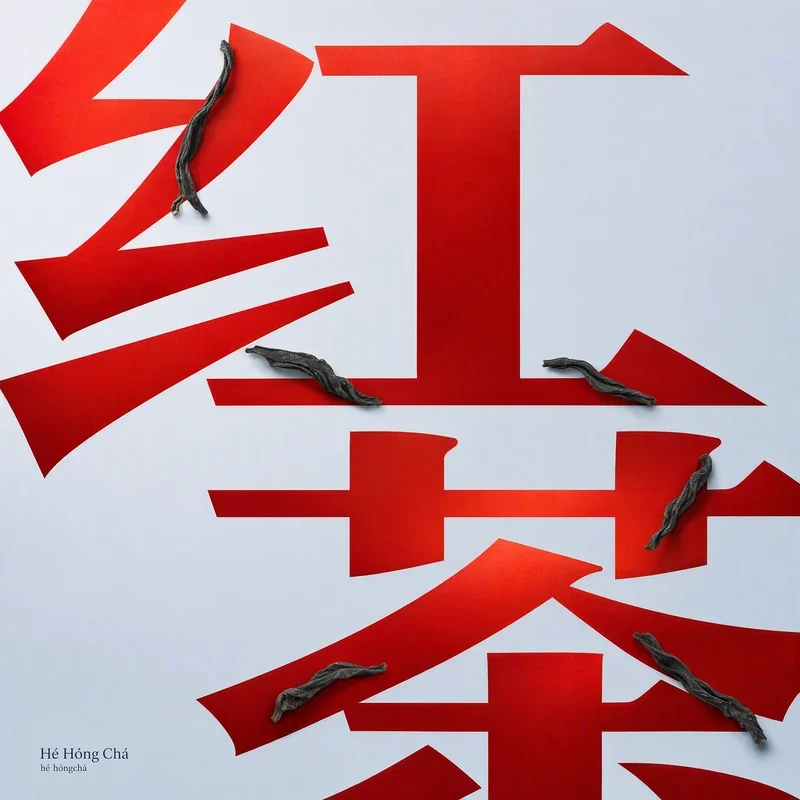
Name Breakdown: The character 河 (hé) means "river" and refers to the town of Hekou — the historic capital of tea trade on the Xìnjiāng River (信江). 红 (hóng) — "red," indicating the red tea category. 茶 (chá) — "tea." The full historical name — Hékǒu Hóng Chá (河口红茶, Hékǒu hóngchá), "red tea from Hekou," later shortened to He Hong Cha. There is also the established expression "河红茶帮" (Hé hóngchá bāng) — "guild of He Hong Cha masters," reflecting the role of Yanshan tea masters who spread red tea technology throughout China during the Ming and Qing dynasties.
Cultivar: Local small-leaf population (中小叶群体种, zhōngxiǎoyè qúntǐzhǒng) Camellia sinensis var. sinensis, growing on the northern slope of the Wuyi Mountains. For the "He Hong Lao Cong" (河红老枞) category, raw material from trees over 70 years old, growing at altitudes above 400 m, is used.
Picking: Spring picking — primary, begins during the Qīngmíng period (清明, early April); summer picking (after the 4th lunar month) yields more mature leaves. Picking is conducted in clear weather, in the morning; fresh leaves are delivered to the factory in bamboo containers without delay.
Pluck Standard: For highest grades — 1 bud + 2 leaves (一芽两叶, yī yá liǎng yè) in the "small opening" stage (小开面), leaf blade width no more than 1 cm. For "He Hong Xiaozhong" (河红小种), up to 1 bud + 3 leaves is acceptable. For "He Hong Lao Cong" (河红老枞) — 1 bud + 3 leaves and more mature raw material of similar tenderness.
Raw Material: Whole, clean leaves without coarse stems and mechanical damage; minimal delay between picking and the start of withering to prevent premature oxidation.
Altitude: Main zone — 400–1500 m above sea level. Original Fozhai plantation — 1200–1500 m. Huangganshan Peak (黄岗山, 2160.8 m) — the highest peak in Eastern China — is located on the county border and creates a unique microclimate.
Climate: Subtropical monsoon, average annual temperature 8.7–17.9°C. Annual precipitation 1733–2000 mm. Frequent fogs and high humidity provide diffused light, favorable for the accumulation of amino acids and aromatic compounds.
Soil: Red and yellow-red soils (红壤, 黄红壤), as well as yellow-brown soils (黄棕壤), acidic, pH 4.5–5.5. Soils between rocky outcrops (岩壑之间) are particularly rich in minerals.
Forest coverage of the county is 74%. The main production zone is within Wǔyì Mountain National Park (武夷山国家公园, Jiangxi sector). Tea gardens are managed according to traditional organic systems: without pesticides and chemical fertilizers; inter-rows are covered with wild grasses to preserve moisture and soil bioactivity; fertilization — compost, oil cake, wood ash.
1 bud + 2(3) leaves, morning hand-picking in clear weather.
Traditional method — sun withering (晒青, shàiqīng) on bamboo mats (竹簟). Layer thickness — about 3 cm, with regular turning. Duration depends on sun strength and raw material condition ("rain leaf" or "sun leaf"). Readiness is determined by leaf darkening to dark green color and elasticity when compressed.
Hand rolling in three stages: first light pressure with slow rotation, then increased pressure with fast rotation, and finishing with gentle pressure and slow rotation. Goal — formation of tight, rounded tea particles with cell juice brought to the surface. After rolling — resting (静置定型) for 10 minutes.
Rolled leaf is exposed to sun for 5 minutes, then placed in wooden vats or bamboo baskets, the bottom of which is lined with a double layer of Liánsì paper (连四纸). The mass is slightly compacted, covered with paper and damp cloth on top. Fermentation takes place in a special room at 20–25°C for 6–8 hours. Readiness: about 80% of the leaf surface acquires a bronze-copper shade, veins redden, fruity aroma appears.
Thermal stopping of oxidation and aroma fixation. Final light heating (roasting) is possible for flavor stabilization.
Leveling the batch by fractions, separating tips, forming grades.
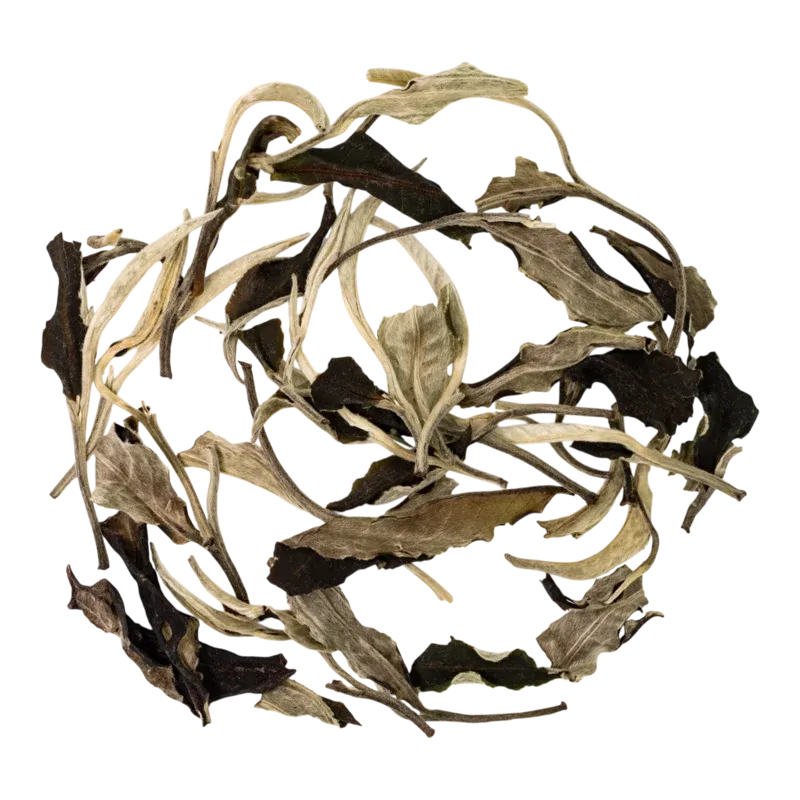
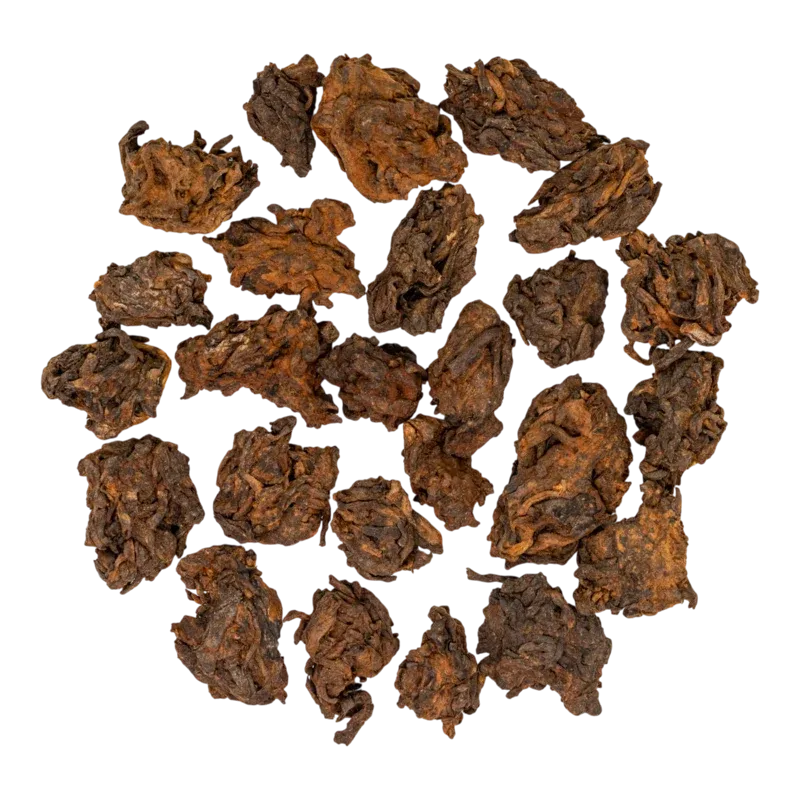
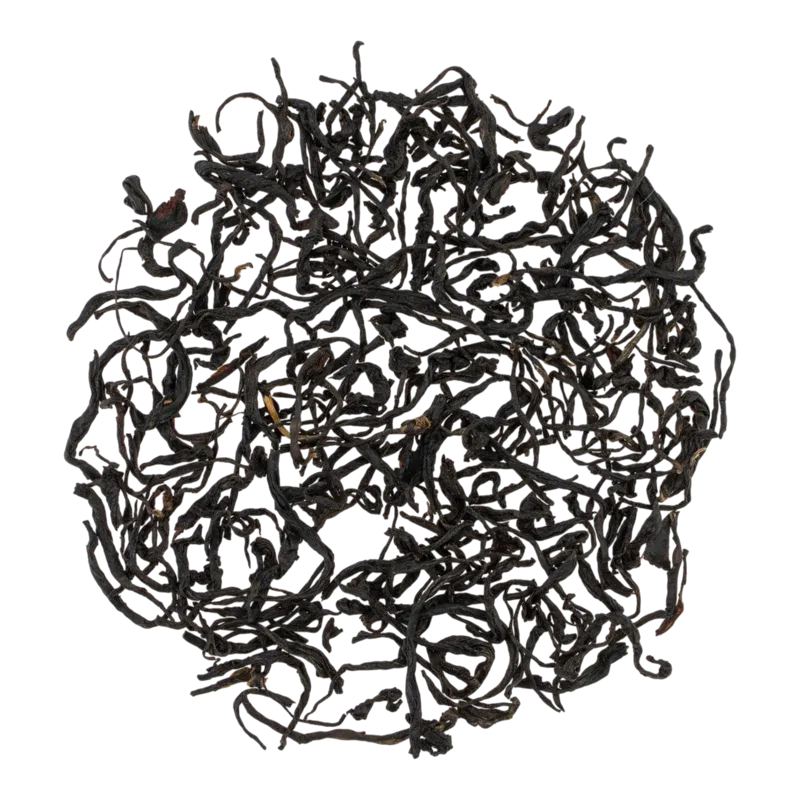
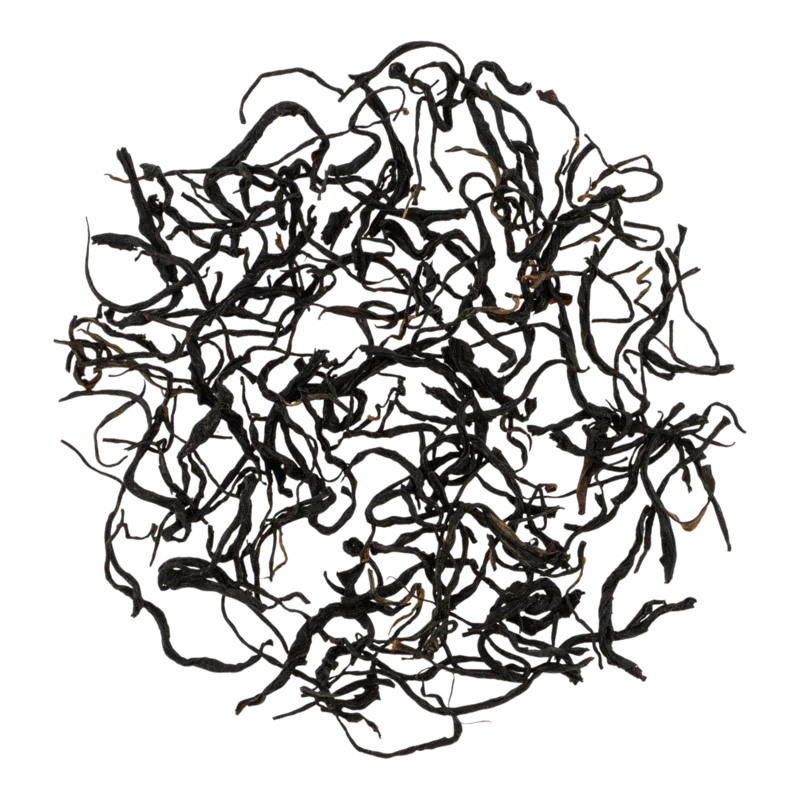
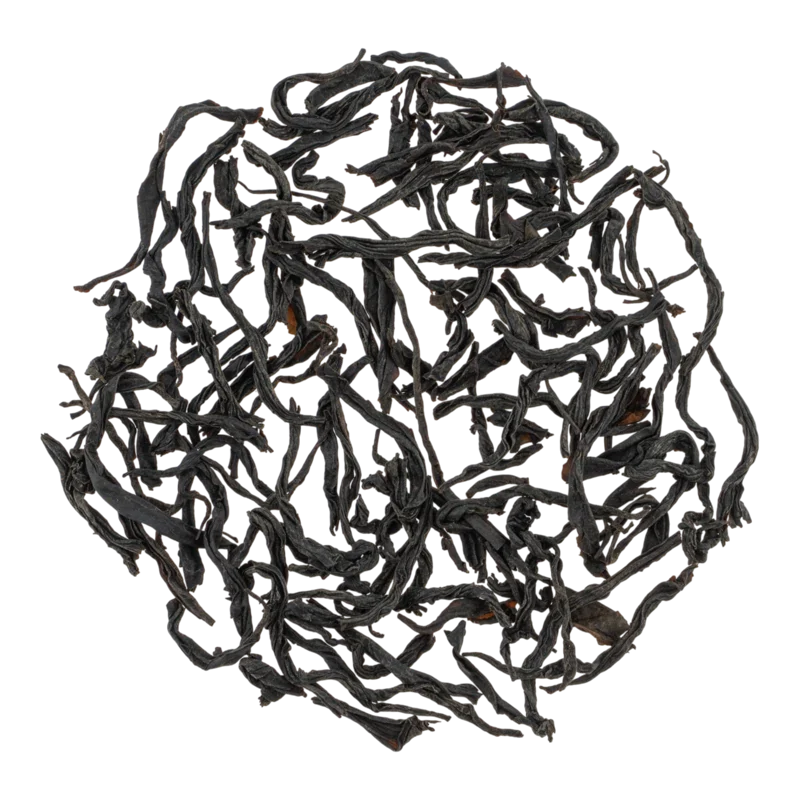
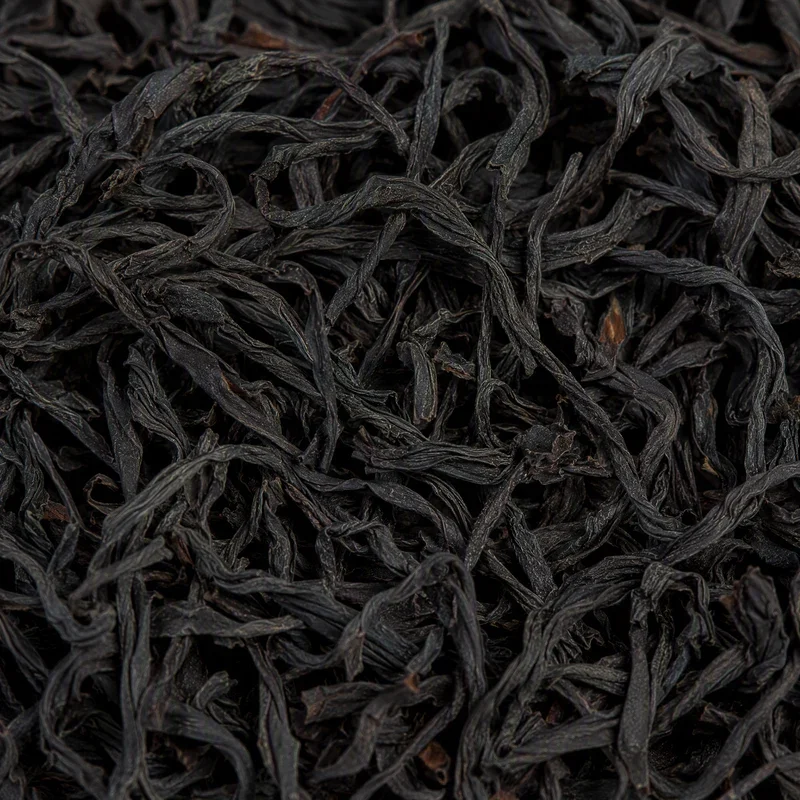
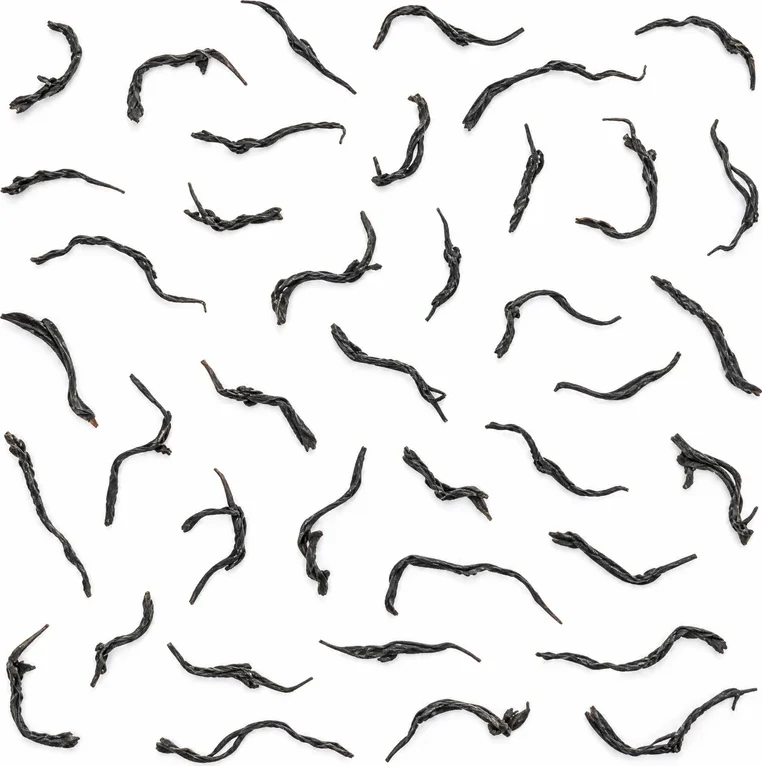
Dry Leaf Appearance: Tightly twisted, even tea particles (条索紧实匀整) with dark, oily luster (色泽乌润). In highest grades — abundance of golden tips (金毫披露).
Dry Leaf Aroma: Deep, honey-sweet with notes of dried longan (桂圆), caramel and light floral undertones. Aroma is high and lasting (甜香高长).
Liquor Aroma: Rich, with dominance of honey and dried fruits; with multiple brewings, nuances of fresh mint and mountain herbs unfold. In aged batches — warm woody tones.
Liquor Color: Red-orange to ruby (红浓), clear and bright, with pronounced golden ring (金圈) on cup walls.
Spent Leaves: Red-copper, elastic, evenly colored. In high grades — leaves are whole, tender.
Taste: Full-bodied, dense and round (醇厚), with pronounced sweetness (甘甜) and silky texture (绵甜爽滑). Astringency is mild, quickly transitioning to prolonged sweet aftertaste (回甘快好). Dense mouthfeel (杯底香浓). When brewing over 10 infusions, characteristic minty freshness appears.
Alkaloids: Caffeine (2.5–4.0% dry weight), theobromine, theophylline. Synergy of caffeine and L-theanine gives mild, sustained tonic effect without sharp peak.
Amino Acids: High-altitude origin and acidic soils promote increased accumulation of L-theanine, which provides characteristic sweetness and taste smoothness. Free amino acid content in raw material is above average for red teas.
Rich complex of essential oils and volatile compounds — linalool, geraniol, methyl salicylate, phenylacetaldehyde — forms characteristic honey-fruity profile with minty nuances.
Climatic conditions of the region — frequent fogs, abundant precipitation and large day/night temperature differences — promote intensive accumulation of aromatic substances and amino acids with relatively low crude fiber content.
Minerals: Potassium, magnesium, manganese, zinc, fluorine, selenium — due to mineral richness of Wuyi mountain soils.
Polyphenols: Total tea polyphenol content typical for gongfu hong cha. During oxidation, a significant portion of catechins is converted to theaflavins (TF — form brightness and "golden ring" of liquor) and thearubigins (TR — responsible for color depth and "velvety" taste).
Vitamins: C (partially preserved), B₁, B₂, PP.
Highest grade from the most tender buds, heir to imperial tribute traditions.
Classic category, produced by traditional small variety technology from 1 bud + 1–2 leaves raw material of small-leaf population.
Special category from raw material of trees over 70 years old, growing at altitudes above 400 m. Standard — 1 bud + 3 leaves. Distinguished by taste depth, minerality and "woody" sweetness.
Tèjí (特级, tèjí — supreme) and further standard quality levels by leaf size, proportion of tips and twist evenness.
Tea Amount: 4–6 g per 100–120 ml (gongfu method) or 2–3 g per 200–250 ml (steeping in cup/teapot).
Teaware: Gàiwǎn (盖碗) 100–120 ml — optimal choice for aroma development; porcelain teapot for soft, round liquor; for dense "Lao Cong" batches, Yixing teapot from red or zhuni clay is suitable.
Water Temperature: 90–95°C for standard batches; 85–90°C for delicate highest grades with abundance of tips.
Closest "relative" — both teas originate from the Wuyi Mountains, but from different slopes: Zheng Shan Xiao Zhong — from the southern (Fujian), He Hong Cha — from the northern (Jiangxi). Traditional Zhèng Shān Xiǎo Zhǒng is distinguished by characteristic smoky aroma of pine wood (松烟香), while He Hong Cha has a clean honey-fruity profile without smoky notes.
Anhui "Keemun" is famous for complex aroma with rose-fruity nuances (祁门香). He Hong Cha is simpler in aromatics but denser and sweeter in taste, with more pronounced liquor "body." Historically, He Hong Cha is older than Keemun by about two centuries.
Yunnan red tea from large-leaf varieties C. sinensis var. assamica is distinguished by powerful, malty taste and thick orange-golden liquor. He Hong Cha, produced from small-leaf raw material, is more elegant and delicate, with higher and cleaner aroma.
Modern premium red tea from the same Wuyi territories, but from pure buds. Jin Jun Mei is lighter and more refined, with pronounced floral-honey sweetness; He Hong Cha is denser and more "bodied," with deep honey character.
No reviews yet. Tell us what you think of this tea.
Rate this tea and share your impressions. We review each submission before publishing it.