Brewing
Gongfu brewing
- Water temperature
- 75 °C
- Tea amount
- 5 g
- Water volume
- 100 ml
- First steep
- 10 s
- Time added per infusion
- 5 s
- Infusions
- 3

Gùzhǔ Zǐ Sǔn
Choose a brewing method. Start with the recommended quantities and time, then adjust to taste.
Brewing
Brewing
Taste
Tea encyclopedia
Category: Historical tribute tea (贡茶, gòngchá) with the longest continuous tribute history in China—876 years (763–1375). Confirmed in 1982 as a "National Famous Tea" (国家级名茶). Geographical indication product.
Category: Historical tribute tea (贡茶, gòngchá) with the longest continuous tribute history in China—876 years (763–1375). Confirmed in 1982 as a "National Famous Tea" (国家级名茶). Geographical indication product.
Coordinates: Approximately 30°52′ North latitude, 119°50′ East longitude.
Origin: China, Zhèjiāng Province (浙江, Zhèjiāng), Chángxīng County (长兴县, Chángxīng Xiàn), Mount Guzhushan (顾渚山, Gùzhǔ Shān). The production zone covers the southwestern and northwestern low-mountain areas of the county, including the districts of Guzhushan, Sanruowu (桑孺坞), and Xuanjiaolin (悬脚岭).
Type: Green tea (non-oxidized). By technology—half pan-fired, half oven-dried (半炒半烘, bàn chǎo bàn hōng): a combination of wok firing (炒) and oven drying (烘), which allows for combining tight rolling with delicate, floral aroma.
Cultural Significance: Guzhu Zisun is one of the key teas in the history of Chinese tea culture. It was around this tea that China's first state system of tea tribute developed. In modern Changxing, the Táng Dynasty Tribute Tea Palace (大唐贡茶院, Dà Táng Gòngchá Yuàn) has been recreated—a museum-production complex reproducing the technology of pressed tea cakes (饼茶, bǐngchá) from the Tang period. The tea remains a symbol of Changxing and a crucial element of the region's cultural heritage.
History: The history of Gùzhǔ Zǐsǔn is inseparably linked with the name of Lù Yǔ (陆羽, 733–804)—the "tea sage" (茶圣, chá shèng), author of "The Classic of Tea," the foundational treatise on tea. It was Lu Yu, who lived in Changxing and personally researched the tea mountains of the region, who during the Guangde period (广德, 763–764) recommended tea from Mount Guzhu to the imperial court—and from this moment began an unprecedented history of tribute.
Cultivar: Local indigenous varieties of Camellia sinensis var. sinensis, adapted to the conditions of Mount Guzhu. A distinctive feature of the raw material is that young buds have a light purple (anthocyanin) pigment, which is related to the special genotype of local populations and reaction to the mountain microclimate. It was precisely this purpleness that Lu Yu noted as a sign of supreme quality.
Picking: Main spring harvest. For premium grades—standard of "one bud with one barely opened leaf" (一芽一叶初展). To produce 500 g of dry tea requires approximately 36,000 buds—an indicator of high labor intensity.
Pluck Standard: Strict selection: tender, uniform shoots without coarse leaves and damage. Processing—on the day of harvest.
Raw Material: Buds and young leaves with characteristic purple tint. The leaf should be juicy, fleshy, covered with fine down.
Altitude: 100–500 meters above sea level. The terroir core is the Shuǐkǒu district (水口乡), the peak of Mount Guzhu (355 m), nestled between the Xuanjujie (悬臼岕) and Zhuoshejie (斫射岕) gorges, facing Taihu on the eastern side.
Climate: Subtropical humid, with mild winters and abundant precipitation. Average annual temperature—15.6°C, annual precipitation—1309 mm. The mountains are often shrouded in clouds and fog, creating diffused light and promoting amino acid accumulation in leaves.
Soil: Deep, fertile, slightly acidic (pH 4.5–6.5). Yellow clay-sandy soils (黄泥沙土) and "ash" soils (香灰土, xiānghuī tǔ) with exceptionally high organic matter content (2–7%) predominate. It is precisely the "ash" soils of the core zone that are considered a key factor determining the special mineral profile and depth of flavor of the finest batches.
Mount Guzhushan belongs to the low-mountain hilly zone. Slopes are gentle, with rich vegetation. Nearby is Lake Taihu, which influences the microclimate.
Fresh raw material is spread in a thin layer in a cool room for brief withering, removal of excess moisture, and initiation of aromatic precursor formation.
Pan-firing in a heated wok to stop enzyme oxidation. Temperature and work speed ensure fixation of green aromatics and purple pigment.
Leaves are manually shaped, giving them a straight, tight form resembling bamboo shoots.
Cooling and moisture redistribution.
Drying at moderate temperature to reduce moisture and fix shape.
Final drying at reduced temperature to stable condition. Double oven drying ensures deep, persistent aroma and long preservation.
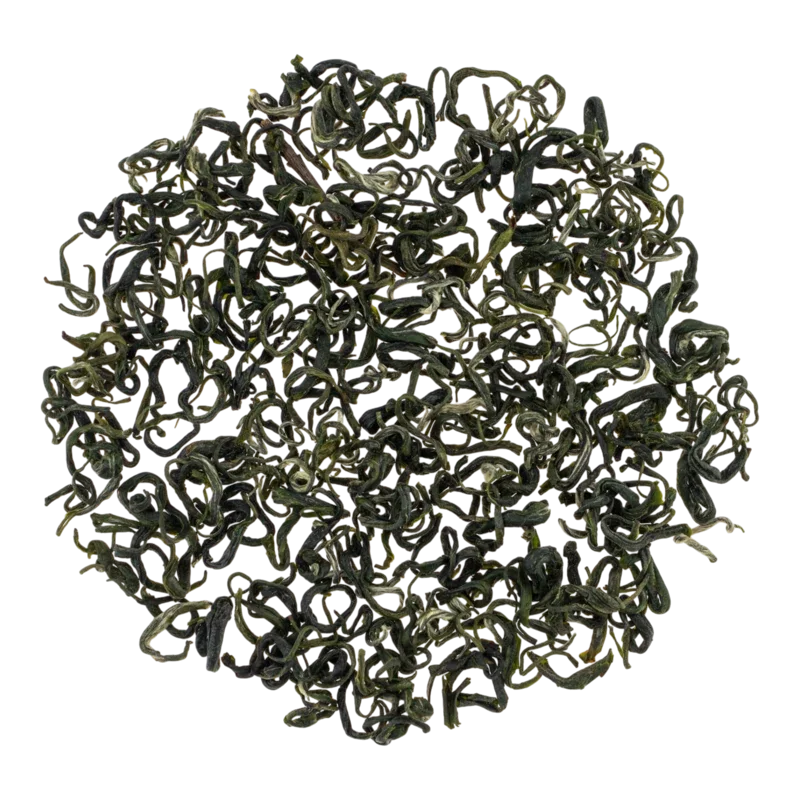
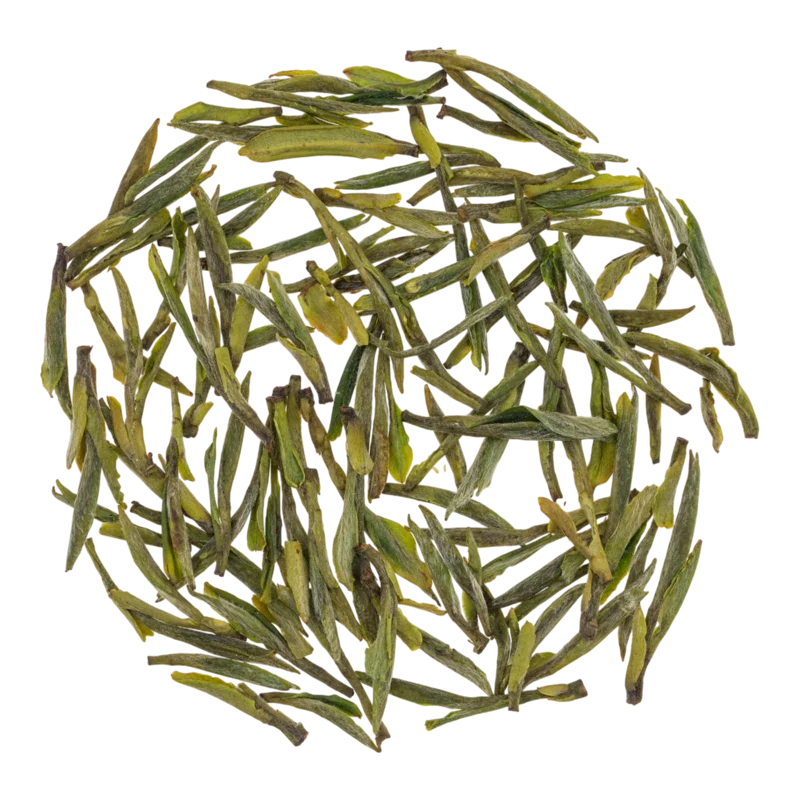
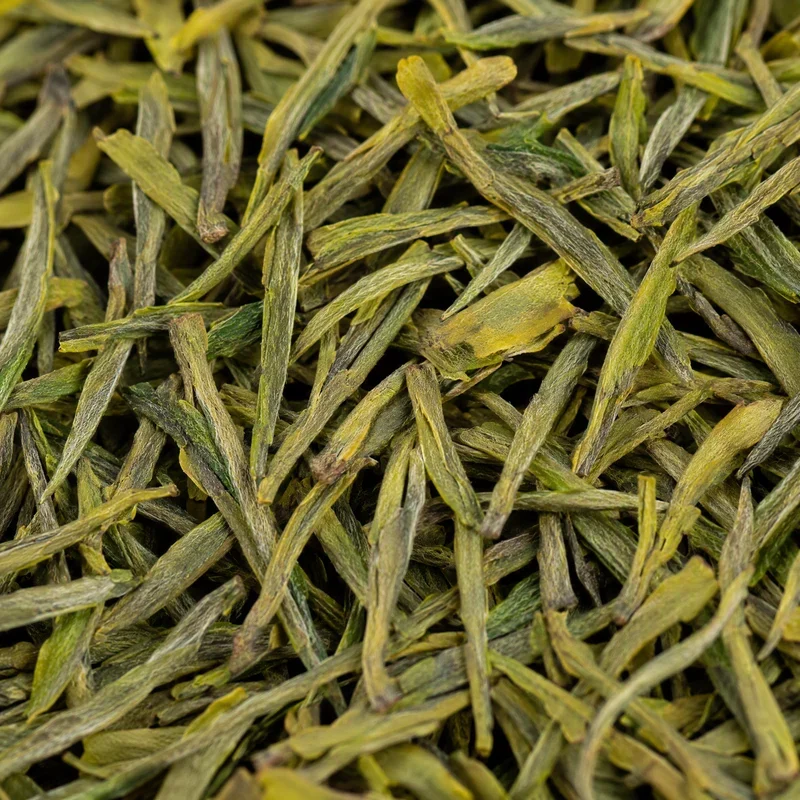
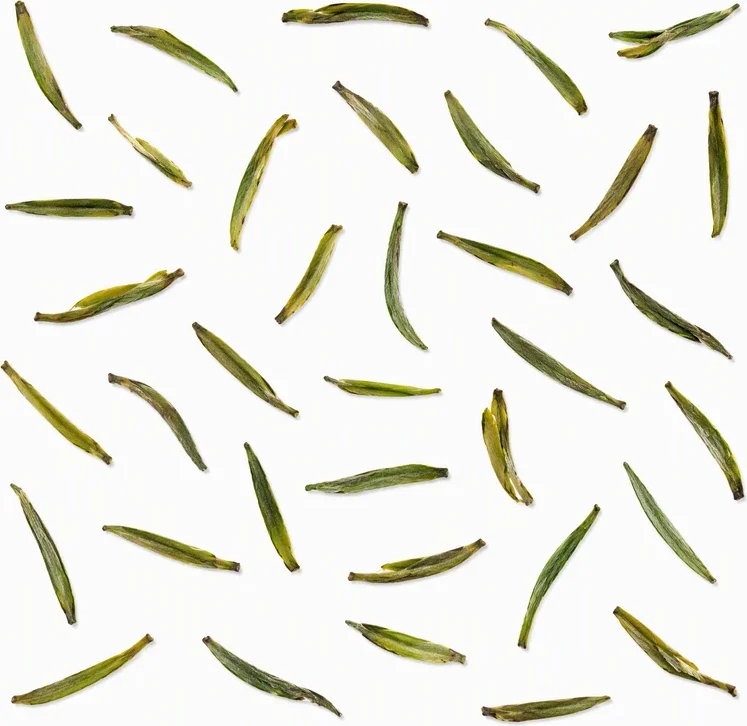
Dry Leaf Appearance: Straight, tight shoots resembling bamboo "shoot-arrows" (紧直如笋). Color—green with light purple sheen (characteristic sign of authentic Guzhu Zisun). After brewing, leaves unfold, taking the form of orchid flowers (兰花状, lánhuā zhuàng).
Dry Leaf Aroma: Clean, fresh, with pronounced orchid note (兰花香, lánhuā xiāng). Delicate aroma of young buds (嫩香, nèn xiāng), without grassiness.
Liquor Aroma: Orchid-like, persistent and elegant. Clean and high (清香). Aroma persists through several brewings.
Liquor Color: Tender green, clean and transparent, with lively brightness.
Spent Leaves: Tender, unfolded shoots resembling orchid petals. Leaf is light green, uniform, resilient, without damage.
Taste: Fresh and brisk (鲜爽, xiānshuǎng), soft and round (鲜醇, xiānchún), with gentle sweetness (甘醇, gānchún) and silky texture (甘滑, gānhuá). Astringency is minimal, bitterness practically absent. Aftertaste—long, clean, sweetish.
Alkaloids: Caffeine—moderate content providing mild tonic effect. Theobromine, theophylline.
Amino Acids: Elevated content—key factor in softness, sweetness, and umami note of taste. High theanine level is explained by foggy microclimate and organic-rich soils.
Purple pigment of young buds is due to the presence of anthocyanins—a group of flavonoid compounds with pronounced antioxidant properties. This is a distinctive chemical feature of Guzhu Zisun among green teas.
Minerals: Potassium, magnesium, zinc, manganese—profile determined by organic-rich soils of Mount Guzhu.
Polyphenols: Moderate content—result of abundant diffused light and mild climate. Catechins provide light structural depth without pronounced astringency.
Vitamins: Vitamin C, B-group vitamins, carotenoids.
Caffeine combined with L-theanine provides gentle, focused alertness.
Complex of amino acids and alkaloids promotes recovery after mental and physical exertion.
Catechins and anthocyanins neutralize free radicals.
Polyphenols promote vascular elasticity (抑制动脉硬化).
Stimulation of digestive enzyme secretion.
The infusion excellently quenches thirst.
the listed properties are based on publicly available data and are not medical recommendations.
brew immediately and drink hot—it is precisely at high infusion temperature that the orchid aroma maximally unfolds. Do not oversteep (avoid "闷泡") to prevent increased astringency.
Tea Amount: 3 g per 150 ml water (1:50 ratio).
Teaware: Glass cup (玻璃杯)—for observing the unfolding of "bamboo shoots" into orchid flowers. White porcelain gàiwǎn (盖碗)—for precise aroma control.
Water Temperature: 85–95°C. Guzhu Zisun is one of the few green teas for which relatively high brewing temperature (up to 95°C) is acceptable, thanks to tight rolling and fleshy raw material.
Flat leaf, chestnut-bean aroma. Longjing—"tribute tea" from 17th century, Guzhu Zisun—from 8th century. By style: Longjing—structural and umami-oriented; Guzhu Zisun—more orchid-like and silky.
From Sichuan Province. Also ancient "tribute tea" (from 742), rolled leaf with floral aroma. Ganlu—more "dewy" and sweet; Guzhu Zisun—more linear in form and with characteristic purple tint.
From Anhui Province. Another historical tea mentioned by Lu Yu. Songluo—more grassy and astringent; Guzhu Zisun—more delicate and sweet.
From neighboring Yixing (Jiangsu). Also Tang "tribute tea." Xueya—more needle-like and "snowy"; Guzhu Zisun—more "bamboo-like" in form and more orchid-like in aroma.
authentic Guzhu Zisun buds have light purpleness—this is natural anthocyanin pigment, not a defect.
characteristic orchid tone, clean and fresh. Absence of floral character is reason for doubt.
when brewed, leaves should unfold into characteristic "orchid" rosettes.
suspiciously low price is a sure sign of counterfeit.
No reviews yet. Tell us what you think of this tea.
Rate this tea and share your impressions. We review each submission before publishing it.