Brewing
Gongfu brewing
- Water temperature
- 93 °C
- Tea amount
- 5 g
- Water volume
- 100 ml
- First steep
- 10 s
- Time added per infusion
- 5 s
- Infusions
- 4

Gùzhǔhóng
Choose a brewing method. Start with the recommended quantities and time, then adjust to taste.
Brewing
Brewing
Taste
Tea encyclopedia
Category: Regional red teas of Zhejiang. Modern artisanal product based on the terroir and raw material base of the ancient tea region of Guzhu.
Category: Regional red teas of Zhejiang. Modern artisanal product based on the terroir and raw material base of the ancient tea region of Guzhu.
Coordinates: Approximately 31°01′ N, 119°52′ E (Mount Guzhu, Shuikou Township, Changxing County).
Origin: China, Zhèjiāng Province (浙江省, Zhèjiāng Shěng), prefecture-level city Húzhōu (湖州市, Húzhōu Shì), Chángxīng County (长兴县, Chángxīng Xiàn), Shuǐkǒu Township (水口乡, Shuǐkǒu Xiāng), Mount Gùzhǔ area (顾渚山, Gùzhǔ Shān). Guzhu is the cradle of "The Classic of Tea": it was here that Lù Yǔ (陆羽, Lù Yǔ) completed his work on "Cha Jing" (茶经), and the imperial tea court of the Tang dynasty erected the first tribute tea factory in Chinese history — Gòngchá Yuán (贡茶院).
Type: Chinese red tea (black tea) (红茶, hóngchá), fully oxidized.
Cultural Significance: Guchuhong allows one to rediscover one of the world's most historically significant tea terroirs. For a region whose identity for centuries was inseparably linked with green tribute tea, the appearance of red tea is a symbol of living tradition able to adapt to the demands of time. Guchuhong is interesting to connoisseurs already familiar with Guzhu Zisun: it provides an opportunity to compare how the same raw material and the same terroir manifest themselves under radically different processing technology. Changxing County remains one of the key "tea tourism" centers of Zhejiang: here is located the restored complex of Dà Tāng Gòngchá Yuán (大唐贡茶院), stone steles with inscriptions by Tang poets and governors, as well as Jinshaquan spring (金沙泉) — "Golden Sand Spring," which Lu Yu considered the best water for brewing tea.
History: The tea history of Mount Guzhu spans more than 1,250 years. As early as the Tāng dynasty (唐朝), the region was famous for producing green pressed tea Gùzhǔ Zǐsǔn (顾渚紫笋, Gùzhǔ Zǐsǔn) — "Purple Shoots from Mount Guzhu," which became in 770 CE (fifth year of Dali reign, 大历五年) the first official tribute tea for the imperial court. Guzhu Zisun tea remained tribute tea for nearly nine centuries — one of the longest periods of "tea tribute" in Chinese history. Tea sage Lu Yu (733–804) personally established tea gardens on Mount Guzhu and wrote the famous "Guzhu Shan Ji" (顾渚山记, "Records of Mount Guzhu"), considering the local tea "first under heaven." At Gùzhǔ Gòngchá Yuán (顾渚贡茶院) during its heyday, more than a thousand masters and thirty thousand seasonal workers labored; next to the factory functioned Jinghuiting (境会亭) — a pavilion for tea banquets, where governors, officials, and literati gathered.
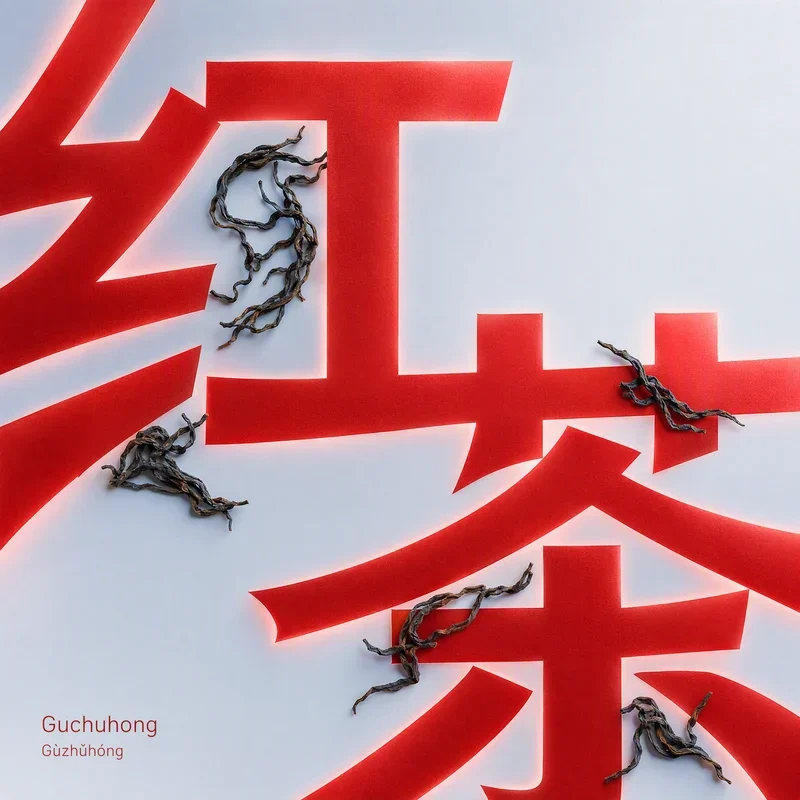
Name Breakdown: "Guzhu" (顾渚) is a toponym of the mountain and adjacent village in Changxing County. The etymology traces back to an ancient landscape description: according to "Huanyuji" (《寰宇记》), Prince Wǔ Fugai (夫概) "surveyed (顾) this shore (渚)" and recognized the locality as suitable for a capital. "Hong" (红) — "red," indicates the tea type (红茶, hongcha). Thus, the full name means "Red tea from Mount Guzhu."
Cultivar: The foundation is the local population of small-leaf variety Camellia sinensis var. sinensis (群体种), historically growing on the slopes of Guzhu and in surrounding villages. This same varietal foundation is used for producing green tea Guzhu Zisun. The shoots are distinguished by delicate texture, pronounced down, and elevated amino acid content, inherited from centuries of cultivation in conditions of humid mountain microclimate. Some farms additionally use breeding cultivars selected to enhance sweetness and liquor density.
Picking: Main season — spring (March–April). The best batches are harvested before Qīngmíng festival (清明) or in the first days after it. Summer harvest is also possible, yielding coarser but denser leaf.
Pluck Standard: One bud and one-two leaves (一芽一叶 — 一芽二叶) for standard batches; for premium — bud with one tender leaf or purely tippy harvest (单芽).
Raw Material: Fresh, whole leaf without mechanical damage and coarse stems; minimal interval between harvest and beginning of withering; uniformity of shoots by degree of maturity.
Altitude: 200–355 m above sea level. Tea gardens are located predominantly on gentle mountain slopes and in intermountain valleys (岕, jiè), protected from sharp winds.
Climate: Subtropical monsoon with pronounced influence of Taihu; average annual temperature 15–16 °C; average annual precipitation 1,200–1,400 mm. High humidity, frequent morning fogs, and gentle diffused light create ideal conditions for accumulation of amino acids and aromatic substances in tea leaves. Lu Yu noted that "tea born in these places is of the highest class" (茶生其间,尤为绝品).
Soil: Weakly acidic (pH 4.5–6.0) yellow-brown mountain soils (山地黄棕壤) with high organic content and good air permeability. Rocky substrate provides excellent drainage and imparts fine minerality to the tea.
Traditional hand picking; many farms adhere to ecological practices. Bamboo groves and mixed forests around plantations form a natural ecosystem, reducing the need for pesticides.
Hand selection of tender shoots; for red tea, slightly more mature leaf is acceptable than for Guzhu Zisun, which provides the necessary "fullness" of body.
Leaves are spread in a thin layer on bamboo trays in a ventilated room or under diffused sunlight. Goal — reduce moisture to 58–62%, impart elasticity and initiate initial biochemical processes. Duration 10–16 hours. Withering is the key stage of "tuning" the aromatic profile: it is here that honey and fruit notes are established.
Leaf formation and release of cellular juice for uniform oxidation. Small-leaf Zhejiang raw material is rolled delicately to preserve integrity and avoid excessive astringency. Duration 40–60 minutes with gradual pressure increase.
Rolled leaf is laid in a layer 6–10 cm in rooms with controlled temperature (26–30 °C) and humidity (90–95%). During oxidation, catechins transform into theaflavins and thearubigins, forming the characteristic color and "body" of red tea. Duration 3–4 hours; readiness criterion — rich fruit-floral aroma and uniform copper-red leaf color.
Two-stage drying: first stage at elevated temperature to stop fermentation and fix aromatics; after intermediate cooling — second stage at moderate temperature for delicate completion to final moisture content (5–6%). Individual masters apply additional final heating (提香) to accentuate honey-caramel notes.
Separation of finished tea by fractions (leaf size, tip proportion) and quality level. Removal of broken fragments, stems, and foreign inclusions.
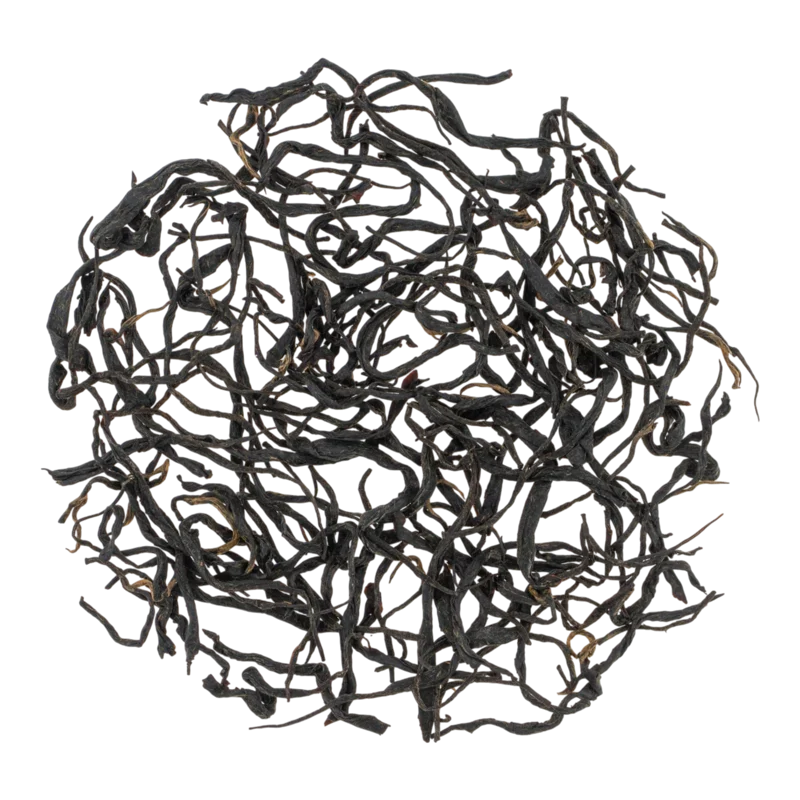
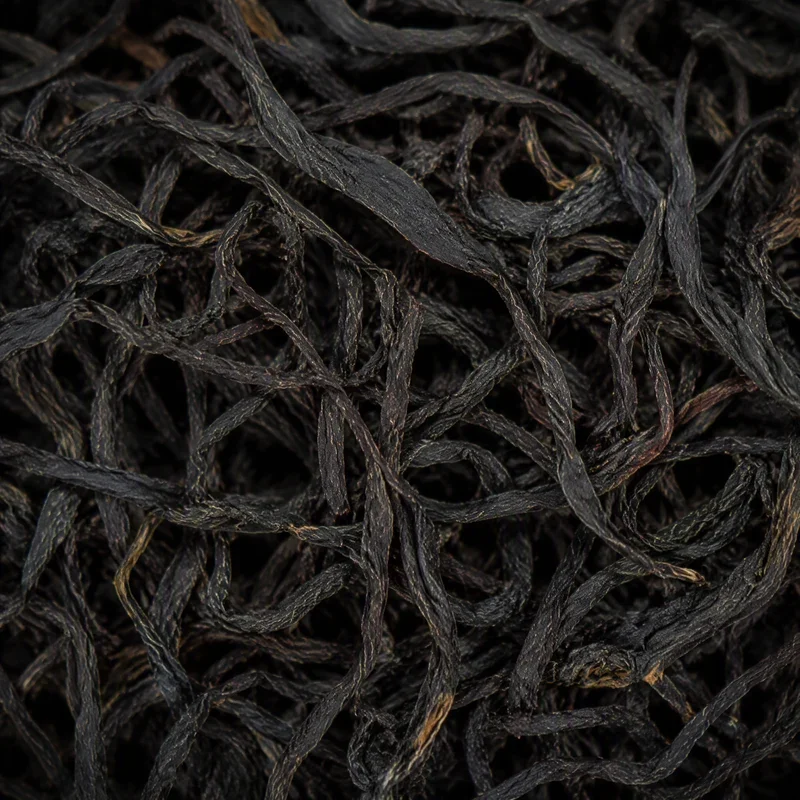
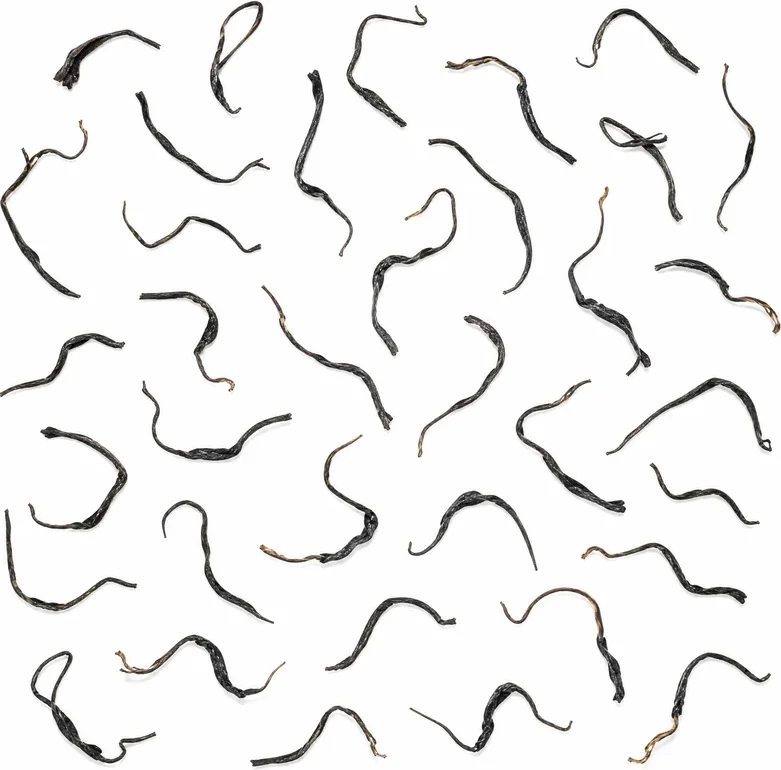
Dry Leaf Appearance: Tightly twisted, neat threads of medium length; color — dark chestnut to black with natural luster; in higher grades, pronounced silvery or golden tips are noticeable (显毫, xiǎnháo).
Dry Leaf Aroma: Warm, sweetish — honey, dried fruits (date, apricot), light bread tone. Clean, without foreign notes.
Liquor Aroma: Multi-layered — from initial honey and dried fruit notes to bread-caramel tones; in cooling liquor, delicate woody note emerges. Aroma is persistent, "enveloping."
Liquor Color: From amber to red-chestnut, transparent and clean, with lively luster.
Spent Leaves: Leaf unfolds uniformly and elastically; color from copper-brown to reddish-chestnut, texture soft, without coarse veins.
Taste: Dense and rounded (醇厚, chúnhòu); clean natural sweetness — without oily heaviness, but with perceptible "body"; astringency moderate, gently dissolving in long warming aftertaste. In the best batches, fine minerality is perceptible, inherited from the rocky soils of Guzhu.
Alkaloids: Caffeine 2–3.5% dry mass (approximately 35–55 mg per 200 ml cup); theobromine and theophylline in trace amounts.
Amino Acids: 2–4%, including L-theanine — key component of taste softness and sweet aftertaste. Raw material from Mount Guzhu is historically famous for elevated amino acid content thanks to frequent fogs and diffused lighting.
Complex of terpenes (linalool, geraniol) and Maillard reaction products, forming honey-fruit-caramel profile. Variations in final heating allow shifting balance toward either "fresh" (fruity) or "warm" (caramel-chocolate) notes.
Minerals: Potassium, magnesium, manganese, zinc, fluorine; trace element composition determined by mineralization of Guzhu mountain soils.
Polyphenols: Dominated by catechin oxidation products — theaflavins (TF, responsible for brightness and "golden rim" of liquor) and thearubigins (TR, forming color depth and "velvety" taste). Total polyphenol content — 10–15% dry mass.
Vitamins: B₁, B₂, B₃, vitamin C (partially preserved), vitamin E.
Caffeine in combination with L-theanine supports alertness and concentration with a more even and gentle effect than coffee.
Theaflavins and thearubigins demonstrate pronounced ability to neutralize free radicals, contributing to slowing cellular oxidation processes.
Warm red tea after meals stimulates digestive secretion and promotes food assimilation, especially fatty and meat dishes.
Regular moderate consumption of red tea is associated with maintaining vascular tone and normalizing cholesterol profile.
Red tea of "warm nature" (温性) is especially beneficial in cold weather and for people with sensation of internal cold.
Tea polyphenols provide immunomodulating and mild anti-inflammatory action.
Synergy of L-theanine and caffeine contributes to improvement of working memory, reaction speed, and concentration ability while simultaneously reducing subjective anxiety level.
Red tea antioxidants (primarily theaflavins) contribute to protecting skin cells from UV damage and support healthy tone.
Tea Amount: 4–6 g per 100–120 ml (gongfu); 2–3 g per 200–250 ml (steeping).
Teaware: Porcelain gàiwǎn (盖碗, 100–120 ml) — universal choice, transmitting aroma without distortion. Porcelain teapot suitable for "smoother" liquor. Yíxīng teapot from purple clay (紫砂壶) — for those who prefer more rounded, "enveloping" profile.
Water Temperature: 90–96 °C; for delicate batches with high tip proportion — 88–92 °C.
Famous green tea from the same mountain — direct "green twin" of Guchuhong. Zisun is unoxidized, with bright "bamboo" aroma, fresh grassy taste, and greenish-yellow liquor. Comparison shows how full oxidation radically changes profile: from freshness and "greenness" are born honey, caramel, and warm aftertaste.
Zhejiang red tea from Hangzhou vicinity (Lin'an area). More "fresh" and floral profile, lighter in body, with characteristic "plum" tone in aroma. Guchuhong is denser and "warmer," with more pronounced honey sweetness.
Anhui masterpiece with signature "Qimen aroma" (祁门香) — honey-orchid, "perfumed." Compared to it, Guchuhong is simpler and more "homey," closer to honey and bread, without that "perfumed" complexity, but with perceptible minerality.
Fujian gongfu hongcha with signature "longan aroma." Denser and more "oily" in texture, with more pronounced fruit component. Guchuhong is softer, "drier" in taste, closer to honey-bread spectrum.
Another Zhejiang red tea (from Shaoxing), historically oriented toward export. Denser and coarser, with more pronounced astringency. Guchuhong is more delicate, with finer aromatic profile.
No reviews yet. Tell us what you think of this tea.
Rate this tea and share your impressions. We review each submission before publishing it.