Brewing
Gongfu brewing
- Water temperature
- 93 °C
- Tea amount
- 5 g
- Water volume
- 100 ml
- First steep
- 10 s
- Time added per infusion
- 5 s
- Infusions
- 4

Gǔzhàng hóngchá
Choose a brewing method. Start with the recommended quantities and time, then adjust to taste.
Brewing
Brewing
Taste
Tea encyclopedia
Category: Chinese red tea (black tea) of the gongfu category (工夫红茶, gōngfū hóngchá). Product with protected geographical indication (地理标志产品, dìlǐ biāozhì chǎnpǐn).
Category: Chinese red tea (black tea) of the gongfu category (工夫红茶, gōngfū hóngchá). Product with protected geographical indication (地理标志产品, dìlǐ biāozhì chǎnpǐn).
Coordinates: ≈ 28.6° North latitude, 109.9° East longitude.
Origin: China, Húnán Province (湖南, Húnán), Xiāngxī Tujia and Miáo Autonomous Prefecture (湘西土家族苗族自治州, Xiāngxī Tǔjiāzú Miáozú Zìzhìzhōu), Gǔzhàng County (古丈县, Gǔzhàng Xiàn). The production territory encompasses the townships of Guyang (古阳镇), Gāofēng (高峰镇), Morong (默戎镇), Duanlongshan (断龙山镇), Hongshilin (红石林镇), Píngbà (坪坝镇) and Yantouzhai (岩头寨镇).
Type: Red tea (black tea) (红茶, hóngchá) — fully oxidized tea.
Cultural Significance: Guzhang is a "tea county" (茶叶之乡) in the full sense of the word: the area of tea plantations exceeds 20,500 mu (~1,367 hectares), and each resident has more than 1.3 mu of tea plantings. Tea is the main industry of the county economy with a total production value exceeding 20 billion yuan (2023 data). Annually, Guzhang hosts the Tea-Tourism Culture Festival (茶旅文化节), combining tastings, skill competitions, and ecotourism. The region is located on the "golden route" between Zhangjiajie and Fenghuang, making tea one of the key tourist symbols of Xiangxi. The lineup of Guzhang red teas (black teas) includes such sub-brands as "Zhangba Hong" (丈巴红), "Laogushu Hongcha" (老古树红茶), "Huangjin Hongcha" (黄金红茶), "Xiaoye Hongcha" (小叶红茶) and others.
History: Tea cultivation in Guzhang County has a centuries-old history. According to the "History of Tea in Hunan Province" (《湖南茶叶史话》), already during the Eastern Hàn dynasty (东汉, Dōng Hàn, 25–220 CE), the Wǔlíng (武陵) region, which includes modern Guzhang, was known as one of the leading tea-producing regions of the Middle Kingdom. During the Tāng dynasty (唐, Táng, 618–907 CE), local tea became a court tribute — a fact confirmed by a record in the "New Book of Tang" (《新唐书·地理志》): "Xizhou — land tribute: tea buds" (溪州土贡茶芽). Later, during the Qīng dynasty (清, Qīng), Hunanese general Yang Zhan'ao (杨占鳌, Yáng Zhànáo), a native of Gǔzhàng and former Gansu military governor (甘肃提督), upon returning to his homeland established the tea shop "Lüxiangyuan" (绿香园) and began large-scale production of red tea (black tea), borrowing elements from the technology of traditional local "medicinal tea pills" (药茶丸, yào chá wán) — a prototype of fermented tea that soldiers carried with them for protection against fever. In 1957, green tea from Guzhang received a gold medal at the World Exhibition in Leipzig, and in 1982 it was recognized as one of the ten best teas of China. The modern history of Guzhang red tea (black tea) is connected with the arrival in the region of the company "Zhengshangtang" (正山堂) from Fujian and a number of scientific institutes, which jointly developed technology that allowed the potential of local small-leaf raw material to be unlocked for the production of high-class red tea (black
Name Breakdown: 古丈 (Gǔzhàng) — toponym, name of the county located in the mountainous heart of the Wulingshan range. The etymology traces back to ancient administrative divisions preserved since the era of the Five Dynasties and the period of tǔsī (土司) rulers, when districts along the Youshui River (酉水) were centers of regional tea production and trade. 红茶 (hóngchá) — literally "red tea," indicating the category of fully oxidized tea. The full name thus means "red tea from [Guzhang] County."
Cultivar: The foundation of the raw material base consists of local small-leaf population varieties of Camellia sinensis var. sinensis (群体种, qúntǐ zhǒng), adapted to the mountain climate of Xiangxi over centuries. In recent years, breeding varieties are also cultivated in parallel: Huángjīn Chá (黄金茶, Huángjīn Chá) from neighboring Baojing County, as well as varieties introduced from Zhejiang Province, including clones of the Anji Bai Cha line. The local small-leaf variety is distinguished by high plasticity — green, red (black), white, yellow and dark tea are all produced from it.
Picking: Spring harvest (March–April) is primary: spring shoots provide the highest concentration of amino acids and characteristic sweetness. Summer and autumn harvests are also used for red tea (black tea) but are considered less premium.
Pluck Standard: Depending on grade: individual buds (单芽, dān yá) for highest categories, bud and one leaf (一芽一叶, yī yá yī yè) for middle class, bud and two leaves (一芽二叶, yī yá èr yè) for mass batches.
Raw Material: Whole, undamaged fresh leaf; preferably hand-picked; minimum interval between harvest and start of withering — no more than 4–6 hours.
Altitude: 250–1,100 meters above sea level. Main plantations are located at altitudes of 400–800 meters.
Climate: Subtropical mountain monsoon, humid. Average annual temperature — about 16°C, extreme heat (>35°C) is observed on average only 15 days per year. Average annual precipitation — 1,476 mm, distributed relatively evenly. Average relative humidity — 81%. Average annual sunshine duration — 1,304 hours. Growing season (average daily temperature >10°C) is about 241 days with a sum of active temperatures ~4,997°C.
Soil: Mountain yellow soils (山地黄壤) and purple-red sandy soils (紫砂土), developed on sandstones and slate shales. pH 5.0–6.5. Organic matter content ≥2.0%. Soil horizon thickness ≥40 cm. Soils are rich in phosphorus — a factor forming the mineral character and density of taste.
Fertilization predominantly organic and specialized tea; chemical fertilizers are applied in combination with organic matter. More than 8,000 mu are certified as organic tea plantations. Systems of intelligent pest monitoring and scientifically based pesticide application are widely implemented. Planting density: no more than 4,000 bushes/mu for single-row scheme and no more than 5,000 bushes/mu for double-row scheme.
Hand selection of shoots of specified standard in morning or evening hours.
Leaf spread in thin layer loses 20–30% moisture; combined withering is applied — brief in sun (日光微凋) followed by completion indoors. Duration — 12–18 hours.
Formation of leaf structure and release of cellular juice. For small-leaf raw material, gentle pressure is applied.
Controlled oxidation at temperature 22–28°C and high humidity (≥90%) for 3–5 hours. It is at this stage that theaflavins and thearubigins are formed, responsible for color, "body" and characteristic sweetness.
Cast iron pan with diameter ~80 cm is heated to 200–220°C; leaf is processed for 5–10 minutes to 20–25% moisture. This stage is the calling card of Guzhang technology.
Additional operation enhancing honey-fruity notes.
Brief heating on cast iron pan, fixing the aromatic profile.
Separation by fractions, removal of dust and damaged fragments, formation of commercial batches.
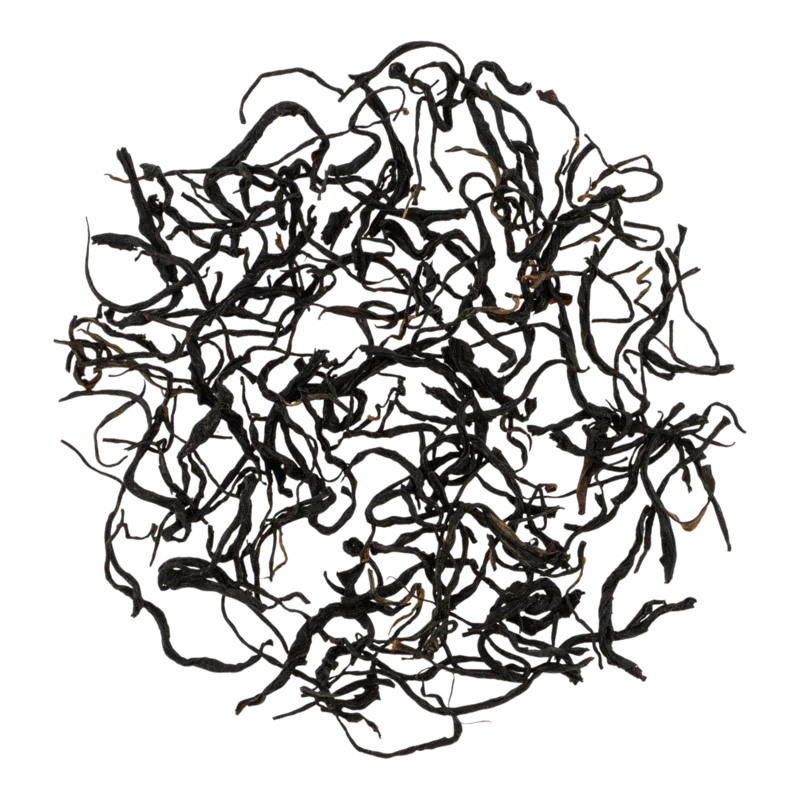
Dry Leaf Appearance: Conditionally needle-like form; dense, uniform twist; color — dark chestnut with bronze sheen. In highest grades, abundance of golden downy tips (金毫, jīn háo), giving the leaf an elegant appearance.
Dry Leaf Aroma: Clean, warm, with pronounced notes of honey, dried apricots and light shade of roasted barley. In batches from old trees — additional depth with nuances of cocoa.
Liquor Aroma: Multi-layered: first steeps reveal honey sweetness and floral notes (nectar flowers of mountain meadows), middle ones — dried fruits (dried apricots, raisins) and caramel, final ones — bread and nutty shades.
Liquor Color: From golden-amber (in batches from buds) to rich red-amber; bright, clear, with noticeable golden rim (金圈) around the edge of the cup.
Spent Leaves: Leaf opens fully and elastically; color — from copper-brown to reddish-chestnut, uniform, without dark spots. Leaf elasticity indicates quality raw material and proper oxidation.
Taste: Dense, round, with characteristic "oiliness" of body. Clean, unobtrusive sweetness; moderate astringency that quickly transitions to long, warming aftertaste (回甘, huígān). In best batches — pronounced tones of floral honey and ripe peach.
Alkaloids: Caffeine — about 2.5–4.0% of dry mass (somewhat lower than large-leaf red teas (black teas) of dianhong type). Theobromine and theophylline are present in trace amounts.
Amino Acids: Free amino acid content — 3–5% of dry mass. L-theanine (L-茶氨酸) is the dominant amino acid and is responsible for softness, sweet aftertaste and synergistic effect with caffeine (calm alertness without anxiety).
Complex of terpene alcohols (linalool, geraniol), aldehydes and Maillard reaction products forming honey-caramel aroma, especially enhanced by double heating on pan.
Minerals: Potassium, magnesium, manganese, zinc, selenium (in trace amounts), phosphorus (elevated content due to phosphorus-containing soils of the region).
Polyphenols: In finished red tea (black tea), a significant portion of catechins is converted to theaflavins (茶黄素, cháhuángsù) and thearubigins (茶红素, cháhóngsù). According to analysis data of Guzhang red tea (black tea), theaflavin content is 0.7–1.0% (with improved method determination — up to 1%, approaching the theoretical maximum for Chinese red teas (black teas) of gongfu type). High theaflavin content ensures liquor brightness and "astringent sweetness."
Vitamins: B-group vitamins (B₁, B₂, B₆), vitamin C (in insignificant amounts, most is destroyed during oxidation), vitamin PP (nicotinic acid).
Combination of caffeine and L-theanine provides prolonged, even alertness without the characteristic coffee "peak and crash."
Theaflavins and thearubigins show pronounced ability to neutralize free radicals, supporting cellular health.
Oxidized polyphenols act more gently on gastric mucosa than green tea catechins; warm red tea (black tea) after meals promotes comfortable digestion.
Regular moderate consumption of red tea (black tea) is associated with maintaining vascular elasticity due to potassium and polyphenols.
L-theanine promotes concentration and improves quality of mental work, especially in combination with caffeine.
Red tea (black tea) enhances peripheral circulation and helps reduce subjective sensation of fatigue, which is especially valuable in cold weather.
Polyphenols and trace elements (zinc, manganese) contribute to overall immune balance with regular consumption.
Red tea (black tea) antioxidants help neutralize oxidative stress, which with regular consumption may positively affect skin tone and elasticity.
Tea Amount: 4–5 g per 100–120 ml (gongfu method); 3–4 g per 200 ml (steeping in cup/European-style teapot).
Teaware: Porcelain gàiwǎn (盖碗, gàiwǎn) — optimal choice for revealing aromatics; Yíxīng clay teapot (宜兴紫砂壶) — for more rounded, "velvety" profile; glass teapot — for visual enjoyment of liquor color.
Water Temperature: 90–95°C (for grades from pure buds — 85–90°C, to avoid burning delicate tips).
Container: Airtight, opaque: tin can, foil bag with zip lock or vacuum packaging.
Shelf Life: Optimal consumption — within 12–18 months after production. Quality batches with dense twist may "round out" and improve over 2–3 years with proper storage conditions, acquiring deeper honey-caramel tones.
Dry, dark, cool place with temperature 15–25°C. Avoid proximity to strongly aromatic products (spices, coffee).
Classic Anhui red tea from Qimen County. Distinguished by its characteristic "Qimen aroma" (祁门香) — a complex bouquet with notes of orchid and honey. Guzhang Hong Cha typically demonstrates a denser body and pronounced caramel sweetness, while Qimen has a more delicate, "floral" structure.
The Fujian progenitor of all red teas; classic batches are characterized by a smoky aroma of pine wood. Guzhang Hong Cha lacks smokiness and is closer to a "pure" honey-fruit profile.
Yunnan red tea from the large-leaf var. assamica variety; usually more powerful, "meaty," with a pronounced chocolate body. Guzhang Hong Cha, made from small-leaf raw material, is distinguished by greater refinement, a higher floral-honey note, and less aggressive astringency.
Red tea from the Huangjin Cha variety grown in neighboring Baojing County. Possesses a bright floral aroma and increased sweetness due to the high amino acid content in the variety. Guzhang Hong Cha from local small-leaf raw material is slightly more astringent, with greater mineral depth.
Taiwanese red tea from a high-mountain region. Distinguished by characteristic "Taiwanese" sweetness and light fruity acidity. Guzhang Hong Cha possesses a more "earthy," mineral character and warmer aromatic profile, conditioned by double heating on a cast iron pan.
Price Category: Medium and above-medium segment of Chinese red teas (black teas). Price varies from 300–500 yuan/500 g for mass grades to 2,000–5,000 yuan/500 g for competition batches from pure buds or old trees. Main factors affecting cost: harvest standard (buds vs. leaf), plantation altitude, tree age, producer reputation.
No reviews yet. Tell us what you think of this tea.
Rate this tea and share your impressions. We review each submission before publishing it.