Brewing
Gongfu brewing
- Water temperature
- 75 °C
- Tea amount
- 5 g
- Water volume
- 100 ml
- First steep
- 10 s
- Time added per infusion
- 5 s
- Infusions
- 3


Guìzhōu léigōngshān chá
Choose a brewing method. Start with the recommended quantities and time, then adjust to taste.
Brewing
Brewing
Taste
Tea encyclopedia
Category: High-mountain ecological green tea of Guizhou; the public brand "Leigongshan Cha" (雷公山茶) unites several product lines — Léigōngshān Qīngmíng Chá (雷公山清明茶, Léigōngshān Qīngmíng Chá), Léishān Yínqiú Chá (雷山银球茶, Léishān Yínqiú Chá — ball tea with geographical indication protection) and a number of others. In Guizhou Province, Léigōngshān Chá is among the ten famous green teas alongside Dūyún Máojiān (都匀毛尖) and Méitán Cuì Yá (湄潭翠芽).
Category: High-mountain ecological green tea of Guizhou; the public brand "Leigongshan Cha" (雷公山茶) unites several product lines — Léigōngshān Qīngmíng Chá (雷公山清明茶, Léigōngshān Qīngmíng Chá), Léishān Yínqiú Chá (雷山银球茶, Léishān Yínqiú Chá — ball tea with geographical indication protection) and a number of others. In Guizhou Province, Léigōngshān Chá is among the ten famous green teas alongside Dūyún Máojiān (都匀毛尖) and Méitán Cuì Yá (湄潭翠芽).
Coordinates: ≈ 26.4° N, 108.2° E (Leishan County; plantations are distributed across the altitudinal belt of 900–1,400 m throughout the county area).
Origin: China, Guìzhōu Province (贵州, Guìzhōu), Qiándōngnán Miáo and Dōng Autonomous Prefecture (黔东南苗族侗族自治州, Qiándōngnán Miáozú Dòngzú Zìzhìzhōu), Léishān County (雷山县, Léishān Xiàn). Plantations are located on the slopes and valleys of the Léigōngshān mountain massif (雷公山, Léigōngshān) — the main peak of the Miáolǐng range (苗岭, Miáolǐng), the largest mountain range in southeastern Guizhou.
Type: Green tea (绿茶, lǜchá) — non-oxidized, oxidation degree less than 5%. Enzyme fixation by heat (杀青, shāqīng).
Cultural Significance: Léishān County is one of the main cultural territories of the Miáo people (苗族, Miáozú); here is located the world's largest Miao settlement — Xījiāng Qiānhù Miáozhài (西江千户苗寨, Xījiāng Qiānhù Miáozhài) — "Thousand-Household Miao Village in Xijiang," a category AAAA tourist heritage site. Tea in these places is not just an agricultural crop, but part of daily life, festive hospitality, and fair trade of the Miao. The silvery balls of Yinqiu Cha, resembling miniature silver bells on traditional Miao ornaments, have become both a gastronomic and cultural symbol of the region. Mountain tea is a popular souvenir for visitors to Leishan's ethnocultural and natural locations.
History: The Leishan territory has a long, though poorly documented, tea tradition. According to the "Leishan County Chronicle" (《雷山县志》), tea gardens were already being established in these places during the Qing era, but due to the inaccessibility of the mountain region, many plantations were eventually abandoned. Organized tea cultivation development began in the 1970s, when county authorities undertook large-scale restoration and expansion of tea lands.
Cultivar: The region presents a mosaic of planting material: local populations of Camellia sinensis var. sinensis (shrub and semi-woody forms adapted to high mountains) and introduced varieties oriented toward early and tender spring picking. For specific batches, it is recommended to clarify the cultivar with the producer. A distinctive feature of Leigongshan high-mountain populations is increased natural pectin content in young shoots, making ball formation possible (for Yinqiu Cha).
Picking: Main value — early spring picking (before and around the Qingming festival, 清明, Qīngmíng, early April). High mountains delay the start of vegetation: shoots appear later than in lowlands, but slow growth ensures higher concentration of amino acids and aromatic substances. Harvesting is conducted predominantly by hand; according to statistics, more than 90% of pickers are Miao women.
Pluck Standard: For Yinqiu Cha and highest grades of Qingming Cha — "one bud + one leaf" (一芽一叶, yī yá yī yè) or "one bud + two initially unfolded leaves" (一芽二叶初展, yī yá èr yè chūzhǎn). For mass batches — more mature leaf.
Raw Material: Whole, elastic leaf without signs of yellowing and aging; uniform fraction; absence of foreign odors (smoke, fuel, household fragrances).
Altitude: Optimal tea belt — 1,200–1,400 m above sea level. It is precisely at these heights that the best plantations are concentrated, including around Jiǎoyáo village (脚尧村, Jiǎoyáo Cūn) — the core of Yinqiu Cha production.
Soil: Micro-acidic (pH 4–6) sandy-clay yellow soils (黄壤, huángrǎng) with granular structure; deep, loose, fertile horizon. Organic matter content — 3.47–7.22%, nitrogen — 2.02–3.42 g/kg. Heavy metals do not exceed norms; toxic elements not detected. Mineral resources of the surface layer are insignificant, minimizing the risk of anthropogenic contamination.
Mount Leigongshan is the main peak of the Miaoling range, maximum height — 2,178.8 m above sea level. Climate is mid-subtropical monsoon, mild and humid: average annual temperature 14–15.6°C, frost-free period — over 240–282 days; average annual precipitation — 1,250–1,375 mm; relative humidity — about 80%; average annual insolation — about 1,136–1,225 hours (寡日照, "little sun" — natural shading by mountain clouds). Low insolation and abundance of diffused light are key factors ensuring amino acid accumulation in leaves and reduction of coarse astringency.
Almost one-third of Léishān County area is part of Léigōngshān National Nature Reserve (雷公山国家级自然保护区). Vegetation coverage — 94%, forest coverage — about 72.8%. Absence of industrial enterprises, proximity to protected massifs, and high-altitude location create a reputation for "ecological tea." However, in an encyclopedic context, one should distinguish the real agrotechnics of a specific producer (presence or absence of organic certification, use of pesticides/fertilizers) from the marketing image.
Early morning, hand picking; rapid cooling and delivery of raw material to production.
Even spreading on bamboo trays in a ventilated room; 30–90 minutes depending on weather and leaf moisture. Goal — moisture equalization, initial reduction of "grassy harshness" and preparation for fixation.
Stopping enzymatic oxidation. In Guizhou, both pan-firing (锅炒, guōchǎo) and drum fixation are encountered. It is critically important not to overheat the tender high-mountain leaf: overheating gives bitterness and "roasted heat," underheating — "raw grassiness."
Moderate, to give "body" to the liquor without destroying the leaf blade into dust.
When necessary — giving commercial form: straight strip, slightly curved twist. For Yinqiu Cha — unique operation: hand rolling into balls (搓球, cuōqiú) 18–20 mm in diameter using natural pectin; each ball weighs about 2.5 g.
Stepped: primary moisture fixation and final drying to stable 5–6%. For Yinqiu Cha, special care is required: the ball must dry evenly, without a "raw core" (外干内湿), otherwise mold is possible.
Removal of coarse fragments, control of batch uniformity.
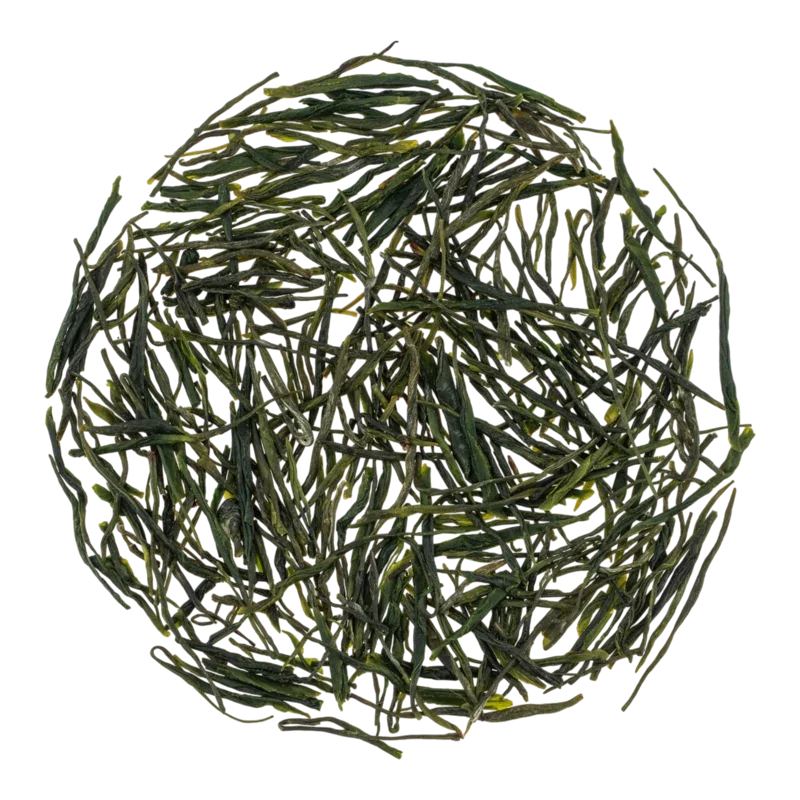
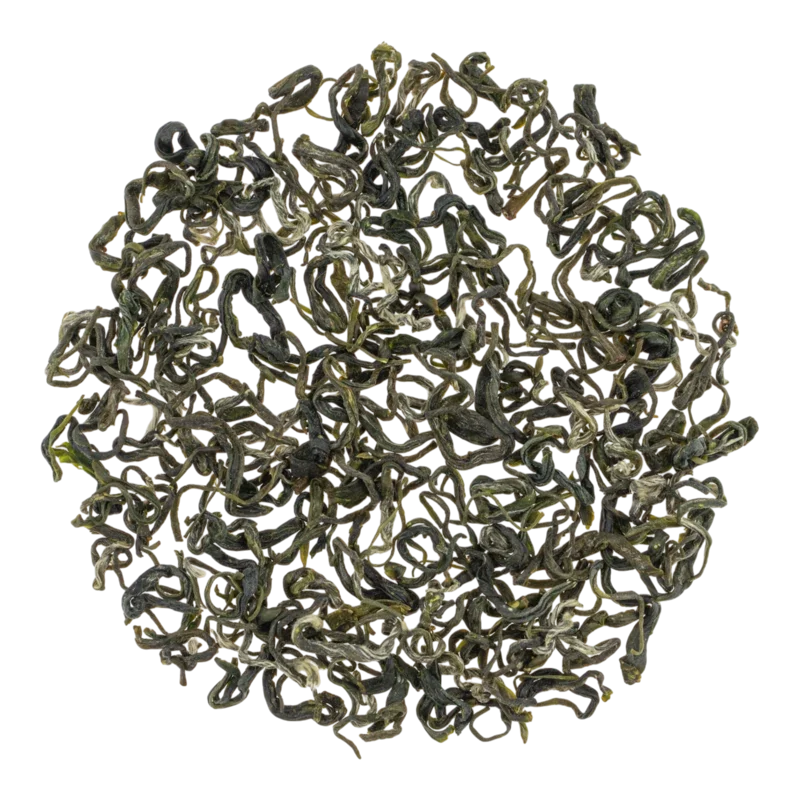
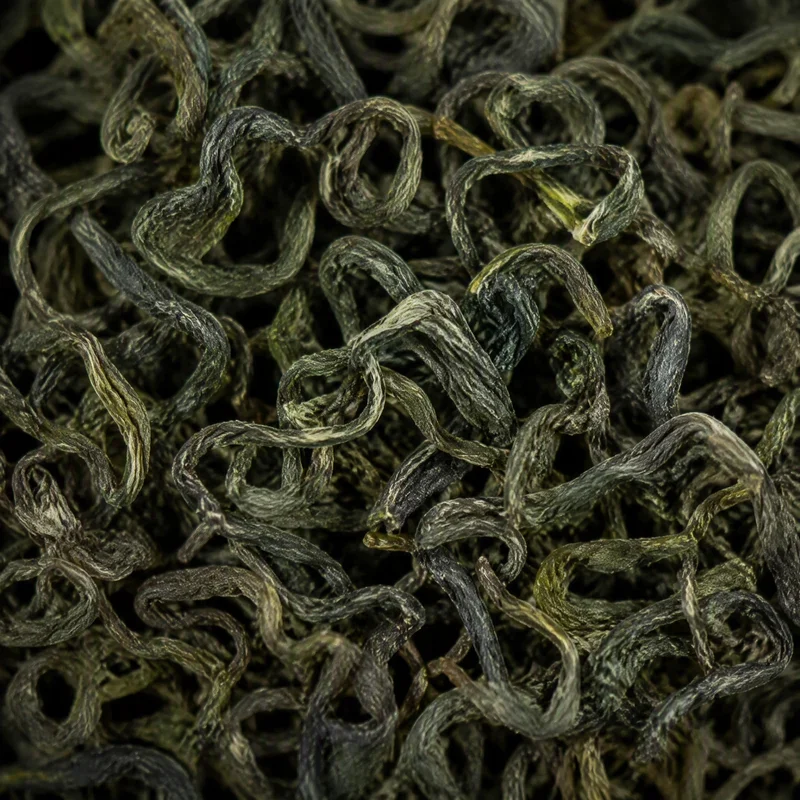
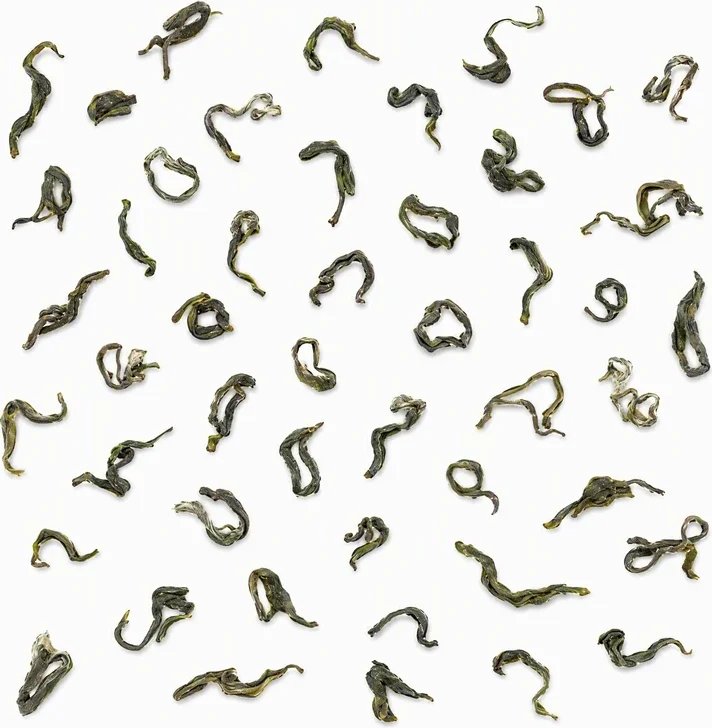
Dry Leaf Appearance: Tightly twisted, neat strips (条索紧结, tiáosuǒ jǐnjié) from bright green to dark green color with oily luster (墨绿油润, mòlǜ yóurùn). For Yinqiu Cha — even balls of silvery-dark-green shade with light down.
Dry Leaf Aroma: Fresh, grassy-floral (清香, qīngxiāng); with warmer fixation — mild nuttiness or chestnut tone (栗香, lìxiāng).
Liquor Aroma: Clean, with chestnut background and floral overtones; Yinqiu Cha has a denser aroma with "tender milky" and "pectin" notes.
Liquor Color: From light green and straw-golden to yellow-green (黄绿明亮, huánglǜ míngliàng); transparent and clear.
Spent Leaves: Tender, whole leaves — bright green, fresh, elastic; uniform fraction. For Yinqiu Cha — the ball slowly and effectively "unfolds" in the glass, "like a lotus bud blooming" (宛若荷苞初绽).
Taste: Mild, fresh (鲜爽, xiānshuǎng), with moderate richness (醇厚, chúnhòu). Bitterness is usually short and quickly transitions to long "returning sweetness" (回甘, huígān) with a sensation of mineral coolness. Thanks to thick leaf and high extractive substance content — good resistance to multiple brewings (耐冲泡, nài chōngpào).
Amino Acids: Increased L-theanine content is due to slow growth in conditions of "little sun" and high-mountain coolness. It is precisely theanine that accounts for the characteristic sensory mildness and "brothy" sweetness of the liquor.
Main ones — catechins, including EGCG; content varies by fraction and season.
Moderate content; in synergy with theanine provides smooth stimulation.
Unusually high content in spring shoots of the 1,200–1,400 m altitude belt — a key property allowing Yinqiu Cha to be formed into dense balls without artificial binders.
Distinctive feature — increased selenium content: according to analyses, in Yinqiu Cha — 2.00–2.02 μg/g, which is approximately 15 times higher than the average indicator for green teas. Also noted is the presence of zinc and other mineral elements.
Vitamins: C, B₁, B₂, E — typical set for green teas; high-mountain origin promotes vitamin C preservation.
Polyphenols (catechins) neutralize free radicals, supporting cellular health.
Caffeine combined with L-theanine — alertness without anxiety, improved concentration and attention.
Traditionally green tea is drunk after meals to ease digestion.
Polyphenols help maintain vascular elasticity and normal cholesterol levels.
L-theanine stimulates brain alpha waves, promoting calm focus.
Increased selenium content — antioxidant cofactor, important for immune system and thyroid function.
Antioxidant properties of catechins contribute to skin protection from photoaging and support of its tone.
Green tea is traditionally associated with mild influence on fat and carbohydrate metabolism; preclinical research data indicate catechins' ability to stimulate thermogenesis.
If tea becomes bitter — lower temperature and reduce amount, don't "blame the tea." High-mountain green teas of Guizhou often reveal best at temperatures even below 80°C — this preserves their "sweet transparency."
Tea Amount: 3–4 g per 150 ml (glass or gaiwan). For Yinqiu Cha — 1 ball (≈ 2.5 g) per 150–200 ml.
Teaware: Transparent glass cup (玻璃杯) — for visual enjoyment of ball "unfolding"; porcelain gaiwan (盖碗) — for maximum aroma revelation.
Water Temperature: 75–80°C. Higher temperature intensifies bitterness and "hides" the delicate amino acid sweetness of high-mountain leaf.
The most famous green tea of Guizhou, one of China's "Ten Great Teas." Grows further south, in the Duyun area. More "classical" profile: pronounced down, sharp freshness, light astringency. Leigongshan Cha is generally milder and more "transparent," with emphasis on amino acid sweetness.
Flat green tea from northern Guizhou (Zunyi area). More "nutty" and dense; technologically closer to Longjing. Leigongshan Cha is more voluminous in form and more "floral-grassy" in bouquet.
Steamed green tea from neighboring Hubei Province. Similar "mildness" direction, but completely different technological profile: steam fixation gives bright "marine" taste and umami notes, while Leigongshan Cha is pan-fired, with floral-chestnut character.
Yunnan high-mountain green teas from var. assamica leaf are often denser, more "grassy" and with pronounced astringency. Leigongshan Cha from var. sinensis is lighter, more transparent, with more delicate body.
Price Category: Determined by plantation altitude, picking time (early spring batches before Qingming are most expensive), bud proportion, and specific producer reputation. Yinqiu Cha is a premium product with labor-intensive hand forming, therefore costs significantly more than ordinary leaf Leigongshan Cha. Mass batches of "Qingming Cha" are more affordable.
Raw material substitution: cheap green tea from neighboring counties or even provinces, sold under the "Leigongshan" brand. For Yinqiu Cha — attempts to imitate ball form from low-quality raw material with insufficient pectin (balls fall apart when brewed).
No reviews yet. Tell us what you think of this tea.
Rate this tea and share your impressions. We review each submission before publishing it.