Brewing
Gongfu brewing
- Water temperature
- 75 °C
- Tea amount
- 5 g
- Water volume
- 100 ml
- First steep
- 10 s
- Time added per infusion
- 5 s
- Infusions
- 3


Guìdìng xuě yá
Choose a brewing method. Start with the recommended quantities and time, then adjust to taste.
Brewing
Brewing
Taste
Tea encyclopedia
Category: Premium line of the "Guiding Yunwu Gongcha" (贵定云雾贡茶) brand. Protected Geographical Indication product (国家地理标志保护产品, 2024). One of the "Ten Famous Teas of Guizhou" (贵州十大名茶). Guiding County holds the titles "Hometown of Famous Teas of China" (中国名茶之乡) and "Land of Miaoling Tribute Tea" (中国苗岭贡茶之乡). Winner of the Fourth International Tea Exhibition and Evaluation (2002, gold medal). In 1990, at the National Famous Tea Evaluation, it scored 99.85 points — the highest result in the country,...
Category: Premium line of the "Guiding Yunwu Gongcha" (贵定云雾贡茶) brand. Protected Geographical Indication product (国家地理标志保护产品, 2024). One of the "Ten Famous Teas of Guizhou" (贵州十大名茶). Guiding County holds the titles "Hometown of Famous Teas of China" (中国名茶之乡) and "Land of Miaoling Tribute Tea" (中国苗岭贡茶之乡). Winner of the Fourth International Tea Exhibition and Evaluation (2002, gold medal). In 1990, at the National Famous Tea Evaluation, it scored 99.85 points — the highest result in the country, receiving four awards including the Ministry of Commerce prize for "best tea." The traditional handcraft production technology of "Yunwu Gongcha" was included in the Guizhou Intangible Cultural Heritage Registry (2009).
Coordinates: Approximately 26°20′ North latitude, 107°14′ East longitude.
Origin: China, Guìzhōu Province (贵州省, Guìzhōu Shěng), Qiánnán Buyi and Miáo Autonomous Prefecture (黔南布依族苗族自治州), Guìdìng County (贵定县, Guìdìng Xiàn). The tea is produced on Mount Yunwushan (云雾山, Yúnwù Shān) — the main peak of the Miáolǐng Range (苗岭山脉主峰), which serves as the watershed for the Wǔ (乌江), Yuán (沅江), and Pān (盘江) rivers. The mountain's elevation exceeds 1,500 m.
Type: Green tea (绿茶, lǜchá), non-oxidized. Belongs to pan-fired green teas with spiral rolling (卷曲形炒青绿茶, juǎnqūxíng chǎoqīng lǜchá). The shape of the finished tea leaf resembles a fishing hook — hence the historical name "Yugoucha" (鱼钩茶, "Fishing Hook Tea").
Cultural Significance: Guiding Xue Ya is not merely tea, but a living embodiment of "triple heritage" (三重遗产): historical heritage (1790 stele, Qing Palace archives), ethnocultural heritage (centuries-old Miao tea cultivation tradition, rituals of picking and offering), and Buddhist heritage (Mount Yangbaoshan — one of the three great Buddhist monasteries of Southwest China, where monks cultivated "White Cloud Tea" for centuries). Annually, Guiding hosts the "Tribute Tea Cultural Tourism Festival" (贡茶文化旅游节), including Miáo bull fighting competitions (斗牛) — a spectacle attracting thousands of tourists.
History: Guiding possesses one of the deepest and best-documented tea histories in Guizhou — over 2,000 years of tea cultivation and more than 600 years of confirmed "tribute tea" (gòng chá) status.
Cultivar: Primary cultivar — Niǎowáng Quntichong (鸟王群体种, Niǎowáng Qúntǐzhǒng) — "King of Birds Population Variety." This is a unique local population variety of Camellia sinensis var. sinensis propagated by seed, recognized as a "living fossil" (活化石) of Guizhou's tea history and one of the world's endemic tea cultivars. Characteristics: green leaves, abundant down, large and fleshy buds, high "tenderness retention" (持嫩性强). Belongs to the tree-type (乔木型). For premium grades, exclusively Niaowang is used; for mass production — additionally Fúdǐng Dàbái Chá (福鼎大白茶).
Picking: Five picking rounds are conducted annually — three spring, zero to two summer. Autumn picking is not practiced. Most valuable is "mingqiancha" (明前茶) — before Qingming (~April 5).
Raw Material: Shoots must be uniform in size, intact, with abundant down. A folk saying describes the standard: "Pick tenderly — like [catching] an oriole's tongue" (嫩采雅雀嘴, nèn cǎi yǎ què zuǐ).
Altitude: 800–1,400 meters above sea level. Production core — at altitudes of 1,200–1,500 m, in the zone of constant cloud cover.
Climate: Mount Yunwu is located in a subtropical monsoon climate zone with extremely low insolation — annual sunshine hours amount to only 677–1,068, and sunshine ratio (日照率) — 15–24%. This is one of the most "overcast" tea terroirs in China. Average annual temperature — 13.9–15°C. Annual precipitation — 1,100–1,800 mm. Relative humidity — ≥80%. Number of foggy days in the production core — over 200. Frost-free period — 300–340 days.
Soil: Acidic yellow soils (酸性黄壤, suānxìng huáng rǎng) with pH 4.4–4.85. Organic matter content — 3.19% (exceptionally high indicator). Soils are rich in minerals.
Hand-picking according to the "oriole's tongue" standard.
Shoots are spread on bamboo sieves for 2–4 hours.
Processing at 130–150°C. Enzyme fixation, establishing aroma foundation.
Unique stage: rolling is conducted directly in the hot wok, not on a separate table. Three cycles of "hot rolling" form the characteristic spiral "fishing hook" shape.
Leaves are rolled into tight spirals, while silvery down is "raised" to the surface.
Final drying over slow fire (文火足干, wénhuǒ zúgān) until complete moisture removal. Gentle regime preserves honey aroma.
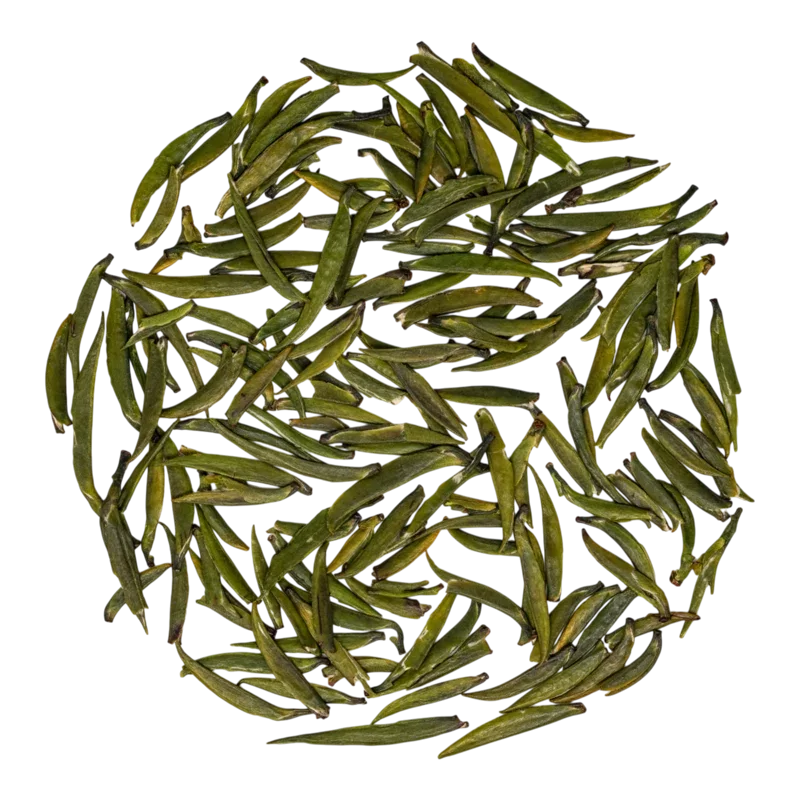
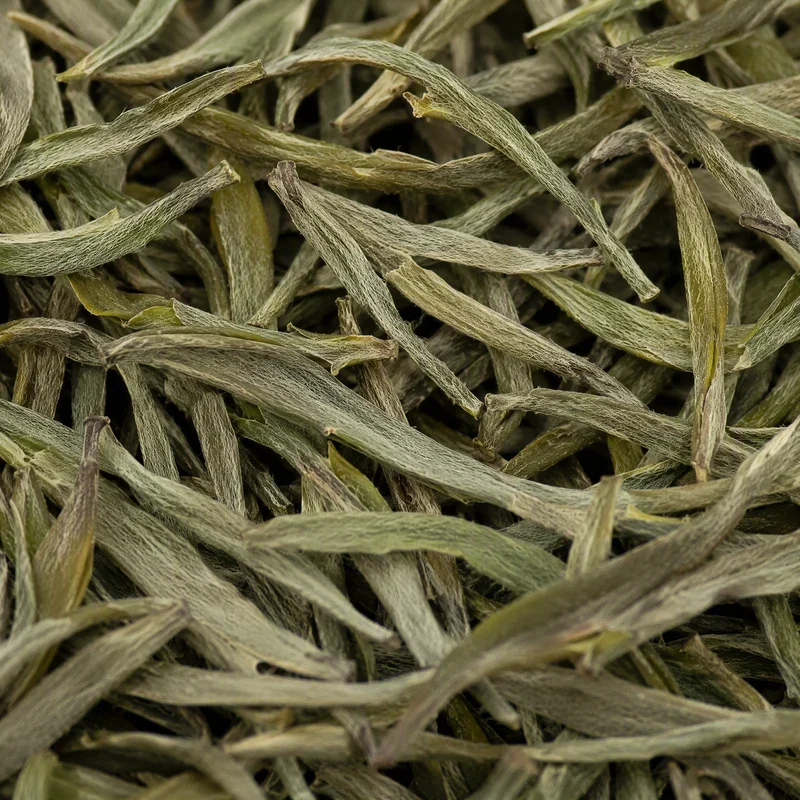
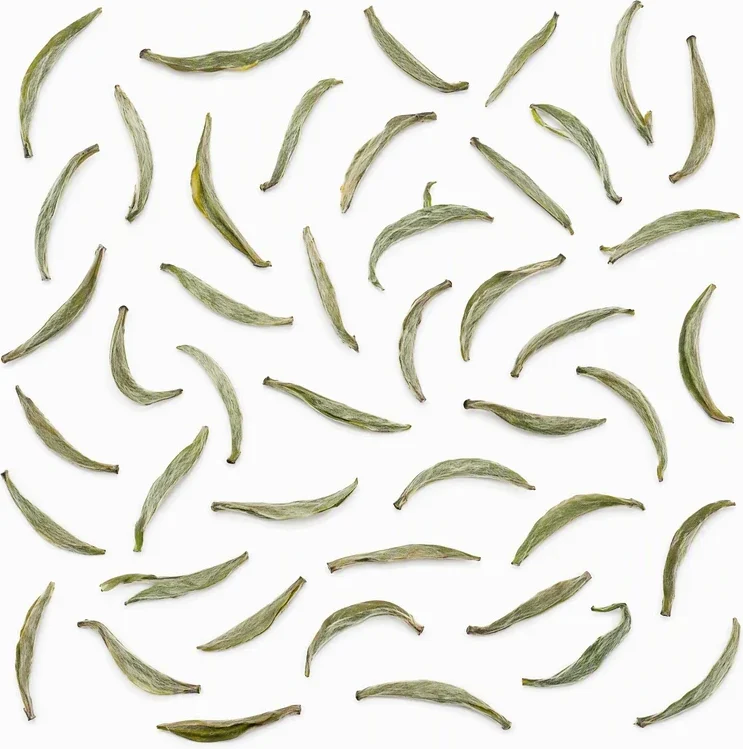
Dry Leaf Appearance: Tightly rolled spirals (紧秀如螺), resembling fishing hooks (鱼钩状弯曲) — in premium grades. Color — emerald green with abundant silvery down (翠绿披银毫). In premium grade — up to 80% of surface covered with down.
Dry Leaf Aroma: Honey (蜜香, mìxiāng) — the primary and most characteristic note of Guiding Xue Ya. Complemented by high floral tone (花香高扬). Cold cup retains aroma for over 30 minutes (!) — an outstanding indicator.
Liquor Aroma: Honey-floral, persistent and elegant. In the best batches — with notes of orchid and mountain honey.
Liquor Color: Yellow-green, bright and clear (黄绿明亮).
Spent Leaves: Tender green, uniform, shoots unfold intact. When brewed in a glass cup, a characteristic effect is observed: the cloud of steam above the cup first resembles an umbrella, then a cloud, and slowly rises upward — for this phenomenon the tea received one of its names: "Cloud Tea" (云雾茶).
Taste: Fresh and brisk (鲜爽), with pronounced "juiciness" — result of exceptionally high amino acid content (6–9% according to some data). Body is mellow and rich (醇厚, chúnhòu) thanks to polyphenols (25–30%). Returning sweetness (回甘) — prolonged and building.
Amino Acids: 6–9% (according to some sources; standard data for Niaowang cultivar — 2.18%). Exceptionally high indicator, explaining honey sweetness and "juiciness."
~3.39% (for Niaowang cultivar). Moderate level.
≥43.28%. Richness of soluble components.
114.66 mg/g. High EGCG indicator.
Minerals: Potassium, magnesium, zinc, manganese.
Polyphenols: 25–30% (for Niaowang cultivar — up to 31.67%). Provide rich body and pronounced antioxidant potential.
Vitamins: Vitamin C, B-group vitamins.
Polyphenols 25–30% + catechins 114.66 mg/g.
Caffeine (~3.4%) combined with L-theanine — gentle "slow" alertness.
"Cool" nature of green tea — traditional application in hot months.
Catechins normalize intestinal microflora.
Polyphenols promote lipid metabolism normalization.
Complex of vitamins and minerals from organically rich mountain soils.
Tea Amount: 3 g per 150 ml.
Teaware: Glass cup (for observing the "cloud" steam effect) or porcelain gaiwan.
Water Temperature: 80–85°C.
The main "famous" tea of Guizhou. Curled, downy, with sharp freshness. Guiding Xue Ya — straight "needles," honey sweetness, more delicate.
Flat, nutty aroma (closer to Long Jing). Guiding — "needle-shaped," floral-honey, with a thousand-year history of "gongcha" (tribute tea).
Ball-shaped tea, also from the Miaolin mountains. Completely different form, but similar terroir (misty mountains, 1200+ m).
Price Category: Upper segment of Guizhou green teas. Premium grade (特级, mingqiancha) from Niaowang cultivar — from 600–1,000 yuan per 500 g. First grade — 300–500 yuan. Second grade — more affordable.
No reviews yet. Tell us what you think of this tea.
Rate this tea and share your impressions. We review each submission before publishing it.