Brewing
Gongfu brewing
- Water temperature
- 93 °C
- Tea amount
- 5 g
- Water volume
- 100 ml
- First steep
- 10 s
- Time added per infusion
- 5 s
- Infusions
- 4

Guǎngdōng dāncóng hóngchá
Choose a brewing method. Start with the recommended quantities and time, then adjust to taste.
Brewing
Brewing
Taste
Tea encyclopedia
Category: Rare, artisanal red tea (black tea). Modern direction of Guangdong tea production, combining oolong production traditions with red tea technology.
Category: Rare, artisanal red tea (black tea). Modern direction of Guangdong tea production, combining oolong production traditions with red tea technology.
Coordinates: Wudongshan: approximately 23°55′ N, 116°32′ E; Yingde: approximately 24°11′ N, 113°24′ E.
Origin: China, Guǎngdōng Province (广东省, Guǎngdōng Shěng). Main production regions:
Type: Red tea (black tea) (红茶, hóngchá) — fully oxidized. According to European classification corresponds to black tea.
Specialized tea shops with direct relationships with Guangdong producers. Reputable online retailers with detailed product descriptions and origin certificates.
Guangzhou tea markets, particularly Fangcun Tea Market (芳村茶叶市场), where many Guangdong producers have representation.
Tea farms in Chaozhou (for Dancong varieties) and Yingde (for Ying Hong No. 9) often welcome visitors and offer direct sales.
Request certificates of origin, production dates, and detailed information about cultivars used. Reputable sellers provide complete traceability information.
Guangdong Dancong Hong Cha is one of the most striking examples of successful "inter-category" adaptation in Chinese tea production. Raw material that for centuries was glorified in oolong form acquires completely new character with full oxidation — preserving recognizable floral complexity but becoming softer and sweeter.
Guangdong red teas have repeatedly become "diplomatic beverages." In 2023, Ying Hong No. 9 Jīn Máo Háo (金毛毫) and Fenghuang Dancong were chosen for tea ceremony between Chinese and French leaders in Guangzhou, demonstrating to world community the richness of Guangdong tea palette.
Dancong philosophy assumes that each old tree is a unique "tea personality" with inimitable aromatic code. When such tree becomes raw material for red tea, its individuality is not erased but transformed — similar to how the same musician sounds differently in chamber and symphonic ensembles.
Guangdong red teas have won numerous international awards since the 1960s. Yingde Hong Cha is among the three largest red tea brands of China alongside Dian Hong and Qimen Hong Cha, and "Ying Hong No. 9" brand was included in 2023 in the "Belt and Road" — list of geographical indications for international promotion.
In Fenghuangshan mountains, more than 3000 tea trees aged over 100 years are preserved. Some of them may be used for Dancong Hong Cha production, making such tea not simply a beverage but liquid testimony of centuries-old history.
Large-leaf red tea from the eponymous cultivar. Distinguished by powerful, rich taste with notes of malt, honey and sweet potato. Liquor bright, red-orange. Most accessible and mass-produced variety.
From classic Shui Xian cultivar. Characterized by narcissus floral notes, softness, delicacy.
From mutation with light coloration of young leaves. Light, elegant, with emphasis on floral-honey notes.
From "Honey Orchid" line cultivars. Perhaps most "oolong-like" in character — with pronounced orchid-honey profile.
From traditional oolong cultivars of Wudong mountain. Complex, refined, expensive.
From Ying Hong No. 9 cultivar and other large-leaf varieties. More powerful, rich, accessible.
Spring harvest (most valuable) and autumn harvest. Spring tea distinguished by more delicate, complex aroma; autumn — greater density and sweetness.
Cultural Significance: Guangdong Dancong Hong Cha embodies the concept of "living heritage" of Guangdong tea production. Raw material is often collected from old, powerful trees aged up to 50 and more years, each being a carrier of unique genetic and aromatic code. Processing such raw material into red tea is not simply a change of technology, but a dialogue between the centuries-old oolong tradition of Chaozhou and modern tea market needs.
History: The history of red tea production in Guangdong is closely intertwined with the development of the tea industry in Southern China in the 20th century. In 1956, large-leaf Yunnan varieties (Camellia sinensis var. assamica) were first introduced to the Yingde region, and by 1959 the first Yīngdé Hóng Chá (英德红茶, Yīngdé Hóngchá) was successfully produced from them. In the 1960s, Guangdong red tea gained international recognition: in 1963 at the London tea auction it was highly evaluated by experts who compared its quality to Ceylon red teas. In 1986, Guangdong red tea was awarded a gold medal at an international exhibition in Paris. Meanwhile, in the Fenghuangshan mountains (凤凰山, Fènghuáng Shān) near Chaozhou, a unique tradition of cultivating and selecting individual bushes — Dancong — developed for centuries, each possessing an inimitable aromatic profile. The idea of processing this exceptional raw material using red tea technology is an innovation of recent decades, aimed at revealing the new potential of old cultivars.
Several groups of cultivars are used for production:
Cultivar: Camellia sinensis var. sinensis (for traditional Dancong) and hybrids with var. assamica (for Ying Hong No. 9).
Picking: Predominantly spring (March–April), when content of aromatic substances and amino acids in the leaf is maximum. Harvesting standard — tender flush: one bud and two upper leaves (一芽二叶, yī yá èr yè). For Dancong, hand-picking from old, individually standing trees is often practiced.
Raw Material: Leaves must be fresh, elastic, without mechanical damage. Buds of some cultivars are covered with dense silvery down. Most valued is raw material from old trees (老丛, lǎo cóng) aged 30–50+ years, having accumulated deep mineral and aromatic potential.
Climate: Southern subtropical, transitional to mid-subtropical. Average annual temperature around +20°C. Precipitation — around 2000 mm per year. Warm and humid, without pronounced frosts.
Soil: Red and yellow-red lateritic soils, acidic (pH 4.5–5.5), deep and fertile.
600–1200 m above sea level. Wudongshan peak reaches 1391 m.
100–500 m above sea level (hilly terrain).
In both subregions, organic or near-organic farming is widely practiced with minimal application of chemical fertilizers. Old Dancong trees grow in natural mountain environment, often surrounded by wild subtropical vegetation, which contributes to formation of unique "mountain rhyme" (山韵, shānyùn) in the tea.
Careful hand-picking of young flushes. For old trees — exclusively manual, with special care not to damage branches.
Combined process characteristic of Guangdong tradition. Begins with short sun-withering (晒青, shài qīng) lasting 15–30 minutes — to initiate primary enzymatic processes and partial moisture evaporation. Then — longer withering in shade (阴凉萎凋, yīnliáng wěidiāo), in ventilated room, for uniform moisture reduction to 58–62% and accumulation of aroma precursors.
Gentle rolling of leaves to break cell walls and release cell sap. Rolling force is carefully controlled — to preserve integrity of large Dancong leaf.
Key stage. Rolled leaves are spread in room at temperature around 25°C and humidity 90–95%. Process is conducted slower than for standard red teas — often 4–6 hours — which allows development of more complex floral-fruity aromatic notes, preserving characteristic "oolong nuances" of raw material. Leaf acquires uniform red-brown color.
Final drying with hot air at 100–110°C to stop oxidation and reduce moisture to 3–5%. Some producers include additional stage of light roasting (烘焙, hōngbèi) at lower temperature to form final flavor profile with notes of caramel and baked goods.
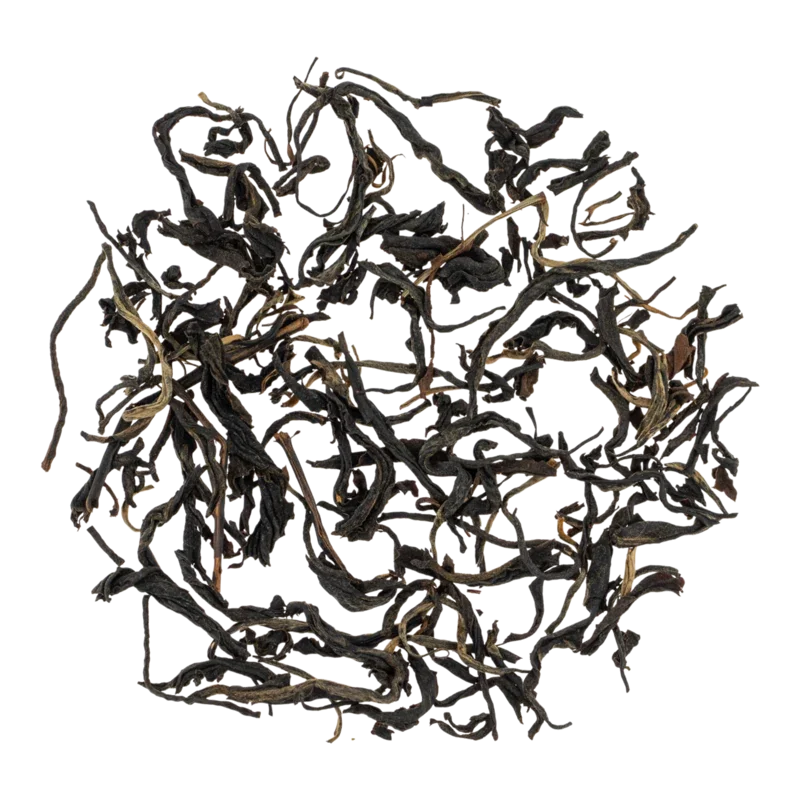
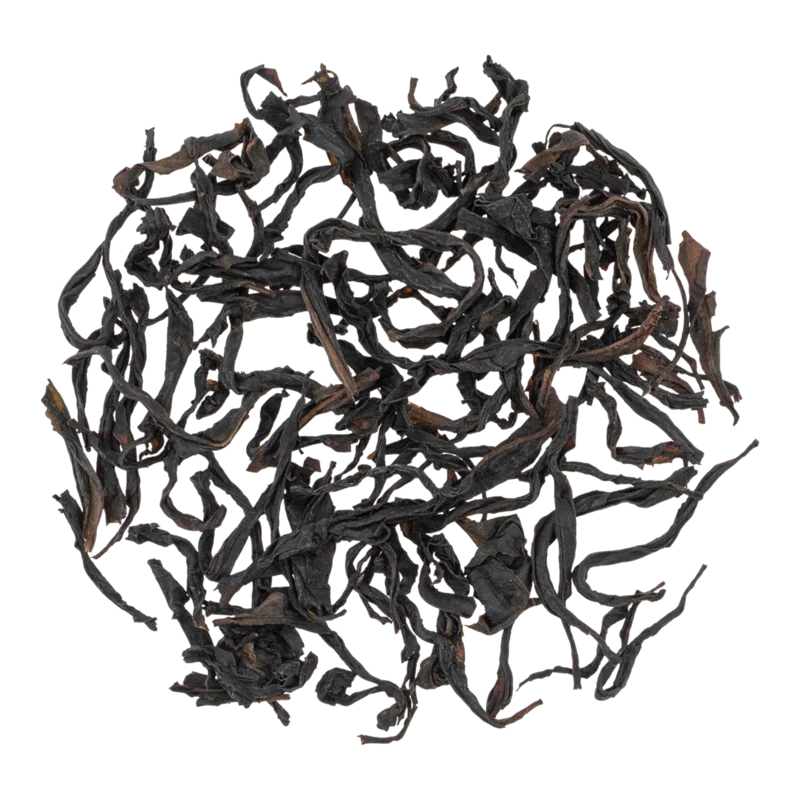
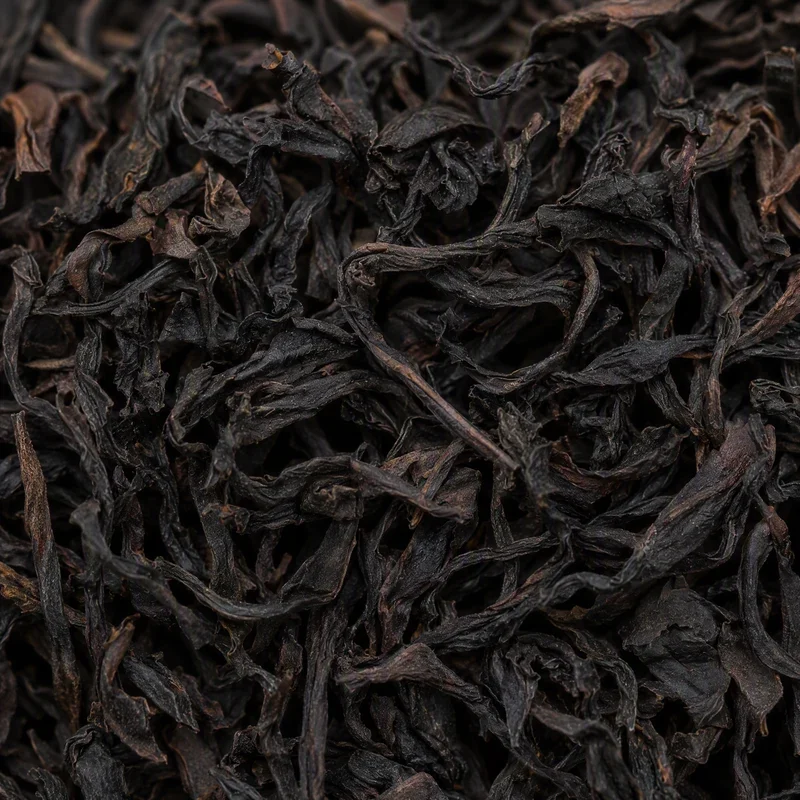
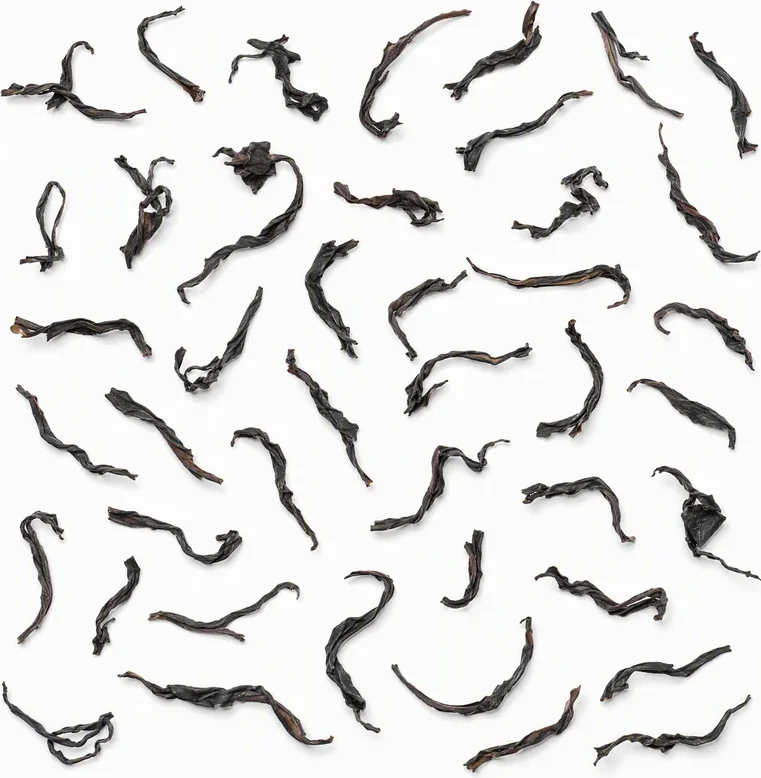
Dry Leaf Appearance: Large, long, longitudinally twisted leaves of dark brown or black color with reddish tinge. Depending on cultivar and processing, golden or copper buds may be present. Leaf is whole, uniform.
Dry Leaf Aroma: Intense, complex, sweet. Notes of honey, flowers (orchid, rose), ripe fruits (lychee, peach, longan), baked goods. Subtle "oolong nuances" may remain — light spiciness, woodiness.
Liquor Aroma: Bright, enveloping, sweet, with pronounced floral-fruity and honey dominants. Unfolds richer than dry leaf aroma — with each steeping new notes appear.
Liquor Color: Bright, clear, transparent. Varies from golden-orange to deep red-ruby or cognac — depending on degree of oxidation and cultivar.
Spent Leaves: Whole, large, elastic leaves of uniform reddish-brown color with well-defined vein structure. Leaves do not tear with light stretching.
Taste: Dense, rich, yet soft and smooth, practically without astringency and bitterness. Honey sweetness dominates, fruity notes (often with citrus acidity), berry tones, sometimes hints of cocoa or caramel. Aftertaste is long, sweet and refreshing, with sensation of "returning sweetness" (回甘, huígān).
Alkaloids: Caffeine (2–4%), theobromine, theophylline. Caffeine content is somewhat higher than in green teas, due to large-leaf raw material.
Amino Acids: L-theanine and other free amino acids (1.7–2.4% in fresh Ying Hong No. 9 leaf), responsible for taste softness and effect of calm concentration.
Key feature — exceptionally rich complex of aromatic substances inherited from oolong Dancong cultivars. Terpenes (linalool, geraniol — floral notes), aldehydes (benzaldehyde — almond notes), alcohols (phenylethyl alcohol — rose notes), as well as nerol, nerolidol and indole, forming unique "honey-orchid" profile.
Minerals: Potassium, manganese, fluorine, zinc. Water extract (水浸出物) of Ying Hong No. 9 reaches 40–42% — indicator testifying to exceptional taste richness.
Polyphenols: During full oxidation, catechins of green leaf transform into theaflavins (give liquor brightness, golden tinge and light astringency) and thearubigins (form rich red color and fullness of taste). Total polyphenol content for Dancong raw material — 20–25%, for Ying Hong No. 9 — 30–32%.
Vitamins: B group (B₁, B₂, B₃), C, PP (rutin).
Moderate caffeine content combined with L-theanine provides gentle, prolonged alertness without nervous overstimulation.
Theaflavins and thearubigins actively neutralize free radicals, slowing cellular aging processes.
Oxidized tea gently stimulates digestive processes, improves GI motility. Traditionally red tea is recommended after heavy meals.
Combination of L-theanine and caffeine stimulates dopamine and serotonin production, contributing to stress reduction and emotional state improvement.
Regular moderate consumption is associated with cholesterol level normalization and vascular wall strengthening.
Polyphenols and B vitamins contribute to maintaining normal immune response.
In traditional Chinese medicine, red tea belongs to "warm" beverages, recommended in cold season and for people with "cold" constitution.
2–3 g per 200–250 ml water 90–95°C, steep 3–5 minutes. 1–2 re-steepings are acceptable.
Teaware: Porcelain gàiwǎn (盖碗, gàiwǎn) — optimal choice, allowing aroma evaluation and extraction control. Also suitable are Yixing clay teapots designated for red teas, or thin-walled porcelain teapots.
Water Temperature: 90–95°C. Too hot water may give excessive bitterness, too cool — will not allow aromas to fully unfold.
Container: Airtight, opaque container — ceramic jar, tin with tight lid, foil bag with ziplock. Avoid plastic containers.
Shelf Life: Optimally consume within 1–2 years after production. Some varieties without strong final roasting may interestingly evolve over time, acquiring deeper, softer notes — however this applies only to high-quality tea under ideal storage conditions.
Dry, cool, protected from direct sunlight.
Store away from spices, coffee, household chemicals. Red tea actively absorbs foreign aromas.
Temperature: Room temperature (15–25°C), low humidity (less than 60%). Unlike green tea, refrigerator storage is not necessary.
Large-leaf black tea from the cultivar of the same name. Distinguished by a powerful, rich flavor with notes of malt, honey, and sweet potato. The liquor is bright, red-orange. The most accessible and mass-produced variety.
From the classic Shui Xian cultivar. Characterized by floral narcissus notes, softness, and delicacy.
From a mutation with light-colored young leaves. Light, elegant, with an emphasis on floral-honey notes.
From cultivars of the "Honey Orchid" line. Perhaps the most "oolong-like" in character — with a pronounced orchid-honey profile.
From traditional oolong cultivars of Wudong Mountain. Complex, refined, expensive.
From Ying Hong No. 9 cultivar and other large-leaf varieties. More powerful, rich, accessible.
Spring harvest (most valuable) and autumn harvest. Spring tea is distinguished by a more delicate, complex aroma; autumn tea by greater density and sweetness.
Price Category: High and very high. Cost of Guangdong Dancong Hong Cha is determined by several factors: use of rare oolong raw material (especially from old trees), complex and labor-intensive technology, limited production volumes (individual exclusive batches — only dozens of kilograms per year), high demand among connoisseurs. Tea from old Wudongshan trees may cost from 100 to 500+ dollars per 100 g. Tea from Ying Hong No. 9 cultivar — significantly more affordable (20–80 dollars per 100 g).
Specialized tea shops with direct supplies from Chaozhou or Yingde.
Whole, large leaf with uniform twist. Broken, small leaf — sign of low quality.
Natural Dancong Hong Cha possesses complex, multilayered, natural aroma without "perfumery" or chemical notes. Artificial flavoring is easily recognized during brewing: aroma quickly disappears after 1–2 steepings.
Genuine tea — soft, sweet, without astringency. Fakes often bitter or give flat, one-dimensional taste.
Suspiciously low price with claimed origin from Wudongshan or from old trees — serious reason for wariness.
No reviews yet. Tell us what you think of this tea.
Rate this tea and share your impressions. We review each submission before publishing it.