Brewing
Gongfu brewing
- Water temperature
- 80 °C
- Tea amount
- 5 g
- Water volume
- 100 ml
- First steep
- 10 s
- Time added per infusion
- 5 s
- Infusions
- 3



Dàfú lóng jǐng
Choose a brewing method. Start with the recommended quantities and time, then adjust to taste.
Brewing
Brewing
Taste
Tea encyclopedia
Category: Product of Protected Designation of Origin (原产地保护, 2003). Well-known Trademark of China (中国驰名商标, 2010). Production is regulated by group standard T/CTSS 42-2022 "Dafu Long Jing Cha". Since 2025, an innovative "three labels" system (三大标签) is in effect — certification by origin, ecology, and premium quality.
Category: Product of Protected Designation of Origin (原产地保护, 2003). Well-known Trademark of China (中国驰名商标, 2010). Production is regulated by group standard T/CTSS 42-2022 "Dafu Long Jing Cha". Since 2025, an innovative "three labels" system (三大标签) is in effect — certification by origin, ecology, and premium quality.
Coordinates: Approximately 29°30′ North latitude, 120°55′ East longitude.
Origin: China, Zhèjiāng Province (浙江, Zhèjiāng), Shàoxīng City (绍兴市, Shàoxīng Shì), Xīnchāng County (新昌县, Xīnchāng Xiàn). The production zone is part of the "Yuezhou Production Zone" (越州产区) — one of three official Longjing tea zones. The terroir core consists of high-mountain tea districts in Huishan Township (回山镇), Shuangcai Township (双彩乡), Jingling Township (镜岭镇), Shaxi Township (沙溪镇), and Chengtan Township (澄潭镇).
Type: Green tea (non-oxidized). Belongs to flat pan-fired green teas (扁形炒青绿茶, biǎnxíng chǎoqīng lǜchá) of the Longjing type.
Cultural Significance: Dafu Long Jing is an example of successful regional brand-building: tea that grew from a government project to develop rural economy became a nationally recognized brand in three decades. It demonstrates that the "Longjing" tradition is not a West Lake monopoly, but an entire school uniting producers throughout Zhejiang.
History: Unlike Xi Hu Long Jing with its thousand-year history, Dafu Long Jing is a young brand created in the 1990s as a targeted project for developing regional tea economy. In the 1980s, Xinchang tea growers began scientific work to create a new type of flat green tea adapted to local high-mountain raw material. By the early 1990s, the "Dafu Long Jing" brand was developed and launched, named after the famous Buddhist temple Dafosi — Xinchang's main attraction.
Tea from Xinchang's core zone, basic quality guarantee.
From certified ecological (or "digital") tea gardens of county level and above.
Compliance with group standard T/CTSS 42-2022 at "精品" level — highest quality.
Cultivar: Predominantly high-mountain cultivars of Camellia sinensis var. sinensis, including Wūniú Zǎo (乌牛早, Wūniú Zǎo) — an ultra-early variety allowing harvest to begin in March, and other local varieties adapted to acidic soils and mountain climate. Young shoots from ecologically clean plantations (高山无公害良种茶园) are used.
Picking: Early spring harvest, with emphasis on pre-Qīngmíng batches (明前茶). Principle: "early, tender, diligent" (早、嫩、勤, zǎo, nèn, qín) — harvest begins as early as possible, raw material used is maximally tender, sorting performed maximally carefully.
Pluck Standard: "Three labels" system (三大标签, 2025):
Raw Material: Tender, uniform shoots without damage. Processing — on the day of harvest.
Altitude: 200–700 meters above sea level. Best batches — from high-mountain gardens (above 400 m).
Climate: Subtropical monsoon. Average annual temperature — 15–16°C, annual precipitation — 1400–1800 mm. Many foggy days, abundance of diffused light (漫射光). Conditions favoring accumulation of amino acids and aromatic compounds.
Soil: Yellow clay-sandy soils (黄泥沙土) and "ash" soils (香灰土, xiānghuī tǔ) — loose, fertile, acidic, rich in minerals. Similar soil type occurs in the core zone of Xi Hu Long Jing, ensuring similar conditions for flavor formation.
Xinchang is located east and more mountainous than Hangzhou. More pronounced topography and greater plantation altitude produce tea with more substantial, "robust" shoots compared to the more refined West Lake raw material.
Topography: Eastern Zhejiang hilly-mountainous zone (浙东丘陵山区). Tea gardens are located on hillsides and mountain slopes.
Fresh raw material is spread for brief withering.
Pan-firing in a heated wok with simultaneous formation of flat shape. "Ten hand techniques" are applied to give tea leaves the characteristic Longjing silhouette.
Intermediate cooling and moisture redistribution.
Final pan-firing at reduced temperature, fixing shape, aroma, and luster.
Final sorting by size and removal of fragments.
The highest "精品" level undergoes an additional stage — low-temperature grinding on granite millstones (花岗岩石磨低温研磨提香), which enhances and "refines" the aroma.
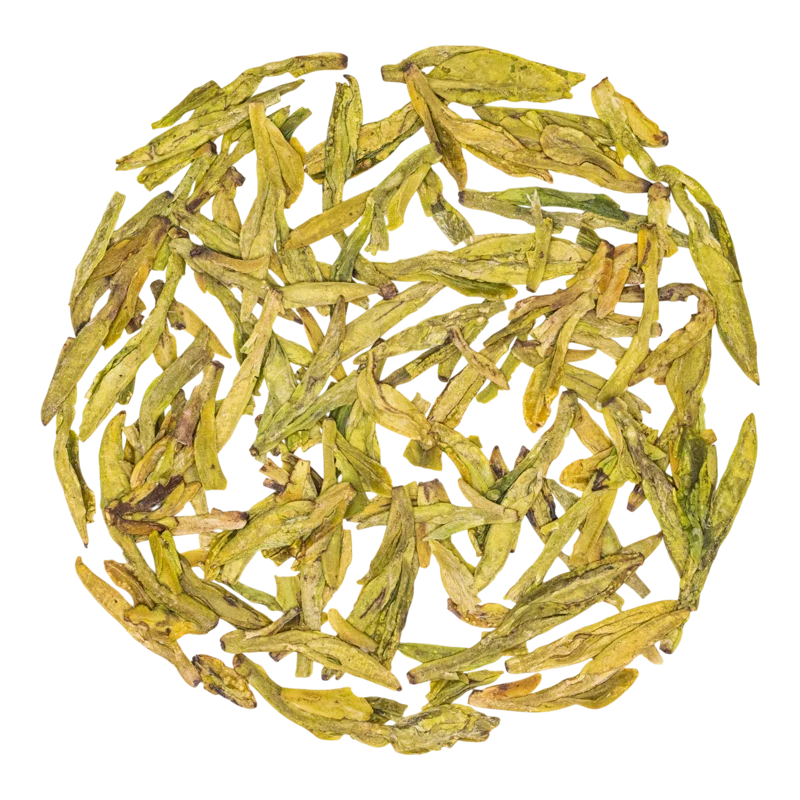
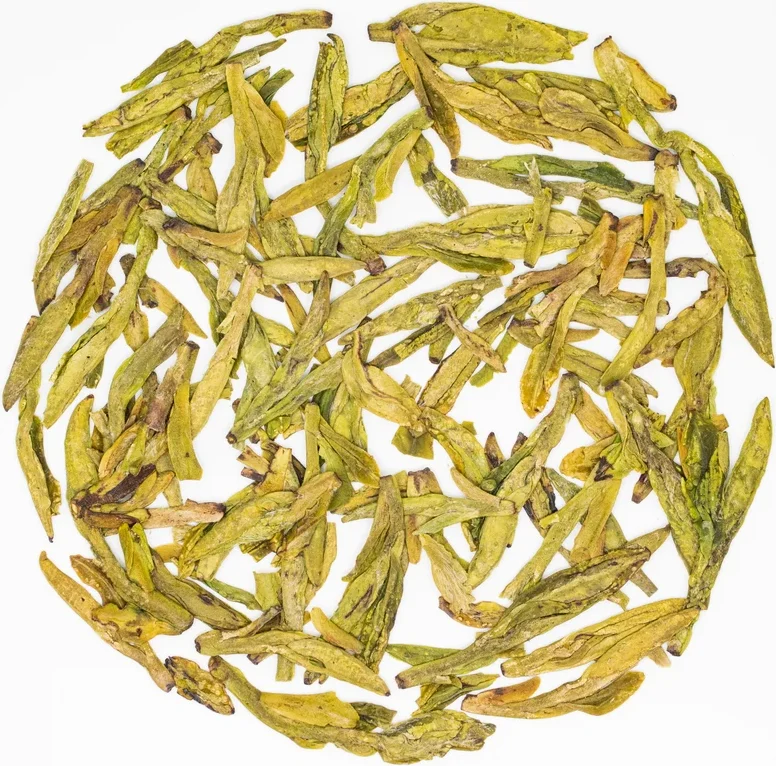
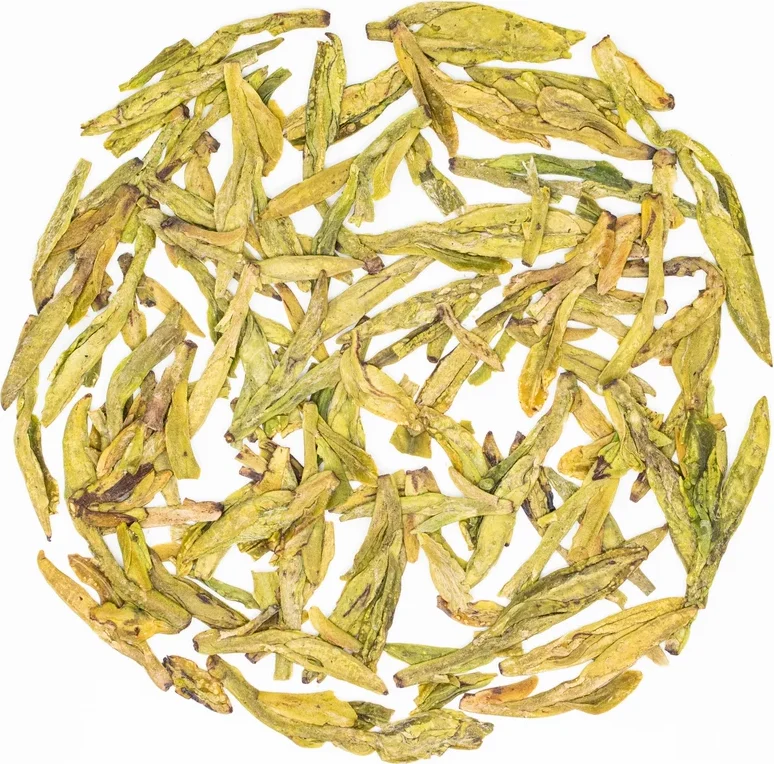
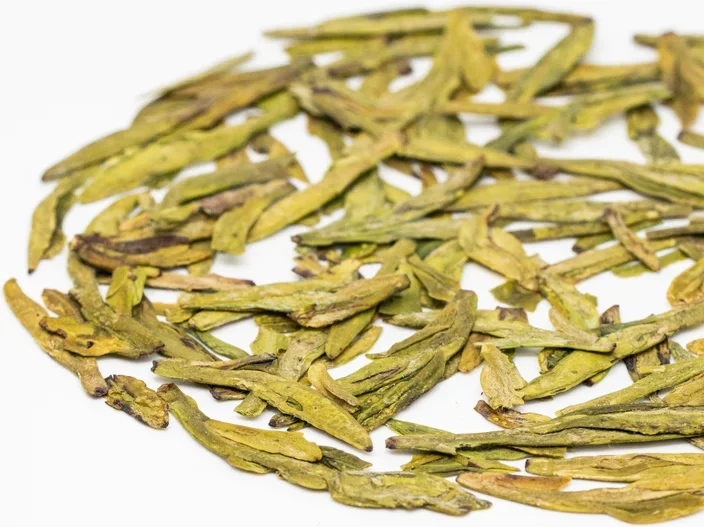
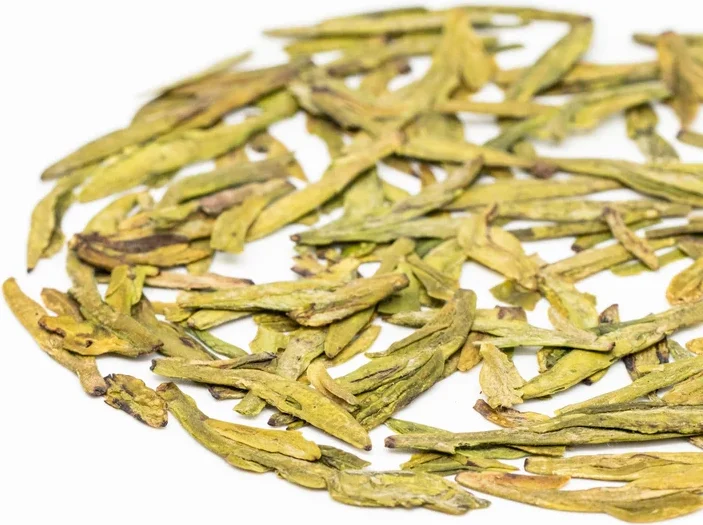
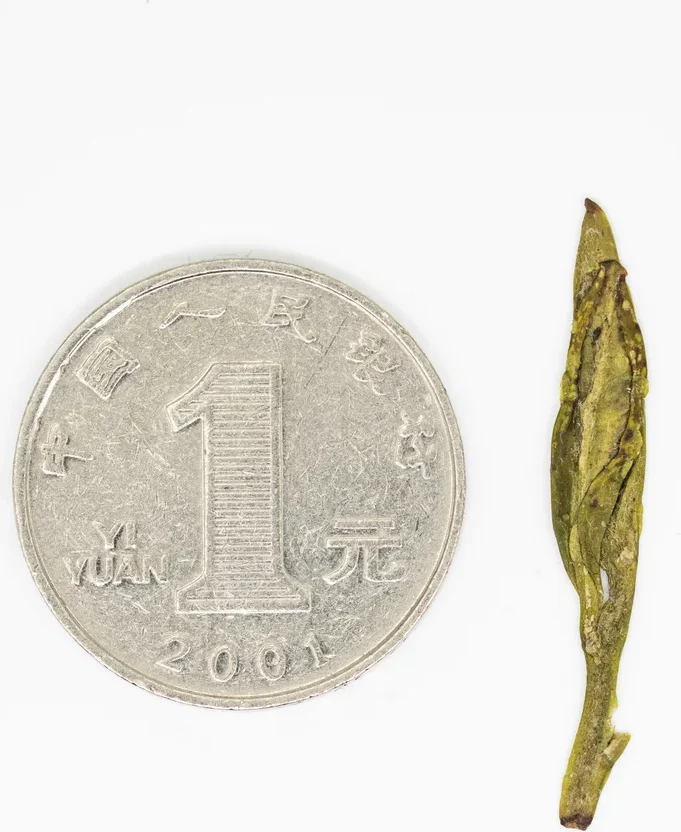
Dry Leaf Appearance: Flat, even tea leaves of Longjing formation. Dàfú shoots are more substantial and robust (肥壮, féizhuàng), with more pronounced pointed tips (尖削挺直, jiānxiāo tǐngzhí) than the more "elegant" Xi Hu Long Jing.
Dry Leaf Aroma: Delicate aroma of young buds (嫩香, nèn xiāng), orchid note (兰花香), chestnut roasting (栗香).
Liquor Color: Yellow-green, bright and clear.
Spent Leaves: Tender, uniform shoots, unfolded from flat tea leaves.
Taste: Fresh and brisk (鲜爽, xiānshuǎng), mellow-sweet (甘醇, gānchún). Aftertaste — returning sweetness.
Alkaloids: Caffeine — moderate content. Theobromine, theophylline.
Amino Acids: Elevated content — result of high-mountain origin and abundant diffused light. Determines freshness and sweetness.
Minerals: Potassium, magnesium, zinc, manganese — profile determined by yellow clay-sandy soils.
Polyphenols: Significant content — provides antioxidant potential and taste structure.
Vitamins: Vitamin C, B-group vitamins.
Catechins neutralize free radicals. High-mountain origin enhances antioxidant potential.
Caffeine and L-theanine provide gentle alertness.
Traditionally recommended in hot weather.
Polyphenols stimulate fat breakdown.
the listed properties are based on publicly available data and are not medical recommendations.
when liquor cools to ~40°C, an interesting effect of "cold aroma tempered by fire" (冷香淬火, lěng xiāng cuìhuǒ) appears — a warm caramel echo in the throat. Freshly purchased tea is recommended to rest for 2 weeks for "departure" of excess unprocessed polyphenols.
Tea Amount: 3–5 g per 150 ml water (1:50 ratio).
Teaware: Glass tumbler or white porcelain gaiwan.
Water Temperature: 85–95°C — Dafu Long Jing, thanks to more substantial raw material, withstands slightly higher temperature than delicate Xi Hu Long Jing.
Original and standard. More "elegant" and refined: thin flat tea leaves, pronounced bean aroma (豆花香, dòuhuā xiāng), oily "umami" body. Dafu is more robust and substantial in form, with delicate orchid (not bean) aroma and more accessible price.
Another brand from Yuezhou zone, from neighboring Shengzhou County. Close to Dafu in style, but less extensive as a brand.
From Guizhou. Also flat "Longjing type," but from different terroir. Meitan is more "pure" and fresh (amino acids ≥4.2%); Dafu is more classical in Longjing formation.
From Sichuan. Flat, but more "bamboo-like" in form. Zhuye Qing is lighter; Dafu is more full-bodied and "chestnut-like."
Dafu Long Jing is more substantial and robust than Xi Hu Long Jing. Overly thin, "elegant" tea leaves are probably not from Xinchang.
"Green" and "Yellow" versions are legitimate styles, not defects.
delicate, with orchid and chestnut notes. Coarse or "chemical" smell is a sign of counterfeit.
suspiciously low price is cause for doubt.
No reviews yet. Tell us what you think of this tea.
Rate this tea and share your impressions. We review each submission before publishing it.