Brewing
Gongfu brewing
- Water temperature
- 75 °C
- Tea amount
- 5 g
- Water volume
- 100 ml
- First steep
- 10 s
- Time added per infusion
- 5 s
- Infusions
- 3




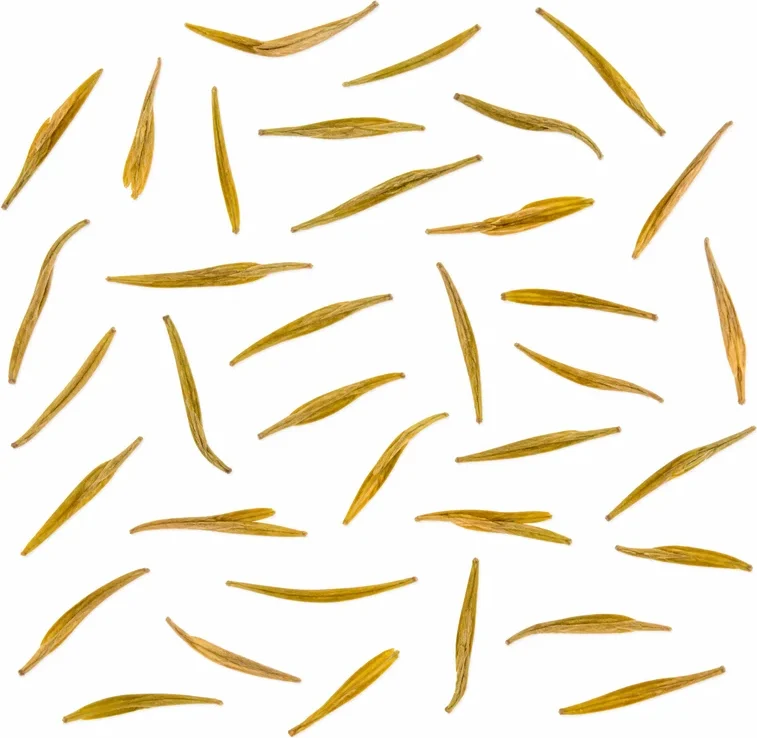
Ānjí huángjīn yá
Choose a brewing method. Start with the recommended quantities and time, then adjust to taste.
Brewing
Brewing
Taste
Tea encyclopedia
Category: Rare elite green tea; light-sensitive yellow variant of white (albino) mutant tea varieties.
Category: Rare elite green tea; light-sensitive yellow variant of white (albino) mutant tea varieties.
Coordinates: Anji, main production area: approximately 30°38′ N, 119°41′ E. Original discovery location (Yuyao, Sanqishi): approximately 29°57′ N, 121°17′ E.
Origin: The Huángjīn Yá cultivar (黄金芽, Huángjīn Yá) was discovered in the late 1990s at the "Deshi Jia" tea farm (德氏家茶场) in Sānqīshì township (三七市镇, Sānqīshì zhèn), Yúyáo city (余姚市, Yúyáo shì), Zhèjiāng Province (浙江, Zhèjiāng). Later, the variety was widely introduced to Ānjí County (安吉县, Ānjí xiàn) in the same province, which became the main commercial production region. Currently, Huángjīn Yá is also cultivated in Guìzhōu (贵州), Sìchuān (四川), Ānhuī (安徽), Húběi (湖北), Jiāngxī (江西) provinces and other tea-producing regions of China.
Type: Green tea (绿茶, lǜchá) — non-oxidized. Despite the bright golden-yellow color of the leaves, caused by genetic mutation (rather than the "sealed yellowing" stage as in yellow teas), Huangjin Ya undergoes standard green tea processing with the kill-green stage (杀青, shā qīng) to halt oxidation.
Cultural Significance: Huangjin Ya quickly occupied a special place in modern Chinese tea culture. Due to the extreme rarity of the variety, complexity of its cultivation, and high cost, the tea received the unofficial nickname "tea panda" (茶中大熊猫) — by analogy with China's national symbol, the giant panda, embodying uniqueness and the value of biodiversity. In tea circles, Huangjin Ya is regarded as an elite collectible tea and status gift. Its visual aesthetics — golden leaves floating in a transparent glass, like "bamboo shoots breaking through earth" (群笋出土, qún sǔn chū tǔ) — transforms tea drinking into true contemplation.
History: In the 1990s, Zhāng Wànlín (张完林, Zhāng Wànlín), director of the "Deshi Jia" tea farm, discovered an unusual natural mutation among ordinary tea bushes — a branch with consistently yellow shoots. From 1998, targeted breeding work began with participation from the Yúyáo Forest and Special Crops Technology Extension Station (余姚市林特科技推广总站), the Ningbo Agroforestry Science Center (宁波市林特科技推广总站), and the Tea Research Institute of Zhèjiāng University (浙江大学茶叶研究所, Zhèjiāng Dàxué Cháyè Yánjiūsuǒ). Through repeated vegetative propagation by cuttings and multi-stage line purification, a stable variety was obtained. In 2004, with support from Ningbo's science and technology department, a production-research group for yellow tea varieties was formed. In 2005, Huangjin Ya was first presented to the public at the spring Ningbo Tea Exhibition, where it caused a sensation with its "three yellows": yellow dry leaf, yellow liquor, yellow spent leaves. In 2008, the variety passed certification by the Zhèjiāng Province Woody Plant Variety Certification Committee (浙江省林木品种审定委员会) and was recognized as a provincial improved variety (省级良种) with registration number 浙R-SV-CS-010-2008. From this moment began the rapid spread of the variety across all tea-producing provinces of China.
Name Breakdown: The name Huángjīn Yá (黄金芽) consists of three characters: 黄金 (huángjīn) — "gold," 芽 (yá) — "bud, shoot." Thus, the literal translation is "Golden Bud," which accurately reflects the characteristic golden-yellow color of young shoots. The prefix "Anji" (安吉) indicates the main commercial production area. The name was assigned by breeding specialists, since the leaves and shoots of the bush maintain their golden hue year-round.
Evergreen shrub of medium growth vigor. Leaf narrowly elliptical, about 6.9 cm long, about 2.7 cm wide; color of young leaves — from light yellow to rich golden depending on illumination. Leaf tip blunt. Serration fine and frequent. Shoot pubescence weak. Flowering occurs in early November. Weight of 100 shoots (one bud + three leaves) is about 32.3 g, length of such shoot — about 4.8 cm.
Cultivar: Huángjīn Yá (黄金芽, Huángjīn Yá) — an asexual (vegetatively propagated) plant belonging to the species Camellia sinensis (L.) Kuntze. Morphologically classified as shrub type (灌木型, guànmù xíng), small-leaf variety (小叶类, xiǎoyè lèi), early-sprouting variety (早芽种, zǎo yá zhǒng). Crown semi-spreading (半开张, bàn kāizhāng), growth vigor medium, branching dense, beginning low from the base. Leaf blade narrowly elliptical, directed upward. Huangjin Ya belongs to light-sensitive yellow variants of white (albino) mutations of tea plants. Unlike the related variety Ānjí Bái Chá (安吉白茶, Ānjí Báichá), which is temperature-sensitive (turns white at temperatures below 23°C, then turns green), Huangjin Ya depends on light intensity: with sufficient light (over 15,000 lux) leaves consistently turn yellow, with shading — they turn green. This feature makes it unique — shoots maintain their golden color throughout three seasons (spring, summer, autumn), with summer and autumn yellowing even more intense.
Picking: Opening of harvest (开采期, kāicǎi qī) — typically late March. Period of mass harvest of "one bud + two leaves" standard (一芽二叶盛期) — early April. Highest quality is possessed by spring harvest material before the Qīngmíng festival (清明, Qīngmíng) — around April 5, the so-called Míng Qián harvest (明前, Míng Qián). Huangjin Ya allows three harvest seasons per year (spring, summer, autumn), with even summer and autumn material maintaining yellow color and acceptable quality — a rare property among green teas. However, in Anji commercially, typically only the spring harvest is collected.
Pluck Standard: For highest grades — one bud (一芽, yī yá) or one bud + one young leaf (一芽一叶, yī yá yī yè). For standard grades — one bud + two leaves (一芽二叶, yī yá èr yè). Only undamaged shoots of uniform golden color are harvested.
Raw Material: Shoots must be fresh, tender, without mechanical damage and signs of disease. Shoots with pronounced golden-yellow coloration are preferred — a sign of high amino acid and carotenoid content.
Altitude: Optimally — up to 1200 meters above sea level. Flat or gently sloping areas (slope up to 25°) are preferable, with good wind protection, oriented south or southeast.
Climate: Temperate subtropical. Average annual temperature in the Anji area is about 15–16°C. Precipitation — 1200–1500 mm per year. Frequent fogs and high relative humidity (up to 80–85%) are characteristic, creating diffused light favorable for amino acid accumulation.
Soil: Acidic or slightly acidic (pH 4.5–6.0), loose, well-drained, with deep soil profile (over 80 cm), high humus and organic matter content, rich in potassium, manganese and iron. Water stagnation is not permitted.
Main commercial area — Ānjí County (安吉县), Zhejiang Province, particularly Xīlóng township (溪龙乡, Xīlóng xiāng), Dìpù township (递铺镇, Dìpù zhèn) and adjacent territories of the Tiānmùshān mountain range (天目山, Tiānmùshān). Original area — vicinity of Yuyao, Ningbo. Currently the variety is also widely cultivated in Guizhou, Sichuan, Hubei, Anhui, Jiangxi and other provinces.
Huangjin Ya has reduced resistance to extreme conditions — intense heat, frost and drought. This requires special attention in site selection and agrotechnics. During prolonged heat (over 15 days) additional irrigation is necessary. Partial shading (up to 30% shading) is recommended during hot periods using inter-row plantings of economic tree species. Yellow leaf coloration intensifies with increasing light intensity: at 15,000 lux noticeable yellowing begins, at 25,000–30,000 lux — complete golden coloration of mature leaves, at 60,000+ lux shoot tips may acquire a reddish tint. Shading leads to return of green color.
Hand picking of young shoots of "one bud — one/two leaves" standard in early spring, preferably in morning hours after dew has dried. Raw material is placed in bamboo baskets in loose layers, avoiding compression.
Freshly picked shoots are spread in thin layers on bamboo trays in ventilated rooms for 2–4 hours for light evaporation of surface moisture. Leaves slightly wilt and soften, preparing them for subsequent fixation.
Brief heating of leaves at high temperature (about 180–200°C) for approximately 1–2 minutes to inactivate oxidative enzymes and halt oxidation. Time and temperature of fixation for Huangjin Ya are somewhat lower than for standard green teas (e.g., Longjing) — this allows protecting delicate carotenoid pigments from destruction.
Treatment with warm air to reduce moisture content to approximately 30%. This stage stabilizes leaf shape and prepares it for rolling.
Light rolling with minimal pressure to give leaves characteristic elongated shape (needles or "bird tongues") and partial release of cell juice to the surface, which subsequently forms aroma and taste.
Slow finish-drying at controlled temperature (60–80°C) to residual moisture of about 5%. Traditional charcoal ovens are often used, providing uniform heating. This stage finally stabilizes the tea, fixes aroma and ensures storage stability.
Finished tea is sorted by size and quality, rejecting damaged and unevenly colored leaves.
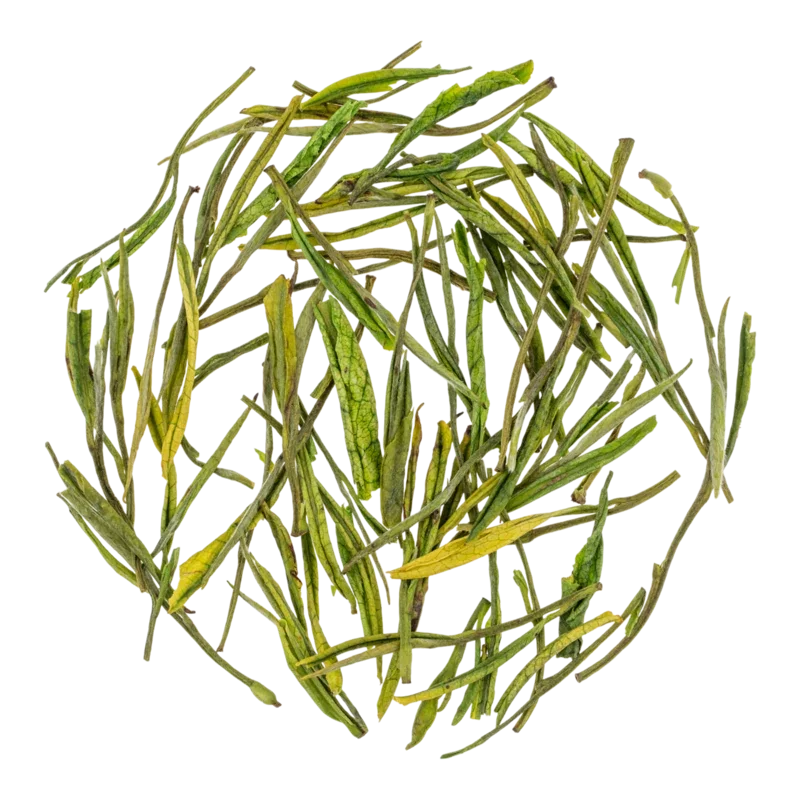
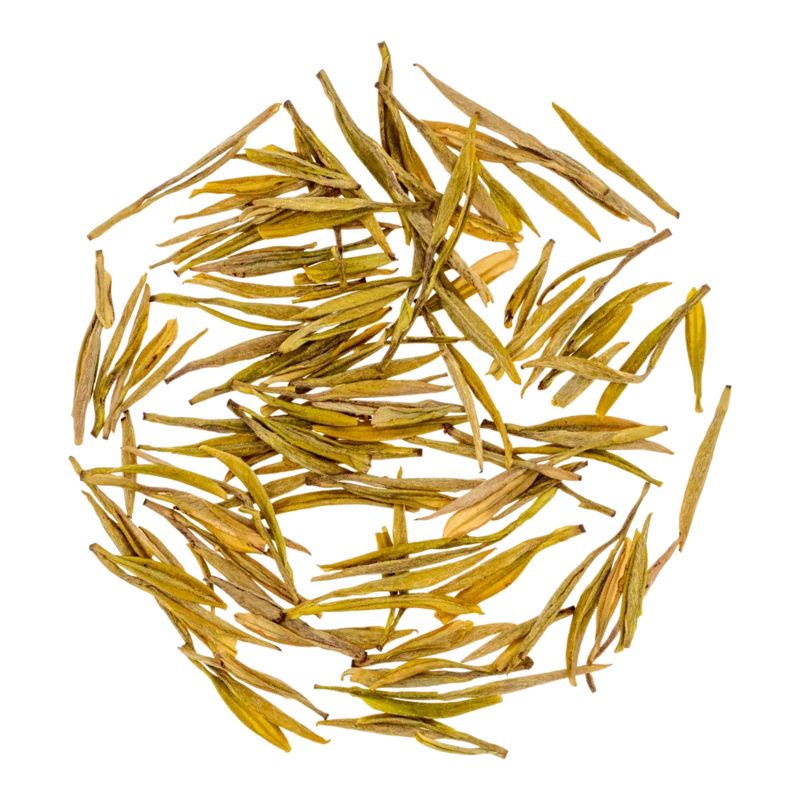
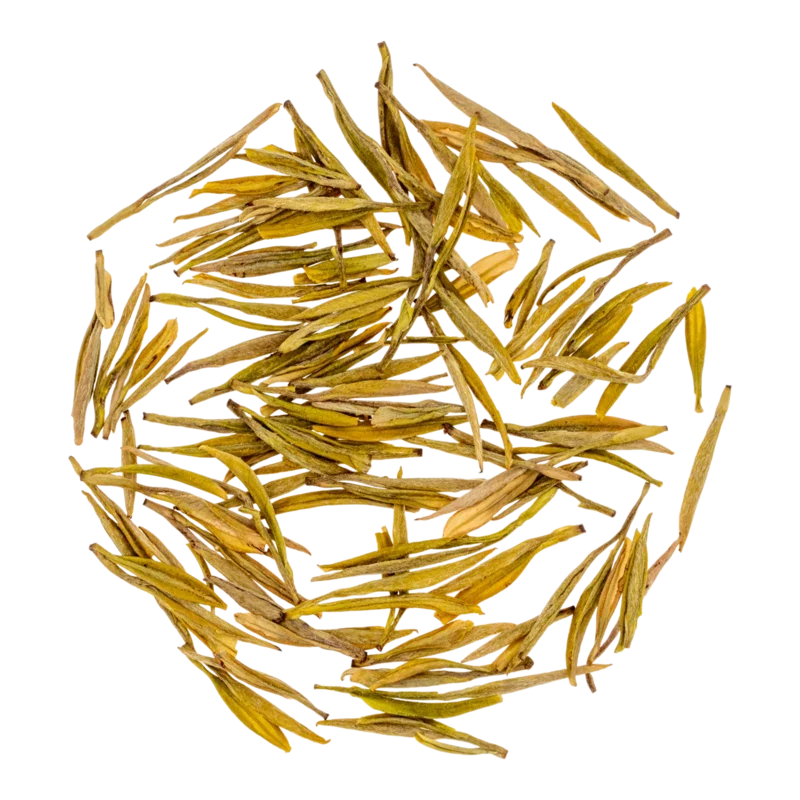
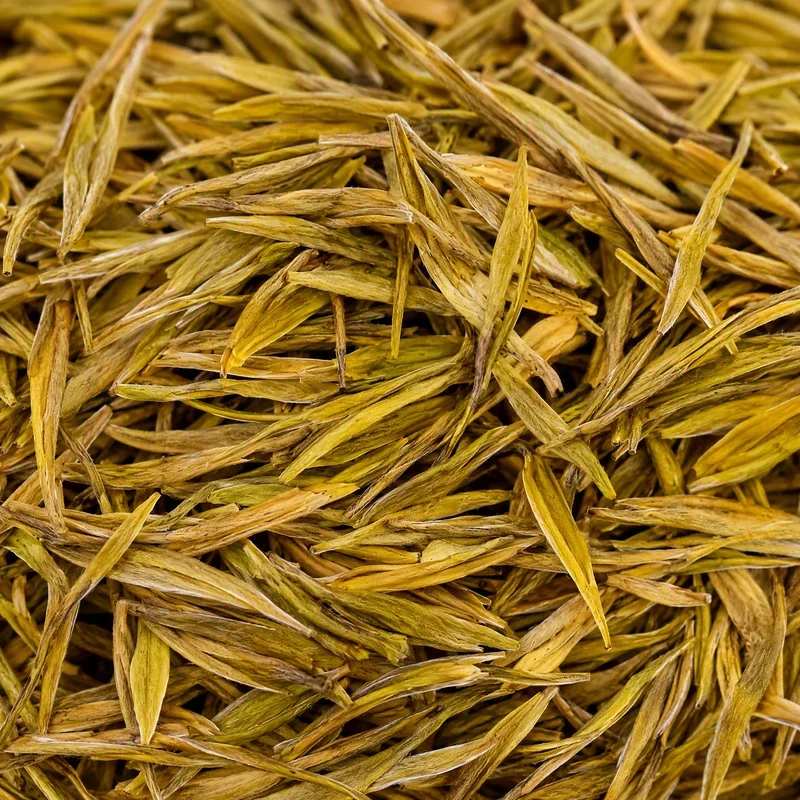
Dry Leaf Appearance: Thin, elegant leaves, rolled into needle shapes or flat "bird tongues" (雀舌, què shé). Color — bright, uniform golden-yellow, sometimes with light greenish tint at the base. Pubescence weak. Leaves whole, without fragments, with characteristic oily luster.
Dry Leaf Aroma: Delicate, sweetish, with notes of ripe persimmon, roasted chestnuts, pumpkin seeds, light oiliness (clarified butter) and fresh asparagus. In highest grades a delicate floral note is present.
Liquor Aroma: Fresh, mild, floral-herbaceous, with tones of meadow grasses, violet powder, light citrus acidity and barely perceptible creamy tone. As it cools, nutty and honey notes unfold.
Liquor Color: Transparent, bright, clear golden-yellow, sometimes described as "chrysanthemum color" or "Japanese persimmon color." When cooling, the color becomes even more saturated and deep.
Spent Leaves: Leaves fully unfold, demonstrating tenderness and uniform golden-yellow-green coloration with characteristic "three-color gradient": shoot tip — golden, middle — yellow-green, base — tender green. Leaves elastic, resilient, do not break when pressed.
Taste: Exceptionally mild, smooth, rounded, velvety — completely lacking bitterness and pronounced astringency. Creamy-nutty notes dominate with natural sweetness; pronounced umami character is felt due to high L-theanine content. Aftertaste long, clean, refreshing, with acacia honey tone and light returning sweet sensation (回甘, huí gān).
Alkaloids: Caffeine — about 3.5–3.8% of dry matter (about 25 mg per 100 ml of liquor). Caffeine action is softened by high L-theanine content, providing mild and prolonged stimulation without sharp excitement. Theobromine and theophylline are also present in insignificant amounts.
Amino Acids: Free amino acid content is record high — from 2.70 to 9% (according to various data; on average about 7–9%, while typical green teas have 3–4%, and Anji Bai Cha has 5–7%). L-theanine (theanine) dominates, providing sweet taste (umami), relaxing effect and stimulation of brain alpha waves. High amino acid to polyphenol ratio (low phenol-amine coefficient, 酚氨比 — about 2.9–7.6) is the main reason for taste mildness and sweetness.
Elevated content — lutein, β-carotene, zeaxanthin. Carotenoids determine the characteristic golden color of leaves (with simultaneous reduction of chlorophyll synthesis). They possess antioxidant properties and support vision health.
The key biochemical trait of Huangjin Ya is extremely high amino acid content with moderate polyphenol level, caused by genetically determined suppression of chlorophyll synthesis and redistribution of metabolic pathways in favor of amino acid and carotenoid accumulation.
Essential Oils: Present in small amounts; responsible for floral-herbaceous aroma of the liquor.
Minerals: Potassium, fluorine, manganese, zinc, selenium and other trace elements.
Polyphenols: Moderate content — about 15.8–22.9%. EGCG (epigallocatechin gallate) is present, possessing powerful antioxidant action. Catechin content — about 12.6–15.0%. Reduced polyphenol level compared to ordinary green teas determines absence of pronounced bitterness.
Vitamins: Vitamin C, B-group vitamins (B₁, B₂), PP (niacin). Vitamin C concentration may be higher than in Anji Bai Cha.
High L-theanine content promotes relaxation without drowsiness, improves attention concentration, memory and focusing ability, stimulates brain alpha wave generation. Combined action of L-theanine and caffeine provides calm, "clean" alertness.
Polyphenols (primarily EGCG) and carotenoids (lutein, β-carotene) protect cells from oxidative stress, neutralize free radicals and slow cellular aging processes.
Catechins help strengthen blood vessel walls, maintain arterial elasticity and reduce "bad" cholesterol (LDL) levels.
Green tea components stimulate metabolism, help maintain normal blood sugar levels. There is evidence that L-theanine may increase cellular insulin sensitivity.
Complex of vitamins (C, B₁, B₂), minerals (zinc, selenium) and antioxidants supports the body's immune defense.
Elevated carotenoid content (lutein, zeaxanthin) beneficially affects retinal condition and reduces eye fatigue.
A number of Chinese studies indicate the ability of Huangjin Ya components to support liver functions and provide protective action on hepatocytes.
Moderate polyphenol content stimulates digestion without causing gastric mucosa irritation, which favorably distinguishes Huangjin Ya from many green teas.
3 g tea per 250–300 ml water at 80°C temperature, steep for 2–3 minutes. Re-steeping up to 2–3 times is permitted.
When brewing in glass cup using "top pouring method" (上投法, shàng tóu fǎ) — first pour water, then add tea — golden shoots effectively float and slowly settle, creating spectacular picture of "bamboo shoots" (群笋出土).
Tea Amount: 3–5 g per 150–200 ml of water.
Teaware: Transparent glass cup (玻璃杯, bōli bēi) — ideal option for contemplating golden shoots in water. Glass teapot, porcelain gaiwan (盖碗, gàiwǎn) or glass flask are also suitable.
Water Temperature: 75–85°C. Boiling water will destroy delicate amino acids and carotenoid pigments, depriving the tea of its main virtues.
The closest "relative" and most famous white albino variety from Anji. Key difference: Anji Bai Cha is a temperature-sensitive variety (turns white at temperatures below 23°C, turns green when it warms up), while Huang Jin Ya is light-sensitive (turns yellow under intense light, turns green when shaded). Bai Cha leaves are white in spring, green in summer; Huang Jin Ya leaves are golden all three seasons. Both teas are mild and sweet in taste, but Huang Jin Ya typically has higher amino acid content (up to 9% versus 5-7%) and a more pronounced creamy-nutty character.
Another yellow-leaf variety from Anji. Unlike Huang Jin Ya, Huang Jin Ye leaves maintain their yellow color from bud to mature leaf without changes, and the coloration is independent of temperature or light. The taste is simpler, with a pronounced chestnut note, less sweet.
A variety from Anhui with yellow leaves. Distinguished by larger leaves and less pronounced sweetness. Has lower amino acid content compared to Huang Jin Ya.
New yellow-leaf varieties developed by the Tea Research Institute of the Chinese Academy of Agricultural Sciences. They have high amino acid content but are less widespread and commercially known than Huang Jin Ya.
Price Category: Huangjin Ya is one of the most expensive green teas in China. Spring harvest of highest quality (Ming Qian) from Anji can reach 10,000 yuan and higher per 1 kg on the domestic market. On the international retail market, price for 100 g of high-grade tea can range from 100 to 250 dollars and higher. Cost is determined by variety rarity, cultivation complexity, limited harvest period, labor-intensive hand production and high terroir requirements. As the variety spreads to Guizhou, Sichuan and other provinces, more affordable versions appear, however tea from Anji traditionally commands higher prices.
No reviews yet. Tell us what you think of this tea.
Rate this tea and share your impressions. We review each submission before publishing it.