Classification and Origin
Category: National Geographical Indication Product of China (国家地理标志产品, 2012). Provincial-level intangible cultural heritage of Hunan (省级非遗, shěngjí fēiyí, 2012 — technology of "环钩定形", huángōu dìngxíng, "hook-ring shaping"). Gold Medal from the Ministry of Agriculture, Animal Husbandry and Fisheries of China (国家农牧渔业部金奖, 1980). Gold Medal at the Fifth Asia-Pacific International Trade Fair (1994). By 2025 — 149,000 mu of tea gardens, 4,700 tons of production, 520 million yuan total value.
Coordinates: Approximately 26°05′ N, 113°55′ E.
Origin: China, Hunan Province (湖南省, Húnán Shěng), Chenzhou City (郴州市, Chēnzhōu Shì), Guidong County (桂东县, Guìdōng Xiàn). Luoxiao Mountains (罗霄山脉), altitude 500–1500 m. Place of origin — Tongluocun Village (铜锣村, Tóngluó Cūn), Qingquan Township (清泉镇, Qīngquán Zhèn), Linglun Group (玲珑组, Línglóng Zǔ).
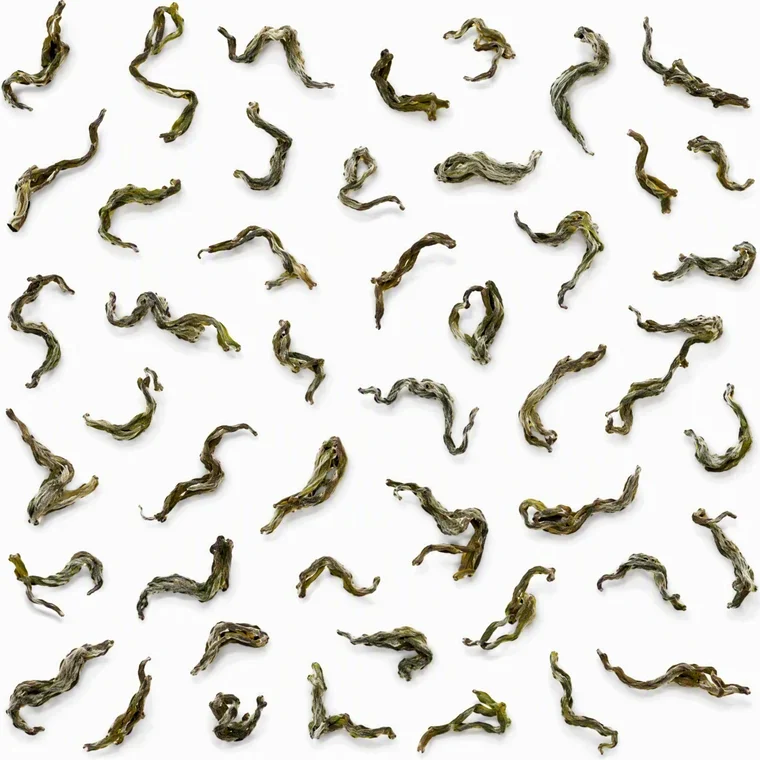
Type: Green tea (绿茶, lǜchá), unfermented. Unique "hook-shaped" form (环钩状, huángōu zhuàng) — "curved hook" closed into a ring. Fixation technology — pan-firing (炒青, chǎoqīng) with final low-temperature drying at 50–60°C.
Botany and Raw Material
Local population variety (本地群体种, běndì qúntǐ zhǒng), belonging to Camellia sinensis var. sinensis. Medium-leaf, early vegetation, abundant down (白毫, báiháo). Wild ancient tea trees over 100 years old have been discovered in the county — evidence of autochthonous origin of tea culture. Biochemical leaf profile: amino acids — 5.15%, polyphenols — 29.98%, caffeine — 6.78%. Phenol-amino acid ratio (酚氨比, fēn'ān bǐ) — 0.17 — exceptionally low, ensuring the taste formula "鲜醇耐泡" (xiān chún nài pào, "fresh, mellow, enduring").
Special (特级, tèjí): single bud — from 2800 yuan/500g (2024). First (一级, yījí): one bud + one leaf — 800–1200 yuan. Second (二级, èrjí): one bud + two leaves — mass grade.
Picking: Spring harvest (春茶, chūnchá) — primary. Highest grade — single buds harvested before Qingming. First grade — "one bud + one leaf initial opening" (一芽一叶初展, yī yá yī yè chūzhǎn). Second grade — "one bud + two leaves" (一芽二叶).
Pluck Standard: Buds must be full, with dense silver down. Uniformity requirement — maximum: shoot length in a batch must not deviate by more than 15%.
Terroir
Soil: Yellow soils on granite base (花岗岩风化黄壤, huāgāngyán fēnghuà huángrǎng). pH — 5.5–6.5. Organic content — ≥2%. Loose structure, deep profile.
500–1500 m above sea level.
Production
2–6 hours on bamboo sieves. Partial moisture evaporation, beginning of enzymatic transformations.
Temperature — 120–130°C — notably lower than most pan-fired green teas (typically 160–220°C). Gentle fixation preserves maximum down and tender texture.
Rapid heat dissipation to stop thermal impact.
Cell destruction at 30–40% — sufficient for extractability but without losing shape.
Reaching "non-sticky to hands" state, down begins to manifest.
Key operation — "two-handed counter-rotational rubbing" (双手反旋搓条, shuāngshǒu fǎnxuán cuōtiáo). The master takes a portion of tea in both palms and rotates them in opposite directions, twisting the leaf into a tight spiral "hook" closed into a ring. Movement — slow, pressure — even. Upon reaching ~80% dryness, transition to "down raising" (提毫, tíháo): palms compress the tea and rotate smoothly, allowing leaves to rub against each other until silver down emerges on the surface. Mechanical pressing is prohibited (禁用机械压条, jìnyòng jīxiè yātiáo) — the "hook-ring" shape is achievable only by hand.
Equalizing moisture between surface and core of the leaf.
50–60°C to moisture ≤6%. Low temperature preserves the fragile "hook" shape and down.
Organoleptic Profile
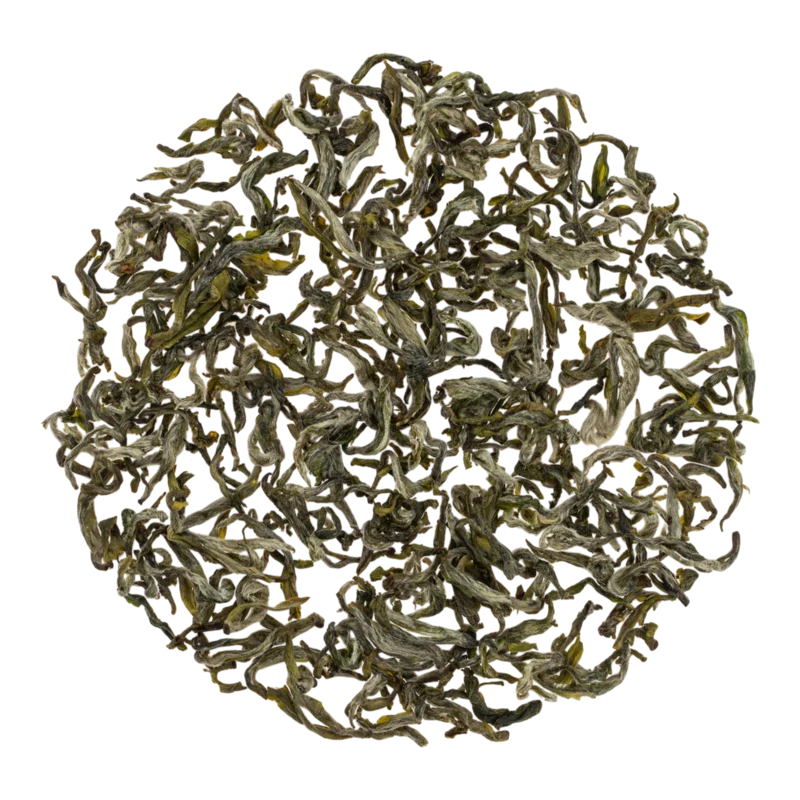
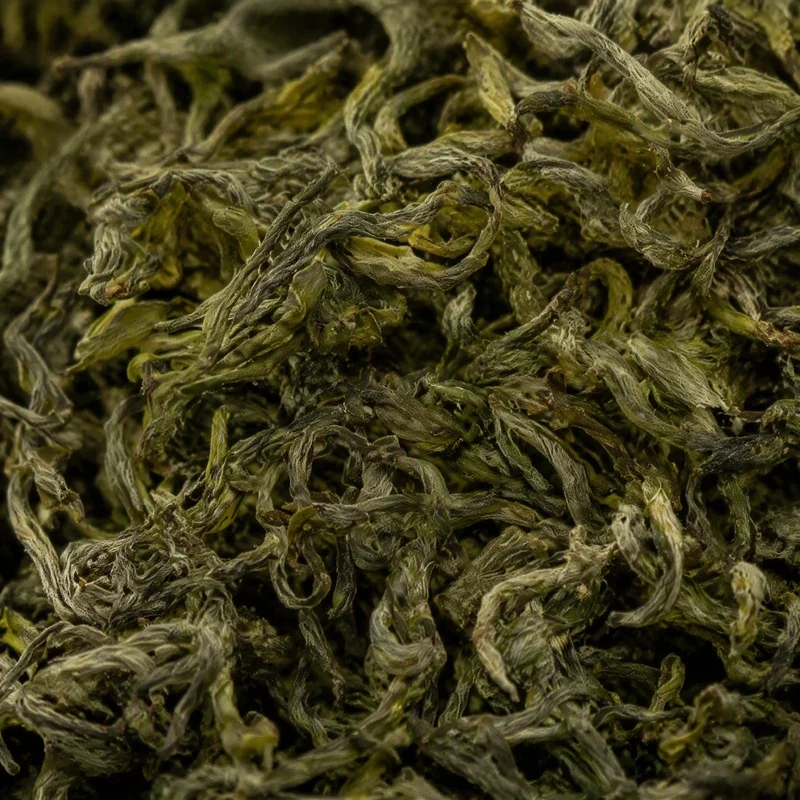
Dry Leaf Appearance: Tight spiral "hooks" closed into rings (紧细弯曲, 环钩状, jǐnxì wānqū, huángōu zhuàng). Color — emerald green with oily luster and abundant silver down (翠绿油润显银毫, cuìlǜ yóurùn xiǎn yínháo). Leaves exceptionally miniature and uniform.
Dry Leaf Aroma: Pure (清香, qīngxiāng), fresh, with chestnut undertone in spring tea. Highest grade — light "tender" (嫩香, nènxiāng) note with young greenery shade.
Chestnut (栗香, lìxiāng) with pure vegetal background. Aroma is persistent — cold cup retains scent over 10 minutes.
Yellow-green, clear and bright (黄绿明净, huánglǜ míngjìng).
Tender, uniform, "in bouquets" (嫩匀成朵, nèn yún chéng duǒ) — shoots open in groups, demonstrating integrity. Color — bright green.
Taste: Fresh and mellow (鲜醇, xiānchún) — result of record 5.15% amino acids. Sweet and refreshing (甘爽, gānshuǎng). Formula "thick but not astringent" (浓而不涩, nóng ér bú sè) — ideal balance of polyphenols (29.98%) and amino acids with phenol-amino acid ratio of 0.17. Sweet aftertaste — quick and persistent.
Chemical Composition
Amino Acids: 5.15% — 40% higher than average for green teas. L-theanine dominates, providing freshness, umami-like sweetness and relaxing effect.
6.78% — above average (typical range for green teas — 2–4%). High content explained by genetics of local variety and ecological conditions. Provides energetic tonic effect.
0.17 — exceptionally low (for most green teas — 5–10 and higher). This means absolute dominance of freshness over astringency — a rare characteristic.
≥43.3% — high extractability, "full-bodied" infusion.
Essential Oils: Terpene alcohols (linalool, geraniol), responsible for pure chestnut-floral aroma.
Minerals: Potassium (K), phosphorus (P), magnesium (Mg), calcium (Ca), manganese (Mn), iron (Fe), zinc (Zn), fluorine (F).
Polyphenols: 29.98% — in upper range for green teas. Main components — catechins (EGCG, EGC, EC, ECG), possessing pronounced antioxidant activity.
Vitamins: Vitamin C (ascorbic acid), B₁ (thiamine), B₂ (riboflavin), P (rutin), carotenoids. Vitamin content in high-mountain spring green teas is typically maximum among all tea types.
Brewing
Tea Amount: 3g per 150ml (ratio 1:50).
Teaware: Tall glass cup (玻璃杯) — ideal for observing "hook-ring" unfolding (spectacular process: tight spirals slowly unfurl, "coming alive" in water). White porcelain gaiwan (盖碗) — for more precise extraction control.
Water Temperature: 80–85°C. For highest grade (一芽, single bud) — 75°C, to avoid "burning" tender buds and preserve down.
Storage
Container: Airtight — vacuum foil bags, tin cans with tight lid. Avoid transparent containers.
Enemies: Moisture, light, foreign odors, oxygen, heat.
Shelf Life: 12 months from production date under proper conditions. When removing from refrigerator — let package reach room temperature before opening.
Temperature: Refrigerator, 0–5°C. For long-term storage — freezer (−18°C) in double vacuum packaging.
Price and Authenticity
Raw material grade, harvest time (mingqiancha — premium), fully manual shaping (环钩定形 technology cannot be mechanized), harvest altitude.