Brewing
Gongfu brewing
- Water temperature
- 95 °C
- Tea amount
- 7 g
- Water volume
- 100 ml
- First steep
- 10 s
- Time added per infusion
- 5 s
- Infusions
- 10



Shèngzhōu huī bái
Choose a brewing method. Start with the recommended quantities and time, then adjust to taste.
Brewing
Brewing
Taste
Tea encyclopedia
Category: Historic Famous Tea of China (中国历史名茶). Regional premium green tea of round-rolled type (圆形绿茶, yuánxíng lǜchá).
Category: Historic Famous Tea of China (中国历史名茶). Regional premium green tea of round-rolled type (圆形绿茶, yuánxíng lǜchá).
Coordinates: Approximately 29.70° N, 120.88° E (reference point — Quangang Village on the southern slope of Mount Fuzhi).
Origin: China, Zhèjiāng Province (浙江省, Zhèjiāng shěng), Shèngzhōu City (嵊州市, Shèngzhōu shì), Sìmíng Mountain area (四明山, Sìmíng Shān). Main production zones: Xiàwáng Township (下王镇, Xiàwáng zhèn) — Quángǎng Village (泉岗村, Quángǎng cūn), as well as Guìmén Township (贵门乡, Guìmén xiāng) — Shàngwùshān Village (上坞山村, Shàngwùshān cūn).
Type: Green tea (绿茶, lǜchá). Non-oxidized, degree of oxidation minimal (less than 5%).
Cultural Significance: Huī Bái is closely connected with the cultural history of Zhèjiāng green teas and is considered the progenitor of the famous Píngshǔi Zhūchá (平水珠茶, píngshǔi zhūchá) — "pearl tea," which from the Qing era became one of China's main export green teas. If Pingshui Zhucha evolved toward maximally dense round rolling for the convenience of maritime export, then Hui Bai preserved the archaic "not quite round" form, remaining a tea for the domestic market and connoisseurs. Local residents describe the geography of Qiangang Village with a poetic saying: "Qiangang dalingtou, zoulu peng bitou, yunyu rao shantou, laohu dun yantou" (前岗大岭头,走路碰鼻头,云雾绕山头,老虎蹲岩头 — "On the great ridge of Qiangang the road runs into the nose, mist wraps around the peaks, and a tiger sits on the rock").
History: The territory of modern Shèngzhōu in ancient times was part of Yuèzhōu Prefecture (越州), and local tea was known under the general name Yuèzhōu Chá (越州茶). As early as the Western Han period (206 BCE — 9 CE), these lands, then called Shān County (剡县), were famous for tea from the upper reaches of the Shǎnxī River (剡溪). During the Tang era, tea master Lù Yǔ (陆羽, Lù Yǔ) in "The Classic of Tea" (茶经, Chájīng) mentioned teas from Yuezhou Prefecture.
Name Breakdown: Shèngzhōu (嵊州) — the administrative county where the tea is produced. Huí (辉) — reference to the key technological stage huiguo (辉锅, "roasting for shine"), during which the dry leaf acquires a characteristic whitish bloom-"frost." Bái (白) — "white," describing this very frost (起霜, qǐshuāng) on the surface of the finished tea. Thus, the full name literally means "shining white [tea] from Shengzhou." Historical variants of writing: Qiángǎng Huí Bái (前岗辉白 / 前冈煇白), Quángǎng Huí Bái (泉岗辉白).
Cultivar: Local population variety (当地群体种, dāngdì qúntǐ zhǒng) — medium-leaf and small-leaf type (中小叶种, zhōngxiǎo yè zhǒng), a historically formed genetic mixture of lines adapted to the mountain terroir of Siming Mountain. Distinguished by high frost resistance and abundant white down on young shoots.
Picking: Predominantly spring — around Gǔyǔ (谷雨, "Grain Rain," approximately April 19–21). Highest grades are picked before Guyu, standard grades — after.
Pluck Standard: For highest grade (高档辉白): one bud and one leaf (一芽一叶, yī yá yī yè), picked before Guyu — such raw material comprises about 30% of total volume. For medium grade: one bud and two leaves in initial opening stage (一芽二叶初展). For standard grade: from one bud with two to one bud with three leaves in initial opening stage. To produce 500 g of highest grade tea requires 40,000–50,000 buds.
Raw Material: Shoots must be robust, with abundant white down (芽叶肥壮,多白毫). After picking, raw material is immediately sorted, achieving uniformity by size and degree of maturity, then laid out by grades for separate processing.
Altitude: 500–800 m above sea level.
Climate: Subtropical monsoon. Average annual number of foggy days — over 280. Air humidity ≥ 80%. Significant diurnal temperature variation promotes accumulation of aromatic and flavor compounds in the leaf. A local saying describes the conditions: "Mist wraps around the peaks" — tea bushes literally grow in clouds.
Soil: Yellow-brown soils of the glacial belt of Fuzhi Mountain, known in local tradition as "ash earth" (香灰土, xiānghuī tǔ). Rich in organic matter and mineral elements. Forest coverage of the territory — 93%, industrial pollution absent.
Tea gardens are located on the southern slope of Mount Fùzhì (覆卮山, Fùzhī Shān, peak elevation 861 m), part of the Siming Mountain range system. The production core — ancient tea gardens of Quangang Village at about 500 m elevation and plantations of Shangwushan Village at about 650 m elevation, located in the belt of ancient glacial deposits.
Ecological plantation management without use of industrial fertilizers and pesticides. Natural shading is provided by mountain forest. Diffused light (漫射光, màn shè guāng) through fog and tree crowns promotes increased synthesis of aromatic substances and amino acids in the leaf.
Temperature of inclined wok 200–220°C. Load — about 1.5–1.7 kg fresh leaf per wok. The master works with bamboo fork-sticks, applying the technique "more steaming, less tossing" (多闷少抛, duō mèn shǎo pāo) for even fixation without overdrying the surface. Duration — 8–9 minutes.
Hot leaf after shaqing is immediately rolled by hand with both hands in a "rolling" motion (滚揉, gǔn róu) until it becomes slightly sticky to the touch. Duration — 2–3 minutes.
Rolled leaf is spread out and dried on bamboo roasters (冲, chōng — local name, analog of hongshao) over charcoal at about 90°C until color darkens and stickiness is lost.
Additional 2–3-minute hand rolling for enhanced shaping.
Temperature drops to 60°C, duration — 10–12 minutes.
Conducted in inclined wok at about 120°C. Load increases to 2.5–3.0 kg. The master with both hands "pushes" and "rubs" the leaf (推炒, tuī chǎo), giving it preliminary round form. Duration — 30–35 minutes.
This is the central and defining stage. Leaf from two previous batches is loaded into the inclined wok. Initial temperature — about 100°C, then it gradually decreases to 30–40°C. The master gently pushes the tea along the wok wall with both hands, causing leaves to slowly curl. The process lasts 3–4 hours — this is the longest stage. It is precisely during huiguo that the leaf acquires the signature "coiled disc" shape (盘花卷曲, pánhuā juǎnqū) and becomes covered with whitish frost (色白起霜). After huiguo, the finished tea is slightly cooled, sifted of dust and yellow leaves and foreign inclusions are manually removed, after which it is hermetically packed in tin containers.
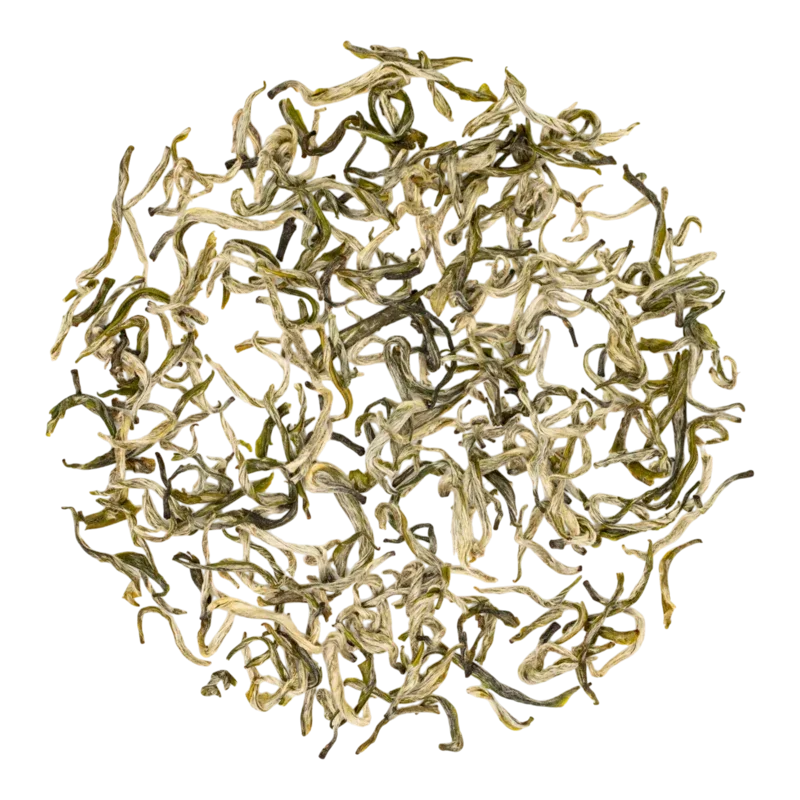
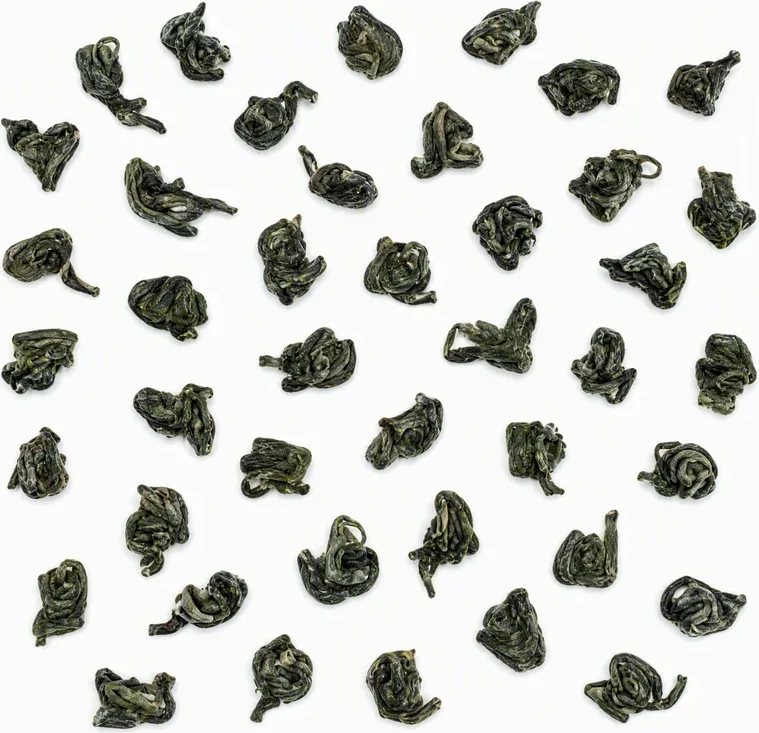
Dry Leaf Appearance: Characteristic "coiled flower" shape (盘花卷曲) — granules that are not perfectly round but tightly rolled. The tea resembles miniature coils or spirals. The surface is covered with light whitish "frost" (披霜, pīshuāng), under which intense emerald-green color shows through. Granule size is uniform, structure dense and neat (紧结匀净).
Dry Leaf Aroma: Clean, fresh, with distinct chestnut tone (栗香, lìxiāng). Tea from the glacial belt of Fuzhi Mountain may have the so-called "cold aroma" (冷香, lěngxiāng) — a subtle mineral note of coolness.
Liquor Aroma: Intense and rich (浓爽, nóngshuǎng). Chestnut tone dominates, complemented by clean "green" freshness. In the best batches, the aroma is high and lasting.
Liquor Color: Yellow-green, bright and clear (黄明清澈, huáng míng qīngchè), with light luster.
Spent Leaves: Tender yellow color (嫩黄, nènhuáng), leaves open in whole "bouquets" (成朵, chéng duǒ), bud tips are clearly visible (芽锋显露). Leaf structure testifies to quality hand processing without excessive mechanical impact.
Taste: Dense, rich (醇厚, chúnhòu), simultaneously fresh and brisk (鲜爽, xiānshuǎng). The taste shows concentrated thickness (浓醇, nóngchún), due to dense rolling: the tea opens gradually, releasing substances slowly. Returning sweetness (huí gān) (回甘) — rapid and pronounced. Bitterness and astringency are minimal with proper brewing.
Amino Acids: Due to high-altitude position, frequent fogs and significant temperature variation, free amino acid content is elevated — for spring harvest highest grade ≥ 4%. L-theanine (L-茶氨酸) predominates, providing characteristic "fresh sweetness" and relaxing effect.
Typical level for green teas — around 2.5–3.5% dry weight. Synergy of caffeine and L-theanine provides gentle, even stimulation without sharp excitation.
Fluorine (content about 200 ppm, which promotes dental enamel protection), potassium, zinc, manganese, selenium (trace element characteristic of glacial belt soils of Fuzhi Mountain).
Chestnut aroma is formed by pyrazines and furan compounds formed during the prolonged huiguo process. "Cold aroma" of tea from glacial soils may be related to increased content of terpene alcohols (linalool, geraniol).
Polyphenols: Content in dry leaf approximately 18–22% — moderate for green tea, which explains the relatively low bitterness and astringency. Main catechins: EGCG, ECG, EGC, EC. Antioxidant activity of Hui Bai catechins, according to sources, is 10 times higher than the analogous indicator of vitamin E.
Vitamins: Present are vitamin C (ascorbic acid), B vitamins (B₁, B₂), vitamin E, vitamin K. Vitamin C is partially preserved due to minimal oxidation during production.
High catechin content, especially EGCG, provides effective neutralization of free radicals and protection of cells from oxidative stress.
The combination of caffeine and L-theanine gives even, calm surge of clarity without anxiety — an effect often described as "clear mind."
Catechins, particularly EGCG, promote acceleration of lipid metabolism and may contribute to normalization of blood cholesterol levels.
Elevated fluorine content (about 200 ppm) suppresses activity of caries-causing bacteria and strengthens dental enamel.
Moderate tannins stimulate peristalsis and secretion of digestive juices. The tea is well-suited to accompany meals.
Polyphenols promote vascular elasticity and may reduce atherosclerosis risk.
Vitamin C and polyphenols together have a general strengthening effect.
Not recommended to drink on empty stomach due to possible gastric mucosa irritation by tannins. With increased caffeine sensitivity, better to consume in the first half of the day.
Finished liquor is recommended to be consumed within 30–60 minutes — prolonged standing leads to excessive astringency and loss of aroma freshness.
Tea Amount: 3 g per 150 ml (1:50 ratio). For gaiwan in gongfu style: 5–6 g per 100–120 ml.
Teaware: Glass tumbler (玻璃杯, bōlí bēi) — optimal choice, allowing observation of gradual granule opening. Porcelain gàiwǎn (盖碗) for gongfu brewing. Glass or porcelain teapot.
Water Temperature: 80–90°C. Highest grades (特级) open better at 80–85°C; use of boiling water is highly undesirable — it destroys chlorophyll and leads to yellowing of liquor and appearance of coarse bitterness.
Shelf Life: Most expressive taste — in first 6–12 months after production. New tea is recommended to be aged 10–15 days in closed packaging at room temperature for "removing fire" (褪火气, tuì huǒqì) before consumption.
Airtight packaging (preferably foil or vacuum bag inside tin or pewter canister). Protection from light, moisture, foreign odors and heat.
Don't open the main storage canister frequently. Better to set aside a 1–2 week supply in a separate small container, and keep the main volume untouched.
Temperature: Optimally — refrigerator, 0–5°C with strict sealing. For current consumption (within 1–2 months), cool dark place at room temperature is acceptable.
Closest "relative" and probably descendant of Hui Bai. Main difference — Zhucha is rolled into perfectly even balls, while Hui Bai — into less regular "disc-spirals" with whitish frost. Zhucha was historically produced for export and has a more standardized but less nuanced profile; Hui Bai — tea for connoisseurs, with more pronounced chestnut aroma and depth of taste.
Both are premium Zhejiang green teas, but technologically they are opposites: Long Jing — flat, pressed in wok, with bean-chestnut aroma and "oily" texture. Hui Bai — round-rolled, with denser, more concentrated body and slow opening.
The spiral rolling of Bi Luo Chun and round rolling of Hui Bai — two different approaches to shaping. Bi Luo Chun is lighter and more delicate, with fruity-floral aroma; Hui Bai — denser, richer, with chestnut tone and higher steeping resistance.
Teas of the "cloud-mist" category (for example, Lushan Yunwu, Tiantaishan Yunwucha) also grow in high cloud conditions and share with Hui Bai elevated amino acid content. However, Yunwu usually have more straight or needle-like form and less dense rolling, giving a lighter, "airy" profile.
Price Category: Wide range depending on grade. Highest grade (特级, before Guyu, one bud — one leaf) — from 800 yuan per 500 g and higher. Medium grade (一级) — 300–600 yuan. Standard (二级) — 100–300 yuan. Price depends significantly on specific producer and proximity of plantation to historic core (Quangang and Shangwushan villages).
Genuine Hui Bai has unique "coiled disc" shape — not perfectly round (unlike Pingshui Zhucha), but "seemingly round but not round," with distinct whitish frost. If granules are too even and shiny — this is most likely ordinary pearl tea.
Authentic chestnut tone (栗香) forms only with proper multi-hour huiguo. Imitations often smell "roasted" or grassy.
Should be yellow-green, clear and bright. Cloudy or too dark liquor indicates raw material substitution or technology violation.
Leaves should open in whole "bouquets" with visible bud tips. Coarse, torn leaves — sign of mechanical processing.
Tea offered as "Shengzhou Hui Bai highest grade" at price below 500 yuan per jin is highly likely to be counterfeit or raw material substitution from neighboring regions.
No reviews yet. Tell us what you think of this tea.
Rate this tea and share your impressions. We review each submission before publishing it.