Brewing
Gongfu brewing
- Water temperature
- 75 °C
- Tea amount
- 5 g
- Water volume
- 100 ml
- First steep
- 10 s
- Time added per infusion
- 5 s
- Infusions
- 3

Lípíng xiāngchá
Choose a brewing method. Start with the recommended quantities and time, then adjust to taste.
Brewing
Brewing
Taste
Tea encyclopedia
Category: China's Geographical Indication Product (国家地理标志保护产品). "Land of Famous Chinese Teas" (中国名茶之乡, Zhōngguó Míngchá zhī Xiāng, 2010). Standard: T/LPCX 01-2020 "Liping Xiangcha" (《黎平香茶》). The county also holds titles "National Key Tea-Producing County" (全国重点产茶县) and "Most Beautiful Tea Land of Western China" (中国西部最美茶乡). By 2024 — more than 40% of the county's total tea production falls under the "xiangcha" category.
Category: China's Geographical Indication Product (国家地理标志保护产品). "Land of Famous Chinese Teas" (中国名茶之乡, Zhōngguó Míngchá zhī Xiāng, 2010). Standard: T/LPCX 01-2020 "Liping Xiangcha" (《黎平香茶》). The county also holds titles "National Key Tea-Producing County" (全国重点产茶县) and "Most Beautiful Tea Land of Western China" (中国西部最美茶乡). By 2024 — more than 40% of the county's total tea production falls under the "xiangcha" category.
Coordinates: Approximately 26°14′ N, 109°08′ E (county center).
Origin: China, Guìzhōu Province (贵州省, Guìzhōu Shěng), Qiándōngnán Miáo and Dòng Autonomous Prefecture (黔东南州), Lípíng County (黎平县). The largest county in the province by area.
Type: Green tea (绿茶, lǜchá), non-oxidized. Spiral form (卷曲形, juǎnqūxíng). Production is fully mechanized. Positioning — mass market (大宗绿茶, dàzōng lǜchá): raw material — one bud + two to three leaves (more mature than premium teas), while maintaining exceptionally high water-extractable indicators (≥42%).
One bud + one leaf. Spiral form, chestnut aroma. From 300 yuan per 500g.
One bud + two leaves. 150–300 yuan per 500g.
One bud + two leaves. 80–150 yuan per 500g.
Cultivar: Main — Longjing 43 (龙井43号, Lóngjǐng 43 hào), share in plantings — more than 50%. Ultra-early clonal variety developed by the China National Tea Research Institute (中国农业科学院茶叶研究所); suitable for forming spiral shape. Belongs to Camellia sinensis var. sinensis. Additional cultivars: Fuding Dabai Cha (福鼎大白茶, Fúdǐng Dàbái Chá) and local population varieties (群体种, qúntǐzhǒng) — large and medium-leaf, with thick leaves and rich pectin content. Polyphenols — ≥14.5%.
Picking: Spring picking — main (March–April). Summer and autumn picking — auxiliary. Picking is fully mechanized.
Altitude: More than 800 m. Tea gardens occupy mountain slopes with vertical elevation differences of 300–1,200 m.
Climate: The county is located in the "Golden Belt of 26° N" (北纬26°黄金产茶带, Běiwěi 26° Huángjīn Chánchádài) — a latitudinal zone optimal for tea cultivation in subtropical China. Average annual temperature — 15–18°C. Precipitation — 1,300–1,500 mm. Cloud cover — more than 180 days per year. Diffused light — more than 70%. Formula: "高海拔、低纬度、寡日照" (gāo hǎibá, dī wěidù, guǎ rìzhào — "high altitude, low latitude, little sunshine") — precisely "寡日照" (deficit of direct sunlight) slows the conversion of amino acids to polyphenols, ensuring taste mellowness and record water-extractable indicators.
Soil: Slightly acidic yellow soils (微酸性黄壤, wēi suānxìng huángrǎng; pH 4.5–6.5). Organic matter content ≥2%. Soils are enriched with selenium (Se) and zinc (Zn) — a characteristic feature of the geochemical profile of Qiandongnan. Forest cover — 76%.
Gāotún Township (高屯镇, Gāotún Zhèn) — "Ten-Thousand-Mu Guihuatai Farm" (10,000 mu), built in 1976 and becoming the foundation of the county's industrial tea cultivation; Deshun Township (德顺乡) — area of wild ancient trees on Taipingshan Mountain, source of genetic material for breeding; Jiuchao Township (九潮镇) — high-yield zone with the most mechanized production.
The county territory is in the transition zone from the Yunnan-Guizhou Plateau to the Hunan-Guangxi hills. Topography — predominantly mid-mountain, with deep valleys of rivers and streams. Water resources are abundant: the county is located in the basin of the Nanjiang River (南江) and its tributaries. The ecological situation is favorable: absence of heavy industry, minimal pollution of atmosphere and water bodies. Liping County is one of the few in Guizhou to receive organic production certification for several tea farms.
Mechanized. Standard — one bud + two to three leaves.
Fresh leaves are spread on bamboo sieves in a ventilated room. Duration — 4–6 hours. Evaporation of excess moisture, beginning of aromatic precursor formation.
Rotary drum at about 300°C — "快速锁翠" method. Rapid deactivation of polyphenol oxidase, fixation of emerald color and chestnut aroma.
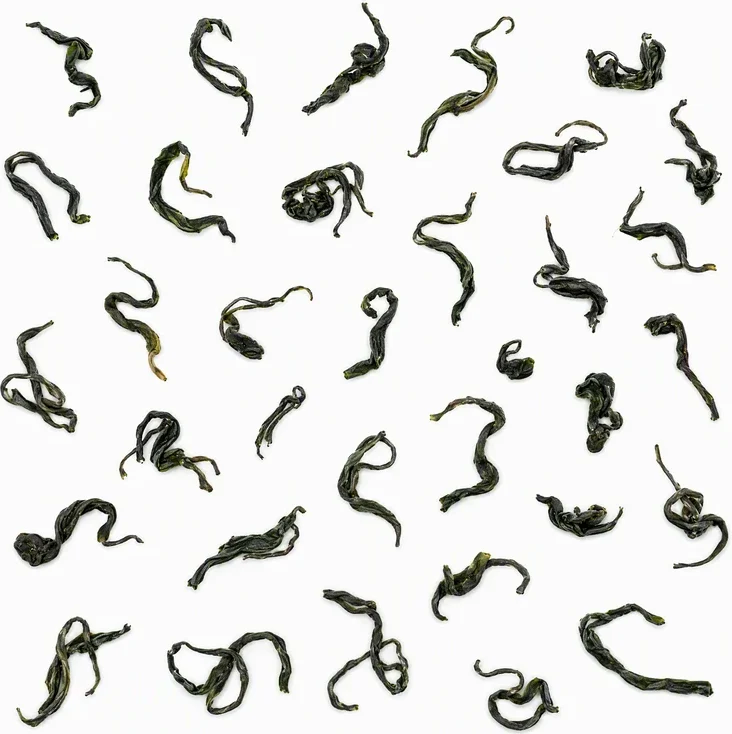
Mechanical. Formation of spiral shape (卷曲形) — key technological operation determining the commercial appearance of the product. Leaves are rolled into tight spirals resembling snail shells.
Two-stage: primary (毛火, máohuǒ) at 120°C → final (足火, zúhuǒ) at 80°C. Residual moisture — ≤6.5%. Low final moisture ensures storage life up to 24 months.
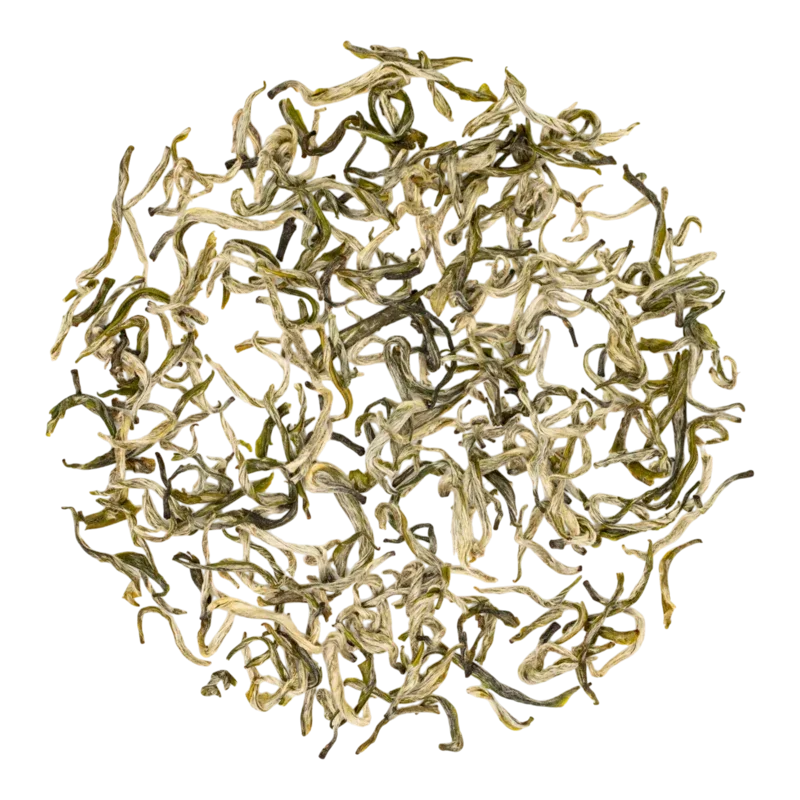
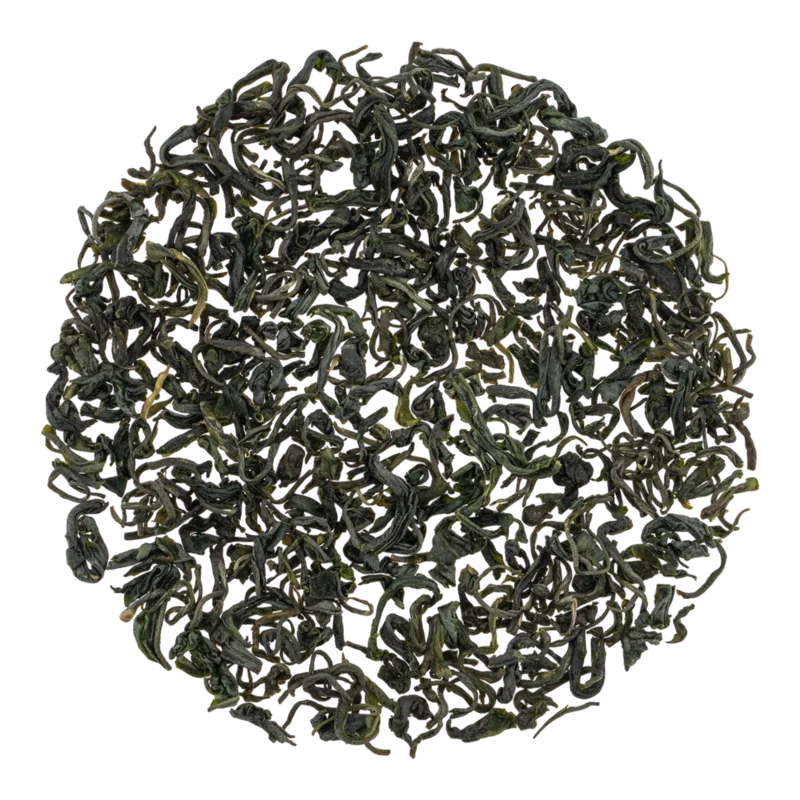
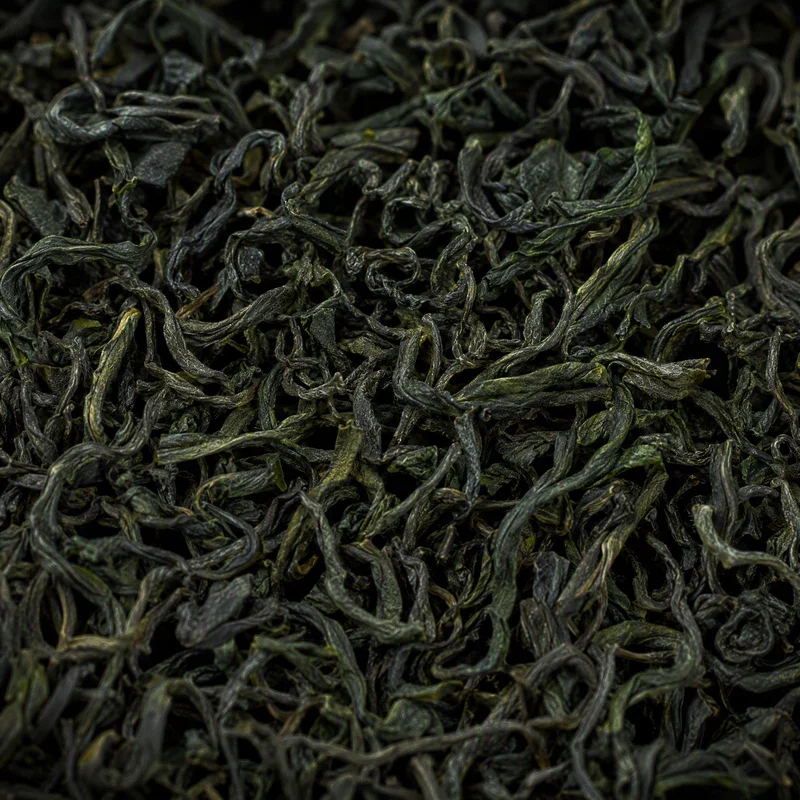
Dry Leaf Appearance: Spiral form (卷曲形). Supreme grade — tight dense spirals "like snails" (紧细如螺, jǐnxì rú luó). Color — dark green (墨绿, mòlǜ), uniform.
Dry Leaf Aroma: Chestnut (栗香, lìxiāng) — dominant. Clean (清香) — in supreme grade. Floral (花香) — pronounced in spring picking.
Liquor Aroma: Rich chestnut with floral undertones. Persistent — remains in cold cup for more than 10 minutes. Formula "香浓" — "rich aroma."
Liquor Color: Supreme grade — tender green, bright and clear. Second grade — yellow-green.
Spent Leaves: Tender yellow-green, uniform. Shoots intact, leaves resilient.
Taste: Mellow and rich (醇厚, chúnhòu) — direct consequence of water-extractables ≥42%: liquor is "full-bodied," with sensation of weight on the tongue. Fresh and brisk (鲜爽) — ensured by increased amino acid content. Pronounced returning sweetness (回甘). Mellowness — polyphenols 14–14.5% (below average for green tea), minimal bitterness. Formula "味醇" — "mellow taste."
Amino Acids: Elevated — result of the "寡日照" formula (deficit of direct sunlight). Altitude >800 m and cloud cover >180 days slow photosynthesis, preventing conversion of amino acids to polyphenols. L-theanine dominates, ensuring characteristic mild sweetness.
≥42% — key indicator, 5–9% higher than national standard GB/T 14456.1. For comparison: minimum threshold per GB for green tea — 34%, typical for quality green teas — 36–38%. High water-extractables ensure liquor "full-bodiedness" and taste persistence.
2–4% (typical for green tea). Combined with elevated amino acids, provides mild, sustained stimulation.
Selenium (Se) and zinc (Zn) — from Qiandongnan soils. Selenium — antioxidant participating in cellular membrane protection; zinc — in immune regulation.
Polyphenols: 14–14.5% — moderate level ensuring mellowness without pronounced astringency. Main components — catechins (EGCG, EGC, ECG).
Vitamins: Vitamin C (preserved thanks to rapid fixation at 300°C), B vitamins, vitamin E.
Traditional method — fry tea leaves in tea oil (茶油), add rice flakes (阴米), peanuts, ginger, salt. Pour boiling water, strain. Serve in small cups with crispy rice garnish. This method is not brewing in the usual sense, but preparation of tea "soup," revealing the "full-bodiedness" of Liping Xiang Cha in a completely different register.
Thanks to low residual moisture (≤6.5%) and mechanized drying, Liping Xiang Cha tolerates transportation and storage better than many green teas — quality does not noticeably degrade during the first year even without refrigeration (though cooling is still recommended).
Tea Amount: 3g per 100ml water (ratio 1:25–1:38 — more concentrated than for most green teas, due to positioning as a "full-bodied" beverage).
Teaware: Porcelain gàiwǎn (盖碗) 100–150ml or glass cup (玻璃杯). For oil tea (油茶) according to Dong tradition — cast iron pot.
Water Temperature: 85–90°C for standard grades. For supreme — 80°C.
Enemies: Moisture, direct sunlight, foreign odors, high temperature.
Shelf Life: Up to 24 months with proper storage — significantly longer than most green teas (typically — 12–18 months). Reason — low residual moisture (≤6.5%), achieved by two-stage mechanized drying.
Airtight packaging (vacuum bags or jars with tight lids). Storage in refrigerator at 0–5°C.
Premium green tea of Guizhou, one of the "ten famous teas of China". Downy, delicate, high price. Liping Xiang Cha is a mass-market alternative: less refined, but significantly more affordable and denser in body.
Another Guizhou brand, flat shape (Longjing type). Liping Xiang Cha differs with its spiral shape, denser body and mass-market orientation.
Spiral shape, fruity-floral aroma, delicate body. Water extractives — 36–38%. Liping Xiang Cha is significantly denser (≥42%) and many times more affordable in price.
Mass-market export green tea in pellet form. Similar in positioning (mass market), but Liping Xiang Cha surpasses it in aromatic profile and water extractives.
Unique "silver ball" from neighboring Leishan County, hand-shaped. Premium, expensive. Liping Xiang Cha is a mass-market analog from the same Qiandongnan Prefecture, but with mechanized technology.
Supreme grade (特级) — from 300 yuan per 500g. First grade — 150–300 yuan. Second grade — 80–150 yuan. The main strength of Liping Xiang Cha is affordability with high water-extractable indicators: this is a mass-market tea where the "price — body in cup" ratio is one of the best in China.
No reviews yet. Tell us what you think of this tea.
Rate this tea and share your impressions. We review each submission before publishing it.