Brewing
Gongfu brewing
- Water temperature
- 92 °C
- Tea amount
- 6 g
- Water volume
- 100 ml
- First steep
- 10 s
- Time added per infusion
- 5 s
- Infusions
- 8

huángjīn guì
Choose a brewing method. Start with the recommended quantities and time, then adjust to taste.
Brewing
Brewing
Taste
Tea encyclopedia
Category: Famous Teas of China (中国名茶). One of the four classic oolong varieties of Anxi County. Product with geographical indication (中国国家地理标志产品).
Category: Famous Teas of China (中国名茶). One of the four classic oolong varieties of Anxi County. Product with geographical indication (中国国家地理标志产品).
Coordinates: Approximately 25°03′ North latitude, 117°58′ East longitude (Huqiu area).
Origin: China, Fújiàn Province (福建省, Fújiàn Shěng), Quánzhōu City (泉州市, Quánzhōu Shì), Ānxī County (安溪县, Ānxī Xiàn). Birthplace of the variety — Luò Yán Village (罗岩村, Luóyán Cūn) and Méi Zhuāng Village (美庄村, Měizhuāng Cūn) in Hǔqiū Township (虎邱镇, Hǔqiū Zhèn). Main production areas: Hǔqiū (虎邱), Dàpíng (大坪), Jingu (金谷), Jiandou (剑斗), Cannei (参内).
Type: Oolong (semi-oxidized tea). Southern Fújiàn oolong (闽南乌龙, Mǐnnán Wūlóng) with light oxidation. Oxidation level in traditional "qingxiang" (清香, qīngxiāng) style is about 15–30%; in more roasted versions — up to 35–40%.
Cultural Significance: Huangjin Gui occupies a special place among Anxi oolongs. Famous tea scholar Chén Chuán (陈椽, Chén Chuán) in his work "Famous Teas of China" (《中国名茶》) called the aroma of Huangjin Gui "intoxicating and unique." Another patriarch of tea science — Zhāng Tiānfú (张天福, Zhāng Tiānfú) — in the monograph "Fujian Oolongs" (《福建乌龙茶》) noted the "exceptional property of 'tou tian xiang' — aroma penetrating through heaven." For generations of Southern Fújiàn emigrants (華僑) in Southeast Asia, Huangjin Gui became a symbol of nostalgia for homeland — tea that reminded of the taste and smell of home. In addition, Huang Dan is a key parent variety in modern breeding: it was on its basis (as paternal plant) in crossing with Tieguanyin (maternal plant) that popular highly aromatic cultivars Huáng Guānyīn (黄观音, Huáng Guānyīn), Jīn Guānyīn (金观音, Jīn Guānyīn, also known as Mingke-1, 茗科1号), Jīn Mǔdān (金牡丹, Jīn Mǔdān) and Huáng Méiguī (黄玫瑰, Huáng Méiguī) were developed.
History: Huángjīn Guī was created during the Qīng dynasty (清朝, Qīng Cháo), during the reign period under the motto Xiánfēng (咸丰, Xiánfēng), that is, from 1850 to 1860. There are two main legends about the tea's origin.
Small tree (小乔木型, xiǎo qiáomù xíng), medium-leaf class (中叶类), early-maturing (早芽种, zǎo yá zhǒng).
Semi-spreading (半开展), dense branching, short internodes.
Elliptical, thin and soft, with pointed tip and slightly upward-curved edges. Leaf blade color — yellowish-green with pronounced gloss. Teeth along leaf edge are deep and sharp, lateral veins are clearly visible and densely arranged.
High frequency of bud formation, dense arrangement of shoots. Minimal pubescence.
About 8 months. Capable of flowering but rarely fruits.
Wide adaptability, good resistance to diseases and pests, relatively high productivity.
Optimally suited for oolong production; also suitable for making red tea (black tea) and green tea.
Cultivar: For producing Huangjin Gui, the eponymous cultivar Huáng Dàn (黄旦, Huáng Dàn) is used, registered as Hua Cha No. 5 (华茶5号). This is an asexual (vegetatively propagated, 无性系) variety belonging to the species Camellia sinensis var. sinensis. Botanical characteristics:
Picking: Huang Dan is the earliest-maturing of the four Anxi varieties. Spring budding begins in early to mid-March, and the first harvest falls in mid-April, ahead of ordinary varieties by 10 or more days, and Tieguanyin by almost 20 days. Thanks to this, Huangjin Gui often becomes the first oolong of the new season, earning the nickname "Qingming Tea" (清明茶). In addition to spring harvest, summer, autumn and sometimes winter ("winter slice," 冬片, dōngpiàn) harvests are also conducted. Spring tea has the greatest value.
Pluck Standard: Harvested when the terminal shoot forms a dormant bud (驻芽, zhùyá), and the upper leaf is opened in "small opening" (小开面) or "medium opening" (中开面) position — pick the shoot with two to three leaves. Too tender picking gives low aroma and bitter taste; overripe — weak, coarse infusion. Optimal harvest time — from 14 to 16 hours, when moisture content in the leaf decreases and aromatic substances accumulate maximally.
Raw Material: Shoots must be whole, uniform in maturity, without purple buds and leaves damaged by diseases or insects. Harvest is conducted in small batches, leaves are laid carefully, without compression, to preserve freshness and integrity.
Altitude: Main Huangjin Gui plantations are located at 400–800 m above sea level. The production core — Huqiu area — occupies heights of 400–600 m; individual plantations in Daping and Jiandou zones reach 700–800 m.
Climate: Subtropical monsoon, with warm humid summers and mild winters. Average annual temperature 18–20°C, annual precipitation 1500–1800 mm. Abundance of fogs and diffused light promotes accumulation of aromatic substances in leaves and formation of characteristic "tou tian xiang."
Soil: Red and yellow soils (红壤, 黄壤), acidic (pH 4.5–6.5), rich in organic matter, with elevated content of microelements — selenium and zinc. The core zone Luoyan-Meizhuang is distinguished by particularly high selenium content in soil, which positively affects the antioxidant profile of the finished tea.
Anxi County is located in the southeastern part of Fujian Province, in the Jīnjiǎng River (晋江) basin. The landscape represents a system of hills and low mountains interspersed with narrow valleys with streams — a typical environment for microterroir formation.
Described in section 3.
Picked leaves are spread in a thin layer under sunlight for a short time. Mass loss is 5–7% — significantly less than for Tieguanyin. Goal — gently start metabolic processes and begin forming the aromatic foundation.
Leaf is transferred to a shaded ventilated room where it acquires plasticity and "rests" before the next stage.
Cycles of careful shaking and rest trigger partial oxidation along leaf edges. For Huang Dan, lighter and less prolonged shaking is applied than for Tieguanyin — the goal is to preserve freshness (保水保青) and prevent excessive reddening of edges (减少红变). It is at this stage that the characteristic floral profile is formed.
Quick heating at high temperature stops enzymatic processes and fixes the aroma direction. For Huangjin Gui, the principle "high temperature, short time" (高温短时) is applied.
Quick and light rolling (快速轻揉), forming the characteristic elongated "spindle-shaped" form of tea particles — unlike the tight semi-spherical twist of Tieguanyin.
Initial stabilization at moderate temperature.
Repeated rolling in cloth to compact the form — conducted more gently than for Tieguanyin.
Alternating heating and rolling to achieve uniformity.
Low-temperature slow drying (低温慢烘), ensuring sublimation of aromatic compounds and formation of final "high aroma." It is precisely the gentle drying regime — the key to revealing "tou tian xiang."
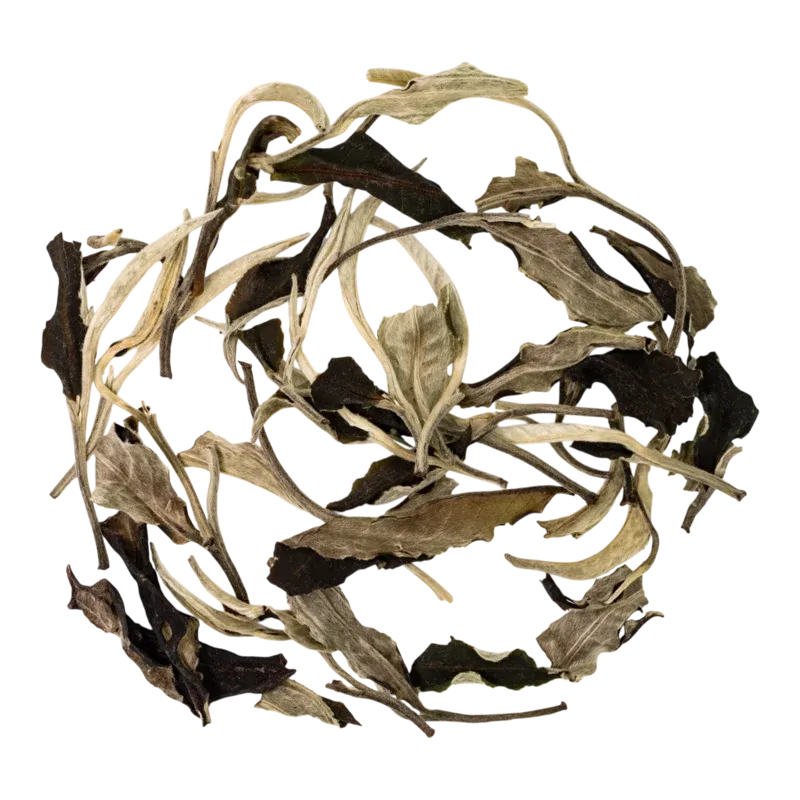
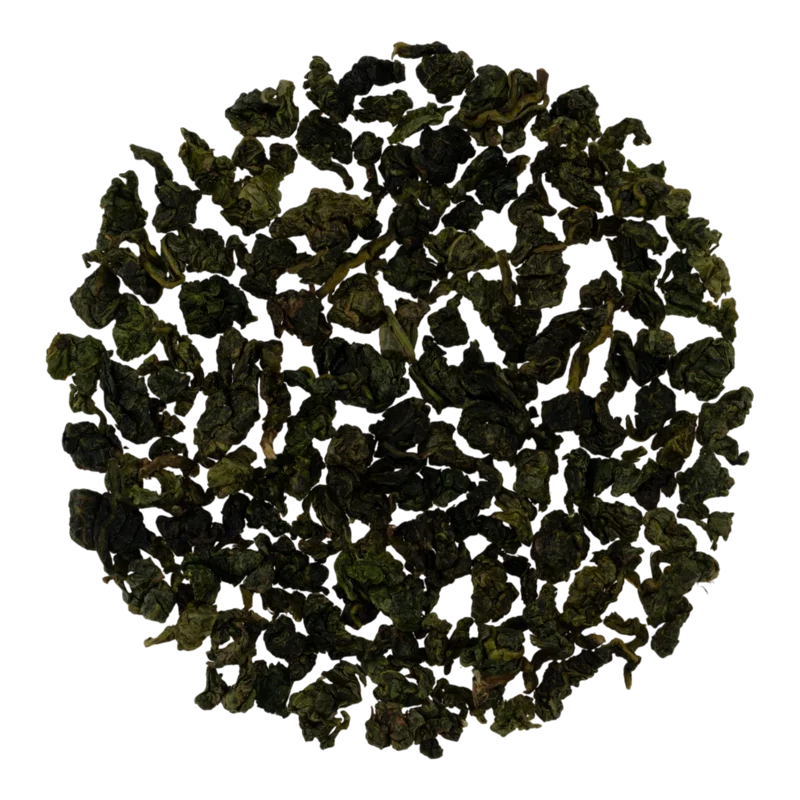
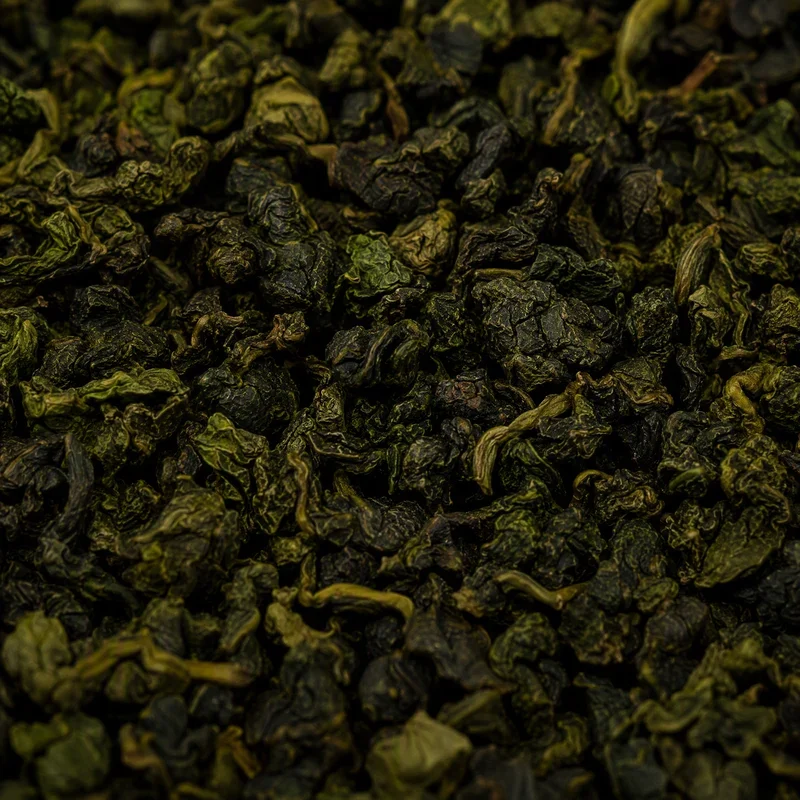
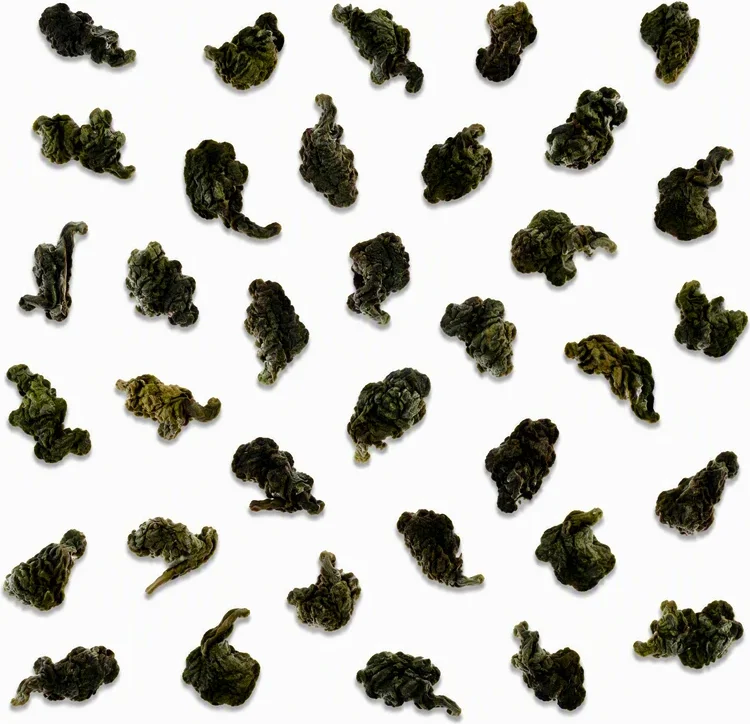
Dry Leaf Appearance: Tea particles are elongated-spindle-shaped (细长尖梭形), relatively loose and light in weight — noticeably less dense and heavy than Tieguanyin. Stems are thin and small. Color varies from yellow-green to golden-yellow with oily luster. In professional circles, the appearance is characterized by three words: "yellow, thin, fine" (黄、薄、细).
Dry Leaf Aroma: Extremely high and powerful — even in dry form the aroma is felt brightly and distinctly. Osmanthus flower notes (桂花, guìhuā) predominate with nuances of gardenia (栀子花, zhīzihuā), ripe pear and water peach (水蜜桃). It is precisely this aroma that gave rise to the saying: "Smell the aroma — and immediately recognize Huang Dan" (一闻香气而知黄旦).
Liquor Aroma: Rich, high, long-lasting. Floral-fruity spectrum with dominant osmanthus, complemented by honey sweetness and light spicy shades. The gàiwǎn lid aroma (盖香, gàixiāng) is especially expressive — it literally "bursts" out at the first contact with hot water, demonstrating the "tou tian xiang" effect.
Liquor Color: Golden-yellow (金黄色), bright, clear, with pronounced luster. With lighter brewing — light straw-colored.
Spent Leaves: Whole unfolded leaves, thin and elongated. Central zone — yellow-green, edges — with characteristic reddish (朱红色) border. Leaf is soft, elastic, with clearly visible main vein. Leaf edge with shallow teeth.
Taste: Clean, refined, with pronounced freshness and liveliness (鲜爽, xiānshuǎng). Body is soft but not watery — rather "thin and silky" (醇细). Sweetness appears from the first steeps, transitioning into long and pronounced returning sweetness (回甘, huígān). The taste contains notes of osmanthus flowers, pear and honey. Astringency is minimal. Bitterness in properly brewed tea is practically absent.
Alkaloids: Caffeine (咖啡碱) — moderate content, characteristic of lightly oxidized oolongs (approximately 2–3% of dry mass). Theobromine and theophylline are also present in trace amounts.
Amino Acids: Total content — about 2782.91 mg/100 g. Among them, L-theanine (L-茶氨酸) plays a special role, providing mild sweetness, "silky" mouthfeel sensation and relaxing effect without drowsiness.
Total extractability — about 40.58%, indicating richness and "fullness" of the infusion.
Essential Oils: Essential oil content (醚浸出物) — about 2.09%. It is precisely essential oils that are responsible for the signature "tou tian xiang" — high persistent aroma with dominance of osmanthus, gardenia and pear. Genome studies of Huang Dan (Fujian Agricultural University, 2021) showed that high aromaticity is controlled by genes of the TPS family (terpene synthases), demonstrating expanded expression and structural variations unique to this cultivar.
Minerals: Potassium, magnesium, manganese, fluorine, as well as selenium and zinc (especially in tea from the core Luoyan zone with selenium-enriched soils).
Polyphenols: Total content of tea polyphenols — about 31.58% of dry mass. The main share consists of catechins (儿茶素), total content of which is about 129.31 mg/g. Catechins provide antioxidant potential and form light astringency of the infusion; at the same time, thanks to light oxidation in Huangjin Gui, non-oxidized forms predominate (EGCG, EGC, ECG).
Vitamins: Vitamin C, B vitamins.
High content of catechins (particularly EGCG) provides effective free radical scavenging. According to several studies, the antioxidant activity of Huangjin Gui is comparable to or even exceeds indicators of other oolongs thanks to significant polyphenol concentration.
The combination of caffeine and L-theanine creates "gentle alertness" — increases concentration and cognitive functions without sharp spikes in nervous excitement.
Polyphenols and catechins stimulate secretion of digestive enzymes, help fat breakdown. Traditionally Huangjin Gui is recommended as tea after abundant meals: in Chinese practice it has established properties of "xiao shi" (消食 — digestive aid) and "jie jiu" (解酒 — alcohol aftermath relief).
In traditional Chinese medicine it belongs to beverages promoting "internal heat dispersion" (清热, qīngrè). Good thirst quencher in hot weather.
Oolongs in general and Huangjin Gui in particular promote normalization of lipid metabolism: studies indicate ability to lower cholesterol and neutral fat levels in blood.
L-theanine combined with pronounced floral aroma creates relaxing effect. The practice of mindful tea drinking (品茗, pǐnmíng) with Huangjin Gui is considered an effective method for reducing stress load.
Antioxidants (polyphenols, vitamin C) support skin elasticity, and SOD (superoxide dismutase) enzyme activity increases with regular oolong consumption, which favorably affects skin condition.
Tea Amount: 5–7 g per 100–125 ml water (gongfu style, 功夫泡). For Western brewing style — 3 g per 200–250 ml.
Teaware: White porcelain gàiwǎn (白瓷盖碗, bái cí gàiwǎn) — ideal choice for Huangjin Gui, as porcelain does not absorb aroma and allows full appreciation of "gaixiang" (盖香) — lid aroma. Yíxīng clay teapot (紫砂壶, zǐshā hú) is also suitable — especially for more roasted versions.
Water Temperature: 95–100°C. Huangjin Gui, despite leaf thinness, reveals its full aromatic potential precisely at high temperature. Water below 90°C will not allow complete extraction of essential oils and demonstration of the "tou tian xiang" effect.
The most famous Anxi oolong. Uses the Tie Guanyin cultivar — large-leafed, late-ripening. Tea leaves are dense, heavy semi-spheres of dark green color. Aroma is orchid-like, deep, multi-layered. Taste is buttery, thick, with a mineral base and long aftertaste. Huang Jin Gui in contrast is light, airy, with a higher and more "piercing" aroma, but less dense body.
A cultivar that externally resembles Tie Guanyin, but the leaves are thinner, and the stems are thinner and less dense. The aroma is softer and more delicate than Tie Guanyin, the taste is lighter, with grassy notes. Compared to Huang Jin Gui, Ben Shan has a less pronounced floral "punch" and a more even, calm profile.
Named for the fine hairs on the shoots, resembling crab fuzz. Distinguished by a jasmine tint in the aroma and a slightly astringent, tart character. Tea leaves are smaller than Tie Guanyin, but denser than Huang Jin Gui. Huang Jin Gui wins in height and purity of aroma, but yields to Mao Xie in "body" and density of infusion.
A hybrid of Tie Guanyin × Huang Dan, inheriting the high aromatics of the father and the body density of the mother. In aroma it is close to Huang Jin Gui, but the body is fuller and more rounded. Used both in the style of Mǐnnán oolongs and for producing yán chá (岩茶) in Wuyi Mountains.
Price Category: Huangjin Gui belongs to medium and medium-high price segment among Anxi oolongs. Price depends on several factors: harvest season (spring more expensive than summer and autumn), origin region (tea from core Luoyan zone is valued higher), processing skill (handmade vs. machine), roasting degree and harvest year. Compared to Tieguanyin of similar grade, Huangjin Gui is generally somewhat more affordable, however particularly quality batches from Luoyan can cost quite comparably.
genuine Huangjin Gui is noticeably lighter than Tieguanyin with same volume — tea particles are loose and "airy," not dense and heavy.
dry leaf should possess powerful, clean, natural floral aroma (osmanthus, gardenia, pear) — without chemical "perfumery" or sharp artificial notes.
color should be clean golden-yellow, clear; muddy or dull infusion indicates low quality.
if price is clearly below market rate for Anxi oolongs, most likely the tea is not produced from Huang Dan cultivar or harvested from flatland plantations.
No reviews yet. Tell us what you think of this tea.
Rate this tea and share your impressions. We review each submission before publishing it.