Brewing
Gongfu brewing
- Water temperature
- 98 °C
- Tea amount
- 7 g
- Water volume
- 100 ml
- First steep
- 10 s
- Time added per infusion
- 5 s
- Infusions
- 12

Dàlǐ gǎntōng chá
Choose a brewing method. Start with the recommended quantities and time, then adjust to taste.
Brewing
Brewing
Taste
Tea encyclopedia
Category: Historical named tea of Yúnnán (云南历史传统名茶, Yúnnán lìshǐ chuántǒng míngchá). One of the "three great teas of Yunnan" of the Míng era (云南三大名茶, Yúnnán sān dà míngchá).
Category: Historical named tea of Yúnnán (云南历史传统名茶, Yúnnán lìshǐ chuántǒng míngchá). One of the "three great teas of Yunnan" of the Míng era (云南三大名茶, Yúnnán sān dà míngchá).
Coordinates: Approximately 25°39′ North latitude, 100°06′ East longitude.
Origin: China, Yúnnán Province (云南, Yúnnán), Dàlǐ Bái Autonomous Prefecture (大理白族自治州, Dàlǐ Báizú Zìzhìzhōu), western slope of the Cāngshān range (苍山, Cāngshān), vicinity of Gǎn Tǒng Sì monastery (感通寺, Gǎntōng Sì), located between Shèngyìng Peak (圣应峰, Shèngyìng Fēng) and Mǎlóng Peak (马龙峰, Mǎlóng Fēng).
Type: Green tea (unfermented). Produced using chao-qing (炒青, chǎoqīng) technology — "kill-green" by pan-firing, with elements of traditional sun-drying.
Cultural Significance: Gǎn Tǒng Chá occupies a central place in the tea culture of the Bái people (白族, Báizú) — the indigenous population of the Dali region. This tea is the "pillar" (台柱茶, táizhù chá) of the "Three Cups of Tea" ceremony (三道茶, Sān Dào Chá), in which it embodies the life philosophy "first bitterness, then sweetness, and finally the aftertaste of memories" (一苦二甜三回味, yī kǔ èr tián sān huíwèi). The first cup — "bitter tea" (苦茶, kǔ chá) — is prepared from pure Gan Tong Cha by roasting in a clay pot. The second — "sweet tea" (甜茶, tián chá) — from Gan Tong Cha infusion with added brown sugar, walnut kernels, and fried milk fans (乳扇, rǔshàn) — a specific dairy product of the Bai. The third — "aftertaste tea" (回味茶, huíwèi chá) — with honey, huajiao (花椒, Sichuan pepper) and cinnamon. The San Dao Cha ceremony is the highest expression of Bai hospitality and is conducted during holidays, weddings, births, and when receiving honored guests. The connection of Gan Tong Cha with Buddhist monastic tradition gives it special significance in the context of chan-tea culture (禅茶, chán chá) — the unity of the tea way and Zen Buddhism.
The beginning of the region's tea history dates back to the period of the Nánzhào kingdom (南诏, Nánzhào). According to "Man Shu" (蛮书, Mánshū) — the chronicle of Fán Chuò (樊绰, Fán Chuò) from the Tang era, the peoples of Dali were already cultivating and drinking tea at that time, brewing it "with pepper, ginger, and cinnamon" (以椒、姜、桂和烹而饮之). The monks of Gan Tong Si monastery were the first to begin purposefully growing and processing tea on the slopes of Cangshan, turning tea cultivation into one of the monastic industries.
In 1383, the abbot of Gan Tong Si — monk Wú Jí (无极, Wú Jí) — made a journey to the capital Nanjing (Jinling) to the court of Emperor Zhú Yuánzhāng (朱元璋, Zhū Yuánzhāng, founder of the Ming dynasty), presenting as gifts a white horse and mountain camellias. The emperor was so impressed that he bestowed upon the monk two poems of his own composition and eighteen verses about the journey, which were carved on stelae in front of the Dà Yùn Tāng (大云堂) hall of the monastery. This event significantly strengthened the fame of the monastery and the tea produced in its vicinity. The famous traveler Xú Xiákè (徐霞客, Xú Xiákè) in his "Notes on Travel in Yunnan" (《滇游日记》, Diān Yóu Rìjì, 1639) described the tea trees in the monastery's vicinity as "three to four zhang in height" (高三四丈), requiring ladders to harvest leaves from them. Xu Xiake also mentioned that he drank tea made with water from the spring at Shengying Peak, and the infusion made a great impression on him. Míng scholar and administrator Lǐ Yuányáng (李元阳, Lǐ Yuányáng) in "Description of Dali Prefecture" (《大理府志》, Dàlǐ Fǔzhì) wrote: "The properties and taste of Gan Tong Cha are not inferior to [tea from] Yangxian" (性味不减阳羡), comparing the Yunnan tea to the celebrated tea from Yixing (Jiangsu Province). Míng official and literatus Féng Shíkě (冯时可, Féng Shíkě) in "Notes on Travel in Yunnan" (《滇行纪略》, Diān Xíng Jìlüè) noted: "Tea from Gan Tong monastery is not inferior to [tea from] Tianchi and Fulong" (感通寺茶不下天池伏龙), only indicating tha
Yú Huái (余怀, Yú Huái) in the treatise "Cha Yuan" (《茶苑》, Cháyuàn) awarded Gan Tong Cha the title "first among the teas of Yunnan" (滇茶第一). However, with the growing popularity and commercial significance of pu-erh, Gan Tong tea gradually lost its dominant position in the Yunnan tea market.
In the 20th century, Gan Tong Cha production experienced decline. In 1985, Xiàguān Tea Factory (下关茶厂, Xiàguān Cháchǎng) — one of the largest tea enterprises in Dali — undertook efforts to restore the traditional technology. In 2014, the Bai tea ceremony San Dao Cha, inextricably linked with Gan Tong Cha, was included in the List of National Intangible Cultural Heritage of the PRC, and in 2022 — in the UNESCO Register of Intangible Cultural Heritage of Humanity as part of "Traditional tea processing techniques and associated social practices in China."
Camellia taliensis — an evergreen tree (unlike the shrub form of most cultivated tea plants), capable of reaching 20–30 m in height in the wild. Characteristic differences from C. sinensis var. assamica: leaves leathery, oval-elliptical, dark green, glossy, without pubescence on young shoots and buds (in C. sinensis buds are densely pubescent); flowers yellow-white; ovary five-chambered with pubescence; style five-parted. Representative specimen — ancient tea specimen Gan Tong Si No. 1 (感通寺1号古茶树): height 5.8 m, age about 600 years.
Cultivar: Dali tea — Camellia taliensis (W.W. Sm.) Melch. (大理茶, Dàlǐ Chá). This is a separate species of tea tree from the section Thea of the Theaceae family (Theaceae), closely related but not identical to the common tea plant Camellia sinensis. The type specimen of the species was collected by British botanist George Forrest (G. Forrest) precisely in the vicinity of Gan Tong Si monastery on Cangshan in the early 20th century and described by W.W. Smith in 1917 as Thea taliensis. In 1925, German botanist Melchior transferred the species to the genus Camellia. The Latin species name taliensis derives from "Tali" — the old romanization of the toponym "Dali." Thus, Gan Tong Cha is tea produced from raw material of the very plant that gave its name to an entire botanical species.
Picking: Spring harvest (March — early April) is considered most valuable. Autumn harvest is also possible but less common.
Pluck Standard: One bud and one-two upper young leaves (一芽一叶 / 一芽二叶, yī yá yī yè / yī yá èr yè). For highest grades ("Gan Tong Biyu," 感通碧玉) — exclusively tender buds and one leaf.
Raw Material: Leaves must be fresh, undamaged, uniform in size, harvested in morning hours after dew has dried.
Altitude: 1900–2300 m above sea level. This is one of the highest tea-growing zones in China, which determines the unique character of the tea.
Climate: Subtropical mountain monsoon with pronounced vertical zonation. Average annual temperature about 13.4 °C. Annual precipitation about 1000 mm. Diurnal temperature variations are significant — 15–20 °C, which promotes slow shoot growth and accumulation of amino acids and aromatic substances. The Cangshan range is characterized by prolonged periods of cloudiness and fog (cloudy period lasts most of the year), thanks to which tea trees receive predominantly diffused light — ideal conditions for increased L-theanine synthesis and reduced bitterness.
Soil: Acidic yellow-brown mountain soils (酸性黄棕壤, suānxìng huáng zōng rǎng), rich in minerals and organic matter, with good drainage.
Core terroir — foothills and slopes of the Cāngshān range (苍山, Cāngshān, also Diancangshan, 点苍山) in immediate proximity to Gan Tong Si monastery, between Shèngyìng Peak (圣应峰) and Mǎlóng Peak (马龙峰), in the valley between Mòcán Xī stream (莫残溪, Mòcán Xī) and Lóng Xī stream (龙溪, Lóng Xī). Core area comprises about 10 sq. km. Extended zone includes tea gardens in Yínqiáo district (银桥镇, Yínqiáo Zhèn) at the foot of Báiyún Peak (白云峰, Báiyún Fēng), where saplings from old trees were transplanted.
Tea trees grow in conditions of rich biodiversity of Cangshan (Cangshan has about 2330 species of seed plants). Proximity to coniferous and broad-leaved species forms a complex microclimate and enriches the soil with forest litter.
Freshly picked leaves are spread in a thin layer in a well-ventilated room for 3–5 hours. Goal — partial moisture removal (to 68–70%), leaf softening and initial aroma development.
Performed in a roasting machine (炒干机, chǎo gān jī) at about 110 °C. High temperature inactivates enzymes (polyphenol oxidase and peroxidase), preventing catechin oxidation and fixing the green color of the leaf. Stage lasts until the appearance of characteristic "hot chestnut" aroma and until the leaf becomes soft and pliable.
Brief light rolling (短时轻压, duǎn shí qīng yā). Goal — destroy cellular structure for subsequent better extraction during brewing and give the leaf characteristic rolled form without damaging its integrity.
Two-stage:
Temperature 70–90 °C. Removal of main mass of residual moisture.
Temperature 110–120 °C. Final aroma fixation and bringing moisture content to 4–6%.
According to historical sources, the historical method included a stage of sun-drying after roasting (炒而复曝): roasted and rolled leaves were laid out on bamboo trays for drying under open sun. This practice, intermediate between chao-qing and shai-qing (晒青, shàiqīng — "sun-drying"), "locked" the chestnut aroma inside the leaf and gave the tea potential for certain aging during long storage, as mentioned by Li Yuanyang: "stored for a long time, the taste becomes even better" (藏之年久,味愈胜也).
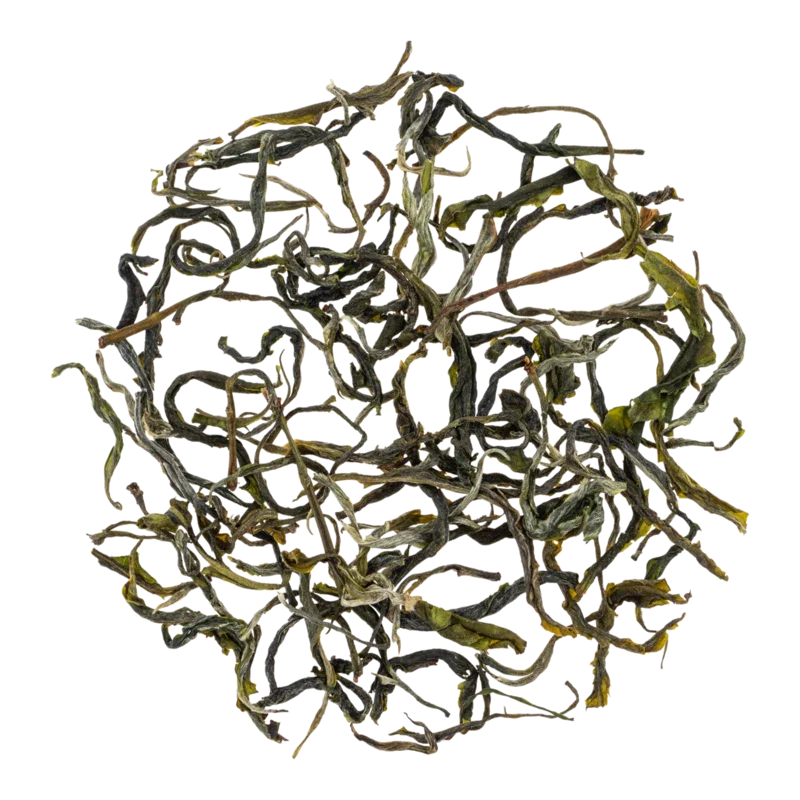
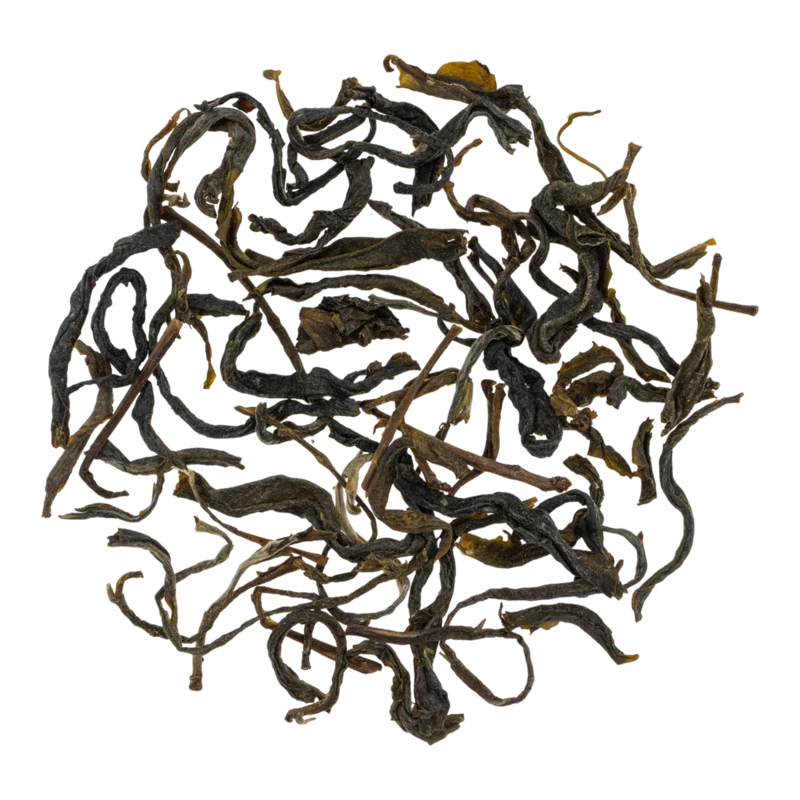
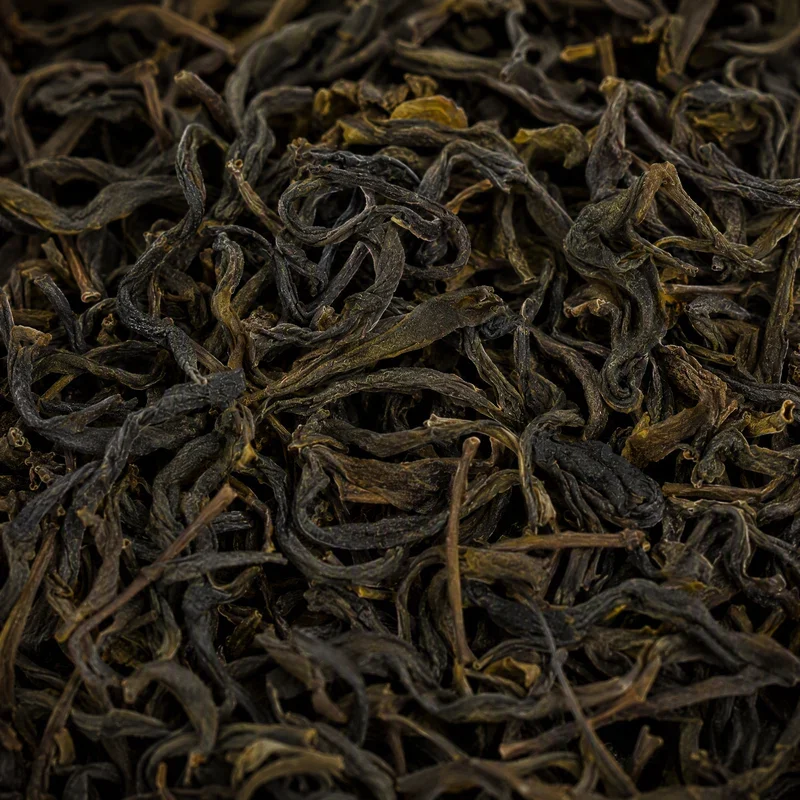
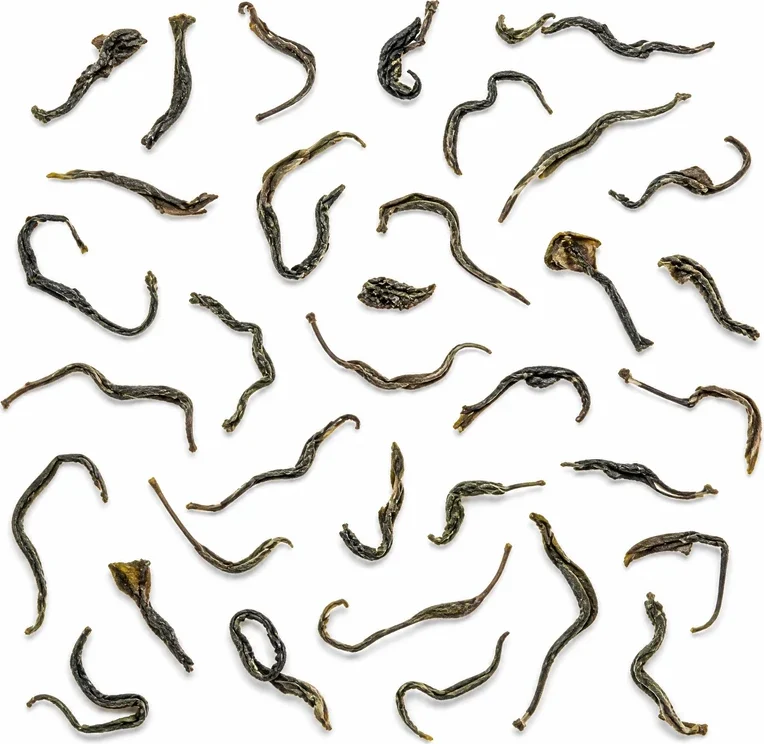
Dry Leaf Appearance: Leaf curled (卷曲形, juǎnqū xíng), tea particles dense, full, tight (条索肥硕紧实, tiáosuǒ féishuò jǐnshí). Color dark green, oily-glossy, with noticeable white down (墨绿油润显白毫, mòlǜ yóurùn xiǎn báiháo). Tea particle size larger than average, characteristic of Camellia taliensis raw material with its large leaves.
Dry Leaf Aroma: Pronounced chestnut tone (熟板栗香, shú bǎnlì xiāng) with floral-fruity undertone, persistent, deep.
Liquor Aroma: Rich, multi-layered: dominated by mature chestnut aroma, complemented by notes of wild flowers and light fruity shade. Aroma is persistent — preserved until late infusions. Cup lid (盖香, gàixiāng) after several minutes demonstrates warm honey-nutty tone.
Liquor Color: Tender green, transparent, with bright clarity (嫩绿清澈, nènlǜ qīngchè). With repeated brewings, color may acquire warm yellowish-green shade.
Spent Leaves: Leaves unfold completely, demonstrating dense, elastic texture with even edges. Color — bright green with yellowish shade. Characteristic large leaf blade area, typical of C. taliensis.
Taste: Dense and full-bodied (醇厚, chúnhòu), with pronounced freshness (鲜爽, xiānshuǎng). Initial light bitterness quickly transitions to long and intense sweet aftertaste — returning sweetness (huí gān) (回甘, huígān). Liquor body thick, oily. Tea is distinguished by high brewing resistance (经久耐泡, jīngjiǔ nàipào) — withstands numerous infusions without significant taste loss.
Alkaloids: Caffeine (咖啡碱, kāfēi jiǎn) — approximately 2.5–4.0%, theobromine, theophylline. Caffeine content may be somewhat lower than in C. sinensis var. assamica, due to species characteristics of C. taliensis.
Amino Acids: Increased L-theanine content (L-茶氨酸, L-chá ānjīsuān) is due to high-altitude location of tea gardens, large diurnal temperature variations, and prolonged period of diffused light. L-theanine gives the infusion characteristic "freshness" (鲜, xiān) and umami-like fullness.
Responsible for characteristic chestnut-floral aroma. During chao-qing process, specific volatile aldehydes and pyrazines are formed, creating the "roasted chestnut" tone.
The biochemical profile of Camellia taliensis differs from C. sinensis in unique set of polyphenols and aromatic compounds, making Gan Tong Cha inimitable in character. Studies have shown that C. taliensis contains specific glycosides and polyphenolic compounds not found (or found in small quantities) in standard tea cultivars.
Minerals: Potassium (K), magnesium (Mg), manganese (Mn), zinc (Zn), fluorine (F), selenium (Se) — high mineral content is due to rich mountain soils of Cangshan.
Polyphenols: Content reaches 25.4% — this is a high indicator, providing powerful antioxidant potential. Main representatives — catechins: epigallocatechin gallate (EGCG), epicatechin gallate (ECG), epicatechin (EC). High polyphenol content is characteristic of species from section Thea growing at significant altitudes.
Vitamins: Vitamin C (ascorbic acid) — preserved thanks to minimal processing; B vitamins (B₁, B₂); vitamin E (tocopherols); vitamin K.
High polyphenol content (25.4%) provides pronounced antioxidant action, promoting neutralization of free radicals and slowing cellular aging processes.
In traditional Chinese medicine, Gan Tong Cha is classified as tea of "cool" nature, effectively dispersing excessive heat and quenching thirst, which is especially valuable in summer.
Catechins stimulate gastric juice and enzyme secretion, promoting food breakdown. Tea is traditionally consumed after heavy meals.
Combination of caffeine and L-theanine provides steady, focused alertness without sharp spikes and subsequent "crashes" characteristic of coffee.
Polyphenols help reduce "bad" cholesterol (LDL) levels, improve vascular elasticity and normalize blood pressure with regular moderate consumption.
Vitamin C, catechins and minerals collectively support the body's protective functions.
L-theanine promotes alpha brain wave production, improving concentration, memory and reducing stress levels.
Fluorine and catechins suppress growth of bacteria causing caries and gum inflammation.
People with increased caffeine sensitivity are recommended to avoid tea consumption in evening and before sleep.
High polyphenol content may irritate gastric mucosa. Recommended to drink tea after meals or with light snack.
Freshly made Gan Tong Cha is desirable to age at least two weeks before consumption. Unoxidized polyphenols in very fresh tea may cause stomach and intestinal discomfort in sensitive people.
Moderate consumption is acceptable, but doctor consultation is recommended due to caffeine content.
Catechins may affect absorption of some medications (especially iron preparations and certain antibiotics). Recommended to separate tea and medication intake by interval of at least one hour.
Optimal drinking temperature — 50–60 °C. Too hot tea may damage esophageal mucosa.
Tea Amount: 3–5 g per 150 ml water (ratio approximately 1:50).
Teaware: Glass vessel or porcelain gàiwǎn (盖碗, gàiwǎn). Glass allows observation of "leaf dance" — large C. taliensis leaves beautifully unfold in water.
Water Temperature: 85 °C. Too hot water can scorch tender leaves and extract excessive bitterness.
Container: Airtight, opaque packaging — vacuum foil, tin can with tight lid, ceramic tea vessel with rubber gasket. Avoid plastic and paper.
Enemies: Light, moisture, foreign odors and high temperature. Store away from spices, garlic and other aromatic products.
Shelf Life: In airtight packaging under refrigeration — up to 12–18 months without significant quality loss. Without refrigeration — 6–8 months.
Li Yuanyang in "Description of Dali Prefecture" noted that Gan Tong Cha "stored for a long time, becomes more delicious" (藏之年久,味愈胜也). This remark may refer to historical technology with sun-drying (shai-qing), giving tea potential for aging similar to Yunnan sheng-cha (晒青毛茶). Modern chao-qing variant, however, is better consumed fresh.
Temperature: Recommended to store in refrigerator at 0–5 °C for maximum preservation of aroma freshness and liquor color (relevant for current season green tea).
General designation for Yunnan green teas, usually from C. sinensis var. assamica. Gan Tong Cha differs in botanical species (C. taliensis), higher altitude terroir and unique chestnut-floral profile. Yunnan green teas from assamica are usually more powerful and astringent.
Yunnan green tea with sun-drying, actually "maocha" (毛茶) — base raw material for sheng pu-erh. Gan Tong Cha historically is closer to this type (due to sun-drying element), but modern chao-qing technology makes it a classic pan-fired green tea.
Famous Sichuan green tea from Mount Mengding. Both teas — high-altitude, with long history and monastic roots, but Meng Ding Gan Lu is produced from C. sinensis var. sinensis, has lighter, more delicate profile and is produced by steaming method (蒸青) or light pan-firing.
Standard of Chinese flat green tea. Completely different in form (flat vs. curled), technology (hand-pressing in heated wok) and botanical raw material (small-leaf cultivars). Long Jing is lighter, with dominating bean-nutty notes, while Gan Tong Cha is denser, with chestnut "body."
Price Category: Gan Tong Cha belongs to medium and upper price segment among Yunnan green teas. Cost depends on tree age (raw material from ancient C. taliensis trees is significantly more expensive), harvest season (spring harvest is more valuable) and degree of hand processing. Top grades, such as "Gan Tong Biyu" (感通碧玉, Gǎntōng Bìyù — "Jade Green of Gan Tong"), can cost several thousand yuan per kilogram. Tea from expanded plantations — significantly cheaper.
Limited core terroir area (about 10 sq. km), uniqueness of botanical species (C. taliensis), high-altitude location (labor-intensive harvest), small production volume.
Buy tea from specialized tea companies in Dali region (for example, "Gan Tong Chaye," 感通茶业), having their own tea gardens in core terroir.
Authentic Gan Tong Cha is distinguished by large, tightly curled tea particles of dark green color with noticeable white down. Counterfeits from standard Yunnan large-leaf raw material may be less dense and less glossy.
Characteristic chestnut aroma with floral-fruity undertone. Absence of chestnut note or presence of musty, stale smell — sign of counterfeit or improper storage.
Liquor should be tender green, transparent, with pronounced taste persistence through several brewings. Cloudy or dull liquor — alarming sign.
Suspiciously low price when claiming "tea from old Gan Tong Si trees" — practically guaranteed sign of counterfeit.
No reviews yet. Tell us what you think of this tea.
Rate this tea and share your impressions. We review each submission before publishing it.