Classification and Origin
Category: Reprocessed product (再加工茶, zài jiāgōng chá) based on Yueyang yellow maocha. It is a key subcategory of the product with protected geographical indication "Yueyang Huang Cha" (registered in 2014).
Coordinates: 112°18′–114°09′ E, 28°25′–29°51′ N (within the "Yueyang Huang Cha" production zone).
Origin: China, Húnán Province (湖南, Húnán), Yuèyáng Prefecture (岳阳, Yuèyáng), Jūnshān District (君山区, Jūnshān Qū).
Type: Compressed yellow tea (紧压黄茶, jǐnyā huángchá). Formally belongs to the yellow tea category (黄茶, huángchá), but technologically includes elements characteristic of hei cha — primarily "flower development" (发花, fā huā) involving Eurotium cristatum. This makes it a unique tea at the intersection of two classes.
Botany and Raw Material
Cultivar: Yellow maocha of "huang dacha" category (黄大茶 — "yellow large-leaf tea"), having undergone standard processing with "double sealed yellowing." Thus, the brick is a secondary processing product of already finished yellow tea.
Picking: Spring, summer, autumn. For compressed tea, later and more mature leaves are acceptable than for loose tea.
Pluck Standard: Predominantly one bud — three to four leaves (一芽三至四叶) — significantly coarser than for loose Yueyang tea (one bud — one leaf). Large mature leaves accumulate more tea polysaccharides (茶多糖) and minerals, which is crucial for forming body in the liquor and aging potential.
Organoleptic Profile
Liquor Color: Deep apricot-yellow (深杏黄) to amber (琥珀色) — noticeably darker and richer than loose Yuèyáng tea (杏黄至橙黄). Liquor — clear, bright.
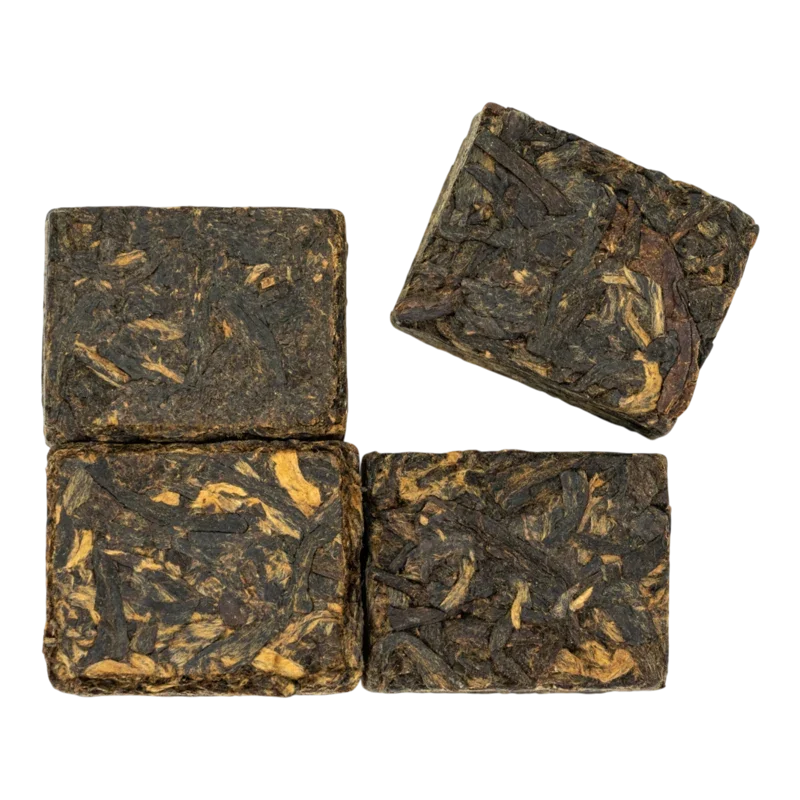
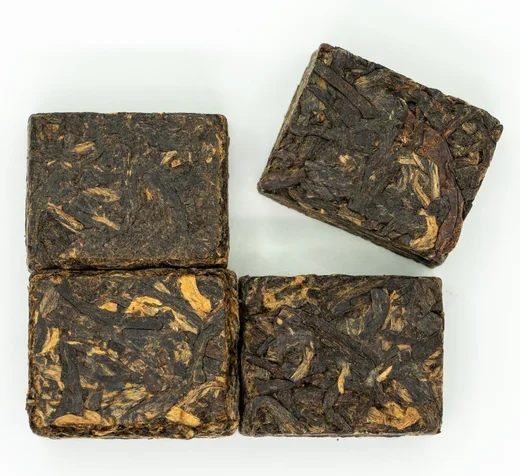
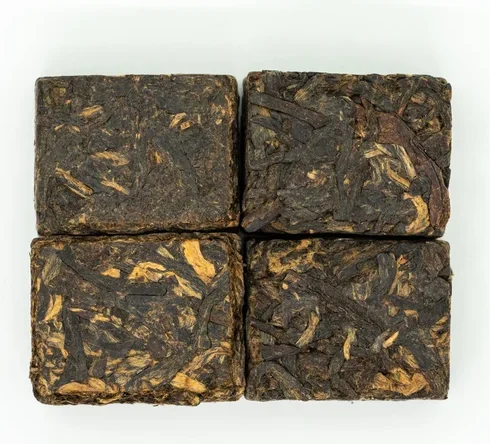
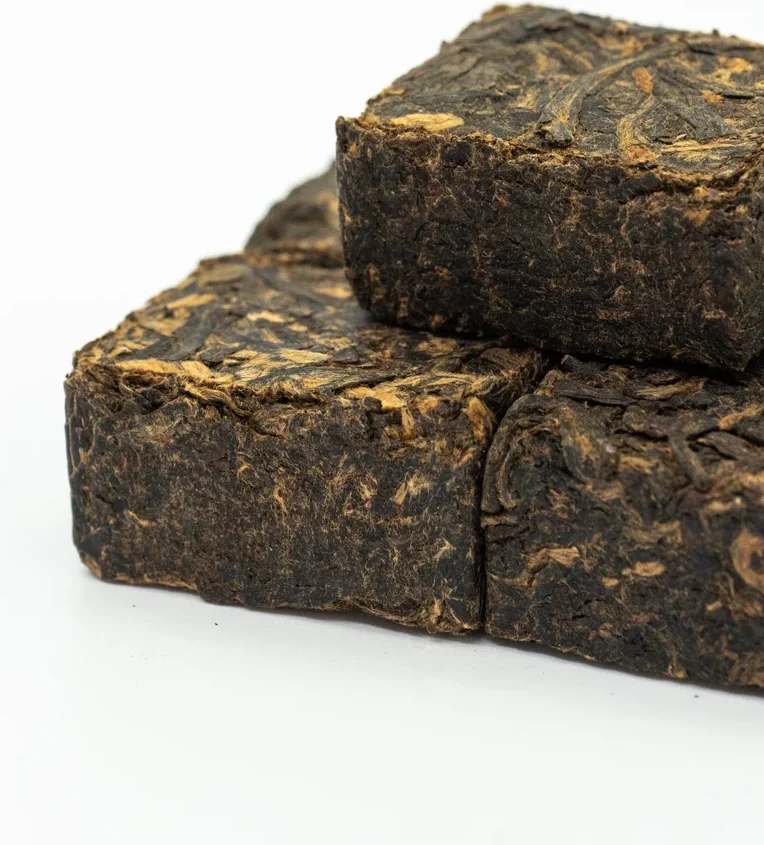
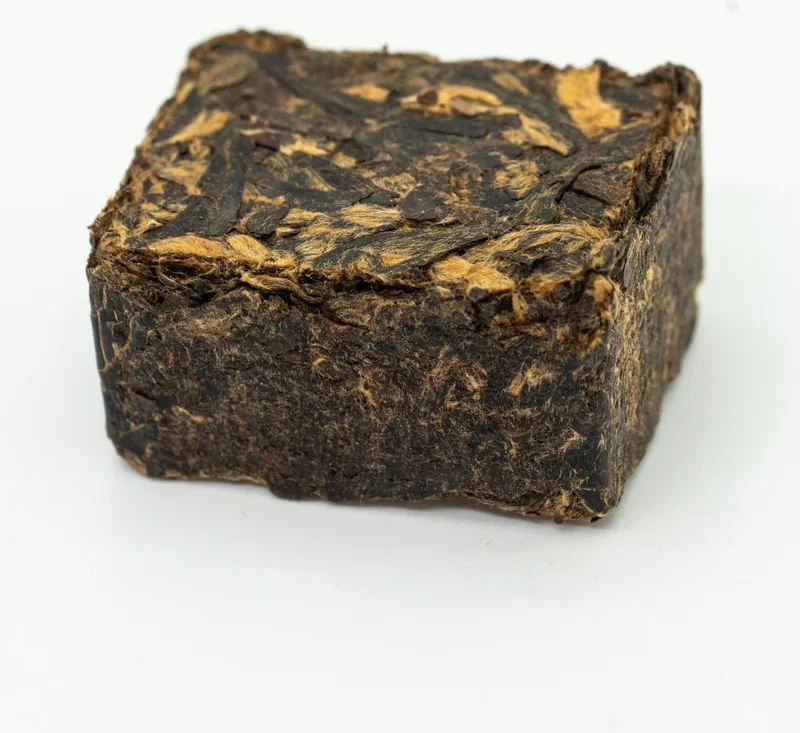
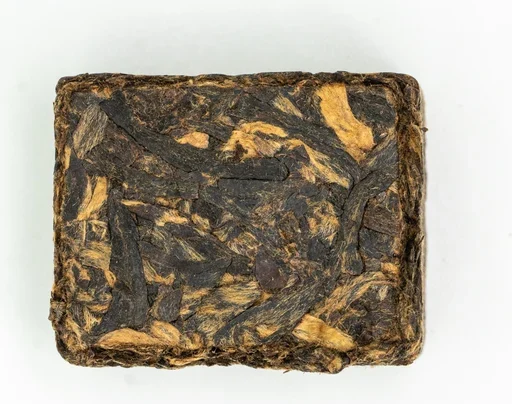
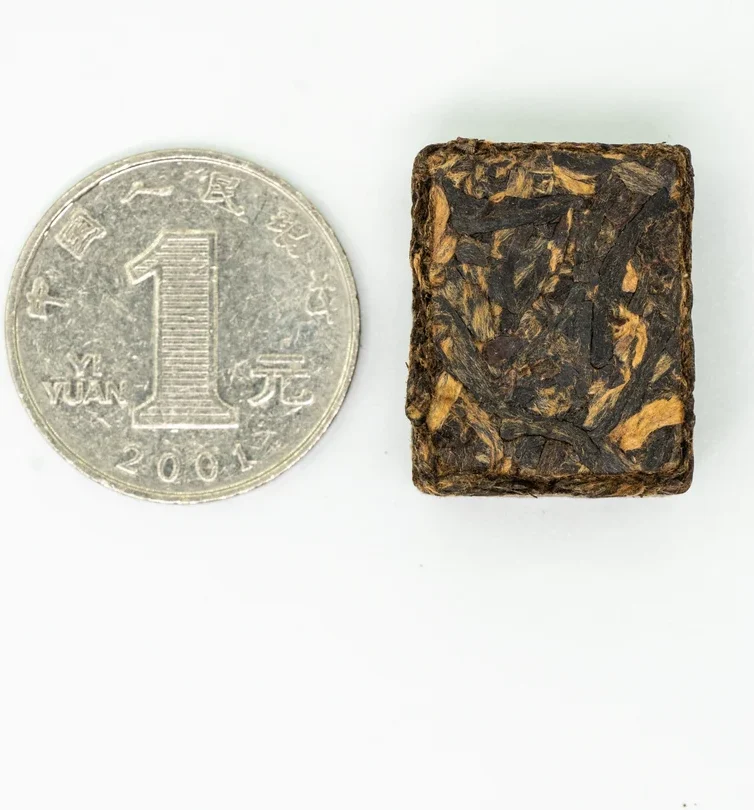
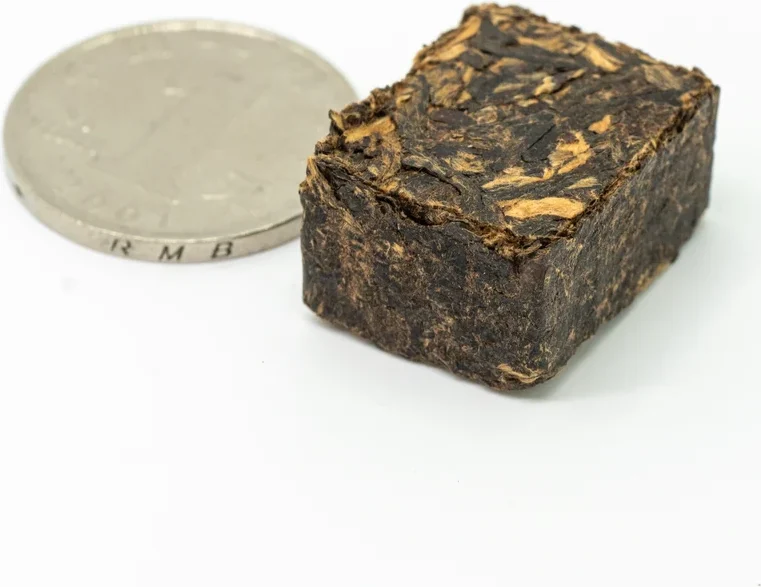
Brick form with even surface, clear edges. Surface — dense, smooth, with golden sheen of down (金毫显露). When breaking the brick, golden spots are visible inside — colonies of Eurotium cristatum ("golden flowers"). Their abundance and brightness are quality indicators: in special grades, "flowering" is dense and uniform.
Dominated by "floral-fermentative aroma" (酵花香, jiào huā xiāng) — a complex note born from Eurotium cristatum metabolism within the tea brick. Additionally — caramel sweetness (焦糖香, jiāo táng xiāng), arising during stepped drying. In specimens older than three years, "chensiang" (陈香) appears — aging aroma with notes of dried fruits and noble wood.
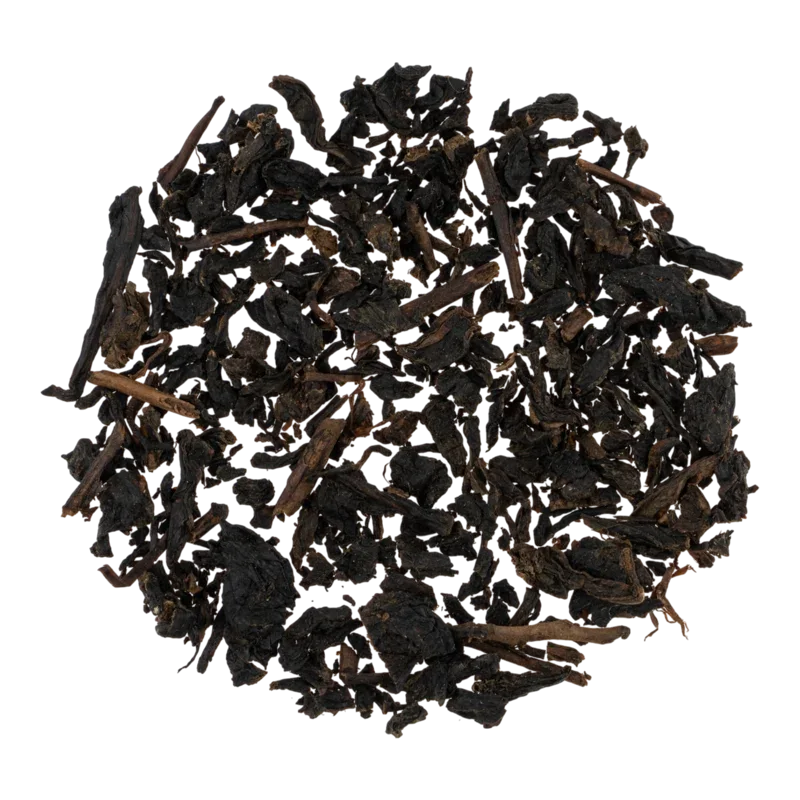
Spent Leaves: Brownish-yellow (褐黄), uniform, glossy. Leaves — fleshy, soft, elastic (significantly larger and thicker than loose Yueyang tea).
Taste: Formula — "醇厚浓强" (chún hòu nóng qiáng — "mellow-thick, rich, strong"). This is fundamentally "heavier" and thicker taste than loose Yueyang tea. The "framework" is formed by polyphenols (≥30.5% — significantly higher than loose tea, ~24.7%). The "filling" — caramel sweetness from polysaccharides (7.2%). Mineral "freshness" — from elements "squeezed" by compression from lake sediments. Aftertaste — long, with distinct "hui gan" sweetness.
Chemical Composition
Alkaloids: Caffeine — 2.5–4.5% of dry matter (content comparable to loose tea).
Amino Acids: Content lower than in loose tea from fine raw material (large leaves accumulate fewer amino acids), but sufficient for forming sweetness and gentleness.
7.2% — very high indicator, significantly exceeding the norm for loose teas. Polysaccharides form the thick, enveloping body of the liquor and contribute caramel sweetness.
Minerals: Elevated content of selenium, zinc, potassium — reflection of Dongting Lake soil geochemistry, enhanced by the "mineral pressing" effect during compression.
Polyphenols: ≥30.5% of dry matter — higher than in loose Yueyang yellow tea (~24.7%). This paradox is explained by the fact that large-leaf raw material (huang dacha) initially contains more polyphenols, and Eurotium cristatum only partially modifies them without destroying them.
Health Notes
Eurotium cristatum secretes amylases and proteases, promoting food breakdown. High polysaccharide content coats the stomach lining, reducing irritation.
Complex action: polyphenols, lovastatin (fungal metabolic product) and extracellular polysaccharides of Eurotium cristatum — three "arms" of lipid-regulating potential.
High polyphenol content provides powerful antioxidant protection, comparable to good green teas.
Tea polysaccharides and polyphenols jointly influence insulin sensitivity.
Eurotium cristatum possesses prebiotic potential, promoting favorable intestinal environment formation.
Caffeine combined with amino acids provides alertness without sharp fluctuations.
Brewing
Tea Amount: 5–7 g per 150 ml.
Teaware: Porcelain gàiwǎn (盖碗) or clay teapot (紫砂壶, zǐshā hú) — dense walls retain heat necessary for opening compressed leaves.
Water Temperature: 95–100°C (boiling water) — compressed tea requires hotter water than loose tea.
Storage
Container: Cotton paper or cardboard; storage without packaging is acceptable (brick "breathes"). Do not use airtight plastic bags — "golden flowers" need minimal gas exchange.
Shelf Life: Unlimited with proper conditions. Compressed Yueyang yellow tea is one of the few yellow teas allowing multi-year (potentially multi-decade) aging.
Dry, cool, dark, ventilated room. Temperature — 20–30°C. Humidity — 50–70%. Absence of direct sunlight and foreign odors.
"Floral-fermentative" aroma dominates. Taste — bright, with light astringency.
Aroma deepens, dried fruit tones appear. Astringency disappears, sweetness increases.
Mature "chensiang" — aging aroma. Liquor — thick, honey-like, with caramel "background." Body — velvety.
"Medicinal herbs" aroma (药香, yào xiāng). Taste — extremely gentle, enveloping, with long warm aftertaste.
Comparison
Related product, but from more tender raw material (one bud — one to two leaves). Aroma — "酵香" and "嫩栗香" (fermentative and chestnut). Taste — light, fresh, "甘醇鲜爽". Liquor — light apricot. Storage — refrigerator, 12–18 months. Main difference: absence of "golden flowers" and inability for long-term aging.
Closest technological analog by presence of Eurotium cristatum. But this is hei cha (dark tea): raw material — black maocha (3rd grade), having undergone wet piling (渥堆). Taste — coarser, "heavier," with pronounced "earthy" note. Liquor — reddish-brown. Yueyang yellow brick — gentler, lighter, sweeter, with preserved "yellow" freshness.
Hunan "thousand liang tea" — giant columnar compressed hei cha. Also contains microflora, but of different composition (less controlled "flowering"). Taste — powerful, "smoky." Completely different stylistic world.
Comparable in the idea of "aging during storage," but without Eurotium cristatum participation. Aged white tea evolution is purely oxidative. Yueyang yellow brick — microbiological. Taste profiles differ: aged white — "honey-date"; Yueyang brick — "caramel-fungal."
Also compressed tea improving with age. But sheng pu-erh is, by classification, "晒青" green tea from large-leaf Yunnan raw material, without purposeful "flowering." Sheng pu-erh microflora forms spontaneously during storage. Yueyang brick — with "controlled" Eurotium cristatum. Taste worlds differ, but the philosophy of "tea growing in time" is common.
Price and Authenticity
Price Category: Medium and high segment. Compressed Yueyang yellow teas are generally more expensive than loose Yueyang Huang Ye, but cheaper than Junshan Yin Zhen. Aged specimens (5+ years) — premium collectible segment.