Classification and Origin
Category: Artisanal/regional red tea from Mei Zhan cultivar. May also be classified as raw material for premium grades of Bái Lín Gōngfū (白琳工夫).
Coordinates: ~25°03′ N, 117°57′ E (Anxi, birthplace of the cultivar).
Origin: The Méi Zhān cultivar originates from Ānxī County (安溪县, Ānxī Xiàn), Fujian Province—specifically from Sānyáng Village (三洋村, Sānyáng Cūn), Lútián Township (芦田镇, Lútián Zhèn), Yinpingshan Mountain (银瓶山). As a red tea, Mei Zhan is produced primarily in two regions: Wǔyíshān (武夷山)—where it is used to create premium red teas (including "Jin Mei Bing Ya"—金梅冰芽); Fúdǐng (福鼎)—where it traditionally served as high-quality raw material for Bai Lin Gongfu; as well as in Anxi itself and other tea-producing regions of Fujian.
Type: Red tea (black tea) (红茶, hóngchá), fully oxidized.
Facts
Mei Zhan is one of the few cultivars from which tea of any type can be made: oolong (light and dark), red, green, white. And in each role it displays its characteristic "plum" signature.
In Wuyishan, Mei Zhan is valued as a blending component—it enriches the blend without overwhelming other varieties (拼茶不夺他茶香).
Poet Lin Henian from Lutian (late Qing) dedicated these lines to Mei Zhan: "种梅三万株,终老吾何悔"—"Plant thirty thousand mei bushes—and grow old without regrets."
In the 1990s-2000s, mass replacement of Mei Zhan with Tieguanyin led to the disappearance of most old plantings in Anxi. Surviving old trees (50-100+ years)—most valuable resource.
Historically, the best batches of Bai Lin Gongfu were made from Mei Zhan—this fact emphasizes its outstanding "red tea" qualities.
History and Culture
Cultural Significance: Mei Zhan is one of the "Six Famous Anxi Teas" (安溪六大名茶), alongside Tieguanyin, Huangjingui, Ben Shan, Maoxie, and Daye Cong. Poet Lín Hènián (林鹤年), one of the "Eight Great Poets of Fujian" of the late Qing, a native of Lutian, wrote: "Plant thirty thousand mei bushes—and grow old without regrets" (种梅三万株,终老吾何悔).
History: The Mei Zhan cultivar has over 200 years of history. There are two main legends about its origin. First: around 1810 (15th year of Jiaqing reign) a farmer named Yáng Yìtáng (杨奕糖) from Sanyang Village met a wandering old man with saplings and treated him to porridge; in gratitude, the old man gave him three tea saplings. Yang planted them by the house "Yushu Cuo" (玉树厝), and after two to three years they flourished. Local juren (举人) Yáng Feiwen (杨飞文), seeing that the flowers and leaves of this tea opened like meihua plum petals and emitted the aroma of wax plum (腊梅), named it "Mei Zhan"—"Plum Occupying First Place." Second legend: in 1821 (1st year of Daoguang reign) a representative of the Wang clan from Xiping saw an unnamed tree in Lutian and, not knowing its name, noticed an inscription on a door portal "梅占百花魁" ("Plum dominates among a hundred flowers")—and took the name "Mei Zhan."
Name Breakdown: "Mei" (梅)—meihua plum; "Zhan" (占)—"to occupy," "to seize first place." Full meaning: "Plum occupying first place among flowers" (梅占百花魁)—a reference to the fact that the flowers of this tea tree resemble meihua plum petals, and the aroma resembles wax plum.
Botany and Raw Material
Méi Zhǎn (梅占), also known as Dàyè Méizhàn (大叶梅占, "Large-leaf Mei Zhan"), Gaojiao Wūlóng (高脚乌龙, "High-footed Oolong"). National variety (GS13004-1985), Camellia sinensis. Asexual line (无性系), small tree type (小乔木型), medium-large leaf (中叶类), medium budding period (中芽种). Plant is tall (up to 1.6 m), with straight trunk, pronounced main shoot, long internodes. Leaves are long, elliptical, dark green, dense, with inward-curled edges. Mei Zhan is a record-holder for adaptability: "whatever you do—everything turns out well" (百变茶青). Suitable for oolong, red, green, and white tea.
Amino acids—3.6%; tea polyphenols—27.5%; catechins—18.1%; caffeine—4.4%.
Picking: Spring (most valuable), summer, autumn. Mid-April—peak of spring harvest. Hand-picked.
Pluck Standard: One bud with one to two leaves for premium grades (including "Jin Mei"—pure bud); one bud with two to three leaves for standard grades.
Raw Material: Tender, early harvest is essential—Méi Zhǎn shoots coarsen quickly (持嫩性较差), requiring prompt action.
Terroir
Mountainous region of southern Fujian. Elevation 400-1,200 m. Subtropical monsoon climate, abundant rainfall, frequent fog, fertile weakly acidic red soils. Yinpingshan Mountain (银瓶山, 1,200 m)—birthplace of the cultivar.
Mei Zhan red tea is also produced in the Wuyi Mountains, where this cultivar was introduced in the early 20th century (Republic of China period). Wuyishan terroir imparts its characteristic "rock rhyme (yán yùn)" (岩韵).
Traditional production zone for Bai Lin Gongfu, where Mei Zhan was used as high-grade raw material.
Since the 1960s, Mei Zhan has been cultivated throughout China—Guangdong, Jiangxi, Zhejiang, Anhui, Hunan, Hubei, Jiangsu, Guangxi, as well as Taiwan. Thanks to its high adaptability and yield (200-350 kg/mu), it has become one of the most widespread universal cultivars.
Production
Hand-picked. Early and tender (早采嫩采)—shoots coarsen quickly.
Solar or indoor, 12-18 hours. Control the degree—"don't over-dry," preserve freshness and initiate aroma formation.
Machine or hand rolling. Formation of tight, long, thin tea strips. Mei Zhan produces abundant juice due to leaf fleshiness.
3-5 hours at ~25-28°C. Key indicator—appearance of orchid-plum note. Over-oxidation produces "flat" taste; under-oxidation—bitterness.
Hot air or over charcoal. For Anxi versions, additional heating (提香, tíxiāng—"lifting aroma") is sometimes applied.
Final hand sorting.
Organoleptic Profile
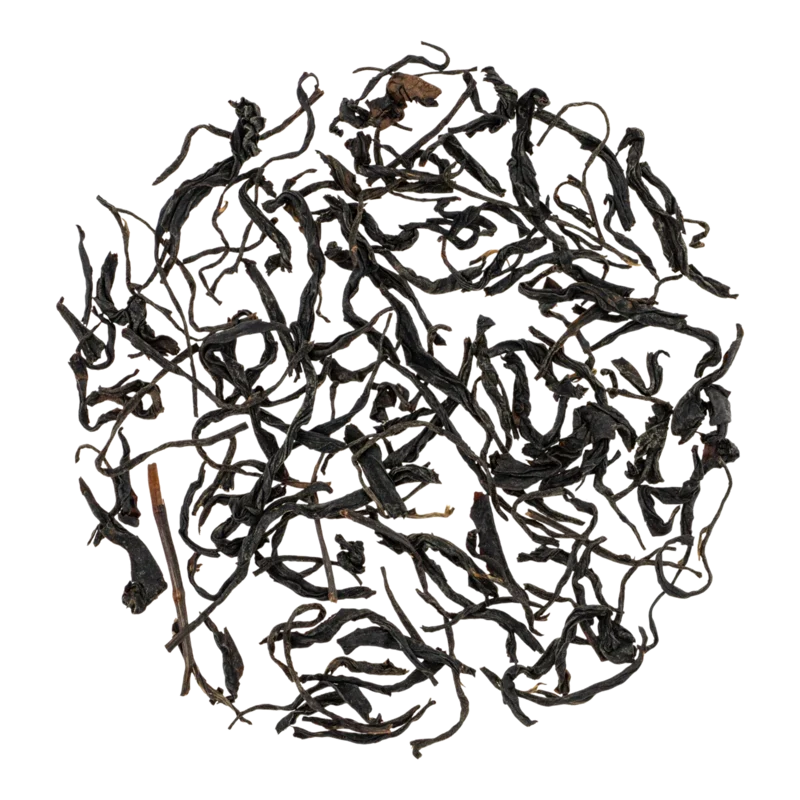
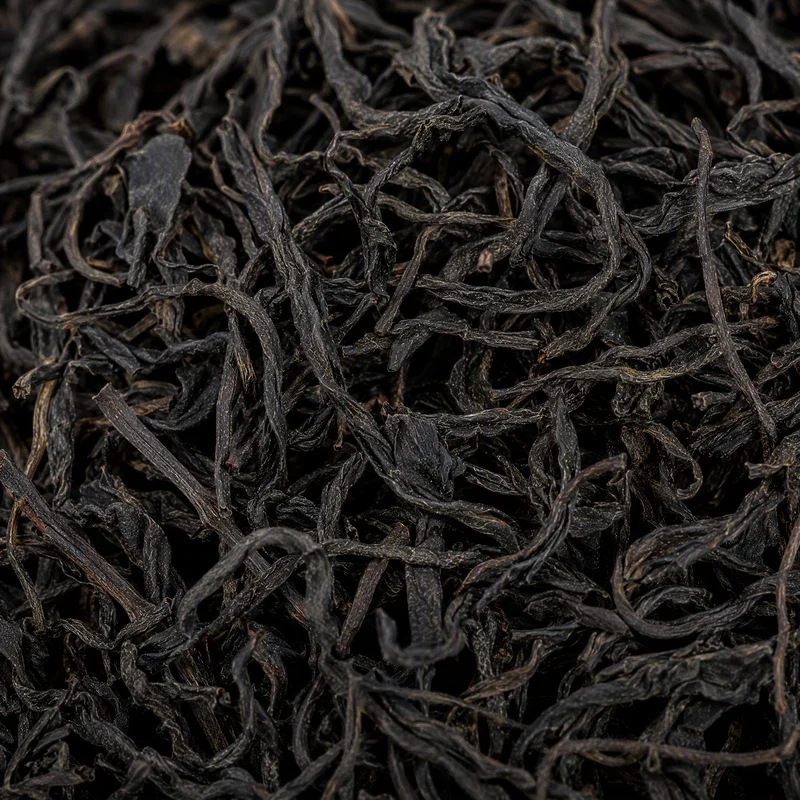
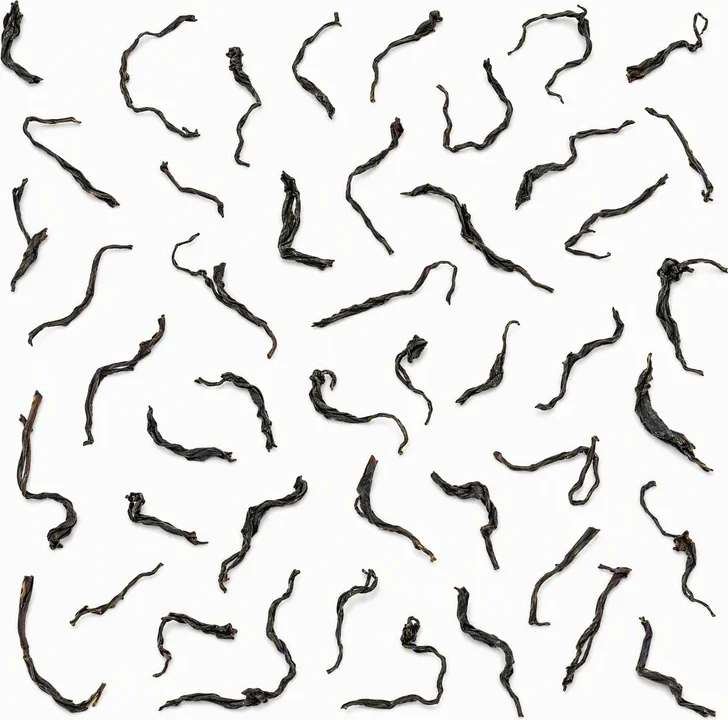
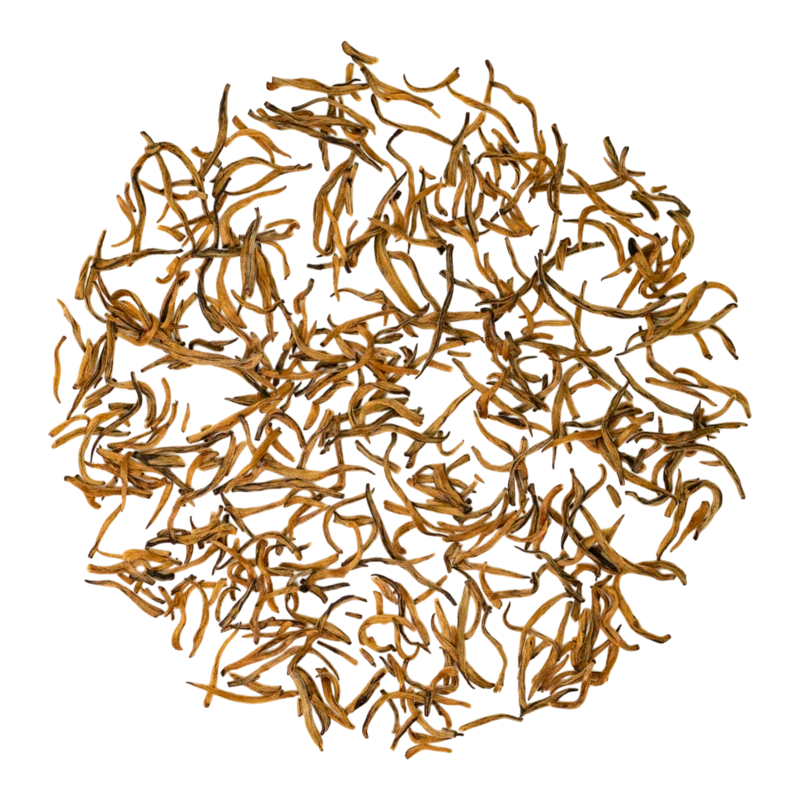
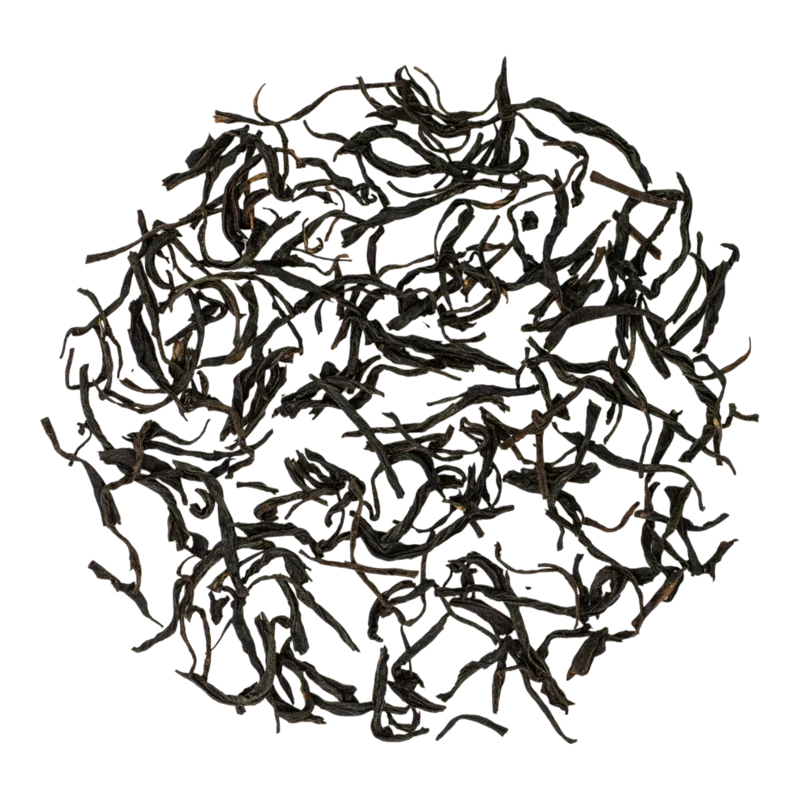
Dry Leaf Appearance: Dense, long, tightly twisted strips (条索紧结细长). Color—black, oily-lustrous (乌黑油润), with golden tips in higher grades. Tea strips are even, whole.
Dry Leaf Aroma: Signature feature—high, "piercing" aroma (香气高锐): orchid (兰花香), meihua plum (梅花香), honey, dried fruits. In Wuyishan versions—additional mineral "rocky" note. Aroma is persistent, recognizable.
Liquor Aroma: Multi-layered—orchid, plum, honey, caramel, light spicy notes. With steepings—intensification of sweet honey-fruity tones.
Liquor Color: Orange-amber to ruby, bright, clear, with "golden ring" (金圈) in higher grades.
Spent Leaves: Large, whole, elastic leaves of red-copper color. Leaf edges with red border (红边显).
Taste: Rich, full, "velvety" (味厚). Dominant notes—orchid, plum, honey, caramel, light chocolate overtones. Astringency—moderate, "silky." Sweetness is natural. Aftertaste—long-lasting, with orchid-plum note. Returning sweetness (huí gān) (回甘)—pronounced.
Chemical Composition
Amino Acids: 3.6%—provide sweetness and smoothness.
4.4%—moderately high level, provides noticeable stimulating effect.
18.1%—during oxidation transform into theaflavins, thearubigins.
Linalool, nerol, geraniol—form the characteristic "orchid-plum" complex.
Polyphenols: 27.5% in raw material (above average), during oxidation—active formation of theaflavins and thearubigins, forming rich color and "body."
Brewing
Process: Warming → adding tea → rinsing (optional) → first steeping 10-15 sec → 5-8 steepings, increasing by 5-10 sec.
Tea Amount: 4-5 g per 100-120 ml (gongfu); 3 g per 200-250 ml (Western method).
Teaware: Porcelain gaiwan—perfectly reveals orchid aroma.
Water Temperature: 90-95°C.
Comparison
Pure bud, from Caicha Tongmu. Sweeter, honeyed, "airy." Mei Zhan Hong Cha—denser, with bright orchid-plum aroma and greater "body."
"Progenitor"—with longan note and (in smoked versions) smoke. Mei Zhan Hong Cha—without smoke, with completely different aromatic profile (orchid, plum).
"Qimen aroma"—delicate, "introverted," rose-honey. Mei Zhan—brighter, "louder," with piercing orchid note.
Same cultivar, but processed by oolong technology. Oolong—more "green," floral, with pronounced returning sweetness (huí gān). Red tea—fuller, richer, with caramel-chocolate depth.