Classification and Origin
Category: Bái Háo Yínzhēn (白毫银针, "Silver Needles with White Down") — the highest grade of white tea (白茶), made from pure unopened buds. According to standard GB/T 22291-2017 "White Tea," Yinzhen is the first of four categories (Yinzhen → Mu Dan → Gong Mei → Shou Mei).
Coordinates: Approximately 24°20′ N, 106°33′ E (Lingyun area).
Origin: China, Guǎngxī Zhuāng Autonomous Region (广西壮族自治区, Guǎngxī Zhuàngzú Zìzhìqū), Bǎisè City (百色市), Língyún County (凌云县) and Lèyè County (乐业县). Also produced in several other mountainous counties of Guangxi where Fujian white tea varieties are successfully cultivated.
Type: White tea (白茶, báichá) — lightly oxidized (5–10% oxidation). Technology: withering and drying, without kill-green (shaqing) fixation and without rolling.
History and Culture
Cultural Significance: Guangxi Yinzhen represents the "new wave" of white tea (白茶): tea born not from historical tradition but from economic logic and climatic advantage. Its emergence testifies to the expansion of white tea (白茶) geography beyond the traditional Fujian core — a process parallel to similar phenomena in Yunnan (Yue Guang Bai, Jinggu Bai Cha), Hunan (Sanzhi Bai Cha), and other provinces.
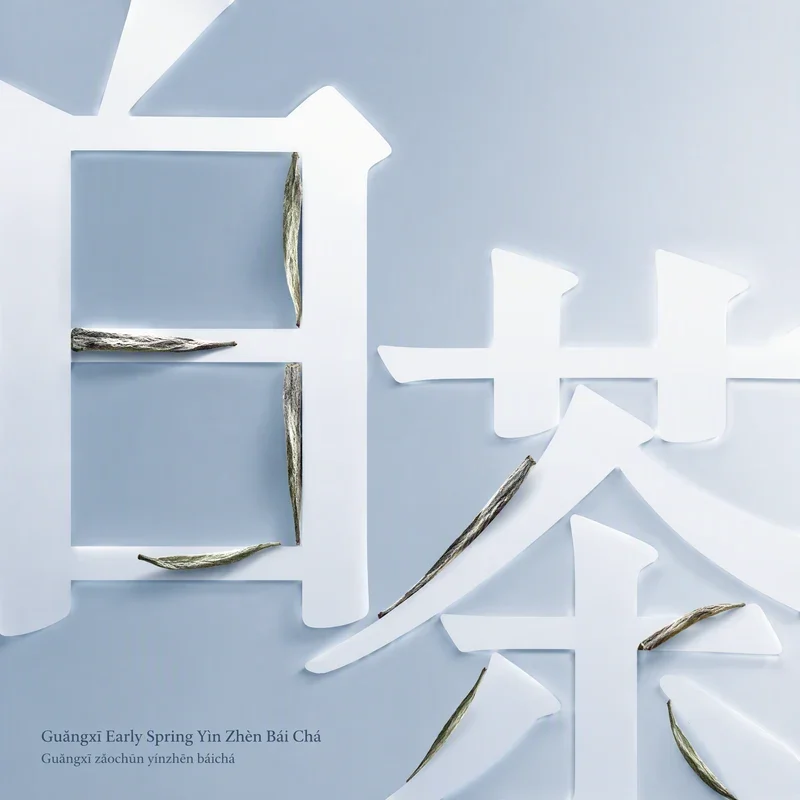
Name Breakdown: 广西 (Guǎngxī) — name of the autonomous region; 早春 (Zǎochūn) — "early spring," emphasizing ultra-early harvest; 银针 (Yínzhēn) — "silver needles"; 白茶 (Báichá) — "white tea."
Botany and Raw Material
Fúdǐng Dǎ Bái Háo (福鼎大白毫, Fúdǐng Dàbáiháo) — also known as Fúdǐng Dǎ Bái Chá (福鼎大白茶, Fúdǐng Dàbáichá), the national reference cultivar for Bai Hao Yinzhen production. Characterized by large, fleshy, dense buds densely covered with silvery-white down (trichomes). Introduced to Guangxi from Fujian; in the new terroir it retains basic morphological characteristics but acquires nuances in flavor profile.
Cultivar: Camellia sinensis var. sinensis.
Picking: Ultra-early spring — late February to early March, before the Qīngmíng festival (清明). Harvesting is conducted exclusively by hand, during clear morning hours after dew has dried. Only unopened terminal buds (单芽, dān yá) 2.5–3 cm long are selected, dense, fleshy, without signs of opening.
Raw Material: The "ten prohibitions" rule (十不采, shí bù cǎi) is observed: do not harvest in rain, on dew, thin/purple/damaged/opened/hollow/diseased buds.
Terroir
Altitude: 800–1500 m a.s.l. Optimal zone — 900–1200 m, where "mountain character" is expressed: frequent fogs, large diurnal temperature variations, diffused light.
Climate: Subtropical monsoon. Average annual temperature 19–23°C — significantly warmer than Fuding (~18.5°C). Annual precipitation 1700–1800 mm. Relative humidity 80–85%. "晴时早晚遍山雾,阴雨成天满山云" — a local saying describes typical conditions: even on clear days, morning and evening the mountains are shrouded in fog. Frost-free period — up to 340 days. Mild winter (average January temperature ~10–12°C) — key factor for ultra-early awakening of tea bushes.
Soil: Red soils (红壤) and yellow soils (黄壤), acidic (pH 4.5–6.0), deep (>40 cm), loose, fertile, with high organic content. Good drainage on mountain slopes.
Mountainous areas of northwestern Guangxi — Lingyun and Leye counties, located at the junction of the Yunnan-Guizhou Plateau and Guangxi karst mountains. This is one of the least industrially developed zones of Southern China — ecologically clean, with extensive forest cover.
Many plantations are managed according to organic or bio-organic standards. Lingyun County is among the first 20 "base counties for pollution-free tea production" in China (无公害茶叶生产示范基地县, since 2001).
Production
Hand-picking of pure buds in early spring.
Key and longest stage. Buds are spread in thin layers on bamboo sieves (水筛, shuǐ shāi) or wooden frames. A combined method is used: initial sun withering (日光萎凋, rìguāng wěi diāo) — 1–2 hours in gentle morning sun to initiate light oxidation; then transfer indoors (室内萎凋, shìnèi wěi diāo) for slow completion of the process at 20–25°C temperature and 60–80% humidity. Total duration — 48–72 hours. At this stage, the main flavor-aroma profile is formed: polyphenols lightly oxidize, proteins and carbohydrates partially hydrolyze, volatile aromatic compounds form (linalool, geraniol, cis-jasmone).
Two-stage: primary at ~80°C, then final drying at ~60–70°C to 4–5% moisture content. Fixes the achieved state and removes residual "grassiness."
Manual removal of damaged buds, stems, and accidental leaves.
Organoleptic Profile
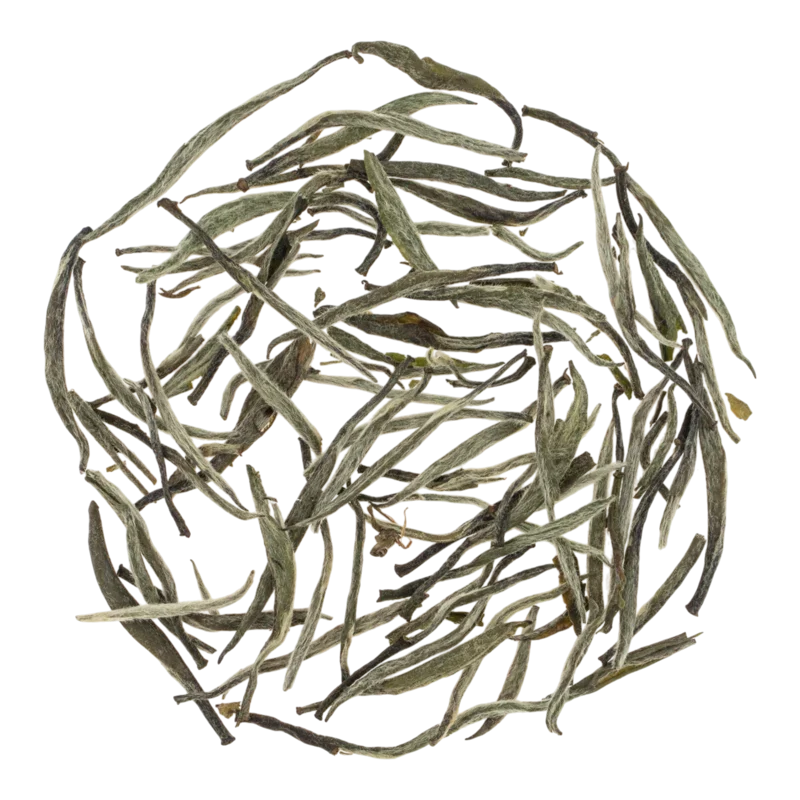
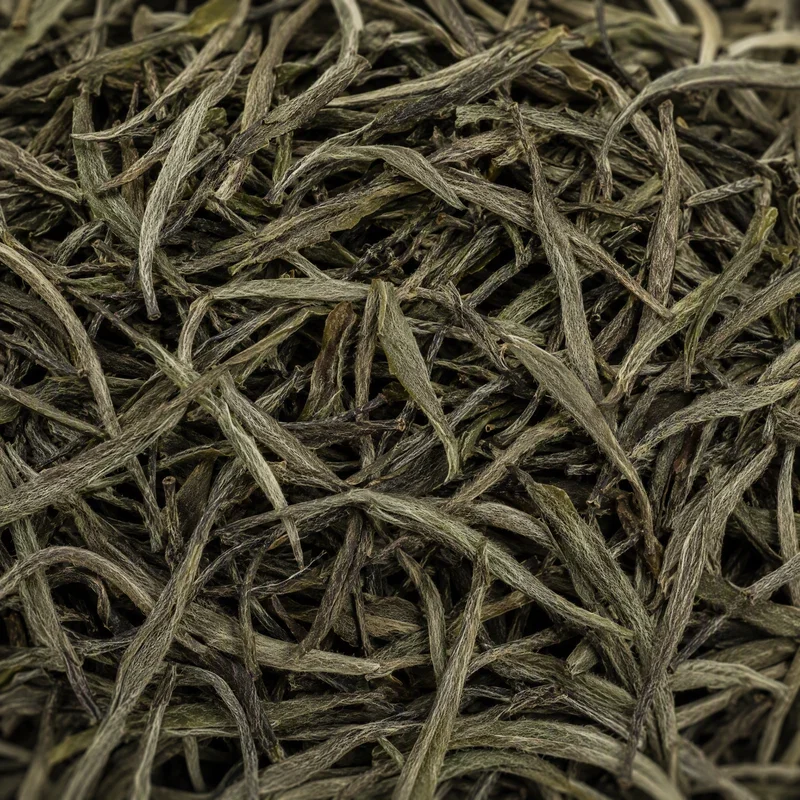
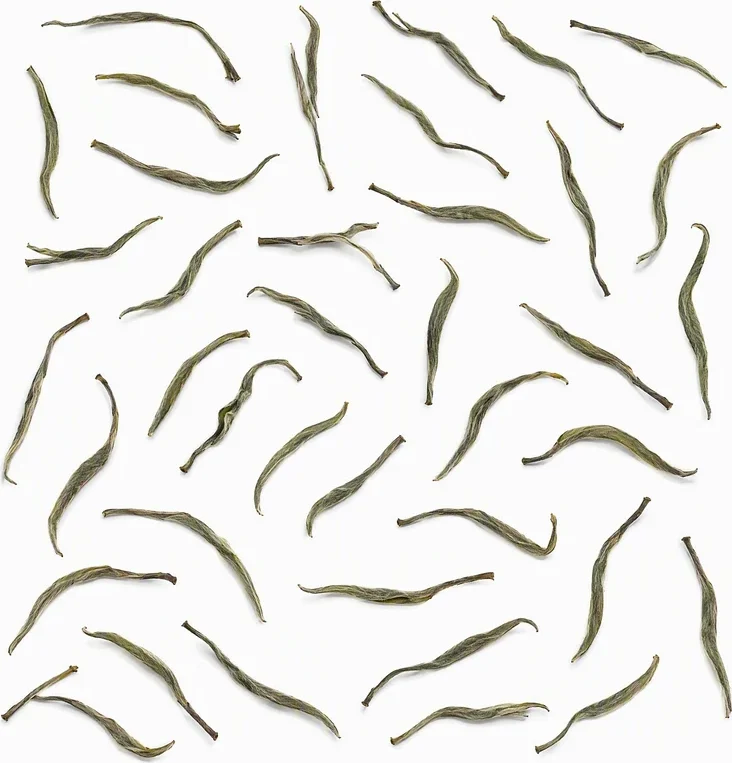
Dry Leaf Appearance: Large, dense, straight or slightly curved buds resembling needles, abundantly covered with thick, lustrous silvery-white down. Color — silvery-white to light gray with greenish tint. Uniformity and integrity of buds — key quality marker.
Dry Leaf Aroma: Delicate, fresh, with floral notes (honeysuckle, orchid), light honey and fruity (melon, apricot) tones. Sometimes — barely perceptible grassy or bamboo nuance.
Liquor Color: From nearly transparent to pale yellow or light apricot. Clear and bright.
Spent Leaves: Fleshy, tender green or yellowish-green buds, maintaining integrity.
Taste: Soft, smooth, silky, without bitterness or astringency. Natural sweetness — melon-honey, with tones of white peach and floral nectar. Aftertaste — long, clean, refreshing. Compared to Fuding Yinzhen — more "gentle," "airy," with more pronounced floral and fruity tones and less pronounced "nuttiness."
Chemical Composition
Amino Acids: High content — ~4–6%. L-theanine dominates. Provides sweetness (鲜甜, xiān tián) and "silkiness" of taste.
~3–5%. Bud tea concentrates more alkaloids than leaf tea.
Dihydromyricetin (二氢杨梅素) — natural hepatoprotector, characteristic component of white tea (白茶).
Linalool, geraniol, β-ionone, cis-jasmone — form the floral-fruity bouquet.
Minerals: Potassium, calcium, magnesium, manganese, zinc, fluorine.
Polyphenols: ~18–22% of dry mass. Main catechins — EGCG, ECG, EGC, EC. Content somewhat lower than in green tea from the same raw material — part of catechins lightly oxidize during prolonged withering.
Vitamins: C (well preserved due to absence of high-temperature processing), B₁, B₂, carotenoids.
Health Notes
High content of polyphenols and flavonoids. White tea (白茶), according to several studies, possesses more pronounced antioxidant activity than green tea, thanks to better preservation of native catechins.
Dihydromyricetin protects liver cells, accelerates hepatocyte regeneration.
L-theanine + caffeine = calm, focused alertness without anxiety.
Polyphenols + vitamin C possess antibacterial and antiviral properties.
Antioxidants protect from photodamage, improve tone.
Fluorine and catechins suppress cariogenic bacteria.
Food product, not medicine. With caffeine sensitivity — do not drink in evening. 3–5 g/day.
Brewing
3–5 g per 150–200 ml.
First pour water into tumbler, then gently lower buds — they will slowly "float" down, creating a mesmerizing spectacle.
Teaware: Glass flask or tumbler — ideal for observing the "dance of needles": buds first float on the surface, then, having absorbed water, slowly sink, standing vertically. Porcelain gàiwǎn (盖碗) — for precise tasting. Yixing clay teapot not recommended — absorbs delicate notes.
Water Temperature: 75–85°C. Boiling water "burns" delicate buds, destroys amino acids and extracts excessive bitterness.
Storage
Enemies: Moisture, light, foreign odors, sharp temperature fluctuations.
Airtight foil packaging, refrigerator 0–5°C. Maximally preserves aroma freshness and liquor color.
Under proper conditions (18–28°C, humidity 40–65%, without light and odors, three-layer packaging) white tea (白茶) can "mature" for years, acquiring deeper, honey-date tones. Aging potential of Yinzhen — up to 10–15+ years.
Comparison
The standard. More dense, "bodied" taste, with nutty and warm notes. Harvest — mid/late March. Guangxi — more delicate, floral, "airy"; harvest — 2–4 weeks earlier.
From Zhenghe Da Bai Cha cultivar — buds larger, color darker, taste more "mature." Guangxi — lighter, easier, more fruity.
From C. sinensis var. assamica — large-leaf. Buds more massive, down may be golden, taste significantly more saturated, "powerful," with honey-tropical notes. Completely different terroir and botanical base.
White tea (白茶) from local Lingyun Baihao cultivar (not Fuding Da Bai Hao). Larger buds and leaves, different flavor profile — more "juicy," with pronounced astringency. Guangxi Yinzhen from Fuding Da Bai Hao — closer to Fuding style.
Still considered the gold standard. Guangxi Yinzhen does not claim to replace it, but offers an interesting alternative — with earlier timing, more accessible price and its own "southern" character.